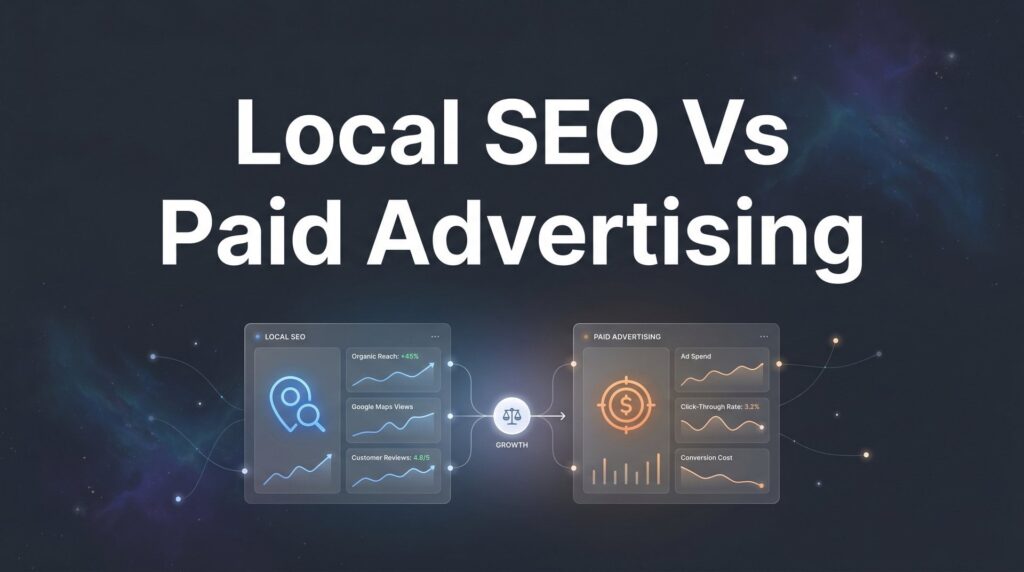
Every local business owner faces the same dilemma: should you invest in local SEO for long-term organic visibility, or pour money into paid advertising for immediate results? The truth is, framing this as an either/or decision is costing you customers.
Smart local businesses understand that the real question isn’t local SEO vs paid advertising—it’s how to leverage both channels strategically based on your specific goals, timeline, and budget.
Think of it like building a house. Paid advertising is your scaffolding—it gets you results fast while you’re constructing something permanent. Local SEO is the foundation and structure—it takes longer to build, but once it’s there, it keeps working without constant cash injections.
The businesses dominating local markets right now aren’t choosing sides. They’re running both channels in a coordinated system that delivers quick wins while building long-term assets. They’re using data from paid campaigns to inform their SEO strategy. They’re capturing organic traffic and converting it later through remarketing. They’re adjusting their budget allocation as their business evolves.
This guide breaks down seven actionable strategies to help you determine the right mix, avoid common money-wasting mistakes, and build a customer acquisition system that delivers both quick wins and sustainable growth. Whether you’re working with a tight budget or ready to scale aggressively, these approaches will help you make confident decisions about where your marketing dollars go.
1. Map Your Customer Journey to Determine Channel Priority
The Challenge It Solves
Most businesses waste money because they’re investing in channels that don’t match how their customers actually search and buy. A plumber fixing emergency leaks has completely different customer behavior than a wedding photographer booked six months in advance. If you don’t understand your customer journey, you’re essentially throwing darts blindfolded.
The problem gets worse when you realize that different types of customers use different channels. Someone searching “emergency dentist near me” at 2 AM needs immediate answers—that’s paid advertising territory. Someone researching “best family dentist in Chicago” is starting a longer evaluation process where organic visibility matters more.
The Strategy Explained
Start by documenting how your actual customers found you and what they did before buying. Pull data from your CRM, survey recent customers, and analyze your website behavior. You’re looking for patterns in search intent, decision timeline, and information needs.
Map out the typical journey from first search to purchase. Does your average customer buy within hours, days, or weeks? Do they compare multiple providers or choose the first one they find? Are they searching for specific services or general categories?
This intelligence tells you where to focus first. Emergency services with immediate buying decisions should prioritize paid advertising because you need to be visible the moment someone searches. Professional services with longer sales cycles benefit more from strong organic presence because customers will research multiple times before deciding.
Implementation Steps
1. Interview your last 20 customers about how they found you and what they searched for before contacting you. Ask specifically what keywords they used and how many businesses they looked at.
2. Analyze your Google Analytics data to see the path people take through your website before converting. Look at time on site, pages visited, and whether they return multiple times before taking action.
3. Create a simple customer journey map that shows the typical search patterns, decision timeline, and key questions your prospects have at each stage. Use this to identify where paid advertising makes sense for immediate capture and where SEO builds long-term visibility.
Pro Tips
Don’t assume your customer journey matches your competitors’. Your specific service offerings, pricing, and reputation all influence how people buy from you. Update your journey map quarterly as you gather more data—customer behavior evolves, especially as your market presence grows.
2. Use Paid Ads as Your Local SEO Testing Ground
The Challenge It Solves
Local SEO takes months to show results. If you optimize for the wrong keywords or create content around topics nobody actually searches for, you’ve wasted three to six months and significant resources. There’s no undo button when you’ve spent months building authority around keywords that don’t convert.
The traditional approach of keyword research tools and search volume data only tells you what people search for—not what actually drives revenue for your specific business. Volume doesn’t equal value, and competitive difficulty scores don’t account for your unique positioning.
The Strategy Explained
Paid advertising gives you real market validation in days instead of months. You can test keyword performance, measure actual conversion rates, and validate messaging before committing to long-term SEO investment. Think of paid campaigns as your laboratory where you run controlled experiments.
Run small-budget paid campaigns targeting the keywords you’re considering for SEO. Track not just clicks and impressions, but actual conversion rates and customer quality. Some keywords might drive tons of traffic but terrible leads. Others might have lower volume but convert at significantly higher rates.
Once you’ve identified the keywords that actually generate qualified leads and customers, those become your SEO priorities. You’re now optimizing based on proven revenue potential rather than theoretical search volume. Understanding the differences between PPC and SEO for local business helps you make smarter testing decisions.
Implementation Steps
1. Create a list of 10-15 keywords you’re considering for long-term SEO investment. Include both high-volume competitive terms and lower-volume specific phrases.
2. Launch small-budget Google Ads campaigns testing each keyword group separately. Allocate enough budget to generate at least 50-100 clicks per keyword to get meaningful data. Track conversions through to actual customers, not just form fills.
3. After 2-4 weeks, analyze which keywords generated the best cost per customer and highest quality leads. These proven winners become your SEO content priorities. Kill or deprioritize keywords that drove traffic but didn’t convert.
Pro Tips
Pay attention to the specific search queries that triggered your ads, not just the keywords you bid on. The search query report often reveals valuable long-tail variations you hadn’t considered. Also track the messaging and landing page angles that performed best—this intelligence directly informs your SEO content strategy.
3. Build a Budget Allocation Framework Based on Business Stage
The Challenge It Solves
A brand-new business needs customers this month to survive. An established business with steady revenue can afford to invest in assets that pay off over time. Applying the same local SEO vs paid advertising split regardless of your business stage is strategic malpractice.
Many businesses make the mistake of either going all-in on paid advertising and never building organic assets, or investing heavily in SEO while starving for immediate revenue. Your budget allocation should evolve as your business matures and your needs change.
The Strategy Explained
In the startup phase (first 6-12 months), you need revenue now. Your split should heavily favor paid advertising—typically 70-80% paid, 20-30% foundational SEO. The SEO work focuses on the absolute basics: claiming your Google Business Profile, getting listed in key directories, and building a solid website foundation.
During the growth phase (1-3 years), you’re balancing immediate revenue with building long-term assets. Shift toward 50-50 allocation. You’re running profitable paid campaigns while simultaneously investing in content, local citations, and review generation that compounds over time. A comprehensive local SEO and PPC strategy becomes essential at this stage.
Once established (3+ years with consistent revenue), flip the script to 30-40% paid, 60-70% SEO. You’ve built organic visibility that generates free traffic, so paid advertising becomes more about maintaining market share and capturing high-intent searches rather than your primary customer source.
Implementation Steps
1. Honestly assess your business stage based on revenue stability, not just time in business. If you’re two years old but still struggling for consistent customers, you’re operationally in startup mode and need the startup allocation.
2. Calculate your total monthly marketing budget and apply the appropriate split for your stage. Set quarterly reviews to reassess whether you’re ready to shift more budget toward long-term SEO investment.
3. Track the percentage of new customers coming from organic versus paid sources each month. As organic percentage increases, you’ve earned the right to gradually shift more budget toward SEO. If organic isn’t growing after 6-12 months of SEO investment, investigate why before throwing more money at it.
Pro Tips
Don’t make dramatic budget shifts based on one good or bad month. Look at quarterly trends before reallocating. Also consider seasonal factors—some businesses might need to temporarily increase paid advertising during peak seasons even if they’re normally SEO-focused.
4. Dominate the Local Pack While Running Targeted Ads
The Challenge It Solves
The local pack—those map results that appear at the top of Google for local searches—represents premium real estate. Studies of local search behavior consistently show that the map results receive the majority of clicks for searches with local intent. If you’re not there, you’re invisible to a huge percentage of potential customers.
But here’s what most businesses miss: showing up in both the paid ads above the map AND in the local pack itself creates omnipresence that dramatically increases trust and click-through rates. When prospects see your business in multiple positions, you’re perceived as the dominant player in your market.
The Strategy Explained
Your Google Business Profile is the foundation of local pack visibility, and it’s technically free—but ranking there requires consistent optimization and effort. This is where your SEO investment pays off. Meanwhile, local search ads and location extensions in Google Ads let you appear in paid positions for the same searches.
The combined strategy creates a “surround sound” effect. Someone searching “plumber near me” sees your paid ad at the top, then scrolls down and sees you again in the local pack. This double visibility doesn’t just increase clicks—it fundamentally changes how prospects perceive your authority in the market.
This approach works because you’re investing in both channels for the same high-value local keywords. Your Google Business Profile optimization focuses on the exact services and locations you’re targeting with paid ads. Following local SEO best practices ensures your organic presence reinforces your paid messaging.
Implementation Steps
1. Fully optimize your Google Business Profile with complete information, regular posts, service details, and consistent review generation. This isn’t a one-time setup—plan for weekly updates and monthly content additions to maintain and improve local pack rankings.
2. Set up Google Ads campaigns with location extensions that highlight your physical proximity to searchers. Use location-specific ad copy that mirrors the service categories in your Google Business Profile.
3. Monitor your visibility for your top 10-20 local keywords. Track whether you’re appearing in paid positions, local pack, or both. Focus additional optimization effort on keywords where you’re missing one of these placements.
Pro Tips
Your Google Business Profile description, services, and posts should use the same language and keywords as your paid ad copy. This consistency reinforces your message and improves Quality Score in your paid campaigns. Also, use the insights from your paid campaign performance to identify which service categories to emphasize in your Google Business Profile.
5. Create a Remarketing Bridge Between Organic and Paid
The Challenge It Solves
Organic traffic is valuable, but conversion rates from first-time organic visitors are typically lower than paid traffic because organic visitors are often in earlier research stages. They find your site, browse around, then leave to check out competitors or continue researching. You’ve paid for the SEO work to attract them, but you’re losing most of that investment when they bounce.
The traditional approach treats organic and paid as completely separate channels. You invest in SEO to drive traffic, and that traffic either converts immediately or it’s gone forever. This wastes the majority of your SEO investment because most people don’t buy on their first visit.
The Strategy Explained
Remarketing creates a bridge that captures value from organic visitors who weren’t ready to convert immediately. When someone finds you organically, views your services, but doesn’t take action, they’re added to a remarketing audience. You then use paid advertising to stay visible as they continue their research and comparison process.
This strategy is particularly powerful for local businesses with longer sales cycles or higher-ticket services. Someone researching kitchen remodeling contractors might visit a dozen websites before requesting quotes. Your remarketing ads keep you top-of-mind throughout that entire journey. Learning how to generate leads for your local business helps you maximize the value of this remarketing traffic.
The economics work because remarketing audiences typically convert at significantly higher rates than cold traffic. These people already know who you are, have seen your services, and demonstrated interest. Your remarketing ads are pushing them over the finish line rather than starting from scratch.
Implementation Steps
1. Set up remarketing audiences in Google Ads based on specific organic visitor behaviors. Create separate audiences for people who viewed service pages, spent significant time on site, or visited multiple pages. These warm audiences deserve different messaging than cold traffic.
2. Build remarketing campaigns with messaging that acknowledges the visitor’s previous interaction. Instead of generic ads, use copy like “Still researching contractors?” or “Ready to move forward with your project?” that speaks to where they are in the buying process.
3. Set appropriate frequency caps and duration windows. For local services, a 30-60 day remarketing window typically makes sense. Show your ads enough to stay visible but not so frequently that you become annoying. Test different frequencies to find the sweet spot for your audience.
Pro Tips
Segment your remarketing audiences by the pages they visited on your site. Someone who viewed your pricing page is further along than someone who just read a blog post. Create specific ad messaging for each segment. Also consider using remarketing to promote special offers or limited-time incentives to create urgency for people who were on the fence.
6. Measure What Actually Matters: Unified Attribution
The Challenge It Solves
Most businesses track paid advertising and SEO in completely separate silos. Google Ads tells you one cost per conversion. Google Analytics shows different numbers. Your CRM has yet another version of reality. When you can’t accurately attribute customers to their true source, you make budget decisions based on incomplete or misleading data.
The problem gets worse when customers interact with both channels before converting. Someone might find you organically, leave, click a paid ad two weeks later, then call directly after seeing your Google Business Profile. Which channel gets credit? The answer determines where you invest your budget, so getting it wrong is expensive.
The Strategy Explained
Unified attribution means tracking the complete customer journey across both organic and paid touchpoints, then measuring the true cost per customer for each channel. This requires connecting your website analytics, ad platforms, and CRM into a single view of customer acquisition.
The goal isn’t perfect attribution—that’s impossible. The goal is consistent measurement that lets you compare apples to apples. When you know that your average customer from paid advertising costs $200 and your average customer from organic costs $150 when you factor in content creation and optimization time, you can make intelligent budget decisions.
This approach also reveals the interaction effects between channels. You might discover that your paid advertising performs better in markets where you also have strong organic visibility, or that organic traffic converts at higher rates when you’re also running brand awareness campaigns. Understanding the nuances of paid advertising vs organic marketing helps you interpret these attribution insights correctly.
Implementation Steps
1. Set up proper conversion tracking that follows customers from first touch through to closed sale. Use UTM parameters consistently on all paid campaigns, enable Google Analytics goals for key actions, and ensure your CRM captures the original traffic source for every lead.
2. Create a simple spreadsheet that tracks total monthly investment in each channel (including your time or agency fees for SEO, not just ad spend) and total customers acquired from each source. Calculate true cost per customer monthly.
3. Review multi-touch attribution reports in Google Analytics to understand how often customers interact with both organic and paid before converting. This shows you the interaction effects and helps you avoid the mistake of cutting a channel that’s actually playing a crucial supporting role.
Pro Tips
Don’t obsess over perfect attribution at the expense of taking action. Even rough attribution that’s consistently measured is better than precise data that doesn’t account for all your costs. Focus on directional accuracy and trends over time rather than trying to track every micro-interaction.
7. Scale Winners and Cut Losers Ruthlessly
The Challenge It Solves
Many businesses set their local SEO vs paid advertising budget once and then run it on autopilot for months or years. Meanwhile, market conditions change, competition shifts, and performance varies wildly between channels. What worked last year might be hemorrhaging money this year, but you’d never know because you’re not actively managing the mix.
The opposite problem is equally common: constantly changing strategy based on short-term fluctuations or gut feelings rather than data. You have a slow month from organic traffic and panic, shifting all budget to paid ads. Then paid ads have an expensive week and you swing back to SEO. This whiplash prevents either channel from building momentum.
The Strategy Explained
Performance-based budget allocation means continuously analyzing what’s actually working and shifting resources toward your highest-performing channels and campaigns. This isn’t about abandoning long-term strategy—it’s about letting data guide your execution within that strategy.
Set quarterly reviews where you analyze cost per customer, customer lifetime value, and ROI across both channels. Look for clear winners and losers. If certain paid campaigns are generating customers at half the cost of others, shift budget toward the winners. If your SEO investment in a particular service category is driving high-quality leads, double down with more content and optimization. Understanding how to scale paid advertising effectively ensures you maximize returns on your winning campaigns.
The key is being ruthless about cutting what’s not working while giving successful approaches enough time and budget to scale. Many businesses make the mistake of spreading budget evenly across everything rather than concentrating resources on proven winners.
Implementation Steps
1. Set up a monthly dashboard that shows cost per customer and total customers from each major channel and campaign. Include both hard costs (ad spend) and soft costs (your time, agency fees, content creation). Make this review non-negotiable every month.
2. Establish clear performance thresholds for each channel. For example, if a paid campaign isn’t generating customers below $300 each after 60 days of optimization, kill it. If an SEO content category hasn’t generated meaningful organic traffic after six months, reassess the keyword targeting.
3. Create a reallocation protocol: when you cut a losing campaign or approach, immediately shift that budget to your top performers. Don’t just reduce overall spend—move money from what’s failing to what’s succeeding. Test new approaches with small budgets, then scale aggressively when they prove out.
Pro Tips
Separate your testing budget from your scaling budget. Allocate 10-20% of your total marketing budget to testing new keywords, content types, or ad approaches. The other 80-90% goes to proven winners. This lets you continuously explore new opportunities without putting your core customer acquisition at risk. Also, consider the lifetime value of customers from each channel—sometimes a higher upfront acquisition cost is justified if those customers spend more over time.
Putting It All Together
The local SEO vs paid advertising debate misses the point entirely. The businesses winning in local markets aren’t choosing one over the other—they’re strategically deploying both based on their goals, timeline, and what the data tells them.
Start by mapping your customer journey to understand how your specific customers search and buy. This intelligence tells you where to prioritize investment. Use paid advertising as your testing ground to validate keywords and messaging before committing months to SEO work. Build a budget allocation framework that matches your business stage—startups need immediate revenue from paid ads while established businesses can shift toward long-term SEO assets.
Create market dominance by appearing in both paid positions and the local pack for your most valuable keywords. Bridge the gap between channels with remarketing that converts organic visitors who didn’t take action immediately. Measure everything with unified attribution so you actually know what’s working, not just what Google Ads or your SEO tool claims is working.
Most importantly, continuously reallocate budget toward what’s performing and ruthlessly cut what’s not. Review your numbers monthly, set clear performance thresholds, and shift resources to proven winners. This isn’t a set-it-and-forget-it strategy—it’s an ongoing optimization process.
The goal isn’t to pick a winner between these channels. The goal is to build a customer acquisition system that delivers predictable, profitable growth month after month. Some of that growth will come from paid advertising giving you immediate visibility. Some will come from SEO building an asset that generates free traffic for years. The exact mix depends on your business, your market, and your stage of growth.
Tired of spending money on marketing that doesn’t produce real revenue? We build lead systems that turn traffic into qualified leads and measurable sales growth. If you want to see what this would look like for your business, we’ll walk you through how it works and break down what’s realistic in your market.