You’re exceptional at what you do. Whether you run a plumbing company, a dental practice, a law firm, or a home services business, your customers leave happy and your work speaks for itself. But somewhere between delivering great results and growing your business, there’s a gap that trips up almost every local business owner: consistently attracting new customers.
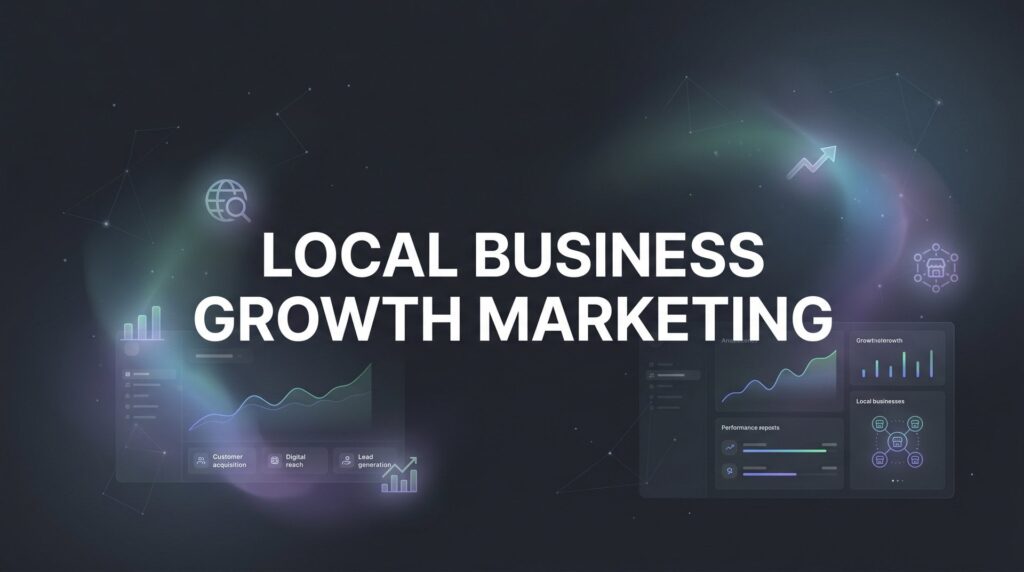
That gap has a name. It’s called local business growth marketing, and it’s not the same thing as generic digital marketing advice you’d find in a textbook. It’s the strategic combination of paid advertising, local SEO, conversion optimization, and performance tracking, all working together with one specific goal: driving measurable customer acquisition within your geographic area.
The distinction matters. Generic digital marketing talks about brand awareness, impressions, and reach. Local growth marketing asks a different question entirely: how many people in your city searched for your service today, and did they find you or your competitor? That hyper-local intent, the proximity-based search behavior of someone who needs a service right now and is ready to pay for it, is the engine this entire system is built around.
This guide breaks down exactly how local business growth marketing works, which channels deserve your attention and budget, and how to build a system that compounds over time. No fluff, no trendy tactics that evaporate next quarter. Just the fundamentals that actually move the needle for local businesses.
Why Traditional Advertising Leaves Money on the Table
There was a time when placing an ad in the Yellow Pages or sending out a mailer to your zip code was a reasonable way to grow a local business. Those days are gone, and the shift that replaced them is more significant than most business owners realize.
Traditional advertising is interruption-based. You put your message in front of people and hope some of them happen to need your service at that moment. A billboard reaches thousands of drivers, but only a handful of them are actually in the market for what you offer right now. You’re paying for everyone and converting a fraction. Understanding the differences between performance marketing and traditional advertising is essential for making smarter budget decisions.
Intent-based marketing works the opposite way. When someone types “emergency plumber near me” or “best dentist in [your city]” into Google, they are actively telling you they need your service. They’re not browsing. They’re buying. The businesses that appear at that exact moment win the customer. The ones that don’t exist in that search result simply don’t exist to that buyer.
The cost problem with traditional channels compounds this issue. There’s no reliable way to know which mailer, which billboard, or which radio spot actually drove a customer through your door. You spend the budget, hope it works, and make decisions based on gut feeling rather than data. That’s not a marketing strategy. That’s an expensive guess. This is exactly why so many owners experience wasted marketing spend without even realizing it.
The competitive reality is equally important to understand. Digital visibility doesn’t automatically favor the biggest or most established business in your market. A competitor who launched last year but invests strategically in local SEO and paid search can outrank you in the results that matter most. The playing field has been leveled, which means businesses that treat digital marketing as optional are actively choosing to lose ground to competitors who don’t.
The shift from interruption to intent isn’t a trend. It’s a permanent change in how people find and choose local businesses. Your growth marketing strategy needs to be built around that reality.
The Four Pillars of a Local Growth Marketing Engine
A sustainable local growth marketing system isn’t built on one channel or one tactic. It’s built on four interconnected pillars that each serve a distinct purpose. When they work together, the results compound. When one is missing, the whole system underperforms.
Pillar 1: Paid Search (PPC) This is your immediate lead flow engine. Google Ads allows you to target people searching for your exact service in your exact geographic area, right now, today. You control the budget, the geography, the hours your ads run, and the specific services you want to promote. When set up correctly, paid search puts your business in front of high-intent buyers within days of launching. It’s not the cheapest channel over the long run, but it’s the fastest path to predictable, measurable lead generation.
Pillar 2: Local SEO and Google Maps While paid ads deliver immediate results, local SEO builds long-term organic visibility that doesn’t disappear the moment you stop paying. Appearing in the Google Maps pack, those three local results that appear prominently for local searches, is enormously valuable because those positions capture a significant share of clicks from people with strong purchase intent. Local SEO takes time to build, but once you have it, it becomes a compounding asset.
Pillar 3: Conversion Rate Optimization (CRO) Here’s the pillar most local businesses completely ignore, and it’s often the highest-leverage opportunity in the entire system. Getting traffic to your website is only half the job. If your site doesn’t convert visitors into phone calls, form fills, or booked appointments, you’re effectively paying for people to leave. CRO is the discipline of systematically improving how well your website and landing pages turn visitors into leads.
Pillar 4: Tracking and Attribution Without this pillar, you’re flying blind. Proper tracking connects every lead back to the specific channel, campaign, and keyword that produced it. You know which ad drove the call, which page generated the form fill, and which campaigns are delivering profitable returns. Learning how to track marketing ROI effectively is what separates businesses that grow intentionally from businesses that just spend money and hope.
The power of this framework is in how the pillars reinforce each other. Better conversion rates make your paid ads more profitable. Better tracking tells you where to invest more in SEO. Stronger SEO reduces your dependence on paid ads over time. This is what a growth marketing engine looks like.
Paid Ads: The Fastest Path to Predictable Lead Flow
If you need leads this month, paid search is where you start. Google Ads, specifically search campaigns targeting service and location-based keywords, puts your business directly in front of people who are actively looking for what you offer. These aren’t people scrolling through a social feed who might be vaguely interested. These are buyers.
Understanding how it works doesn’t require a marketing degree. When someone searches “roof repair in [your city],” Google runs an auction in milliseconds to determine which ads appear. Your bid, combined with the quality and relevance of your ad and landing page, determines your position. The key insight for local businesses is that you’re not competing with the entire internet. You’re competing with the handful of local businesses bidding on the same keywords in your area. A dedicated PPC strategy for local businesses can give you a significant edge in these auctions.
Geo-targeting lets you define exactly where your ads show, down to specific cities, zip codes, or a radius around your business address. Ad extensions add valuable real estate to your ads, including your phone number, your address, links to specific service pages, and even customer review ratings. These extensions don’t cost extra to add and consistently improve click-through rates.
Budget strategy matters enormously here. The most common mistake local businesses make is spreading a limited budget across every service they offer. Instead, start with your highest-margin service or your most in-demand offering. Prove the ROI on that one campaign before expanding. A focused, well-funded campaign on one service will always outperform a thin, underfunded campaign spread across ten services.
The pitfalls that drain budgets are predictable and avoidable. Broad match keywords without a negative keyword list will show your ads to people searching for things that have nothing to do with your business. Sending paid traffic to your generic homepage instead of a dedicated landing page wastes the intent of the click. And failing to track calls and form submissions means you have no idea what’s actually working. If your marketing campaigns are not driving sales, these setup mistakes are often the root cause.
Paid search done right is a revenue machine. Done wrong, it’s an expensive lesson. The difference usually comes down to the quality of setup, ongoing management, and whether someone is actually paying attention to the data.
Local SEO: Building Visibility That Compounds Over Time
Paid ads are a faucet. Turn them on and leads flow. Turn them off and leads stop. Local SEO is different. It’s an asset you build over time that continues generating leads long after the initial work is done, and the marginal cost of those leads decreases as your rankings strengthen.
Your Google Business Profile is the foundation. This is the listing that appears in Google Maps and the local pack results. A complete, well-optimized profile with accurate business name, address, and phone number (NAP), the right service categories, high-quality photos, regular posts, and a consistent stream of genuine customer reviews is the single most important local SEO asset you control. Businesses with strong profiles and consistent reviews regularly outrank competitors with larger websites and bigger budgets.
Review generation deserves special attention. Positive reviews don’t just influence rankings. They influence conversion. A prospect who finds your business in the map pack and sees dozens of recent five-star reviews is far more likely to call than one who finds a competitor with a handful of outdated reviews. Build a systematic process for asking satisfied customers to leave reviews, and respond to every review you receive, positive and negative.
On your website, location-specific service pages are critical. Rather than one generic “Services” page, create dedicated pages for each service in each area you serve. “Emergency Plumbing in [City]” is a far more powerful page for local search than a generic plumbing services page. Implementing targeted advertising for local businesses alongside these pages amplifies your visibility even further. Pair this with schema markup, the structured data that helps search engines understand exactly what your business does and where you serve, and you significantly improve your chances of appearing in relevant local results.
Technical fundamentals matter too. Mobile-friendly design is non-negotiable since the majority of local searches happen on phones. Fast load times reduce bounce rates and signal quality to search engines. These aren’t glamorous tactics, but they’re the foundation that everything else is built on.
The long game advantage of local SEO is real. Businesses that invest consistently over 12 to 24 months often find themselves in a position where organic leads are flowing steadily at a fraction of the cost of paid traffic. That’s the compounding value of building an asset rather than renting visibility.
Turning Clicks Into Customers: Why Conversion Optimization Changes Everything
Here’s a scenario that plays out constantly for local businesses: you invest in ads, traffic goes up, but the phone isn’t ringing the way you expected. The instinct is to blame the ads. Often, the real problem is the website.
Conversion rate optimization is the discipline of systematically improving how many of your website visitors take the action you want, whether that’s calling, filling out a form, or booking an appointment. Most local business websites convert a small percentage of their visitors into leads. Small improvements to that conversion rate create outsized results across your entire marketing investment.
Think about the math. If your website converts two out of every hundred visitors into leads and you improve that to four out of every hundred, you’ve doubled your lead volume without spending an additional dollar on traffic. Every channel in your marketing system, paid ads, SEO, social media, becomes twice as effective. That’s the leverage CRO provides. Understanding your cost per lead in marketing makes this math even more compelling.
The high-impact changes for local businesses are often straightforward. A prominent click-to-call phone number that’s visible on every page, especially on mobile, can meaningfully increase call volume on its own. Trust signals matter enormously: customer reviews displayed on the page, industry certifications, guarantees, and photos of your actual team and work all reduce the hesitation a prospect feels before reaching out.
Streamlined contact forms: Long forms with too many fields create friction. For most local service businesses, a form that asks for name, phone number, and a brief description of the service needed is all you require to qualify a lead. Every additional field you add reduces the number of people who complete it.
Page speed: A slow-loading website loses visitors before they even see your offer. This is especially critical for mobile users who are often searching on the go with varying connection speeds. Page speed is both a conversion factor and an SEO ranking factor.
Dedicated landing pages: Sending paid traffic to your homepage is one of the most common and costly mistakes in local marketing. A dedicated landing page for each service campaign, with a clear headline, relevant trust signals, and a single focused call to action, will consistently outperform a generic homepage.
CRO isn’t a one-time fix. It’s an ongoing process of testing, measuring, and improving. But the businesses that treat it as a priority consistently see lower cost per lead and higher return from every marketing dollar they spend.
Your 90-Day Local Growth Marketing Roadmap
Strategy without execution is just theory. Here’s how to actually build your local growth marketing system over the first 90 days, broken into three focused phases.
Days 1 to 30: Build the Foundation Before you spend a dollar on traffic, make sure you can measure what happens to it. Set up call tracking for local businesses so you know which campaigns drive phone calls. Install Google Analytics and configure goal tracking for form submissions. Audit your website for the most obvious conversion bottlenecks: missing phone numbers, slow load speeds, confusing navigation, or a lack of trust signals.
Simultaneously, fully optimize your Google Business Profile. Verify your listing, ensure your NAP information is accurate and consistent everywhere online, add all relevant service categories, upload quality photos, and respond to any existing reviews. Then launch a focused PPC campaign on your single most valuable service, with proper geo-targeting and a dedicated landing page.
Days 31 to 60: Analyze and Optimize By now you have real data. Review which keywords are driving calls versus which are burning budget. Build out your negative keyword list aggressively. Analyze your landing page performance and begin A/B testing key elements: headlines, call-to-action button text, form placement, or trust signal positioning. Start building location-specific service pages on your website to lay the groundwork for organic visibility. If you’re finding it challenging to expand, understanding why it’s difficult to scale marketing efforts can help you identify and remove bottlenecks.
Days 61 to 90: Scale What’s Working With a proven foundation and optimized campaigns, you’re ready to expand. Add PPC campaigns for additional services or geographic areas that show commercial promise. Implement a systematic review generation process, whether that’s a follow-up email sequence, a text message after service completion, or a direct ask from your team. Establish a monthly reporting cadence that connects marketing spend directly to leads generated and revenue closed. This reporting discipline is what transforms marketing from a cost center into a measurable growth investment.
Ninety days won’t make you the dominant business in your market. But it will give you a functioning system, real data to make decisions from, and a clear picture of what’s working and what to scale.
The Bottom Line on Local Business Growth
Local business growth marketing isn’t about chasing every new platform or tactic that promises overnight results. It’s about building a disciplined, measurable system that consistently puts your business in front of ready-to-buy customers in your area, and getting better at it every month.
The businesses that win locally share a common mindset: they treat marketing as an investment with trackable returns, not an expense they’re reluctantly paying. They know their cost per lead. They know which channels produce their best customers. They make decisions based on data, not instinct, and they compound those decisions over time.
That combination of paid search for immediate lead flow, local SEO for long-term organic visibility, CRO to maximize the value of every visitor, and attribution to know what’s actually working is the system that separates growing local businesses from ones that plateau.
Building it takes expertise, consistency, and the willingness to let data guide your decisions. If you want a partner who’s obsessed with performance and ROI and who knows how to build these systems for local businesses specifically, that’s exactly what we do at Clicks Geek. As a Google Premier Partner agency, we specialize in turning ad spend into real, measurable revenue for local businesses.
If you want to see what this would look like for your business, we’ll walk you through how it works and break down what’s realistic in your market. No generic pitch, just a straightforward conversation about your growth goals and whether we’re the right fit to help you hit them.