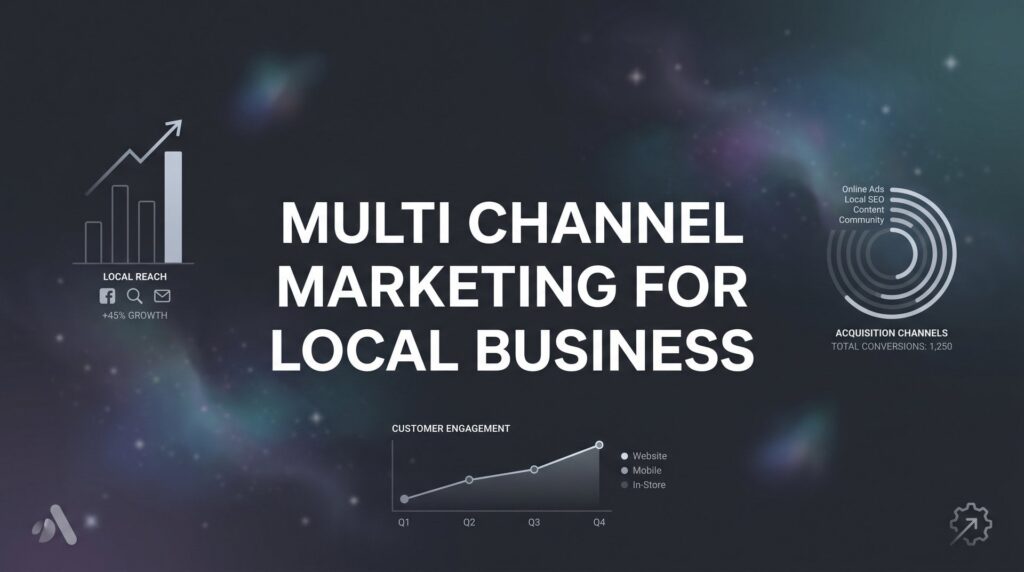
Most local business owners know they need to market online. The harder question is: where do you actually show up, and how do you make sure those channels are working together instead of competing for the same budget?
Multi channel marketing for local business isn’t about being everywhere at once. It’s about being in the right places, with the right message, so that potential customers encounter your business multiple times before they ever pick up the phone. Because here’s the reality: most people don’t call the first business they find. They search, they scroll, they compare, they check reviews, and then they decide. If you only exist on one platform, you’re invisible during most of that process.
The two most common mistakes local businesses make are polar opposites. Some go all-in on a single channel, like Google Ads, and ignore everything else. Others spread themselves across eight platforms without the budget or bandwidth to do any of them well. Both approaches leave serious revenue on the table.
This guide gives you a practical, step-by-step process to build a multi channel marketing system that actually generates leads for a local service business. Whether you run a plumbing company, a pest control operation, a hair salon, a dental practice, or any other local business, these steps apply directly to your situation.
You’ll learn how to audit what you’re already doing, pick the right channel mix without overextending, build a message that stays consistent everywhere customers find you, set up tracking that tells you what’s actually driving revenue, and create a retargeting system that keeps you visible while your competitors disappear. By the end, you’ll have a clear action plan you can start executing this week.
Let’s build a marketing engine that doesn’t depend on a single source of leads.
Step 1: Audit Your Current Marketing Channels and Identify the Gaps
Before you add anything new, you need an honest picture of what you’re already doing and how well it’s actually working. Most local business owners are surprised by what this audit reveals.
Start by listing every channel you’re currently using to get customers. This includes Google Ads, organic search, your Google Business Profile, Facebook or Instagram (paid and organic), email, referrals, direct mail, Yelp, Nextdoor, local directories, and anything else you’re actively using or have set up in the past. Get it all on paper.
Now comes the honest part: for each channel, ask yourself two questions. How much time and money am I putting into this? And how many actual leads or booked jobs has it produced? These two numbers are often dramatically mismatched. Many local businesses spend the most time on social media while their best leads are quietly coming from Google Maps. Others are paying for directory listings that haven’t generated a single call in months. Learning how to track marketing ROI effectively is essential for answering these questions honestly.
Next, map out how your customers actually find and choose a business like yours. The most common path for local service businesses looks something like this: a person searches on Google, lands on a website or Google Business Profile, reads reviews, and then calls. But there are other paths too. Some customers see a Facebook ad, visit the website, then Google the business name before contacting you. Others get a referral, then look you up online to verify you’re legitimate before reaching out. Understanding these paths helps you spot where you’re missing touchpoints.
Now look for the gaps. If you’re running PPC but have no organic presence, you’re entirely dependent on paid traffic. If you’re posting on social media but have no paid strategy, you’re reaching only people who already follow you. If you have no retargeting set up, you’re losing every visitor who leaves your site without converting.
Quick win before moving on: Check your Google Business Profile right now. Is it fully filled out with photos, services, hours, and a description? Are your name, address, and phone number (NAP) identical across your website, Google, Facebook, Yelp, and every other directory you’re listed on? Even small inconsistencies, like “St.” versus “Street” or different phone number formats, can hurt your local search rankings. Fix these first. It costs nothing and pays dividends quickly.
Step 2: Choose Your Core Channel Mix Without Spreading Too Thin
Here’s a principle worth writing down: it’s better to dominate two channels than to dabble in six. Spreading your budget and attention too thin means no single channel gets enough investment to actually perform. You end up with mediocre results everywhere and no clear picture of what’s working.
For most local businesses, the effective channel universe breaks into three main categories.
Paid Search (Google Ads and Local Services Ads): This is typically the fastest path to leads for local service businesses. When someone searches “emergency plumber near me” or “pest control [city],” they have high intent and they’re ready to call. Google Ads and Local Services Ads put you in front of that person at exactly the right moment. The downside is cost: you pay for every click, and competitive markets can be expensive. But the ROI is often the most direct and measurable of any channel. If you’re wondering whether the investment is worth it, this breakdown of whether Google Ads is too expensive for small business puts the real numbers in perspective.
Organic Visibility (Local SEO and Google Maps): This is the long game, but it compounds over time. Getting your website to rank organically for local search terms and optimizing your Google Business Profile for Maps visibility means you can generate leads without paying per click. It takes months to build, but once it’s working, it’s a durable asset. Most businesses should be building this in parallel with paid search from day one.
Social Media (Facebook and Instagram): Paid social is particularly effective for businesses where the visual element matters, like home remodeling, landscaping, hair salons, or catering. It’s also excellent for retargeting. Organic social has limited reach without paid amplification, so treat it as a trust-building layer rather than a primary lead source.
The right mix depends on your industry and budget. A plumber or electrician dealing with urgent service calls will typically see the fastest returns from Google Ads and Local Services Ads, because customers are searching with immediate intent. A hair salon or wedding photographer may get stronger traction from Instagram combined with local SEO, because discovery and visual appeal drive the decision. Understanding the tradeoffs in a Facebook Ads vs Google Ads comparison can help you make a smarter choice for your specific situation.
A practical starting framework: choose two primary channels where you’ll concentrate the majority of your budget and effort, and one to two supporting channels that require less active management. For most local businesses with a modest budget, that means Google Ads as the primary lead driver, local SEO as the long-term foundation, and Facebook retargeting as a supporting layer.
Resist the pull of shiny object syndrome. Every week there’s a new platform someone claims is a goldmine for local businesses. Maybe it is for some. But mastering fewer channels deeply, with proper tracking and optimization, will consistently outperform spreading yourself across every new trend.
Step 3: Build a Unified Message That Works Across Every Platform
Here’s a scenario that kills conversion rates more often than people realize. A potential customer sees your Google Ad, clicks through, and the landing page feels like a completely different company. Then they check your Facebook page, and the tone and offer are different again. By the time they hit your Google Business Profile, they’re confused about what you actually do and why they should choose you.
Inconsistent messaging erodes trust. And trust is the currency that converts local leads into booked jobs.
The fix starts with one exercise: write a single core value proposition that captures what you do, who you serve, and why you’re the best local choice. Keep it to two or three sentences. Something like: “We provide same-day HVAC repair for homeowners in [city]. Our licensed technicians are available 24/7, and every job comes with a 100% satisfaction guarantee.” That’s your anchor. Every piece of marketing you create should reflect that same promise, even if the format changes. Building profitable marketing campaigns starts with getting this foundational message right.
Think of it as adapting the format, not rewriting the message. Your Google Ad needs short, punchy copy that fits within tight character limits and triggers a click. Your landing page needs enough detail to build confidence and overcome objections. Your social media content can use visual storytelling: before-and-after photos, quick videos, behind-the-scenes content that humanizes your team. Your Google Business Profile needs a clear, keyword-rich description that tells both Google and potential customers exactly what you do.
Different format. Same story.
A few non-negotiables for consistency across channels:
Same phone number everywhere. If someone sees your Facebook ad and then Googles your business name, they should find the same number. Inconsistency here creates friction and costs you calls.
Same offer. If you’re running a “free estimate” offer in your Google Ads, that same offer should appear on your landing page, your social ads, and ideally your Google Business Profile. Don’t make people wonder if the deal they saw still applies.
Social proof on every touchpoint. Reviews and ratings should appear on your website, your Google Business Profile, your Facebook page, and ideally referenced in your ad copy. A prospect who sees “4.9 stars, 200+ reviews” consistently across every channel they encounter is far more likely to trust you than one who has to go looking for evidence that you’re legitimate.
When your messaging is unified, your marketing starts to feel like a coordinated system rather than a collection of disconnected efforts. That consistency is what builds the kind of familiarity that makes people choose you.
Step 4: Set Up Cross-Channel Tracking So You Know What’s Actually Working
This is the step most local businesses skip. And it’s the reason so many of them make expensive decisions based on completely wrong information.
Without proper tracking, you’re flying blind. You might be spending most of your budget on a channel that’s generating very few actual leads, while a lower-budget channel is quietly driving your best customers. Without data, you’ll never know. You’ll just keep allocating budget based on gut feeling and hope.
Here’s the tracking foundation every local business running multi channel marketing needs.
Google Analytics 4 with UTM parameters: Install GA4 on your website if you haven’t already. Then, for every link you share in a campaign, whether it’s a Google Ad, a Facebook post, an email, or a directory listing, add UTM parameters. These are simple tags appended to your URL that tell GA4 exactly where each visitor came from. Without them, most of your traffic shows up as “direct” and you lose all attribution. Tools like Google’s Campaign URL Builder make this easy.
Call tracking with unique numbers per channel: This is critical for local service businesses where most conversions happen over the phone. Services like CallRail allow you to assign different tracking phone numbers to different channels. Your Google Ads traffic sees one number. Your Facebook ad traffic sees another. Your organic search visitors see a third. Every call gets attributed to the channel that drove it, so you know your actual cost per lead by source, not just your cost per click. Our complete guide to call tracking for local businesses walks you through the full setup process.
Conversion tracking in Google Ads and Facebook Ads: Set up conversion events in both platforms so that when someone submits a form or calls from your ad, that action is recorded and tied back to the specific campaign, ad group, and keyword that triggered it. This is what allows you to see cost-per-lead by channel rather than just impressions and clicks, which are vanity metrics that don’t pay bills.
One more principle worth emphasizing: track the full funnel, not just the top of it. A click is not a lead. A lead is not a booked job. Wherever possible, track through to actual revenue. Some businesses connect their CRM or booking system to their ad platforms to see which campaigns are generating jobs that actually close, not just form fills. That’s the data that drives smart budget decisions.
Common mistakes that destroy your data: using the same phone number on every channel, failing to tag campaign links with UTMs, and ignoring offline conversions like walk-ins or calls made after someone sees a direct mail piece. Every gap in your tracking is a gap in your ability to make good decisions.
Step 5: Launch, Test, and Optimize Each Channel in Sequence
One of the most common mistakes when building a multi channel marketing system is trying to launch everything at once. It feels efficient, but it creates chaos. When everything goes live simultaneously, you can’t isolate what’s working. Your budget gets fragmented before any single channel has enough data to optimize. And if something breaks, you’re troubleshooting multiple systems at the same time.
The smarter approach is to stagger your launches. Get one channel working well before you add the next. This is how you build a system instead of just a pile of campaigns.
For most local service businesses, this is the sequence that tends to work best:
1. Google Ads and Local Services Ads first. These deliver the fastest results because you’re capturing people who are actively searching for what you offer right now. Get your campaigns running, your tracking set up, and your cost-per-lead to an acceptable level before moving on. This typically takes four to six weeks of active optimization. If you run a service business, this guide to Google Ads management for service businesses covers the key setup decisions.
2. Google Maps and local SEO second. While your paid campaigns are running, start building your organic foundation. This means fully optimizing your Google Business Profile, building local citations, generating reviews, and creating location-specific content on your website. This work compounds over months, so starting it early matters.
3. Facebook and Instagram ads third. Once your paid search is stable and your SEO work is underway, layer in social. Start with retargeting (covered in the next step) before running cold audience campaigns. Retargeting is lower cost and higher conversion rate, so it’s a smarter entry point into paid social.
4. Email and additional retargeting fourth. Build your email follow-up sequence for leads who inquire but don’t book. Set up Google Display retargeting. These are lower-lift additions once the foundation is solid.
Within each channel, run controlled tests. Test two versions of your ad copy. Test different landing pages. Test different offers. Give each test enough budget and enough time to produce statistically meaningful data before drawing conclusions. Changing things after three days and fifty clicks tells you nothing.
Establish a weekly review rhythm. Look at cost-per-lead and lead quality by channel. Pause what’s underperforming. Increase budget on what’s converting. Adjust bids based on what the data shows, not what you assumed when you launched. This process of continuous improvement is at the heart of improving your marketing performance over time.
One skill that separates experienced marketers from beginners: knowing when a channel isn’t right for your business versus when it just needs more optimization. Some channels genuinely don’t work for certain industries or markets. Others just need more time, better creative, or a different audience. Learning to tell the difference saves significant budget and frustration.
Step 6: Create a Retargeting and Follow-Up System That Connects Your Channels
This is where multi channel marketing goes from good to genuinely powerful. And it’s the piece most local businesses never build.
Here’s the core insight: most people who find your business for the first time won’t contact you on that first visit. They might click your Google Ad, browse your website for two minutes, and then get distracted and leave. That visit cost you money. Without retargeting, that person is gone. With retargeting, they start seeing your business everywhere they go online, and the familiarity builds until they’re ready to call.
Think of it as the “surround sound” effect. When a prospect sees your Google Ad on Monday, then encounters your Facebook ad on Wednesday, then sees a display ad on a news site on Friday, you’re not just one option among many. You’re the business they keep seeing. That repeated exposure builds trust in a way that a single touchpoint never can, and it dramatically increases the likelihood they choose you when they’re ready to book. This is the same principle behind a strong multi channel marketing approach that treats every platform as part of a unified system.
Here’s how to set it up:
Facebook and Instagram retargeting from website visitors: Install the Meta Pixel on your website. This allows you to build custom audiences of people who visited specific pages, like your service pages or contact page, and serve them targeted ads on Facebook and Instagram. Someone who spent three minutes reading your “emergency plumbing” page is a very warm prospect. Retarget them specifically.
Google Display retargeting: Set up a remarketing audience in Google Ads that includes everyone who has visited your website. Then run display ads across Google’s network of websites. These banner ads keep your business visible as prospects browse the web after leaving your site.
Email follow-up for unconverted leads: This is the most overlooked channel for local businesses, and it’s essentially free after setup. When someone fills out a contact form but doesn’t book, what happens? For most businesses, nothing. Build a simple three to five email sequence that goes out over the following two weeks. Remind them of your offer, share a customer testimonial, address a common objection, and give them an easy next step. Many of your best customers will come from this follow-up sequence, because they were interested but just not ready on day one. A well-built lead generation system for local businesses always includes this kind of follow-up infrastructure.
The combination of paid retargeting across multiple platforms and a smart email follow-up sequence creates a system that keeps working on your behalf long after the initial click. Your competitors, who have no retargeting and no follow-up, disappear after that first missed conversion. You don’t.
Putting It All Together: Your Multi Channel Marketing Action Plan
Here’s a quick-reference summary of the six steps you’ve just worked through, along with a realistic timeline for what to expect.
Step 1: Audit your current channels, identify where your best leads are actually coming from, map your customer journey, and fix your Google Business Profile and NAP consistency.
Step 2: Choose two primary channels and one to two supporting channels based on your industry and budget. Resist the urge to do everything at once.
Step 3: Build one core value proposition and adapt it across every platform. Keep the message consistent even as the format changes. Add social proof to every touchpoint.
Step 4: Set up GA4 with UTM parameters, call tracking with unique numbers per channel, and conversion tracking in Google Ads and Facebook Ads. Track leads, not just clicks.
Step 5: Launch channels in sequence: paid search first, then organic/Maps, then social ads, then email and retargeting. Test, review weekly, and optimize based on cost-per-lead data.
Step 6: Build your retargeting system across Facebook, Instagram, and Google Display. Create an email follow-up sequence for unconverted leads. Let the surround sound effect do its work.
As for timeline: in month one, expect to have your tracking foundation in place and your first channel live and generating initial data. In months two and three, you’ll be adding channels, running your first optimization cycles, and starting to see a clearer picture of what’s driving leads. By months four through six, a well-executed multi channel system is compounding, with each channel reinforcing the others and your cost-per-lead typically improving as your data and optimization mature.
Managing all of this well takes time, the right tools, and real expertise. Many local business owners find they can set up the basics but struggle to optimize across multiple channels simultaneously while also running their business. That’s where bringing in the right help makes a significant difference.
Clicks Geek is a Google Premier Partner agency that specializes in building exactly these kinds of multi channel lead systems for local businesses. From Google Ads and Local Services Ads to local SEO, Facebook advertising, and conversion rate optimization, the focus is always the same: qualified leads and measurable revenue growth, not vanity metrics.
If you want to see what this would look like for your specific business, we’ll walk you through how it works and break down what’s realistic in your market. No generic pitch, just a direct conversation about your situation and what a real multi channel strategy could produce for you.