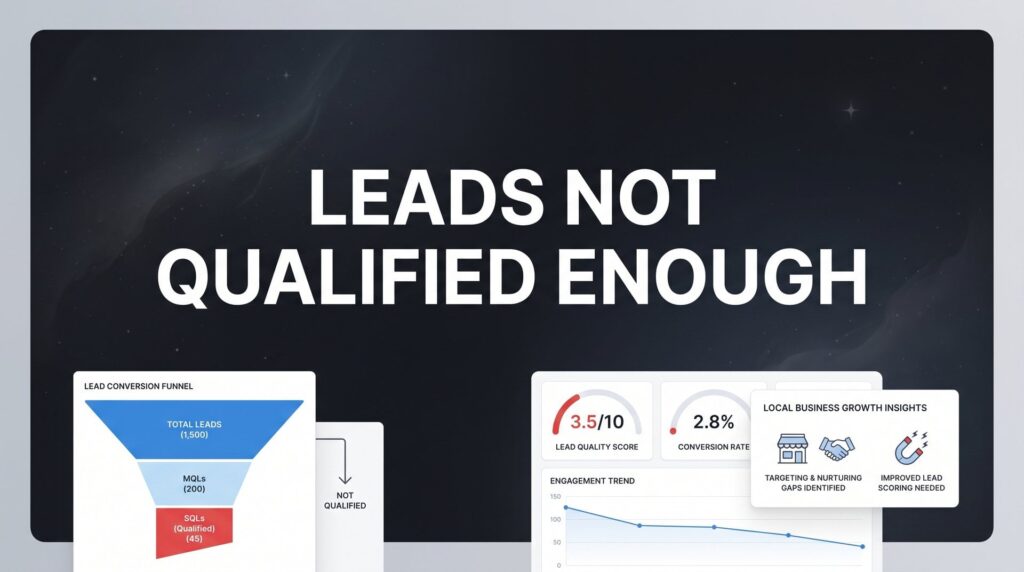
You open your inbox Monday morning to see 47 new lead notifications. Your heart should jump—except it doesn’t. Because you’ve played this game before. You know that out of those 47 people who filled out your form, maybe four will actually be qualified prospects. The rest? Wrong location. Wrong budget. Wrong service needs. Or worse—they’re just collecting quotes with zero intention of buying.
You’re spending real money to generate these leads. Your marketing budget isn’t infinite. Yet here you are, watching your sales team waste hours chasing people who were never going to convert in the first place. Meanwhile, your actual ideal customers—the ones with real budgets and genuine need—are probably clicking on your competitor’s ad right now.
Here’s the thing: this isn’t a lead generation problem. It’s a lead qualification problem. And the difference matters more than you think. Getting more leads is easy. Getting the right leads requires strategy, precision, and a willingness to say no to volume in favor of quality. The good news? Once you understand why your leads aren’t qualified enough, fixing it becomes straightforward. We’re going to walk through exactly why this happens, how to diagnose where your system is breaking down, and what to do about it starting today.
The Hidden Drain on Your Business Resources
Let’s talk about what poor lead quality actually costs you—because it’s way more than the wasted ad spend.
Your sales team spends an average of 15-20 minutes on each initial conversation. When half your leads are unqualified, that’s 10+ hours per week spent on calls that go nowhere. That’s time your best salespeople could be nurturing actual opportunities or closing deals. Instead, they’re explaining to someone in a different state that you don’t service their area, or walking through pricing with someone who thought your enterprise software would cost $50/month.
The math gets brutal fast. If your sales team’s time is worth $75/hour (and it probably is), and they’re spending 10 hours weekly on dead-end leads, you’re burning $3,000 monthly in pure labor cost. Add that to your marketing spend, and suddenly your cost-per-actual-customer looks very different than your cost-per-lead dashboard suggests. Understanding the difference between qualified leads vs unqualified leads is the first step toward fixing this drain.
But here’s the cost nobody talks about: opportunity cost. While your team is on the phone with tire-kickers, your competitors are having real conversations with qualified buyers. The local business owner who actually has budget and needs your service right now? They called someone else because your team was busy. You didn’t lose that customer to better marketing. You lost them to poor qualification.
And let’s be honest about what this does to team morale. Sales teams get demoralized when their pipeline is full of garbage. Marketing teams get defensive when sales complains about lead quality. The finger-pointing starts. The trust erodes. Everyone’s working hard, but the system is designed to waste everyone’s time.
The real kicker? You’re probably celebrating the wrong metrics. You see 200 leads this month versus 150 last month and think you’re winning. But if last month’s 150 leads produced 12 customers and this month’s 200 leads produce 8, you actually went backward. Volume without quality isn’t growth. It’s just noise.
Where Your Lead Quality Actually Breaks Down
Most businesses don’t have a lead generation problem. They have a targeting and messaging problem. Let’s break down exactly where things go wrong.
The Broad Targeting Trap: You want to reach more people, so you cast a wider net. Sounds logical. Except when you target “small business owners” instead of “local HVAC contractors in Chicago with 5-15 employees,” you attract everyone including people who will never buy from you. Your ads show up for the wrong searches. Your Facebook campaigns reach people who fit one demographic criterion but none of the actual buying signals. Broad targeting feels safe—you won’t miss anyone. But you’ll waste money on everyone.
The Messaging Mismatch Problem: Your ad promises “affordable website design” because that’s what gets clicks. But your actual service is premium custom development starting at $15,000. You’re attracting people looking for $500 WordPress templates. They click, they fill out your form, and then they ghost when they see real pricing. The disconnect between your marketing message and your actual offer creates a qualification nightmare. This is often why ads aren’t converting to sales—the messaging attracts the wrong audience from the start.
The Zero-Friction Form Mistake: You’ve heard that reducing form fields increases conversions. So you ask for name and email. That’s it. Congratulations—you just made it equally easy for your ideal customer and every random person with five seconds to spare. No friction means no filtering. When submitting a form takes zero effort and zero commitment, you get zero qualification. The student looking for free advice submits just as easily as the CEO ready to spend six figures.
The Wrong Channel Problem: Not all traffic sources are created equal. Some channels attract researchers and browsers. Others attract buyers. If you’re running aggressive display ads that interrupt people’s content consumption, you’re going to get curiosity clicks, not purchase intent. Compare that to search ads where someone typed “emergency plumber near me”—that’s intent. The channel shapes the quality. Many businesses don’t realize their lead quality problem is actually a channel selection problem.
The Generic Landing Page Issue: Your landing page tries to appeal to everyone. It’s vague enough to work for any visitor, which means it’s specific enough for none of them. There’s no clear indication of who this service is for, what problems it solves, or what it costs. So everyone converts—and nobody’s actually qualified. Your landing page should be a filter, not a funnel. It should make the wrong people self-select out before they waste your time.
Here’s what ties all of these together: they’re optimization mistakes disguised as best practices. You’re following conventional wisdom about increasing volume, reducing friction, and maximizing reach. And it’s killing your lead quality. The fix isn’t doing more of what you’re doing. It’s doing the opposite.
Finding Where Your System Is Failing
You can’t fix what you can’t measure. Before you change anything, you need to diagnose exactly where your lead quality is breaking down. Here’s how to do it.
Start with source-level analysis. Pull your leads from the last 90 days and segment them by source: Google Ads, Facebook, organic search, referrals, whatever channels you’re using. Then track each source’s lead-to-close ratio. You might find that Google Ads generates 60% of your leads but only 20% of your customers, while referrals generate 10% of leads but 40% of customers. That’s not a lead generation problem. That’s a channel quality problem. You’re over-investing in volume and under-investing in quality.
Next, analyze your form submissions for patterns. Look at the last 100 unqualified leads. What do they have in common? Are they all from outside your service area? Are they all asking about services you don’t offer? Are they all price shopping with unrealistic budgets? Most businesses discover that 80% of their unqualified leads fall into 2-3 predictable categories. Once you know the patterns, you can build filters to prevent them.
Talk to your sales team—really talk to them. Ask them to categorize their last 50 leads into three buckets: qualified and worth pursuing, somewhat qualified but not ideal, and completely unqualified. Then ask why each unqualified lead was unqualified. You’ll hear things like “thought we were a different type of company,” “wanted something we don’t offer,” “no budget,” or “not in our service area.” Understanding the distinction between marketing qualified leads vs sales qualified leads helps structure these conversations more effectively.
Review your actual conversion data, not just lead data. How long does it take qualified leads to close versus unqualified ones? What questions do qualified leads ask versus unqualified ones? What pages do they visit before converting? The behavioral differences between good leads and bad leads will show you what signals to look for—and what to optimize for.
This diagnostic phase isn’t glamorous, but it’s essential. You’re looking for the specific, repeatable reasons why leads don’t qualify. Because once you know why they’re unqualified, you can prevent those leads from entering your system in the first place.
Building Filters That Attract the Right People
Now that you know where the problem is, let’s fix it. These aren’t theory—they’re tactical changes that improve lead quality immediately.
Tighten Your Targeting With Exclusions: Most businesses focus on who to target. Smart businesses focus equally on who to exclude. In Google Ads, use negative keywords aggressively. If you’re a premium service, exclude terms like “cheap,” “affordable,” “free,” “DIY.” If you only serve a specific geography, exclude other locations. If you don’t offer certain services, exclude those search terms. Every exclusion filters out unqualified clicks before they cost you money. This feels like you’re limiting reach. You are. That’s the point.
Add Qualifying Questions to Your Forms: Stop using name-and-email forms. Add questions that filter intent. “What’s your budget range?” “What’s your timeline?” “What’s your location?” “What specific service are you interested in?” Yes, fewer people will complete the form. That’s not a bug—it’s a feature. The people who won’t answer basic qualifying questions were never going to become customers anyway. You’re not losing leads. You’re filtering out waste.
Create Content That Repels the Wrong Audience: Write landing page copy that speaks directly to your ideal customer’s specific situation. Use language and examples that only resonate with qualified buyers. If you serve enterprise clients, talk about enterprise problems. If you require a minimum commitment, state it upfront. If you’re premium-priced, communicate premium value. The goal isn’t to appeal to everyone. It’s to appeal intensely to the right people and bore everyone else into clicking away. This approach helps you generate qualified leads online consistently.
Use Price and Requirements as Natural Filters: Many businesses hide pricing because they’re afraid it will scare people away. Good. Let it scare away the wrong people. If your service starts at $10,000, say so. If you require a 6-month commitment, mention it. If you only work with businesses that have certain characteristics, list them. Transparency doesn’t reduce conversions among qualified leads—it increases them. Because qualified buyers want to know if you’re the right fit just as much as you want to know if they are.
The pattern here is simple: stop trying to appeal to everyone. Build deliberate barriers that filter out poor fits before they enter your system. Every filter you add reduces volume. And that’s exactly what you want. Because the volume you’re losing was never going to convert anyway.
Designing Your Funnel for Quality First
Your entire funnel should be designed to qualify, not just convert. Here’s how to restructure it.
Landing Page Qualification Strategies: Your landing page isn’t just a conversion tool—it’s a qualification filter. Use specific language that only your ideal customer will understand. Include details about your process, timeline, and requirements that make it clear who this is for. Add social proof from the types of customers you want more of. If you serve local businesses, feature local business testimonials. If you work with specific industries, showcase industry-specific case studies. The right people will see themselves in your content. The wrong people will bounce—and that’s perfect.
Multi-Step Forms That Self-Qualify: Instead of a single form, use a multi-step approach. Step one asks broad questions anyone can answer. Step two asks qualifying questions that require thought. Step three asks for contact information. This progressive qualification does two things: it filters out low-intent visitors who won’t complete multiple steps, and it gives you more data to prioritize leads. Someone who completes all three steps and provides detailed answers is infinitely more qualified than someone who submitted name and email on a whim.
Implement Lead Scoring Based on Behavior: Not all form submissions are equal. Build a scoring system that prioritizes leads based on qualification signals. Someone who visited your pricing page, read three blog posts, and answered all form questions gets a higher score than someone who clicked one ad and submitted minimal information. Your sales team should contact high-scoring leads within minutes and low-scoring leads when they have time. This isn’t about ignoring leads—it’s about intelligent prioritization based on likelihood to convert. When leads aren’t turning into sales, poor scoring and prioritization are often the culprit.
Create Commitment Mechanisms Before Contact: Make people do something before they can talk to sales. Watch a 5-minute video about your process. Read a detailed case study. Review your pricing structure. Download a resource that explains your methodology. These aren’t obstacles—they’re qualification checkpoints. Someone willing to invest 10 minutes learning about your business before requesting contact is infinitely more qualified than someone who impulsively clicked a “Get Quote” button. You’re not making it harder to buy. You’re making it easier to identify serious buyers.
The fundamental shift here is treating your funnel as a qualification system, not just a conversion system. Every step should answer the question: is this person actually a good fit? If the answer is no, the funnel should help them self-select out. If the answer is yes, it should move them forward with increasing commitment and clarity.
Tracking Metrics That Actually Drive Revenue
If you’re measuring the wrong things, you’ll optimize for the wrong outcomes. Here’s what to track instead.
Cost-Per-Qualified-Lead vs Cost-Per-Lead: Stop celebrating low cost-per-lead numbers. They’re meaningless if the leads don’t convert. Track cost-per-qualified-lead instead—the amount you spend to acquire a lead that your sales team actually wants to pursue. This number will be higher than your cost-per-lead. That’s fine. You want it to be higher. Because you’re paying for quality, not volume. A $200 cost-per-qualified-lead that converts at 30% is infinitely better than a $50 cost-per-lead that converts at 2%.
Revenue Attribution by Source: Track actual revenue generated by each marketing source, not just leads generated. Which channels produce customers who spend the most? Which channels have the highest lifetime value? Which channels close fastest? You might discover that the channel generating the most leads is generating the least revenue. That’s critical intelligence. It means you’re over-investing in volume and under-investing in quality. Shift budget accordingly. This is exactly why marketing campaigns aren’t driving sales for many businesses—they’re optimizing for the wrong metrics.
Lead-to-Close Ratios by Campaign: Don’t just track overall conversion rates. Track conversion rates by individual campaign, ad group, and even keyword. You’ll often find massive variance. One campaign might convert at 15% while another converts at 2%. Same budget, same industry, wildly different quality. When you identify these patterns, you can double down on what works and kill what doesn’t. Most businesses never get this granular. That’s why they keep funding campaigns that generate garbage leads.
Sales and Marketing Feedback Loops: Create a formal process where sales reports back to marketing on lead quality. Not just “these leads suck”—specific feedback on why leads are unqualified and what patterns they’re seeing. Marketing uses this feedback to refine targeting, messaging, and qualification criteria. Then the cycle repeats. This feedback loop is how you continuously improve lead quality over time. Without it, marketing operates blind and sales stays frustrated.
The shift here is from vanity metrics to business metrics. Leads generated, clicks, impressions—these are interesting data points, but they don’t pay the bills. Revenue generated, profit margin, customer lifetime value—these are what matter. When you optimize for the right metrics, lead quality improves automatically because you’re measuring what actually drives business results.
Turning Lead Quality Into a Strategic Advantage
Here’s what you need to understand: lead quality isn’t a lucky accident. It’s a strategic choice you make every day through targeting decisions, messaging choices, and funnel design. The businesses drowning in unqualified leads aren’t unlucky—they’re optimizing for the wrong things.
You now have the framework to fix this. Diagnose where your quality breaks down by analyzing source performance, form patterns, and sales feedback. Build strategic filters through tighter targeting, qualifying questions, and content that repels poor fits. Design your funnel to qualify at every stage, not just convert. And measure what actually matters—qualified leads and revenue, not volume and clicks.
The ironic part? When you focus on quality over quantity, you often end up with both. Because qualified leads convert faster, require less sales effort, and refer other qualified prospects. Your cost-per-acquisition drops. Your sales cycle shortens. Your team’s morale improves. And your marketing budget suddenly produces actual ROI instead of just activity.
Start with one change this week. Add one qualifying question to your form. Exclude one category of unqualified searchers. Tighten your targeting on one underperforming campaign. You don’t need to overhaul everything at once. Small, strategic improvements compound quickly when you’re moving in the right direction.
Tired of spending money on marketing that doesn’t produce real revenue? We build lead systems that turn traffic into qualified leads and measurable sales growth. If you want to see what this would look like for your business, we’ll walk you through how it works and break down what’s realistic in your market.