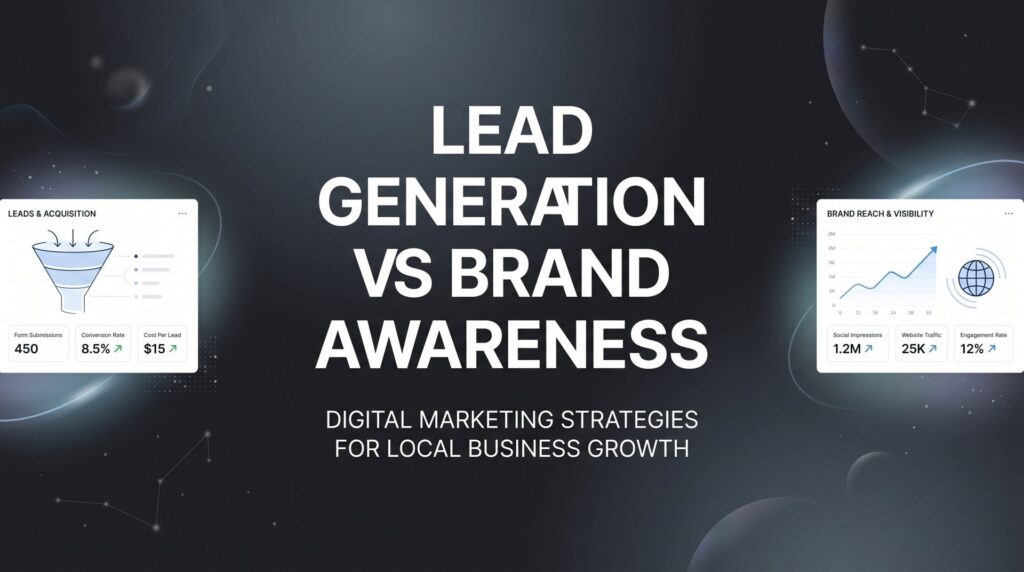
Every local business owner eventually faces the same crossroads: spend your marketing budget chasing leads right now, or invest in building a brand that attracts customers over time? It sounds like a simple choice, but the lead generation vs brand awareness debate directly impacts your revenue, your growth trajectory, and how much you pay per customer acquisition over time.
Here’s the uncomfortable truth: most businesses that struggle with marketing aren’t failing at one or the other. They’re failing to understand when each approach works best and how to make them complement each other.
Think of it like a restaurant that only runs lunch specials or only runs dinner service. You’re leaving money on the table by not operating across the full day. Your marketing works the same way. Lead generation captures the demand that already exists right now. Brand awareness creates the demand that fills your pipeline six months from now.
This guide breaks down seven battle-tested strategies to help you stop treating lead generation and brand awareness as an either/or decision. Whether you’re a plumber trying to fill next week’s schedule or a general contractor building a reputation in a new market, these strategies will help you allocate your budget with confidence and get measurable results from both sides of the equation.
1. Map Your Revenue Timeline Before Choosing a Strategy
The Challenge It Solves
Most business owners make marketing decisions based on gut instinct or whatever their last vendor pitched them. Without a clear picture of your revenue needs across different time horizons, you end up either starving your business of immediate leads or sacrificing the long-term brand equity that makes future leads cheaper to acquire. The result is a constant feast-or-famine cycle that keeps you reactive instead of strategic.
The Strategy Explained
Before you spend a single dollar on ads or content, create a simple revenue map that separates your 90-day needs from your 12-month goals. Your 90-day view should answer one question: how full is your pipeline right now? If you have less than two weeks of booked work, you need immediate lead generation as your priority. If you’re booked out four to six weeks, you have breathing room to invest more heavily in brand awareness.
Your 12-month view should reflect your growth ambitions. Are you trying to enter a new service area? Launch a new offering? Build enough brand recognition to charge premium prices? These goals require brand investment that starts today but pays off over quarters, not weeks. Mapping both timelines gives you a rational framework for your budget split rather than an emotional one. For a deeper dive into building a system that supports this kind of planning, check out how to scale lead generation in a way that aligns with your growth stage.
Implementation Steps
1. Calculate your current pipeline coverage: divide your booked revenue by your average monthly revenue target to get your coverage ratio in weeks.
2. Define your 12-month growth objective in concrete terms, such as entering a new zip code, adding a service line, or increasing average job value.
3. Use your pipeline coverage ratio to set your initial budget split. Thin pipeline means heavier lead gen weighting. Strong pipeline means you can afford to invest more in brand-building activities.
4. Review this map monthly and adjust your allocation as your pipeline health changes.
Pro Tips
Don’t set your budget split once and forget it. Your pipeline health changes constantly, and your marketing allocation should reflect that reality. Many experienced local marketers treat the revenue timeline map as a living document they revisit at the start of each month, not a one-time exercise. This single habit prevents more wasted ad spend than almost any other practice.
2. Use PPC for Immediate Lead Capture While Brand Builds in the Background
The Challenge It Solves
Brand awareness takes time. If you’re waiting for your content strategy or your display campaigns to generate revenue, your bills aren’t waiting with you. Many local businesses abandon brand-building efforts entirely because they can’t see the immediate return, which leaves them perpetually dependent on paid leads at increasingly competitive costs. The challenge is running both without letting either one suffer.
The Strategy Explained
Google Ads is one of the few marketing channels that can serve both goals simultaneously if you structure your campaigns correctly. Search campaigns targeting high-intent keywords capture people who are actively looking for your service right now. These are your immediate revenue drivers. At the same time, Display and YouTube campaigns targeting your local market build familiarity and recognition at a fraction of the cost-per-click you’d pay on Search.
The key insight is that these two campaign types aren’t competing for the same audience or the same budget psychology. Search campaigns are demand capture. Display and YouTube are demand creation. Running them in parallel means you’re never fully dependent on one mechanism, and the brand exposure from your awareness campaigns often improves the conversion rate of your lead gen campaigns over time as prospects recognize your name when they see your Search ad. Understanding the difference between local SEO vs PPC for lead generation can help you decide how to structure this parallel approach.
For deeper guidance on structuring campaigns that actually convert, explore Clicks Geek’s approach to PPC advertising for local businesses.
Implementation Steps
1. Launch Search campaigns targeting your highest-intent keywords first, such as “[service] near me” or “[service] in [city],” with tightly controlled budgets and strong negative keyword lists.
2. Allocate a separate, smaller budget to Display or YouTube campaigns targeting your local geographic area with brand-focused creative that introduces your company name and core value proposition.
3. Monitor your Search campaign impression share alongside your Display reach metrics to ensure both are running consistently without one cannibalizing the other.
Pro Tips
Resist the urge to pause your awareness campaigns when lead volume dips. That’s usually when your competitors are pulling back, which means your brand exposure becomes proportionally more impactful. Staying visible during slow periods is one of the most cost-effective brand investments a local business can make.
3. Turn Your Brand Story Into a Conversion Asset
The Challenge It Solves
Many businesses treat brand storytelling as a nice-to-have that lives on an “About Us” page nobody reads. They create brand content and lead generation content as two completely separate efforts, which doubles the workload and dilutes the budget. The result is brand content that never converts and lead gen content that never builds trust. Both underperform because they’re working in isolation.
The Strategy Explained
Your brand story shouldn’t just tell people who you are. It should actively move them closer to a buying decision. Customer success stories, before-and-after project showcases, owner expertise videos, and trust signals like certifications and reviews all serve a dual purpose: they build brand recognition and they overcome the objections that prevent someone from becoming a lead.
Think of it this way. A potential customer who finds your Google Business Profile sees your name. A potential customer who then reads a detailed case study about how you solved a problem similar to theirs sees your competence. The first touchpoint is brand awareness. The second touchpoint is lead nurturing. When you build your brand story with conversion intent baked in, every piece of content earns its keep twice. Businesses that master this approach often see dramatic improvements when they focus on how to increase their lead conversion rate through trust-building content.
This is especially powerful for local service businesses where trust is the primary barrier to conversion. People aren’t just buying a service; they’re letting someone into their home or business. Your brand story is the evidence that makes that decision feel safe.
Implementation Steps
1. Identify your three most common customer objections and create one brand story asset that directly addresses each one through a real customer experience or expertise demonstration.
2. Add a clear next step to every brand story asset: a phone number, a contact form, or a consultation booking link that captures the lead while trust is highest.
3. Distribute these assets across your website, Google Business Profile, and paid retargeting campaigns so they reach audiences at multiple stages of awareness.
Pro Tips
Video outperforms static content for brand storytelling in local markets. A 60-second video of you explaining your process or a satisfied customer describing their experience does more for both brand trust and lead conversion than most written content can achieve. You don’t need production quality; you need authenticity.
4. Layer Retargeting to Bridge the Awareness-to-Lead Gap
The Challenge It Solves
Most people who encounter your brand for the first time aren’t ready to become a lead immediately. They might visit your website, watch part of a video, or see a display ad and then disappear back into their day. Without retargeting, that initial awareness investment evaporates. You paid to get their attention and then had no system to recapture it when they were finally ready to act.
The Strategy Explained
Retargeting is the bridge between brand awareness and lead generation. It allows you to serve targeted ads specifically to people who have already had some exposure to your brand, whether they visited your website, watched a YouTube video, or engaged with your social content. Because these audiences already recognize you, your ads carry more weight and typically convert at a higher rate than cold traffic campaigns. If you’re looking for platforms that specialize in this, our guide to the best Google Ads remarketing services breaks down what to look for.
The most effective retargeting strategies for local businesses segment audiences by their level of engagement. Someone who visited your pricing page gets a different ad than someone who only visited your homepage. Someone who watched 75% of your explainer video is further along in their decision-making than someone who watched 10 seconds. Matching your retargeting message to the audience’s awareness level makes the transition from brand exposure to lead capture feel natural rather than pushy.
Implementation Steps
1. Install your Google Ads and Meta pixel on your website and configure audience segments based on pages visited, time on site, and video engagement thresholds.
2. Create retargeting ad creative that advances the conversation rather than repeating the same brand message. If they’ve seen your awareness ad, your retargeting ad should offer something more specific, such as a free estimate, a consultation, or a limited-time offer.
3. Set frequency caps on your retargeting campaigns to avoid overexposure, which can damage brand perception rather than improve it.
Pro Tips
Retargeting audiences built from your brand awareness campaigns are some of the most valuable assets in your marketing stack. Treat them as a separate campaign type with their own budget and creative strategy rather than an afterthought bolted onto your lead gen campaigns.
5. Dominate Local Search to Achieve Both Goals Simultaneously
The Challenge It Solves
Local SEO is chronically underinvested in by businesses that think of it purely as a traffic channel. When you only optimize for rankings, you miss the brand-building dimension of local search. Every time your business appears prominently in local results, with strong reviews, a complete profile, and consistent information, you’re not just capturing a lead. You’re reinforcing your brand’s authority in your market.
The Strategy Explained
Your Google Business Profile and local organic rankings are one of the rare marketing assets that serve both lead generation and brand awareness with the same investment. A well-optimized local presence captures high-intent searchers who are ready to call or book right now. At the same time, consistent visibility in local results builds the kind of familiarity that makes your name the first one people mention when a neighbor asks for a recommendation.
Local SEO compounds over time in a way that paid advertising doesn’t. Every review you earn, every piece of locally relevant content you publish, and every citation you build adds to a growing foundation of brand authority. The businesses that dominate local search in competitive markets typically got there by treating it as a long-term brand investment, not just a lead gen tactic. Your online reputation directly fuels lead generation in ways most business owners underestimate.
For businesses that want to explore how local SEO integrates with broader digital marketing strategy, the compounding nature of organic visibility makes it one of the highest-ROI channels available to local service providers.
Implementation Steps
1. Complete and optimize every section of your Google Business Profile, including services, photos, business description, and Q&A, with your target keywords and geographic areas naturally incorporated.
2. Build a systematic review generation process that asks every satisfied customer for a Google review within 24 hours of job completion, when their satisfaction is highest.
3. Publish locally relevant content on your website monthly: neighborhood guides, project spotlights from specific areas you serve, and answers to common questions your customers ask before hiring you.
Pro Tips
Branded search volume, meaning the number of people Googling your business name directly, is one of the strongest signals that your brand awareness efforts are working. Track this metric in Google Search Console monthly. Growth in branded searches typically precedes growth in organic lead volume by several weeks, making it a valuable leading indicator.
6. Build a Measurement Framework That Tracks Both Metrics
The Challenge It Solves
You can’t manage what you don’t measure, and most local businesses only measure what’s easy: form fills, phone calls, and cost per lead. These are critical lead gen metrics, but they tell you nothing about your brand health. Without brand metrics in your dashboard, you’ll consistently undervalue your awareness investments and cut them at exactly the wrong time, right before they were about to pay off.
The Strategy Explained
A proper measurement framework for balancing lead generation and brand awareness requires two distinct sets of KPIs running in parallel. Your lead gen metrics tell you how efficiently you’re capturing demand today. Your brand metrics tell you whether you’re building the market position that will make tomorrow’s demand cheaper and easier to capture.
Lead gen KPIs to track include cost per lead, lead-to-appointment rate, appointment-to-close rate, and revenue attributed to paid channels. Brand KPIs to track include branded search volume, direct website traffic, review count and average rating, and share of local search impressions. Together, these two dashboards give you a complete picture of your marketing health rather than just a snapshot of this week’s lead volume. If your cost per lead feels too high, understanding lead generation pricing benchmarks can help you determine whether you have a measurement problem or a strategy problem.
For businesses working with a digital marketing partner, insisting on visibility into both sets of metrics is one of the most important things you can do to ensure your investment is being managed strategically rather than tactically.
Implementation Steps
1. Set up a simple dual-dashboard in Google Looker Studio or a spreadsheet that pulls lead gen metrics from your CRM and brand metrics from Google Search Console and Google Analytics simultaneously.
2. Establish baseline values for each brand metric before launching any new awareness campaign so you can measure movement over time rather than just absolute numbers.
3. Review both dashboards together in a monthly marketing review, treating brand metric trends as a forward-looking indicator and lead gen metrics as a current-state indicator.
Pro Tips
Direct traffic, meaning visitors who type your URL directly into their browser, is one of the most underappreciated brand metrics available to local businesses. It reflects genuine brand recall. When your direct traffic grows consistently over several months, it’s a reliable signal that your brand awareness investments are translating into real market presence.
7. Shift Budget Dynamically Based on Business Stage and Seasonality
The Challenge It Solves
Static marketing budgets are one of the most common and costly mistakes local businesses make. Setting a fixed monthly spend and never adjusting it ignores the reality that your business needs, your competitive environment, and your customer’s buying behavior all change throughout the year. A roofing company that spends the same on brand awareness in February as it does in September is misallocating resources in both directions.
The Strategy Explained
A dynamic budget allocation model treats your marketing spend as a flexible tool rather than a fixed expense. The core principle is simple: when your pipeline is thin or your peak season is approaching, weight your budget toward lead generation. When your pipeline is healthy or you’re in an off-peak period with lower ad costs, shift more weight toward brand awareness investments that compound over time. Businesses that struggle with pipeline gaps during quieter months should explore strategies for slow season lead generation to stay productive year-round.
Seasonality also affects the cost of your advertising. Many local service businesses find that paid search costs fluctuate significantly between peak and off-peak periods as competitors enter and exit the auction. Off-peak periods with lower competition are often ideal times to invest in brand awareness campaigns at reduced costs, building market presence before your competitors ramp back up.
Competitive pressure is another trigger for dynamic shifts. If a well-funded competitor enters your market, temporarily increasing your brand awareness investment can protect your market position in ways that pure lead gen spending cannot. Customers who already recognize and trust your brand are significantly less likely to switch to a new entrant, even one with aggressive pricing. Our guide on competing with big brands online covers how smaller businesses can hold their ground without matching larger budgets.
Implementation Steps
1. Map your historical lead volume and cost-per-lead data by month to identify your peak and off-peak seasons, then plan your budget allocation shifts in advance rather than reacting to them.
2. Create three budget scenarios: a pipeline-thin scenario weighted heavily toward lead gen, a balanced scenario for steady-state operations, and a pipeline-strong scenario that invests more heavily in brand awareness.
3. Set a monthly calendar reminder to evaluate which scenario fits your current situation and adjust your campaign budgets accordingly at the start of each month.
Pro Tips
The businesses that grow fastest in competitive local markets are often the ones that invest in brand awareness during their competitors’ slow seasons. When everyone else is cutting back, your consistent visibility creates a share-of-mind advantage that pays dividends when peak season arrives and customers start actively searching for your service category.
Putting It All Together: Your Lead Gen and Brand Awareness Playbook
The lead generation vs brand awareness debate has a clear winner: the business that refuses to choose just one. These two goals aren’t in competition. They’re sequential stages in the same customer journey, and the businesses that treat them that way consistently outperform those that don’t.
Here’s how to sequence your approach. Start by mapping your revenue timeline (Strategy 1) to understand your immediate needs and your growth horizon. If cash flow is tight, lean into PPC lead capture (Strategy 2) while beginning to build your brand story assets (Strategy 3) on the side. As your pipeline stabilizes, layer in retargeting (Strategy 4) and local SEO dominance (Strategy 5) to create a self-reinforcing system where brand exposure feeds lead generation and lead generation funds more brand investment.
Track everything with a proper measurement framework (Strategy 6) so you can see both the immediate results and the long-term brand health trends that predict future performance. Stay agile with dynamic budget shifts (Strategy 7) so your spending reflects your actual business reality rather than an arbitrary monthly figure.
The businesses that grow the fastest aren’t the ones spending the most. They’re the ones spending the smartest, with a clear understanding of what each marketing dollar is supposed to accomplish and a system for measuring whether it did.
At Clicks Geek, we help local businesses build marketing systems that generate leads today while building the brand equity that makes tomorrow’s leads cheaper and easier to close. Tired of spending money on marketing that doesn’t produce real revenue? We build lead systems that turn traffic into qualified leads and measurable sales growth. If you want to see what this would look like for your business, we’ll walk you through how it works and break down what’s realistic in your market.