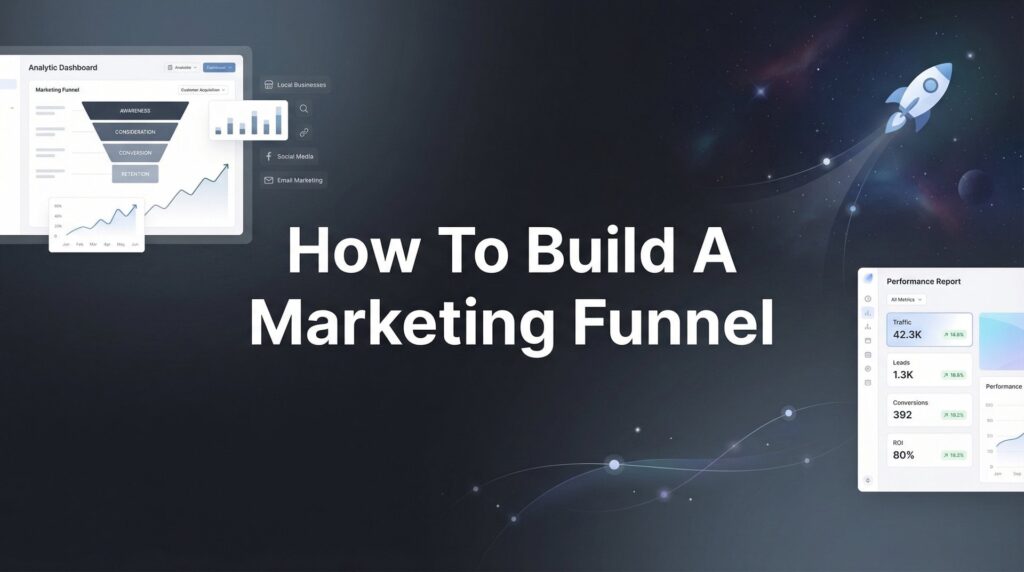
Most local business owners pour money into marketing without a clear system for turning strangers into paying customers. They run ads, post on social media, and hope for the best—but hope isn’t a strategy. A marketing funnel changes everything. It’s the systematic process that guides potential customers from their first interaction with your business all the way to becoming loyal, repeat buyers. Without one, you’re essentially leaving money on the table at every stage of the customer journey.
Think of it like this: You wouldn’t build a house without a blueprint. Yet most businesses try to generate revenue without a clear path from first contact to closed sale. The result? Wasted ad spend, confused prospects, and inconsistent revenue.
In this guide, you’ll learn exactly how to build a marketing funnel from scratch—one designed specifically for local businesses that need real leads and measurable ROI. We’ll walk through each step, from identifying your ideal customer to optimizing your funnel for maximum conversions. By the end, you’ll have a complete blueprint you can implement immediately to start generating more qualified leads and closing more sales.
Step 1: Define Your Ideal Customer and Their Buying Journey
You can’t build an effective funnel until you know exactly who you’re building it for. This isn’t about vague demographics like “business owners aged 35-55.” You need to understand your ideal customer so well that you can predict their objections before they voice them.
Start by creating a detailed customer avatar. Who are they? What keeps them up at night? What problem are they desperately trying to solve? For a local HVAC company, this might be a homeowner who’s dealing with an unreliable air conditioner during summer and fears an expensive breakdown. For a digital marketing agency, it might be a business owner who’s tried Facebook ads before and burned through budget with nothing to show for it.
Document These Critical Elements: What specific pain points drive them to search for a solution? What objections will they have about working with you? What results would make them say yes immediately? What’s their typical budget range and decision-making timeline?
Next, map out their buying journey. Local service businesses often have shorter buying cycles than B2B companies. Someone with a broken water heater isn’t going to spend three months researching—they need help now. But even urgent buyers go through stages: problem awareness, solution research, provider comparison, and final decision.
Identify where your customers spend their time online. Are they searching Google when they have a problem? Scrolling Facebook during lunch breaks? Reading local community forums? This determines where you’ll drive traffic later in your funnel. Understanding these touchpoints is essential for building an effective multi channel marketing strategy that reaches prospects wherever they are.
Here’s your success indicator: You should be able to write a single paragraph describing your ideal customer that’s so specific, you could pick them out of a crowd. If your description could apply to anyone, you haven’t gone deep enough.
Step 2: Create Your Lead Magnet and Entry Point
Your lead magnet is the front door to your funnel. It’s the irresistible offer that convinces someone to raise their hand and say, “Yes, I’m interested.” But here’s where most businesses mess up: they make it too broad or too generic.
A good lead magnet solves one specific problem for your ideal customer. Not five problems. Not a general overview. One problem that’s painful enough that they’ll exchange their contact information for the solution.
Effective Lead Magnet Formats: A checklist that helps them avoid expensive mistakes. A calculator that shows potential ROI or cost savings. A free consultation where you diagnose their specific situation. A short video training that reveals a counterintuitive strategy. A case study showing exactly how you solved a problem they’re facing.
Let’s say you run a roofing company. A generic lead magnet would be “The Complete Guide to Roofing.” Yawn. A specific lead magnet would be “The 7-Point Roof Inspection Checklist: Catch Small Problems Before They Cost You $15,000.” See the difference? The second one speaks to a specific fear and promises a concrete outcome.
Once you’ve created your lead magnet, you need a landing page designed for one purpose: getting that email address. This isn’t your homepage with seventeen different links. It’s a focused page with a compelling headline, a clear explanation of what they’ll get, and a simple form.
Your copy needs to speak directly to the pain point you identified in Step 1. If your ideal customer fears wasting money on marketing that doesn’t work, your headline might be: “Stop Throwing Money at Marketing That Doesn’t Convert: Get Our Proven Lead Generation Blueprint.” Every word should push toward the conversion action. This is where conversion focused marketing services can make a significant difference in your results.
Common pitfall: Making your lead magnet require too much effort. If someone has to read a 50-page PDF, you’ve lost them. Keep it actionable and digestible. A one-page checklist often outperforms a comprehensive guide because people can actually use it.
Success looks like this: Someone lands on your page, immediately understands what they’re getting, sees how it solves their problem, and submits their information within 30 seconds. If they’re confused or hesitant, your offer isn’t clear enough.
Step 3: Build Your Traffic Generation System
You’ve got a killer lead magnet and a conversion-focused landing page. Now you need to drive the right people to it. Notice I said “right people,” not “lots of people.” A hundred targeted visitors beat a thousand random ones every time.
Choose one or two primary traffic sources based on where your ideal customers actually spend time and how they search for solutions. For most local businesses, this comes down to Google Ads for high-intent searches or Facebook and Instagram for awareness and retargeting.
Google Ads Strategy: Target search terms that indicate buying intent. Someone searching “emergency plumber near me” is ready to buy now. Someone searching “how do pipes work” is just curious. Build campaigns around problem-focused keywords that your ideal customer would actually type when they need help.
Your ad copy should pre-qualify leads before they even click. If you only work with commercial clients, say so in the ad. If you require a minimum project size, mention it. You want clicks from people who are actually a fit for your business, not just anyone who’s vaguely interested. If you’re struggling to attract the right prospects, understanding how to generate leads systematically can transform your approach.
Facebook and Instagram Strategy: These platforms excel at building awareness and retargeting people who’ve already shown interest. Create ads that speak to the specific pain points you identified in Step 1. Use video when possible—it dramatically outperforms static images for engagement and conversion.
Here’s the key: Your ad messaging should flow seamlessly into your landing page. If your ad promises “5 ways to cut your marketing costs in half,” your landing page better deliver exactly that. Inconsistency kills conversions.
Start with a modest budget and focus on learning. You’re not trying to scale yet—you’re trying to identify which messages resonate and which audiences convert. Track everything from click-through rates to cost per lead. This data becomes gold when you optimize later.
Success indicator: You’re getting clicks from people who match your ideal customer profile, and your cost per lead is sustainable for your business model. If you’re spending $50 to acquire a lead for a $200 service, the math doesn’t work.
Step 4: Design Your Nurture Sequence
Someone downloaded your lead magnet. Great. But they’re not ready to buy yet. This is where most funnels fall apart—businesses either spam people with immediate sales pitches or go completely silent. Your nurture sequence is the bridge between interest and purchase.
Think of your email sequence as a conversation that builds trust over time. You’re not just sending information—you’re addressing objections, demonstrating expertise, and creating desire for your solution. Most effective sequences for local businesses run 5-7 emails over 10-14 days before making a direct offer. Mastering email marketing for lead generation is one of the highest-ROI skills you can develop.
Email 1 (Immediate): Deliver the lead magnet and set expectations. Thank them for downloading, confirm what they’ll receive, and tell them what’s coming next. This email should feel like the start of a relationship, not a transaction.
Email 2 (Day 2): Deliver pure value. Share a quick win they can implement today. This could be a case study, a counterintuitive tip, or a common mistake to avoid. No selling—just proving you know what you’re talking about.
Email 3 (Day 4): Address a major objection. If your ideal customer typically thinks “this probably won’t work for my industry,” tackle that head-on with specific examples. Use social proof—testimonials from similar businesses who got results.
Email 4 (Day 7): Introduce your methodology or framework. Explain how you approach solving their problem differently than competitors. This positions you as the obvious choice without being pushy.
Email 5 (Day 10): Soft pitch. Mention your service or product as the natural next step for people who want help implementing what you’ve taught. Make it conversational: “Some people prefer to do this themselves, and that’s great. Others want expert help to get it done faster—here’s how that works.”
Email 6-7 (Days 12-14): Direct offer with urgency. Present your service clearly, include pricing or a clear next step, and create authentic urgency. Limited consultation slots, seasonal demand, or a specific deadline all work if they’re genuine.
Don’t stop at email. Set up retargeting ads on Facebook and Google to stay visible. If you collect phone numbers, consider strategic SMS messages for time-sensitive offers. Multiple touchpoints increase conversion rates because people need to see your message several times before they act.
Automation is critical here. Use an email marketing platform to trigger these sequences automatically when someone opts in. This ensures every lead gets the same high-quality experience without you manually sending emails. Choosing the right marketing automation tools can save you hours each week while improving your conversion rates.
Step 5: Create Your Conversion Mechanism
Your nurture sequence has done its job. Leads are educated, objections are addressed, and desire is built. Now you need to make it ridiculously easy for them to become customers. Every unnecessary step in your conversion process costs you sales.
For service-based businesses, this typically means a consultation booking system or a clear sales page. For product businesses, it’s an optimized checkout process. Either way, friction is your enemy.
Consultation-Based Model: Use a scheduling tool that shows your available times and lets prospects book instantly. No back-and-forth emails trying to find a time that works. Include a brief questionnaire before the booking to pre-qualify and prepare you for the call. Ask about their specific situation, timeline, and budget range. This saves everyone’s time and increases show-up rates.
Direct Purchase Model: Your sales page needs to make the value crystal clear. What exactly are they getting? What results can they expect? What happens after they buy? Include social proof prominently—testimonials, case studies, logos of companies you’ve worked with. Address the final objections: money-back guarantee, payment plans, risk reversal.
Build urgency and scarcity elements that are authentic to your business. Limited consultation slots are real—you only have so many hours. Seasonal demand is real—roofing companies genuinely get busier in certain months. Manufactured scarcity feels manipulative and damages trust. Authentic urgency converts.
Remove every possible point of friction. If your checkout requires creating an account, you’re losing sales. If your booking form asks for information you don’t actually need, you’re losing bookings. Simplify ruthlessly.
Success indicator: A qualified lead who’s been through your nurture sequence should be able to go from “I’m ready” to “I’m booked” or “I’ve purchased” in under two minutes. If it takes longer, you’ve got friction to eliminate.
Step 6: Set Up Tracking and Measure What Matters
You can’t optimize what you don’t measure. Most businesses track the wrong things—website visits, social media likes, email open rates. These vanity metrics feel good but don’t connect to revenue. Your funnel tracking needs to focus on metrics that actually matter to your bottom line.
Install proper conversion tracking on every stage of your funnel. When someone downloads your lead magnet, that’s tracked. When they open emails, that’s tracked. When they book a consultation or make a purchase, that’s tracked. Use Google Analytics, Facebook Pixel, and your CRM to capture this data automatically. If you’re unsure where to start, our guide on how to track marketing ROI walks you through the entire process.
Critical Metrics to Monitor: Cost per lead—how much you’re spending to get someone into your funnel. Lead-to-customer conversion rate—what percentage of leads actually buy. Customer acquisition cost—total marketing spend divided by new customers. Average customer value—how much revenue each customer generates. Return on ad spend—revenue generated for every dollar spent on advertising.
Create a simple dashboard that shows these numbers at a glance. You don’t need fancy software—a spreadsheet updated weekly works perfectly. The goal is to spot trends quickly. If your cost per lead suddenly spikes, you know something changed in your traffic generation. If your lead-to-customer rate drops, your nurture sequence or conversion mechanism needs work.
Common pitfall: Tracking engagement metrics instead of revenue metrics. Email open rates don’t matter if nobody’s buying. Website traffic doesn’t matter if it’s not converting. Stay focused on numbers that connect directly to revenue growth. Understanding marketing attribution models helps you identify which channels actually drive your revenue.
Set up weekly reviews of your funnel health. Look at each stage: How many people entered at the top? How many made it to each subsequent stage? Where are the biggest drop-offs? These bottlenecks tell you exactly where to focus your optimization efforts.
Step 7: Test, Optimize, and Scale What Works
Your funnel is live and generating leads. Now the real work begins. The businesses that dominate their markets aren’t lucky—they’re relentless about testing and optimization. Small improvements compound into massive results over time.
Start with A/B testing on elements that have the biggest impact. Test different headlines on your landing page. Test different lead magnet offers. Test different email subject lines. Test different calls-to-action. Run one test at a time so you know exactly what caused any change in performance. Our guide on marketing campaign optimization covers the specific tests that deliver the biggest improvements.
Identify bottlenecks where leads drop off and address them systematically. If 100 people land on your page but only 10 opt in, your offer or copy needs work. If 50 people download your lead magnet but only 5 book consultations, your nurture sequence isn’t building enough desire or trust. Fix the biggest leaks first—they have the most impact.
High-Impact Optimization Areas: Landing page headlines that speak directly to specific pain points. Lead magnet offers that solve more urgent problems. Email subject lines that create curiosity without being clickbait. Call-to-action buttons that use action-oriented language. Sales page testimonials that address specific objections your prospects have.
As you optimize, watch your key metrics improve. Your cost per lead should decrease as your landing page converts better. Your lead-to-customer rate should increase as your nurture sequence gets sharper. When you see consistent improvement, that’s when you scale.
Double down on traffic sources and messages that produce the best ROI. If Google Ads for a specific keyword is generating leads at $20 each while Facebook ads cost $60 per lead, shift more budget to Google. If one email in your sequence gets dramatically higher engagement, study why and apply those lessons to other emails.
Success indicator: Your customer acquisition cost decreases over time while lead quality increases. You’re spending less to acquire better customers. That’s when you know your funnel is working and you can confidently scale your marketing investment.
Your Funnel Blueprint: Ready to Implement
Building a marketing funnel isn’t a one-time project—it’s an ongoing system that compounds over time. Start with the basics: know your customer, create a compelling entry point, drive targeted traffic, nurture leads with value, and make it easy to buy. Then track everything and optimize relentlessly.
The businesses that win aren’t necessarily spending the most on marketing. They’re the ones with the most efficient funnels—converting more visitors into leads and more leads into customers. While your competitors are still throwing money at random tactics, you’ll have a systematic approach that gets better every month.
Use this checklist to get started:
☐ Customer avatar defined with specific pain points and objections
☐ Lead magnet created that solves one specific problem
☐ Landing page live with single conversion focus
☐ Traffic source active and targeting ideal customers
☐ Nurture sequence automated with 5-7 value-driven emails
☐ Conversion tracking installed on all funnel stages
The difference between a business that struggles and one that scales often comes down to this: a proven system for turning attention into revenue. You now have the blueprint. The question is whether you’ll implement it.
Ready to build a funnel that actually delivers ROI? Clicks Geek specializes in creating high-converting marketing systems for local businesses. We don’t just set up campaigns—we build complete lead generation systems that turn traffic into qualified leads and measurable sales growth. If you want to see what this would look like for your business, we’ll walk you through how it works and break down what’s realistic in your market.