
Most electrical contractors treat Google Ads and Local Services Ads like a fork in the road: pick one, put your budget behind it, hope it works. That framing misses the point. The real decision is which channels earn a slice of your marketing spend, in what order, and how you measure which one is actually filling the schedule. This list covers the platforms and tools electrical contractors use to book jobs, starting with the two Google products everyone asks about first.
Quick Comparison
- Clicks Geek: best for contractors who want one team running both Google Ads and LSA together; quote-based; coordinates both channels as a single budget instead of two competing accounts.
- Google Ads: best for targeting specific high-value jobs by keyword; no platform fee, pay-per-click; the only option here with keyword-level control over search intent.
- Google Local Services Ads: best for newer electricians needing instant trust; pay-per-lead; the only channel with a Google Guaranteed badge built in.
- Meta Ads: best for building demand ahead of need; no platform fee, benchmark CPL $10-25; reaches homeowners before they start searching.
- Angi Leads: best for filling open calendar slots without running ads; quote-based, pay-per-lead; zero campaign management required.
- Nextdoor Local Ads: best for building a name in a specific neighborhood; no published minimum; trades on neighbor-to-neighbor trust.
- Yelp Ads: best for urban markets with strong Yelp search traffic; quote-based; captures homeowners already comparing reviews.
- CallRail: best for proving which channel actually books the job; starts around $45/month; the only tool here built purely for attribution.
1. Clicks Geek
Clicks Geek manages Google Ads and Local Services Ads for electrical contractors as a coordinated system rather than as two separate accounts run by two separate mindsets. As a Google Premier Partner, the agency builds campaigns off industry-specific playbooks, including one built specifically for electrical, instead of applying the same generic template used for plumbers or HVAC companies.
What sets this apart from everything else on the list is the coordination piece. Most electricians who run both channels end up with a PPC account bidding on “electrician near me” while their LSA profile chases the exact same searches with a separate budget and no communication between the two. Clicks Geek treats the combined spend as one budget with one goal: booked jobs, not clicks or leads counted in isolation.
- Google Premier Partner account management across both Google Ads and LSA
- Access to 298 industry-specific playbooks, including electrical-specific targeting and messaging
- Coordinated budget allocation between Google Ads and LSA so the two channels don’t cannibalize each other
- Call tracking and lead qualification setup so you know which calls are real jobs versus spam or tire-kickers
- No lock-in contracts, so you can leave if the numbers don’t work
Setup involves handing over or building out your Google Ads and LSA accounts, Google Business Profile, and GA4, along with a call tracking platform. The agency runs day-to-day management, which suits owners who would rather be on a job site than logging into an ads dashboard. That’s also the limitation: this isn’t a self-serve tool, so it won’t suit an owner who specifically wants to log in daily and adjust bids themselves.
Pricing is quote-based and depends on your market and goals, but ad spend for electrical contractors typically runs 8-12% of revenue, consistent with home services benchmarks generally. Expect a 30-90 day ramp period before performance stabilizes, which is normal for both Google Ads and LSA regardless of who manages them.
Best for: Electrical contractors who want one team owning both channels instead of juggling two logins and two invoices.
2. Google Ads
Google Ads is the pay-per-click platform behind the search, display, and Performance Max campaigns that put your ad above organic results when someone searches “panel upgrade cost” or “emergency electrician.” It’s built for contractors who want to decide exactly which searches trigger their ad rather than letting an algorithm decide who sees them.
The distinctive strength here is keyword control. You can bid specifically on high-margin work like EV charger installs or panel upgrades while excluding low-value searches like “how to reset a breaker” with negative keywords. No other channel on this list gives you that level of precision over search intent.
- Search, display, and Performance Max campaign types to match different stages of homeowner intent
- Keyword and negative keyword targeting so you control which searches spend your budget
- Smart Bidding strategies that adjust bids automatically based on conversion likelihood
- Call extensions and geo-radius targeting to capture phone calls directly from the ad
Google Ads connects with GA4, Google Business Profile, CallRail, and Zapier, which makes attribution manageable once it’s set up correctly. The setup and ongoing management are the catch: building negative keyword lists, structuring ad groups, and adjusting bids is a real skill, and an under-managed account bleeds money on irrelevant clicks fast. Home services electrical typically sees a cost per lead in the $18-35 range, though that varies by market competitiveness and how tight your negative keyword list is.
This platform doesn’t suit owners looking for a “set it and forget it” channel. Left unmanaged, Google Ads accounts drift toward wasted spend within weeks.
Best for: Electricians who want to target specific high-value jobs by keyword rather than taking whatever leads come in.
3. Google Local Services Ads
Google Local Services Ads places verified electricians above regular search ads and organic results, with a Google Guaranteed badge attached. Unlike Google Ads, you’re not bidding on keywords, you’re bidding on your profile strength: reviews, responsiveness, and background check status.
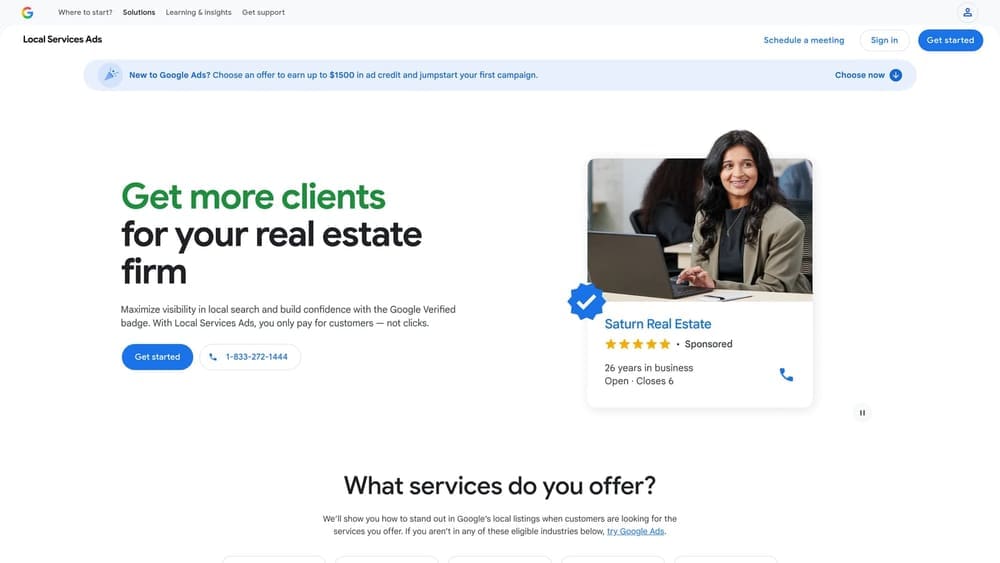
The billing model is what makes LSA fundamentally different from everything else here. You pay per lead, not per click, and Google Guaranteed backs the job up to a certain dollar amount if a customer isn’t satisfied. For an electrician still building a reputation, that badge does real trust-building work before the phone even rings.
- Pay-per-lead billing so you’re not paying for browsers who never call
- Google Guaranteed badge that signals vetted, background-checked status to homeowners
- Placement above standard search ads, ahead of your Google Ads campaigns
- Background check requirement that filters out unlicensed competitors
- Review and responsiveness-driven ranking that rewards fast callbacks
LSA connects to your Google Business Profile but runs in its own separate dashboard, apart from Google Ads. Setup requires passing the background check process, which can take a few weeks depending on your state’s licensing verification. The real limitation is control: you can’t choose keywords, and your lead volume is capped by how many reviews you have and how large your service area is. A brand-new profile with five reviews will see a fraction of the leads a profile with 150 reviews sees.
Pricing varies by market and is billed only when a lead contacts you, so rates should be verified directly on Google’s site since they shift by region and season. Availability and eligibility also vary by market, so confirm both before assuming LSA is live where you operate.
Best for: Newer electrical businesses that need trust signals fast and want to avoid paying for clicks that never call.
4. Meta (Facebook/Instagram) Ads
Meta Ads puts your business in front of homeowners based on demographics and interests rather than active search behavior. That’s a different job than Google Ads or LSA are doing: instead of catching someone mid-search, you’re planting the idea before they’ve started looking.
The distinctive use case is planned, higher-ticket work. Someone isn’t searching “whole home rewiring” the way they’d search “electrician near me” during an emergency, but a well-targeted Meta ad showing before-and-after panel upgrade work can move a homeowner who’s been putting off the project.
- Detailed demographic and interest targeting to reach homeowners in the right age and income bracket for bigger jobs
- Native lead-generation forms that let homeowners request a quote without leaving the app
- Video and carousel ad formats for showing off finished work
- Retargeting for website visitors who checked your site but didn’t call
Meta integrates with CallRail, a GA4 pixel, and CRMs through Zapier, so tracking is doable but requires setup work most electricians don’t do on their own. Day-to-day management usually falls to whoever handles marketing, since campaigns need creative refreshes to avoid ad fatigue.
The limitation is intent. Someone scrolling Instagram isn’t in buying mode the way a Google searcher is, so lead quality is inconsistent unless you follow up within minutes, not hours. Benchmark cost per lead for local service categories on Meta runs $10-25, generally cheaper than Google Ads, but a cheap lead that never answers the phone isn’t actually cheap.
Best for: Electricians who want a pipeline of planned upgrade work between emergency calls, not just same-day jobs.
5. Angi Leads
Angi Leads is a marketplace that matches homeowners who’ve already decided to hire an electrician with contractors in their area, in exchange for a per-lead fee. You’re not running any ads or managing any keywords, you’re buying access to demand someone else generated.
The distinctive value is zero setup. There’s no campaign to build, no ad copy to write, and no bidding strategy to manage. You create a profile, set your service area and categories, and leads start arriving based on homeowner requests.
- Shared and exclusive lead options depending on how much you’re willing to pay per lead
- Business profile with customer reviews that homeowners see before choosing who to call
- Project-based lead matching tied to the specific job type a homeowner requested
- Mobile lead alerts so you can respond within minutes of a lead coming in
Angi runs as a standalone platform with limited CRM sync, so tracking these leads alongside your other channels takes manual work or a call tracking number dedicated to Angi specifically. Anyone on your team who answers the phone can run this, no dedicated marketing manager required.
The real drawback is the shared lead model. On non-exclusive leads, you’re often one of three or four electricians quoting the same homeowner, and close rates drop accordingly compared to a lead that came directly to your own ad. Exclusive leads cost more but avoid that competition.
Pricing is quote-based and varies by service area and job type, with no flat published rate.
Best for: Electricians with open slots on the calendar who want supplemental leads without managing any ads.
6. Nextdoor Local Ads
Nextdoor Local Ads puts your business in front of homeowners within a specific neighborhood radius, on a platform where recommendations come from actual neighbors rather than anonymous review sites.
The distinctive advantage here is the trust format. Electrical work means letting a stranger into someone’s house, and a recommendation from a neighbor two doors down carries more weight than a five-star Google review from someone across town. For contractors building a name in a specific suburb or subdivision, that’s a different kind of proof than anything Google or Meta offers.
- Hyperlocal neighborhood targeting down to specific zip codes or subdivisions
- Business page where neighbors can post recommendations visible to the whole community
- Sponsored posts that appear directly in the neighborhood feed
- Service area radius targeting so spend stays concentrated where you actually work
Setup is straightforward through Nextdoor’s own dashboard, and it runs as a standalone platform with limited third-party integration, meaning attribution generally has to be handled manually or through a dedicated tracking number. Any owner or office manager can run this without much of a learning curve.
The tradeoff is scale. Nextdoor’s reach is inherently smaller than Google or Meta, and its performance reporting is thinner, which makes it harder to prove clean ROI compared to a platform with conversion tracking built in. It works best as an addition to a broader strategy, not the whole strategy.
There’s no published minimum budget, so contractors can test it at a modest spend before committing further.
Best for: Electricians building a reputation in a specific neighborhood or suburb cluster.
7. Yelp Ads
Yelp Ads puts sponsored placement and an upgraded business profile in front of homeowners who default to reading reviews before picking up the phone. It’s aimed squarely at the segment of the market that treats Yelp, not Google, as their first stop for finding a contractor.
The distinctive angle is capturing review-driven research behavior at the exact moment someone is comparing electricians side by side, rather than trying to interrupt them earlier in the process the way Meta does.
- Sponsored placement above organic listings in your category and service area
- Upgraded business profile with more prominent photos and details
- Request-a-quote lead capture built directly into your profile
- Review highlighting that surfaces your best feedback to browsing homeowners
Yelp runs through its own standalone dashboard, so it doesn’t plug into GA4 or CallRail the way Google Ads and Meta do without manual tracking setup. Management is light enough for an owner or office manager to handle directly.
The limitation is volume. In most markets, electrical services traffic on Yelp is meaningfully smaller than what you’ll see on Google, and cost per lead can run higher relative to the number of leads generated. It works better as a supplemental channel in markets where Yelp still carries real local search weight, typically denser urban areas.
Pricing is quote-based with budgets typically set on a monthly basis.
Best for: Electricians in urban markets where Yelp still gets meaningful local search traffic.
8. CallRail
CallRail is call tracking and attribution software, not a lead source. Its job is answering the question every electrician running multiple channels eventually asks: which platform actually produced the phone call that turned into a booked job.
Given that 40-70% of leads in home services arrive by phone rather than through a web form, tracking clicks and conversions in GA4 alone leaves a huge blind spot. CallRail closes that gap by assigning a unique tracked number to each channel, so a call from your Google Ads campaign looks different in the data than a call from your LSA profile or a Nextdoor post.
- Dynamic number insertion that swaps tracking numbers based on which channel or even which keyword drove the visit
- Call recording and tracking so you can review how leads are actually handled on the phone
- Keyword-level attribution tying specific search terms to specific booked jobs
- Form tracking for leads that come through your website instead of calling
- Lead qualification tagging to separate real jobs from spam calls and wrong numbers
CallRail integrates directly with Google Ads, GA4, Local Services Ads, Meta Ads, and most major CRMs, which is exactly why it pairs so well with the multi-channel approach most electricians end up running. Setup takes a few hours for a basic configuration and typically falls to whoever manages your marketing, whether that’s you, an office manager, or an agency.
The obvious limitation: CallRail generates zero leads on its own. It’s a measurement layer, useful only once you already have channels running that need to be compared against each other.
Pricing starts around $45 a month, though current rates should be verified on CallRail’s site since tiers are based on number of tracking numbers and call minutes.
Best for: Electricians running Google Ads and LSA together who need to know which one is actually paying for itself.
Building Your Channel Mix Without Guessing
If your budget supports it, running Google Ads and LSA together beats picking one. Google Ads gives you keyword control over high-value jobs, LSA gives you pay-per-lead trust signals with a Guaranteed badge, and together they cover both the searcher who knows exactly what they need and the one who just wants a vetted electrician fast. A newer business without much review history is often better off leaning on LSA alone first, since the badge does trust-building work that a bare Google Ads listing can’t replicate yet.
Meta or Nextdoor make sense as an addition once your core search channels are stable, aimed at planned upgrade work rather than same-day emergencies. Angi and Yelp work best as supplemental lead flow to fill open calendar slots, not as your primary acquisition strategy, since shared leads and thinner local volume limit how far they scale. Whatever mix you land on, CallRail or an equivalent call tracking setup is what tells you which channel is actually worth the spend instead of guessing based on gut feel.
Tired of spending money on marketing that doesn’t produce real revenue? We build lead systems that turn traffic into qualified leads and measurable sales growth. If you want to see what this would look like for your business, we’ll walk you through how it works and break down what’s realistic in your market.