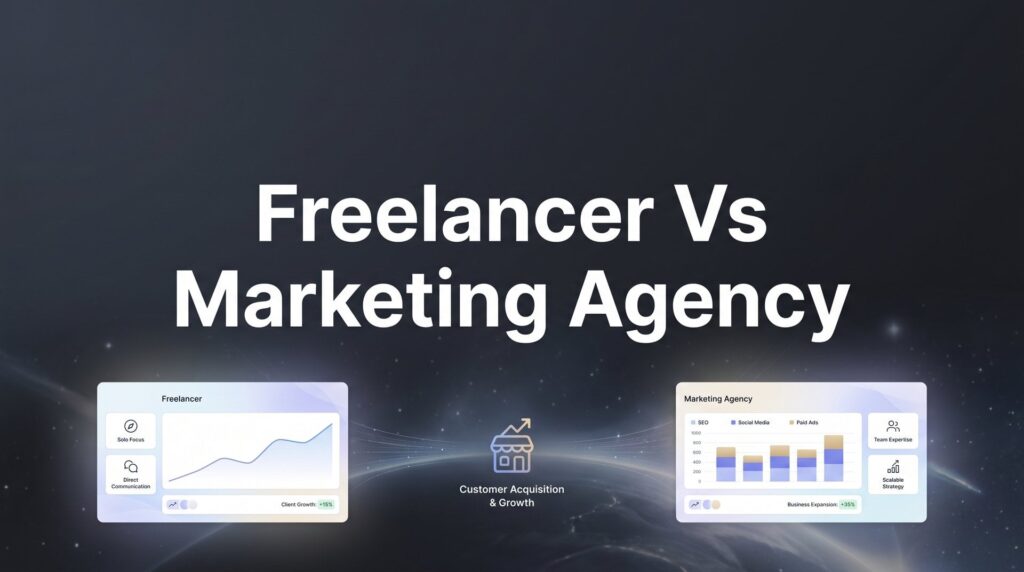
Every local business owner eventually faces the same crossroads: hire a freelancer or partner with a marketing agency? It feels like it should be a simple decision, but get it wrong and you’re not just wasting money. You’re losing time, momentum, and customers to competitors who made the smarter call.
Freelancers can offer specialized skills at competitive rates. Agencies bring multi-disciplinary teams, established systems, and accountability structures that solo operators simply can’t match. Neither option is universally better. The right choice depends on your growth stage, budget reality, campaign complexity, and how much operational risk you’re willing to absorb.
Here’s what most business owners get wrong: they treat this as a one-time, binary decision. In reality, the smartest operators use a deliberate framework to evaluate which model, or combination of models, delivers the highest return on every marketing dollar spent.
This guide walks you through seven actionable strategies to make that decision with confidence, sidestep costly mistakes, and ultimately choose the path that generates real, measurable revenue for your business.
1. Audit Your Marketing Needs Before You Hire Anyone
The Challenge It Solves
Most businesses jump straight to budget conversations before they’ve mapped out what they actually need. The result? They hire based on price rather than fit, and discover the gaps only after the invoice arrives. A structured needs audit forces clarity before any commitment is made.
The Strategy Explained
Start by listing every marketing channel, task, and skill your business currently uses or plans to use in the next 12 months. Think paid search, social media, SEO, email, content creation, conversion rate optimization, and analytics. For each one, note the skill level required, the time commitment involved, and whether it needs to be done consistently or in bursts.
Once you have that map, ask a direct question: does this work require a single specialist, or does it require multiple disciplines working in coordination? If your answer involves three or more interconnected channels, a solo freelancer is likely to become a bottleneck. If you need one specific skill for a defined project, a freelancer may be the sharper, more cost-effective tool. For a deeper look at what local marketing agency packages typically include, that comparison can help you benchmark your needs list.
Implementation Steps
1. List every active and planned marketing channel for the next 12 months, including any you’ve been neglecting but know you need.
2. For each channel, identify the specific skills required, the weekly time commitment, and whether results depend on coordination with other channels.
3. Categorize tasks as either “standalone” (a freelancer can handle independently) or “integrated” (requires coordination across multiple disciplines or platforms).
4. Count how many integrated tasks you have. If the majority fall into that category, you’re looking at agency territory.
Pro Tips
Don’t just audit what you’re doing now. Audit what you’ll need six months from now. Many businesses discover mid-engagement that their freelancer can’t scale with them, forcing a disruptive transition at the worst possible time. Build your audit around your growth trajectory, not your current state.
2. Calculate the True Cost, Not Just the Invoice Price
The Challenge It Solves
A freelancer’s hourly rate looks attractive on paper. But the invoice price is rarely the full cost. When you factor in the time you spend managing, briefing, reviewing, and correcting work, the actual cost of a “cheap” freelancer often rivals or exceeds a full agency retainer. This strategy helps you see the real number before you commit.
The Strategy Explained
The concept of total cost of engagement is well-established in procurement and HR. Applied to marketing partnerships, it means accounting for every resource your business expends, not just the check you write. This includes your own time managing the relationship, the cost of tools and software the freelancer doesn’t bring, onboarding time, revision cycles, and the opportunity cost of delayed campaigns. Understanding the full digital marketing agency cost breakdown can help you make an apples-to-apples comparison.
Many local business owners report that managing a roster of freelancers becomes a part-time job in itself. When you’re spending eight to ten hours a week coordinating, briefing, and quality-checking, that time has a real dollar value. Factor it in. An agency that handles its own project management, reporting, and cross-channel coordination often delivers a lower true cost even at a higher nominal price.
Implementation Steps
1. List the freelancer’s or agency’s quoted price as your baseline cost.
2. Estimate the hours per week you’ll personally spend managing the engagement. Multiply by your effective hourly rate as a business owner.
3. Add the cost of any tools, platforms, or subscriptions the freelancer doesn’t provide that an agency would include in their retainer.
4. Factor in onboarding time, ramp-up period, and the cost of any mistakes or rework during the learning curve.
5. Compare the true totals, not the invoice totals.
Pro Tips
Watch out for the common failure pattern: businesses hire a cheap freelancer, get inconsistent results, then hire an agency anyway and spend more total because they’re now paying to undo damage first. The cheapest starting point is rarely the cheapest outcome. Price the full journey, not just the first step.
3. Stress-Test for Accountability and Performance Tracking
The Challenge It Solves
Without structured accountability, marketing spend becomes a leap of faith. Whether you hire a freelancer or an agency, the absence of clear KPIs and reporting cadences means you won’t know what’s working, what isn’t, or when to course-correct. This strategy ensures you’re buying measurable outcomes, not just activity.
The Strategy Explained
Before signing any agreement, ask a direct question: how will performance be measured, by whom, and how often? A credible agency will have established reporting infrastructure, defined KPIs tied to your business goals, and a regular cadence of performance reviews. A good freelancer can also provide this, but it often requires more setup work on your end.
The accountability gap between freelancers and agencies typically shows up over time. Agencies have internal review processes, account managers, and reputational incentives to deliver results. A solo freelancer’s accountability is more personal and less systemic. That’s not a knock on freelancers. It’s a structural reality that affects how you should manage the relationship. If your marketing is not driving sales, weak accountability structures are often the root cause.
For local businesses focused on lead generation and customer acquisition, the right KPIs usually include cost per lead, lead quality, conversion rate, and revenue attribution, not just traffic or impressions.
Implementation Steps
1. Define your primary KPIs before any hiring conversation. Know what success looks like in measurable terms.
2. Ask every candidate, freelancer or agency, to walk you through their reporting process. What do you receive, how often, and in what format?
3. Establish a reporting cadence in the contract: weekly snapshots, monthly deep dives, and quarterly strategy reviews at minimum.
4. Build in a defined review point at 30, 60, and 90 days with specific performance benchmarks attached.
Pro Tips
If a freelancer or agency is vague about reporting or resists defined KPIs, treat that as a red flag. Professionals who deliver results welcome measurement. Those who avoid it usually have a reason to.
4. Evaluate Scalability Before You Need It
The Challenge It Solves
Growth creates pressure. When your business scales, your marketing needs to scale with it, often quickly and across multiple channels simultaneously. Choosing a marketing partner based only on current needs without evaluating their capacity to grow with you is one of the most common and costly mistakes local businesses make.
The Strategy Explained
Think about where your business needs to be in 12 months, not where it is today. If you’re planning to expand into new service areas, launch new products, or significantly increase your ad spend, your marketing partner needs to have the bandwidth and capability to support that trajectory.
A freelancer working at capacity today has a hard ceiling. If you double your ad budget or need to add two new channels, they may not be able to absorb that work without quality suffering. An agency, by contrast, typically has the team depth to scale engagements without disrupting ongoing campaigns. If you’re already feeling this pressure, our guide on struggling to scale marketing campaigns breaks down what’s actually holding most businesses back.
Mid-campaign disruptions are expensive. Switching partners while a campaign is running means lost momentum, data, and often significant ramp-up costs with the new provider. Evaluating scalability upfront avoids that scenario entirely.
Implementation Steps
1. Map your 12-month growth plan and identify the marketing milestones that need to be hit at each stage.
2. Ask every candidate directly: if our needs doubled in six months, how would you handle that? What would change in our engagement?
3. Evaluate whether the freelancer has a network of collaborators they can pull in, or whether they’re truly a single-person operation with a fixed capacity ceiling.
4. For agencies, ask specifically about team structure and how accounts are managed when the primary contact is unavailable.
Pro Tips
Scalability isn’t just about capacity. It’s about institutional knowledge. An agency that already understands your brand, market, and customer can scale faster and with less disruption than bringing in a new freelancer mid-growth phase. That accumulated knowledge has real dollar value.
5. Protect Your Business with a Risk Assessment Framework
The Challenge It Solves
Marketing partnerships carry operational risks that most business owners don’t think about until they’re already exposed. Single-point-of-failure risk, IP ownership disputes, and continuity gaps can derail campaigns and cost far more to fix than they would have cost to prevent. This strategy builds a risk lens into your decision-making process.
The Strategy Explained
With a freelancer, your entire marketing operation often depends on one person’s availability, health, motivation, and continued interest in your account. If they take on a bigger client, get sick, or simply move on, you can find yourself mid-campaign with no one at the wheel. That’s a single-point-of-failure risk that agencies structurally eliminate through team redundancy.
IP ownership is another area worth examining carefully. Who owns the creative assets, the ad copy, the audience data, and the campaign structures built during the engagement? With freelancers, this can be ambiguous without explicit contract language. Reputable agencies typically have clear policies and ensure that client-specific assets belong to the client. Reading growth marketing agency reviews before you hire can reveal how past clients experienced these risk factors firsthand.
Continuity planning matters too. If your marketing partner disappears tomorrow, how quickly could your campaigns continue running? What documentation exists? What institutional knowledge lives only in their head?
Implementation Steps
1. For any freelancer engagement, include explicit IP ownership clauses in the contract. All deliverables, assets, and campaign data should belong to your business.
2. Ask agencies about their continuity protocols. What happens if your account manager leaves? How is knowledge transferred?
3. Maintain your own access to all advertising accounts, analytics platforms, and content repositories. Never allow a third party to hold exclusive access.
4. Evaluate the single-point-of-failure exposure for each option and decide whether that risk level is acceptable given your business situation.
Pro Tips
Always own your own ad accounts. Whether you work with a freelancer or an agency, your Google Ads, Meta Ads, and analytics accounts should be in your name with the partner operating as an authorized user. This protects your data, your history, and your ability to switch providers without losing everything.
6. Match Expertise Depth to Campaign Complexity
The Challenge It Solves
There’s a significant gap between what marketing channels require in theory and what individual contributors can realistically deliver in practice. Mismatching expertise depth to campaign complexity leads to coordination nightmares, skill gaps that don’t surface until campaigns underperform, and expensive course corrections after the fact.
The Strategy Explained
A skilled freelancer can be genuinely excellent at one or two disciplines. The problem arises when businesses expect a single person to be deeply competent across paid search, PPC campaign management, SEO, conversion rate optimization, content strategy, and analytics simultaneously. That’s not specialization. That’s a superhuman job description that no single person can fill at a high level.
Campaign complexity scales with the number of channels, the size of the budget, and the sophistication of the targeting. A local business running a single Google Ads campaign with a modest budget might be well-served by a focused freelancer. A business running multi-channel campaigns across Google, Meta, and YouTube with aggressive growth targets needs a team with genuine depth in each discipline. Learning how to build profitable marketing campaigns requires that kind of coordinated expertise.
Agencies that carry Google Premier Partner status have met Google’s performance and spend thresholds, a verifiable quality signal that the team has demonstrated competency at scale. That kind of credential doesn’t exist in the freelancer world, and it matters when campaign complexity is high.
Implementation Steps
1. Return to your needs audit from Strategy 1 and tag each channel with the expertise level required: basic, intermediate, or advanced.
2. For any channel tagged advanced, ask candidates to demonstrate specific experience with measurable results, not just familiarity with the platform.
3. Identify which channels require coordination with each other. Multi-channel attribution, for example, requires someone who understands how each channel interacts, not just how each one works in isolation.
4. For complex, multi-channel campaigns, evaluate whether a single freelancer can genuinely provide depth across all required areas or whether you’re paying for breadth at the expense of depth.
Pro Tips
Ask candidates to walk you through a specific campaign they’ve run that resembles what you need. Not a general overview. A specific example with context, decisions made, and outcomes achieved. How they answer tells you far more than any portfolio or credential.
7. Run a 90-Day Performance Pilot Before Going All In
The Challenge It Solves
Long-term commitments made without performance data are bets, not decisions. A structured 90-day pilot engagement gives you real-world evidence about how a partner operates, communicates, and delivers results before you’re locked into a significant financial commitment. It’s the most practical way to convert a hiring decision into a data-driven one.
The Strategy Explained
Industry best practice recommends 90-day evaluation periods for marketing engagements because most channels need 60 to 90 days to generate statistically meaningful performance data. Paid search campaigns need time to accumulate click and conversion data. SEO efforts need time for indexing and ranking shifts. A 30-day snapshot rarely tells you anything reliable.
Structure the pilot with specific, pre-agreed success metrics. Not vague goals like “increase traffic” but defined benchmarks: cost per lead targets, conversion rate thresholds, or a specific number of qualified inquiries per month. Both parties should sign off on what success looks like before the engagement begins. Understanding typical performance marketing agency rates helps you set realistic budget expectations for a meaningful pilot.
The pilot also tests the working relationship itself. How responsive is the partner? How clearly do they communicate? How do they handle a campaign that underperforms in week three? These behavioral signals matter as much as the performance data, because you’re evaluating whether this is someone you want to work with for years, not just 90 days.
Implementation Steps
1. Define the pilot scope clearly: which channels, which budget, and which specific campaigns will be included in the test period.
2. Set three to five measurable success metrics before the pilot begins. Document them in writing and get agreement from both sides.
3. Schedule formal check-ins at Day 30 and Day 60 to assess early signals and make any necessary adjustments before the final evaluation.
4. At Day 90, conduct a full performance review against the agreed benchmarks and make your long-term decision based on evidence, not instinct.
Pro Tips
Be honest about what a fair pilot looks like. If your budget is too small or the timeline too compressed to generate meaningful data, the pilot won’t give you useful information. Invest enough to get a real signal. A pilot that’s too small to measure isn’t a pilot. It’s just a delayed decision.
Making the Right Call for Your Business
The freelancer vs. agency decision isn’t a coin flip. It’s a strategic choice that deserves the same rigor you’d apply to any significant business investment.
Start with the needs audit from Strategy 1. Map every channel, task, and skill your business requires. Then run the true cost calculation from Strategy 2 to see what each option actually costs when you factor in your own time, tools, and opportunity cost. Use the remaining five strategies as your decision filter: accountability structures, scalability headroom, operational risk, expertise depth, and a pilot framework that lets data make the final call.
For most local businesses pursuing consistent, scalable growth, a results-driven agency with proven systems and genuine accountability structures typically outperforms a patchwork of freelancers. Not because freelancers lack talent, but because integrated campaigns require integrated teams, and managing that integration yourself defeats the purpose of outsourcing in the first place.
The businesses that grow fastest aren’t the ones who found the cheapest option. They’re the ones who found the right partner and built a system that compounds over time.
Tired of spending money on marketing that doesn’t produce real revenue? We build lead systems that turn traffic into qualified leads and measurable sales growth. If you want to see what this would look like for your business, we’ll walk you through how it works and break down what’s realistic in your market.