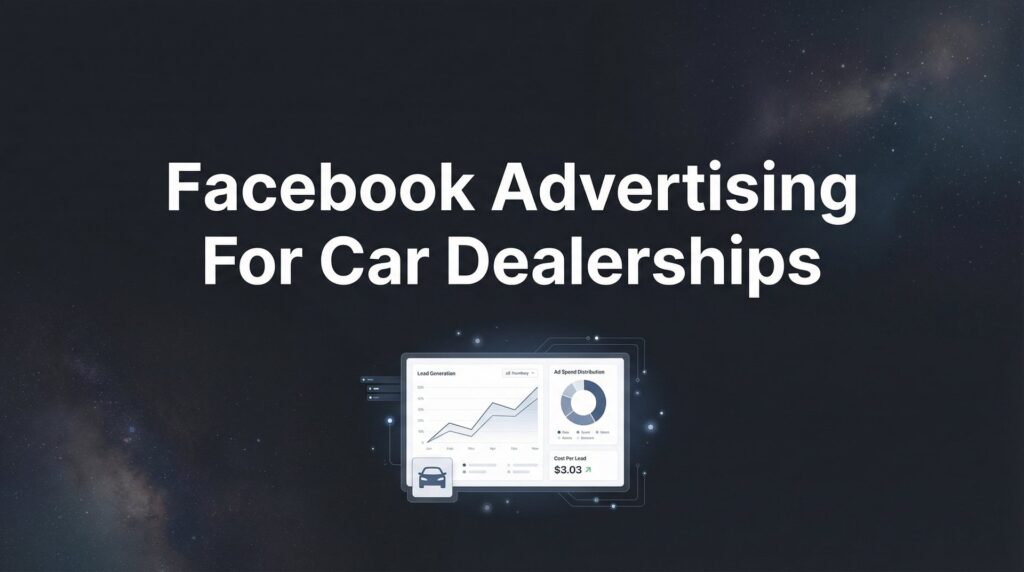
Car buyers don’t wake up and decide to visit a dealership. They scroll Facebook during lunch breaks, browse inventory on their phones at night, and research options for weeks before stepping onto a lot. That’s exactly why Facebook advertising for car dealerships has become one of the most powerful tools for getting qualified buyers through your doors.
The platform gives you something traditional advertising never could: the ability to reach people actively in the market for a vehicle, target by income and location, and showcase your inventory with dynamic ads that update automatically.
But here’s the problem—most dealerships either waste money boosting random posts or get overwhelmed by Facebook’s advertising options and give up entirely.
This guide changes that. You’ll learn exactly how to set up, launch, and optimize Facebook ads that actually drive showroom visits and vehicle sales. We’re talking step-by-step instructions, not theory. Whether you’re advertising new inventory, promoting service specials, or trying to move last year’s models, these six steps will help you build campaigns that deliver measurable ROI.
Step 1: Set Up Your Facebook Business Infrastructure the Right Way
Think of Facebook Business Manager as the foundation for everything you’ll build. Without proper setup, you’re essentially trying to construct a building on sand. The good news? Getting this right takes maybe an hour, and you only do it once.
Start by creating or verifying your Facebook Business Manager account at business.facebook.com. This centralizes control of your dealership’s Facebook page, ad accounts, and tracking tools. If you’re currently running ads directly from your personal profile or dealership page, stop—you’re missing critical features and making yourself vulnerable if employees leave.
Next comes the Meta Pixel, and this is where most dealerships either skip steps or mess up the installation. The Pixel is a piece of code that goes on every page of your website. It tracks what visitors do: which inventory they view, whether they submit lead forms, if they click your phone number, or request directions. Without this data, you’re flying blind.
Here’s what makes this tricky: browser privacy updates from Apple and others have made pixel tracking less reliable. That’s where the Conversions API comes in. Think of it as a backup tracking system that sends data directly from your website server to Facebook, bypassing browser restrictions. Most modern website platforms offer plugins or integrations that handle this automatically. Proper call tracking for marketing campaigns becomes essential when phone leads are a significant part of your dealership’s business.
Now configure custom events for actions that matter to your business. Standard events like page views are fine, but you need to track dealership-specific behaviors. Set up events for inventory detail page views, finance calculator usage, trade-in value form submissions, click-to-call buttons, and directions requests. Each of these signals buying intent at different levels.
Finally, verify your domain in Business Manager. Facebook requires this to maintain full ad functionality and avoid delivery restrictions. The process involves adding a DNS record or uploading an HTML file to your website—your web developer can handle this in minutes.
Success indicator: When you visit your website and check the Facebook Pixel Helper browser extension, it should show your pixel firing correctly on every page with the appropriate events triggering based on your actions.
Step 2: Build Your Vehicle Catalog for Dynamic Inventory Ads
Dynamic inventory ads are where Facebook advertising for car dealerships gets seriously powerful. Picture this: someone browses a specific truck on your website but doesn’t submit a lead. Hours later, they’re scrolling Facebook and see that exact truck in an ad with current pricing and availability. That’s catalog magic.
Most dealer management systems already integrate directly with Facebook’s Catalog Manager. If you’re using a major DMS like CDK, Reynolds & Reynolds, or Dealertrack, there’s likely a one-click integration available. Check your DMS settings or contact their support team to enable the Facebook catalog feed.
Your inventory feed needs to include specific fields for Facebook to display vehicles properly. Make, model, year, trim level, price, mileage, VIN, multiple high-quality images, vehicle condition (new/used/certified), and availability status are all essential. Missing any of these creates gaps in your ad displays.
The real power comes from automatic feed updates. When you sell a vehicle, it should disappear from your Facebook ads within hours, not days. When new inventory arrives, it should appear automatically. This requires your DMS to push updates to Facebook regularly—ideally every few hours. Nothing frustrates potential buyers more than seeing ads for vehicles you sold last week.
Create catalog subsets to power different campaign types. You might have one subset for all new vehicles, another for certified pre-owned under $30K, another for trucks and SUVs only, and another for luxury vehicles. These subsets let you target different audiences with precisely relevant inventory. Understanding Facebook remarketing ads helps you bring back browsers who viewed specific vehicles without converting.
Before launching any campaigns, test your catalog connection thoroughly. Use Facebook’s catalog preview tool to see exactly how your vehicles will appear in ads. Check that images load correctly, pricing displays properly, and links direct to the right inventory pages on your website.
One warning: if your inventory data is messy in your DMS, it’ll be messy in Facebook too. Clean up duplicate listings, standardize your image quality, and ensure pricing is consistent before connecting your catalog.
Step 3: Define Your Targeting Strategy for Local Car Buyers
Here’s where dealerships either nail it or waste thousands of dollars. Facebook lets you target with incredible precision, but that doesn’t mean you should target everyone everywhere.
Start with geography. Most dealerships draw customers from a realistic radius—typically 25 to 50 miles depending on your market density and competition. Urban dealerships might tighten to 15 miles; rural dealers might expand to 75 miles. The key is being honest about where your actual customers come from. Check your CRM data from the past year to see the zip codes of buyers who actually purchased.
Layer in demographic targeting based on your inventory mix. If you’re selling luxury vehicles, target households with annual incomes above $100K. Moving certified pre-owned economy cars? Focus on younger buyers (25-45) with moderate income levels. Facebook provides detailed demographic options including age, gender, household income, education level, and job titles.
Facebook’s automotive-specific interest targeting is surprisingly sophisticated. You can target people interested in specific makes and models, auto enthusiast segments, people who’ve recently engaged with automotive content, and even Facebook’s proprietary “in-market auto shoppers” audience. This last one identifies users whose behavior suggests they’re actively researching vehicle purchases. If you’re weighing your options, understanding Google Ads versus Facebook Ads for lead generation helps you allocate budget across platforms effectively.
Custom audiences from your CRM data create powerful retargeting opportunities. Upload lists of past customers for conquest campaigns on new models, service customers who might be ready for their next vehicle, and website visitors who viewed inventory but didn’t convert. Just ensure you have proper consent to use customer data for advertising purposes.
Lookalike audiences amplify your best customers. Upload a list of your highest-value buyers from the past two years, and Facebook will find users with similar characteristics, behaviors, and demographics. Start with a 1% lookalike (the most similar) and test 2-3% audiences as you scale.
The mistake most dealerships make? Targeting too broadly because they’re afraid of missing someone. In reality, tight targeting with higher budgets outperforms wide targeting with scattered spend. You want to dominate visibility among qualified local buyers, not whisper to everyone within 100 miles.
Step 4: Create Ad Campaigns That Drive Showroom Visits
Campaign structure makes or breaks performance. Throw everything into one campaign and you’ll never know what’s working. Organize strategically and you can scale winners while cutting losers.
Choose campaign objectives based on your specific goals. The Traffic objective works well for building awareness and driving inventory browsing. The Leads objective is perfect for capturing contact information through Facebook’s native lead forms. The Store Traffic objective (often overlooked) specifically optimizes for getting people to your physical location—ideal for dealerships focused on showroom visits.
Structure separate campaigns by inventory type and goal. Run one campaign for new vehicle inventory, another for used vehicles, a third for certified pre-owned, and separate campaigns for service specials or seasonal promotions. This separation lets you allocate budget based on what’s most profitable and adjust messaging for different buyer types.
Budget setting requires balancing learning with efficiency. Facebook’s algorithm needs data to optimize, which means starting too small starves the system. Begin with $50-100 daily per campaign minimum. This generates enough activity for Facebook to identify patterns and improve delivery. Once you identify winning campaigns, you can scale budget aggressively. If you’re new to paid advertising, reviewing paid search advertising for beginners provides foundational knowledge that applies across platforms.
Configure conversion tracking from day one. Don’t optimize for link clicks or impressions—optimize for business outcomes. If your goal is lead submissions, track form completions. If you want showroom visits, track directions requests and store visit conversions. Facebook can only optimize for what you tell it matters.
Set up A/B testing as a permanent practice, not a one-time experiment. Test different audience segments against each other. Test various ad creative approaches. Test different landing pages. Facebook’s built-in split testing tools make this straightforward, and the insights you gain compound over time.
One critical setting: turn off automatic placements. While Facebook recommends letting their system choose where ads appear, dealerships typically see better results focusing on Facebook and Instagram feeds while excluding Audience Network and some Messenger placements. Test this for your market, but start selective.
Step 5: Design Ads That Stop the Scroll and Sell Cars
Your ad creative determines whether someone stops scrolling or keeps moving. In automotive advertising, authenticity often beats polish.
High-quality vehicle images are non-negotiable, but here’s the surprise: smartphone videos frequently outperform professional productions. A quick walkaround video shot on an iPhone, showing the vehicle’s exterior, interior, and key features while a salesperson narrates, creates authenticity that scripted videos lack. People want to see real vehicles, not advertising fantasies.
Write headlines that lead with concrete value, not vague promises. “2025 F-150 XLT – $3,500 Off MSRP This Week Only” beats “Amazing Deals on Trucks.” Specific monthly payment callouts work exceptionally well: “Drive This Certified Camry for $289/Month.” Unique selling points matter too: “Only 12K Miles – One Owner – Full Service History.”
Your call-to-action needs to be crystal clear and low-friction. “Schedule a Test Drive” works better than “Learn More” because it’s specific. “Get Your Trade-In Value” captures leads while providing immediate value. “View Available Inventory” works for browsing-stage buyers. Match your CTA to where the prospect is in their buying journey.
Carousel ads showcase multiple vehicles or highlight different features of a single model. Use them to display your top five trucks in stock, or show exterior, interior, engine, and technology features of a specific vehicle. Each carousel card can link to different inventory pages, maximizing relevance. Understanding what is performance marketing helps you frame your creative decisions around measurable outcomes rather than vanity metrics.
Create urgency without being sleazy. “Only 3 of This Model Left in Stock” works if it’s true. “Special Financing Ends This Weekend” drives action if you actually have a time-limited offer. “2025 Models Arriving Soon – Clear Out 2024 Inventory Now” leverages natural buying cycles. Fake urgency destroys trust; real urgency drives decisions.
Test different creative angles for the same vehicle. One ad might emphasize safety features for family buyers. Another highlights towing capacity for work truck shoppers. A third focuses on fuel efficiency for commuters. Same vehicle, different value propositions based on audience segments.
Step 6: Monitor Performance and Optimize for Maximum ROI
Launching campaigns is the beginning, not the end. Dealerships that treat Facebook advertising as “set it and forget it” waste money. Those who optimize relentlessly dominate their markets.
Track metrics that connect to revenue, not vanity numbers. Impressions and reach don’t pay your bills. Focus on cost per lead, cost per showroom visit, and ultimately cost per vehicle sold. If you’re spending $50 per lead but closing 10% of those leads at $3,000 gross profit per vehicle, you’re printing money. If you’re spending $15 per lead but closing 1% at $1,500 gross, you’re losing.
Review performance weekly at minimum, daily for high-budget campaigns. Look for patterns: which ad sets generate the most qualified leads? Which audiences convert at the lowest cost? Which creative approaches drive the most showroom traffic? Let data guide decisions, not hunches. If your campaigns aren’t delivering, understanding why marketing isn’t working for your business can reveal hidden issues in your funnel.
Pause underperforming ad sets after they’ve received sufficient data to be statistically meaningful. Generally, wait until an ad set has generated at least 1,000 impressions before making judgments. If it’s significantly underperforming after that point, cut it and reallocate budget to winners.
Scale winning campaigns gradually to maintain performance. When you find an ad set crushing it, resist the urge to triple the budget overnight. Increase by 20-30% every few days, giving Facebook’s algorithm time to adjust. Aggressive scaling often tanks performance as the system struggles to find enough qualified users at higher volumes.
Refresh creative every 2-3 weeks to combat ad fatigue. In local markets, your target audience sees your ads repeatedly. When the same creative runs too long, response rates drop as people become blind to it. Rotate in new images, update copy, test different offers, and keep things fresh.
Connect Facebook data with your CRM to track complete customer journeys. Which Facebook leads actually showed up for test drives? Which ones purchased vehicles? What was the average time from ad click to sale? This closed-loop tracking reveals the true ROI of your Facebook advertising spend and helps you optimize for quality, not just quantity. Exploring the best paid advertising platforms for businesses helps you understand where Facebook fits in your overall marketing mix.
One advanced tactic: create retargeting campaigns for people who engaged with your ads but didn’t convert. Someone who watched 75% of your vehicle video is significantly more interested than someone who scrolled past. Build custom audiences from video viewers, lead form openers who didn’t submit, and landing page visitors, then hit them with sequential messaging that addresses objections and reinforces value.
Putting It All Together
You now have a complete roadmap for launching Facebook advertising for car dealerships that actually drives results. Let’s run through your pre-launch checklist one more time.
Business Manager configured with Pixel installed and firing correctly on all pages. Vehicle catalog connected to your DMS with automatic updates ensuring sold vehicles disappear and new arrivals appear in real-time. Targeting strategy defined for your realistic sales radius with demographic and interest layers appropriate for your inventory mix. Campaign structure organized by objective with separate campaigns for new vehicles, used inventory, and service promotions. Scroll-stopping creative ready to deploy with high-quality images, value-driven headlines, and clear calls-to-action. Tracking in place to measure real business outcomes like cost per lead and cost per showroom visit.
The dealerships seeing the best results from Facebook ads aren’t doing anything magical—they’re following a systematic approach and optimizing based on data. Start with one campaign type, master it, then expand. Maybe that’s new vehicle inventory if you’re pushing current models, or certified pre-owned if that’s your profit center.
Test, measure, refine, scale. That’s the cycle. Your first campaigns won’t be perfect, and that’s fine. You’ll learn what resonates with your local market, which offers drive action, and which creative approaches generate qualified buyers versus tire kickers.
Remember that Facebook advertising works best as part of an integrated strategy. Your ads should drive people to optimized landing pages. Your CRM should capture and nurture leads effectively. Your sales team should follow up quickly when leads come in. The advertising is just one piece of a complete lead generation system.
If you’d rather have experts handle your dealership’s Facebook advertising while you focus on selling cars, Clicks Geek specializes in PPC and paid social campaigns that deliver qualified buyers to local businesses. We’re a Google Premier Partner agency with a track record of turning ad spend into actual revenue. If you want to see what this would look like for your dealership, we’ll walk you through how it works and break down what’s realistic in your market.
Want More Leads for Your Business?
Most agencies chase clicks, impressions, and “traffic.” Clicks Geek builds lead systems. We uncover where prospects are dropping off, where your budget is being wasted, and which channels will actually produce ROI for your business, then we build and manage the strategy for you.