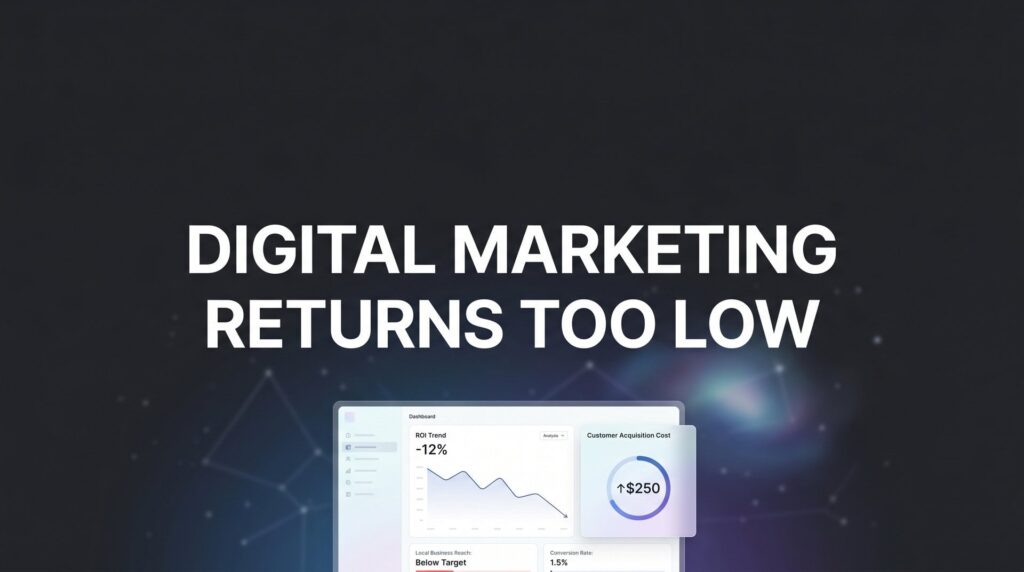
You’ve been investing in digital marketing for months—maybe even years. You’ve hired agencies, run ads, posted on social media, maybe even dabbled in SEO. The clicks are coming in. The reports look busy. But when you check your bank account, something doesn’t add up.
The revenue isn’t there. The phone isn’t ringing with qualified buyers. Your cost per customer acquisition makes you wince every time you calculate it.
Here’s the uncomfortable truth: low digital marketing returns rarely mean you’re spending too little. More often, you’re spending wrong. You’re pouring budget into leaky funnels, targeting the wrong people, or measuring the wrong metrics entirely.
The good news? These problems are fixable. Not with vague advice about “being more strategic” or “creating better content,” but with concrete, tactical changes you can implement this week.
This article breaks down seven proven strategies that local businesses use to transform underperforming marketing into profitable customer acquisition systems. These aren’t theoretical concepts—they’re the exact fixes that separate businesses drowning in marketing spend from those generating consistent, measurable growth.
Whether you’re running Google Ads, Facebook campaigns, or investing in SEO, these strategies apply across channels. Let’s stop the bleeding and start building marketing that actually pays you back.
1. Audit Your Conversion Funnel for Hidden Leaks
The Challenge It Solves
You’re driving traffic to your website, but visitors vanish before converting. Your ads are working—people are clicking—but something between that click and a completed purchase or lead form is broken. Most businesses focus obsessively on getting more traffic while ignoring the fact that they’re losing 80-90% of visitors who already showed interest.
This is like filling a bucket with holes. No matter how much water you pour in, you’ll never fill it until you patch the leaks.
The Strategy Explained
A conversion funnel audit means mapping every step a prospect takes from first click to conversion, then identifying exactly where people drop off. Think of your funnel as a series of doors. Each door represents a decision point: clicking your ad, landing on your page, reading your offer, filling out a form, submitting contact information.
Most businesses discover their biggest losses happen at predictable points. Landing pages that load slowly lose visitors before they even see your offer. Forms asking for too much information scare away interested prospects. Unclear calls-to-action leave people confused about what to do next.
The goal isn’t perfection—it’s identifying your biggest leak and fixing it first. A 10% improvement in your conversion rate often delivers better ROI than doubling your ad spend.
Implementation Steps
1. Set up Google Analytics or similar tracking to monitor user behavior from landing page through conversion, paying special attention to exit pages and form abandonment rates.
2. Use heatmap tools like Hotjar or Microsoft Clarity to see where users actually click, how far they scroll, and where they lose interest on your key pages.
3. Test your own conversion process on mobile and desktop—call your own phone number, fill out your own forms, go through checkout if you’re e-commerce—and document every friction point.
4. Calculate conversion rates for each funnel stage (landing page to form view, form view to form start, form start to form completion) to pinpoint exactly where the biggest drop-offs occur.
Pro Tips
Start with mobile. Most local business traffic comes from mobile devices, and mobile experiences are often drastically worse than desktop. If your form requires typing on a tiny keyboard or your page takes eight seconds to load on 4G, you’re hemorrhaging potential customers before they even see your offer. Fix mobile first, then optimize desktop. Understanding why marketing isn’t working for your business often starts with identifying these hidden conversion killers.
2. Stop Targeting Everyone and Start Targeting Buyers
The Challenge It Solves
Your ads reach thousands of people, but most of them were never going to buy. You’re paying for clicks from tire-kickers, job seekers, competitors, and people in completely wrong demographics or locations. Broad targeting feels safe—more reach means more potential customers, right? Wrong. It means more wasted budget on people who will never convert.
When your targeting is too wide, you dilute your budget across low-intent audiences and miss opportunities to dominate with high-intent prospects.
The Strategy Explained
Effective targeting means ruthlessly narrowing your audience to people who actually match your ideal customer profile and show buying intent. This isn’t about reaching more people—it’s about reaching the right people.
High-intent targeting looks different across channels. In search advertising, it means bidding on specific, commercial-intent keywords rather than broad informational terms. In Facebook and social ads, it means layering demographic, interest, and behavioral targeting to find people who look like your best customers. In all channels, it means excluding audiences who consistently don’t convert.
Think of it like fishing. You can cast a wide net and catch everything (including trash), or you can use the right bait in the right spot at the right time to catch exactly what you want. The second approach costs less and works better. If you’re struggling with low ROI from digital advertising, poor targeting is often the primary culprit.
Implementation Steps
1. Analyze your existing customer base to identify common characteristics—age ranges, locations, job titles, income levels, interests, and behaviors that your best customers share.
2. Review your ad platform data to identify which audience segments, keywords, or demographics generate actual conversions versus just clicks, then build exclusion lists for consistently poor performers.
3. For search campaigns, shift budget from broad match keywords to phrase match and exact match variations that indicate buying intent (terms including “near me,” “cost,” “best,” “hire,” or specific service names).
4. Create separate campaigns for different audience segments so you can customize messaging and track which specific audiences deliver the best ROI.
Pro Tips
Don’t confuse activity with results. A campaign that generates 1,000 clicks but zero sales is worse than a campaign generating 50 clicks and 5 sales. Watch your cost per conversion, not just your cost per click. If tightening targeting reduces your overall traffic but improves your conversion rate and cost per acquisition, you’re winning.
3. Reallocate Budget Based on Actual Performance Data
The Challenge It Solves
You’re spreading your marketing budget evenly across multiple channels, campaigns, or ad groups like peanut butter on toast. It feels balanced and safe, but it’s actually sabotaging your returns. Some of your marketing efforts are profitable. Others are burning money. When you fund them equally, you’re subsidizing failure with success.
Most businesses discover that a small percentage of their campaigns drive the majority of their results, but they keep feeding budget to underperformers out of habit or hope.
The Strategy Explained
The Pareto principle applies powerfully to marketing: roughly 80% of your results come from 20% of your efforts. The strategy is simple—identify your top performers and dramatically shift budget toward them while cutting or eliminating spend on consistent underperformers.
This doesn’t mean putting all your eggs in one basket. It means being honest about what’s working and what isn’t. If your Google Search campaigns generate leads at $40 each while your Facebook campaigns cost $200 per lead, the answer isn’t to keep funding both equally. It’s to double down on search and either fix or kill Facebook.
Performance-based reallocation requires discipline. You have to let data override gut feelings, personal preferences, and the sunk cost fallacy. Just because you invested time building a campaign doesn’t mean you should keep funding it if it doesn’t deliver. This is the core principle behind performance marketing—paying only for measurable results.
Implementation Steps
1. Pull a 90-day performance report showing cost per conversion for every campaign, ad group, and channel you’re currently running—use actual conversions (sales, leads, calls), not vanity metrics like impressions or clicks.
2. Rank everything by cost per acquisition and identify your top 20% of performers—these are your profit engines that deserve more budget.
3. Pause or dramatically reduce spending on anything performing worse than 2x your acceptable cost per acquisition, freeing up budget to reinvest in proven winners.
4. Implement a monthly reallocation review where you shift at least 10-20% of budget from underperformers to top performers based on the previous 30 days of data.
Pro Tips
Give campaigns enough data before making decisions. A campaign with 10 clicks isn’t statistically significant. Wait until you have at least 100 clicks or 30 days of data before making major budget decisions. But once you have that data, act decisively. Mediocre campaigns rarely become great—they just consume budget that could be generating actual returns.
4. Fix Your Tracking Before Making Any Other Changes
The Challenge It Solves
You’re making marketing decisions based on incomplete or inaccurate data. Your conversion tracking is broken, missing, or only capturing part of the story. You think certain campaigns aren’t working when they’re actually your best performers, or you’re dumping money into channels that look good on paper but deliver nothing in reality.
Flying blind is expensive. When you can’t accurately measure what’s working, every optimization attempt is just guesswork.
The Strategy Explained
Accurate tracking means knowing exactly which marketing efforts generate which results. Not approximately. Not “we think.” Exactly. This requires proper conversion tracking setup across all channels, call tracking for phone leads, form tracking for web submissions, and attribution that connects conversions back to specific campaigns and keywords.
For local businesses, phone calls often represent the most valuable conversions, yet many businesses don’t track them at all. Someone clicks your ad, calls your number directly, and you have no idea which campaign drove that call. That’s like making sales but not knowing which products are selling. Implementing call tracking for marketing campaigns solves this blind spot completely.
Proper tracking isn’t sexy, but it’s foundational. Every other strategy in this article depends on having accurate data. Fix tracking first, or you’re optimizing in the dark.
Implementation Steps
1. Implement conversion tracking in Google Ads, Facebook Ads, and any other platform you use—track form submissions, phone calls, chat initiations, and purchases as separate conversion actions.
2. Set up call tracking using services like CallRail or CallTrackingMetrics to assign unique phone numbers to different marketing channels and campaigns, capturing which ads drive phone leads.
3. Verify your tracking is working by completing test conversions yourself—fill out forms, make calls, go through checkout—and confirm each action appears correctly in your analytics and ad platforms.
4. Implement Google Tag Manager to centralize tracking code management and make it easier to add, modify, or troubleshoot tracking without constantly editing website code.
Pro Tips
Track offline conversions too. If people convert online but complete purchases in-store or over the phone after initial contact, set up systems to feed that data back into your ad platforms. Google Ads and Facebook both support offline conversion imports. Without this, you’re only seeing half the picture and dramatically undervaluing campaigns that drive real revenue.
5. Improve Lead Quality Over Lead Quantity
The Challenge It Solves
Your marketing generates plenty of leads, but most of them go nowhere. Your sales team wastes hours chasing unqualified prospects who were never serious buyers. You’re measuring success by lead volume when you should be measuring by revenue generated. More leads feels like progress, but if they don’t close, they’re just noise.
Low-quality leads don’t just waste sales time—they skew your data, demoralize your team, and hide the real cost of customer acquisition. The low quality leads problem is one of the most common reasons businesses feel their marketing isn’t working.
The Strategy Explained
Quality over quantity means implementing qualification mechanisms earlier in your funnel. Instead of making it easy for anyone to submit a form or request information, you add strategic friction that filters out tire-kickers while encouraging serious buyers to move forward.
This seems counterintuitive. Won’t fewer leads mean fewer sales? Actually, no. When you qualify leads earlier, your sales team spends time on prospects who are actually ready to buy, your close rate increases dramatically, and your true cost per customer acquisition drops.
Qualification can happen through form questions, pricing transparency, detailed service descriptions, or even requiring phone calls instead of form submissions. The goal is to make it slightly harder to become a lead, which paradoxically improves results by filtering out people who weren’t going to buy anyway.
Implementation Steps
1. Add qualifying questions to your lead forms—budget range, timeline, specific needs—that help you prioritize serious buyers and filter out poor-fit prospects before they consume sales resources.
2. Display pricing information or pricing ranges on your website to self-qualify visitors before they submit forms, reducing sticker shock conversations and attracting prospects whose budgets align with your services.
3. Create separate lead paths for different intent levels—immediate need versus future planning—so your sales team can prioritize follow-up and customize their approach based on buying timeline.
4. Implement lead scoring based on form responses, behavior on site, and demographic information to automatically rank leads by likelihood to close, ensuring your best prospects get fastest response.
Pro Tips
Track lead-to-customer conversion rate, not just cost per lead. A campaign generating 100 leads at $20 each with a 2% close rate delivers worse ROI than a campaign generating 20 leads at $50 each with a 20% close rate. The second campaign costs more per lead but delivers four times as many customers at better economics. Optimize for customers, not leads. For more tactics, explore our guide on fixing poor quality leads from marketing.
6. Optimize Your Sales Follow-Up Speed and Process
The Challenge It Solves
Your marketing is working—leads are coming in—but your sales process is losing them. You respond too slowly, follow up inconsistently, or lack a systematic approach to moving prospects through your pipeline. The best marketing in the world can’t overcome a broken sales process.
Many local businesses discover their real problem isn’t marketing ROI—it’s sales conversion. They’re generating qualified leads but failing to close them because of slow response times, poor follow-up, or no follow-up at all.
The Strategy Explained
Speed to lead matters tremendously. When someone submits a form or calls your business, they’re hot. They have a problem, they’re actively looking for solutions, and they’re probably contacting multiple providers. The business that responds first often wins, not because they’re better, but because they’re there.
Beyond speed, systematic follow-up ensures no leads fall through cracks. A structured process—immediate response, scheduled follow-ups, clear next steps—converts more prospects than relying on individual sales reps to remember who to call when. The right marketing automation tools can handle this systematically without adding headcount.
This isn’t about being pushy. It’s about being responsive and organized. Prospects want to hear from you quickly. When you make them wait, they assume you don’t want their business and move on to competitors who respond faster.
Implementation Steps
1. Set up automated immediate response systems—auto-reply emails, SMS confirmations, or instant callback scheduling—that acknowledge new leads within minutes and set expectations for next steps.
2. Implement a CRM or lead management system that assigns leads to sales reps automatically, tracks follow-up activity, and sends reminders for scheduled callbacks to prevent leads from going cold.
3. Establish a follow-up cadence with specific touchpoints—initial contact within 5 minutes, second attempt within 24 hours, third attempt at 48 hours—and stick to it religiously for every lead.
4. Train your sales team on phone and email scripts that move conversations forward efficiently, qualify prospects quickly, and schedule appointments or close sales on initial contact whenever possible.
Pro Tips
Measure response time as a key performance indicator. Track how long it takes from lead submission to first contact attempt, and hold your team accountable. Set a goal of responding to all leads within 5 minutes during business hours. This single change can dramatically improve conversion rates without spending an extra dollar on marketing.
7. Test Aggressively and Kill What Doesn’t Work Fast
The Challenge It Solves
You’re running the same campaigns the same way month after month, hoping they’ll magically improve. You launch new initiatives but never systematically measure whether they work. You keep mediocre campaigns running because you’re afraid to try something different. Stagnation kills returns.
Marketing without testing is marketing by luck. You might stumble onto something that works, but you’ll never know why it works or how to replicate it.
The Strategy Explained
Aggressive testing means constantly experimenting with new audiences, ad copy, landing pages, offers, and campaign structures—then ruthlessly killing what doesn’t work and scaling what does. This isn’t random experimentation. It’s structured hypothesis testing with clear success metrics.
The key is establishing kill thresholds before you launch tests. Decide in advance: if this campaign doesn’t achieve X cost per conversion within Y budget or Z timeframe, we shut it down. No excuses, no “let’s give it one more week.” This discipline prevents you from throwing good money after bad.
Testing also means you’re never satisfied with current performance. Even your best campaigns can be improved. Top performers test new ad variations, try different bidding strategies, experiment with audience expansions, and constantly look for incremental gains. Consider using Facebook remarketing ads to re-engage visitors who didn’t convert on their first visit.
Implementation Steps
1. Establish clear success metrics and kill thresholds for every test—define acceptable cost per conversion, minimum conversion rate, or maximum cost per click before launching any new campaign or variation.
2. Create a testing calendar that schedules specific experiments each month—new audience tests, ad copy variations, landing page changes, or offer experiments—ensuring you’re always learning and improving.
3. Use proper A/B testing methodology where you change one variable at a time and run tests long enough to achieve statistical significance before making decisions based on results.
4. Document everything in a testing log that records what you tested, results achieved, insights learned, and next steps—this creates institutional knowledge and prevents you from repeating failed experiments.
Pro Tips
Start small with tests, but scale winners fast. Allocate 10-20% of your budget to testing new approaches while keeping 80-90% in proven performers. When a test beats your control by a meaningful margin, don’t hesitate—shift budget aggressively toward the winner. The businesses that win are the ones that test constantly but scale decisively when they find something that works.
Your Implementation Roadmap
Low digital marketing returns aren’t a death sentence. They’re a diagnosis. And now you have the treatment plan.
Here’s your prioritized action plan: Start with strategy four—fix your tracking immediately. You can’t optimize what you can’t measure accurately. Once tracking is solid, audit your conversion funnel to identify and patch your biggest leaks. Then refine your targeting to stop wasting budget on people who will never buy.
From there, implement performance-based budget reallocation, improve lead quality mechanisms, optimize your sales follow-up process, and establish a disciplined testing cadence. You don’t need to do everything at once. Pick one strategy, implement it completely, measure the results, then move to the next.
The businesses that win with digital marketing aren’t the ones with the biggest budgets. They’re the ones that treat marketing as a system to optimize, not a slot machine to feed. They measure obsessively, test constantly, kill underperformers quickly, and scale winners aggressively.
Every strategy in this article is proven and actionable. The question isn’t whether these approaches work—it’s whether you’ll implement them consistently enough to see results.
Tired of spending money on marketing that doesn’t produce real revenue? We build lead systems that turn traffic into qualified leads and measurable sales growth. If you want to see what this would look like for your business, we’ll walk you through how it works and break down what’s realistic in your market.
Your marketing returns don’t have to stay low. Fix the fundamentals, follow the data, and watch what happens when you stop guessing and start systematically optimizing for actual revenue.