You’ve done everything right, or at least everything you were told to do. You ran some ads, asked happy customers for referrals, maybe even hired someone to help with sales. For a while, it worked. Leads trickled in, the phone rang, and business felt like it was moving in the right direction.
Then you tried to grow faster. You doubled your ad budget. You expanded your service area. You brought on another salesperson. And instead of doubling your results, you got something far more frustrating: higher costs, worse leads, and the nagging feeling that the harder you push, the less it works.
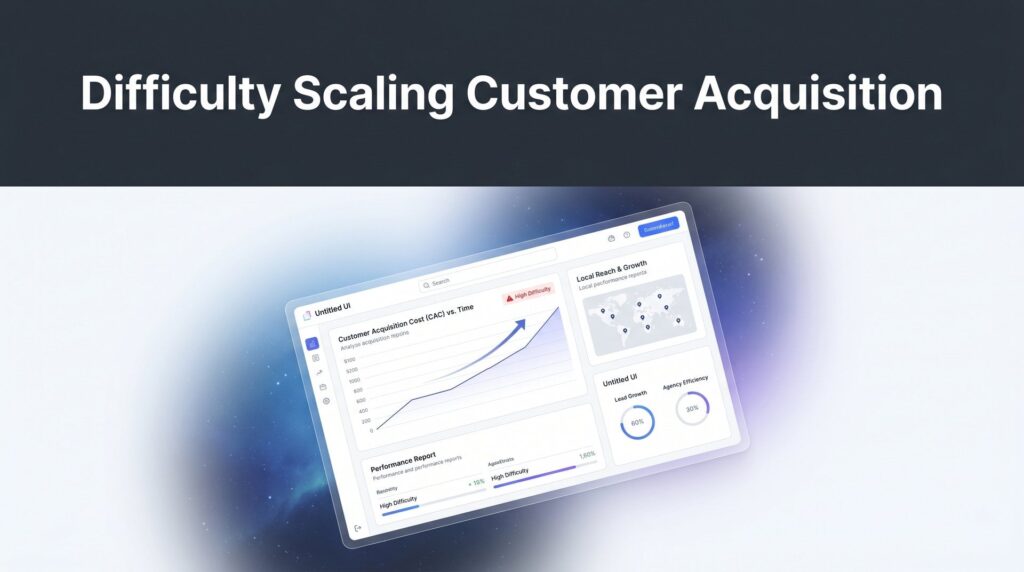
This is the difficulty scaling customer acquisition, and it’s one of the most common growth ceilings for local and service-based businesses. It’s not a sign that your business is broken. It’s a predictable pattern that almost every business hits when it tries to grow beyond what its current marketing infrastructure can support.
The problem isn’t effort. It’s architecture. What worked to land your first 50 customers rarely works to land your next 500, because the conditions are completely different. Your early customers were the easiest to reach: they already knew you, already trusted you, or were already searching for exactly what you offer. Scaling means reaching people who don’t know you yet, and that requires a fundamentally different approach.
This article breaks down why scaling customer acquisition stalls, where the hidden bottlenecks actually live, and how to build an acquisition system that compounds instead of collapses under pressure. No fluff, no generic advice. Just a practical framework for local business owners who are serious about growth.
Why ‘Just Spend More’ Is a Trap, Not a Strategy
It seems logical. If spending $1,000 a month on ads brings in 20 leads, spending $5,000 should bring in 100. If one salesperson closes 10 deals a month, two salespeople should close 20. This is linear thinking, and it’s the first reason most scaling attempts fail.
Marketing doesn’t scale linearly. It follows a diminishing returns curve. When you first launch a campaign, your budget captures the highest-intent buyers: the people actively searching for your service right now, in your area, ready to make a decision. These are your easiest conversions. As you increase your spend, you’ve already reached those people. The platform has to go wider, targeting colder audiences, less specific keywords, and less motivated searchers. Your cost per lead rises. Your lead quality drops. And suddenly that extra budget isn’t generating proportional returns; it’s generating noise. If this sounds familiar, you may be dealing with ads spending too much with no results.
The same principle applies to referrals. Your first wave of referrals comes from your most enthusiastic customers, the ones who genuinely love what you do and naturally tell people. As you try to systematize referrals at scale, you’re asking less enthusiastic customers to refer people who are less similar to your ideal buyer. The quality degrades.
Here’s the distinction that changes everything: linear growth versus systems-based growth. Linear growth means adding more inputs to get more outputs. Hire another rep. Buy more clicks. Print more flyers. It works up to a point, then it plateaus because you’re adding cost without adding leverage.
Systems-based growth means building acquisition infrastructure that compounds. A conversion-optimized website that turns more visitors into leads without you doing anything extra. A tracking setup that tells you exactly which channels produce revenue, so you can reallocate budget intelligently. Multiple acquisition channels that reinforce each other. These are assets that keep working and keep improving, not inputs you have to keep adding. Understanding what cost per acquisition really means is the first step toward building this kind of system.
The trap most local businesses fall into is optimizing individual tactics in isolation. They tweak their Google Ads headline. They try a new Facebook campaign. They redesign their homepage. Each of these moves might produce a small lift, but none of them address the system. Without an integrated acquisition infrastructure, you’re playing whack-a-mole with marketing tactics while the underlying architecture stays broken.
Scaling customer acquisition requires stepping back from individual tactics and asking: do I have the right system in place? The answer, for most businesses hitting a growth ceiling, is no. And the good news is that building the right system is entirely learnable.
The Five Hidden Bottlenecks That Block Scalable Growth
When growth stalls, most business owners assume the problem is budget or channel. They’re not spending enough, or they’re on the wrong platform. But in most cases, the real problem is a bottleneck somewhere in the acquisition pipeline that no amount of additional spend will fix. Here are the most common ones.
Bottleneck 1: A website that doesn’t convert. This is the single most overlooked problem in local business marketing. You can drive traffic from Google Ads, organic search, social media, and everywhere else, but if your website isn’t designed to persuade and capture leads, that traffic evaporates. Many local business websites are essentially digital brochures: they describe the business but don’t guide visitors toward taking action. No clear value proposition above the fold. No compelling call to action. No trust signals like reviews, credentials, or guarantees. Forms that ask for too much information. Slow load times that kill mobile visitors before they even read a word. When you scale traffic to a low-converting site, you scale your waste, not your results.
Bottleneck 2: Tracking and attribution gaps. If you don’t know which marketing activities are actually producing revenue, you cannot scale intelligently. You’re flying blind. Many local businesses have basic analytics set up but lack proper conversion path analysis: they don’t know which campaigns drove phone calls, which landing pages generated form fills, or which lead sources turned into paying customers. Without that data, budget decisions are guesswork. You might be cutting your best-performing channel because it looks expensive on the surface, while doubling down on a channel that generates volume but not revenue.
Bottleneck 3: Over-reliance on a single acquisition channel. Referrals are great until your network is tapped out. Google Ads work until your impression share is maxed or a competitor outbids you. Organic search performs well until an algorithm update hits. Any single-channel strategy has a hard ceiling on volume, and it creates fragility. When that one channel underperforms, your entire acquisition pipeline suffers. Businesses that rely on one source aren’t just limiting their growth; they’re one platform change away from a revenue crisis. Exploring the best customer acquisition channels for local business is essential to breaking past this ceiling.
Bottleneck 4: Misaligned messaging. Scaling acquisition requires reaching people who don’t already know you, and those people need to immediately understand why they should choose you over every other option. Generic messaging like “quality service at great prices” doesn’t cut through. If your ads, landing pages, and website can’t articulate a specific, compelling reason to call you instead of your competitor, you’ll generate impressions and clicks but not conversions. Messaging that works for warm referrals often fails completely with cold paid traffic.
Bottleneck 5: No lead nurturing infrastructure. Not every prospect is ready to buy today. Many local businesses treat every lead as a binary: they either convert immediately or they’re lost. Without a follow-up system, whether email sequences, retargeting ads, or even a structured callback process, you’re leaving a significant portion of your pipeline on the table. Scaling acquisition without nurturing infrastructure means you’re constantly filling a leaky bucket.
The businesses that break through growth ceilings don’t just fix one of these bottlenecks. They audit the entire pipeline and address each constraint systematically.
Channel Saturation: When Your Best Source Stops Growing
Every acquisition channel has a ceiling. This isn’t pessimism; it’s math. Within any given market, there’s a finite number of people searching for your service on Google right now. There’s a finite number of relevant referral relationships in your network. There’s a finite addressable audience on any single ad platform within your geographic area.
When you push past that ceiling, costs rise sharply and returns fall just as fast. This is channel saturation, and it’s one of the most common reasons local businesses feel stuck despite doing everything “right.”
Here’s what it looks like in practice. You’ve been running Google Ads successfully for a year. Your campaigns are well-optimized, your impression share is strong, and your cost per lead has been stable. Then you try to scale. You increase the budget, but impression share is already near its maximum for your target keywords in your area. The platform starts showing your ads in broader match contexts, to less relevant searchers, in neighboring areas outside your sweet spot. Your cost per click climbs. Your lead quality drops. You’re spending more and getting less, not because your campaigns are poorly managed, but because you’ve hit the natural ceiling of that channel in your market. For many, this is when Google Ads starts feeling too expensive for what it returns.
The same dynamic plays out with referrals. Your most enthusiastic customers have already referred everyone they know who fits your ideal profile. Asking them again or incentivizing referrals from less-engaged customers yields diminishing returns. The well isn’t dry, but it’s running low.
The antidote isn’t to push harder on a saturated channel. It’s diversification, but smart diversification, not random channel hopping. The goal is to build multiple acquisition levers that capture customers at different points in their decision journey.
Think about how this works in a local service business context. Google Ads captures people who are actively searching and ready to buy now. SEO builds organic visibility that captures high-intent searchers over time without ongoing cost per click. Google Maps optimization captures local searches with strong buying intent. Retargeting re-engages people who visited your site but didn’t convert. Understanding the tradeoffs between local SEO vs paid ads for customer acquisition helps you decide where to invest next.
When these channels work together, something important happens: they reinforce each other. Someone sees your Google Ad, visits your site, doesn’t convert, then sees your retargeting ad a few days later and calls. Someone finds you through organic search because your SEO has built authority. Someone searches for your business name after hearing about you from a friend and finds a well-optimized Google Business Profile that closes the deal. The whole becomes greater than the sum of its parts.
Channel diversification also creates resilience. If one platform changes its algorithm, raises prices, or underperforms in a given month, your entire acquisition pipeline doesn’t collapse. You have other levers pulling in leads while you adjust.
The Conversion Rate Multiplier Most Businesses Ignore
Here’s a question most business owners never ask: before you spend more to get more traffic, are you converting the traffic you already have?
Conversion rate optimization, or CRO, is arguably the highest-leverage activity in the entire customer acquisition toolkit. The math is straightforward. If your website converts 2% of visitors into leads and you get 500 visitors a month, you’re generating 10 leads. If you optimize that site to convert at 4%, you’re generating 20 leads from the exact same traffic. You’ve effectively halved your customer acquisition cost without spending an extra dollar on ads.
Now apply that multiplier to a scaled campaign. When you increase your ad budget, every additional dollar goes further because your conversion infrastructure is working harder. The combination of more traffic and better conversion is where real scaling acceleration happens.
So what does CRO actually look like for a local service business? It’s not complicated, but it does require attention to detail across several elements.
Landing page clarity: Your landing page should do one job, get the visitor to take the next step. That means a clear headline that speaks directly to what they’re looking for, a value proposition that differentiates you from competitors, and a single, obvious call to action. Pages that try to do too much confuse visitors and reduce conversions. A landing page split testing service can help you systematically identify what converts best.
Trust signals: Local service businesses live and die on trust. Your landing page should feature real customer reviews, specific results or outcomes you’ve delivered, any relevant certifications or credentials, and photos that make your business feel real and credible. These elements reduce the perceived risk of reaching out.
Mobile optimization: A large portion of local search happens on mobile devices. If your site loads slowly, has text that’s too small to read, or has forms that are difficult to complete on a phone, you’re losing a significant share of your potential leads before they even engage.
Form simplicity: Every additional field in a lead form reduces completion rates. For most local businesses, name, phone number, and one qualifying question is enough to start a conversation. You can gather more information once you’ve made contact.
Speed: Page load time directly affects both conversion rates and ad quality scores. A slow site costs you leads and costs you more per click. It’s a compounding problem that gets more expensive as you scale.
The “more traffic” mindset says: if I’m not getting enough leads, I need more visitors. The “better conversion” mindset says: if I’m not getting enough leads, I need to convert more of the visitors I already have. The latter is almost always the faster, cheaper, and more sustainable path to scaling acquisition.
Building a Multi-Channel Acquisition Engine That Actually Scales
Knowing the bottlenecks and understanding the principles is one thing. Building the actual system is another. Here’s a practical framework for constructing an acquisition engine that can scale without falling apart.
Step 1: Start with one profitable channel and nail it. Before you diversify, you need a foundation. For most local service businesses, that’s Google Ads targeting high-intent search terms in your market. The goal isn’t just to run ads; it’s to build a profitable, measurable campaign with a clear cost per lead and cost per acquisition that you understand and can defend. This becomes your baseline and your first proof of concept. A comprehensive local business online marketing guide can help you establish that foundation correctly.
Step 2: Optimize your conversion infrastructure before scaling spend. Once you have traffic coming in, audit your conversion pipeline ruthlessly. Is your landing page converting at a competitive rate? Is your tracking set up correctly so you know which campaigns produce revenue, not just clicks? Is your follow-up process capturing leads that don’t convert immediately? Fix these before pouring more budget into the top of the funnel.
Step 3: Layer in additional channels systematically. Once your first channel is profitable and your conversion infrastructure is solid, add the next channel with intention. SEO is a natural complement to paid search: it builds long-term organic visibility that reduces your dependence on paid spend over time. Google Maps optimization captures local intent searches. Implementing remarketing campaign strategies recaptures visitors who didn’t convert on the first visit. Add each channel with clear goals and measurement in place.
Step 4: Build a data review cadence. Scaling requires ongoing intelligence, not set-it-and-forget-it management. At minimum, review your cost per lead, cost per acquisition, and lead quality metrics on a weekly basis. Monthly, look at channel-level performance to understand where to reallocate budget. The businesses that scale successfully aren’t the ones with the biggest budgets; they’re the ones that iterate fastest based on real data.
The way paid ads, SEO, and a high-performing website work together as a system is worth emphasizing. Paid ads drive immediate traffic and produce data about which messages and keywords convert. That data informs your SEO content strategy. Your website’s conversion rate determines how efficiently both channels produce leads. Your SEO authority improves your Google Ads quality scores, which lowers your cost per click. Each element improves the performance of the others. This is what a real acquisition system looks like, and it’s fundamentally different from running isolated tactics in parallel.
The businesses that crack scaling don’t have unlimited budgets. They have better systems and better data. That’s a replicable advantage, not a luck-dependent one.
Specialists vs. DIY: Knowing When to Make the Call
Most business owners can manage basic marketing. Setting up a Facebook page, running a boosted post, even configuring a simple Google Ads campaign. These are learnable skills, and for early-stage businesses, doing it yourself makes sense.
But scaling customer acquisition is a different discipline. It requires deep expertise in paid media strategy, conversion rate optimization, analytics and attribution, SEO, and the interplay between all of these channels. These are skills that take years to develop, and they evolve constantly as platforms change their algorithms, bidding strategies, and targeting capabilities. Many of these are among the biggest digital marketing challenges for small business owners.
The DIY ceiling is real. At some point, the hours you spend managing and learning marketing are hours you’re not spending running your business. And the cost of suboptimal campaigns, wasted ad spend, and missed optimization opportunities often exceeds what a specialist would charge.
When evaluating an agency or marketing partner, look for these qualities. Proven results in your industry or in comparable local service businesses, not just general claims but specific outcomes they can speak to. Transparency on metrics, meaning they report on cost per lead, cost per acquisition, and lead quality, not just impressions and clicks. A focus on revenue-driving activity rather than vanity metrics. And verifiable credentials: a Google Ads certification agency designation, for example, is a real, audited credential that indicates an agency meets Google’s standards for performance, spend management, and certification. It’s not a marketing claim; it’s a verifiable credential.
The cost of inaction is worth naming directly. Every month you spend struggling with acquisition scaling, running campaigns that aren’t optimized, or managing a website that converts poorly, is a month of revenue going to competitors who’ve already built the right infrastructure. Market share doesn’t wait. The businesses in your area that figure out scalable acquisition first build compounding advantages: more reviews, more brand recognition, more data to optimize with. The gap widens over time.
Putting It All Together
Difficulty scaling customer acquisition is not a sign that your business has a fundamental problem. It’s a predictable growth challenge that nearly every local and service-based business encounters when it tries to move beyond its initial customer base. The businesses that break through aren’t the ones with the biggest budgets or the most aggressive tactics. They’re the ones that stop treating marketing as a collection of isolated tactics and start building integrated acquisition systems.
Take an honest look at where you are right now. Is your website actually converting the traffic it receives, or is it a digital brochure that looks fine but doesn’t generate leads? Do you have tracking in place that tells you which channels produce revenue, not just activity? Are you dependent on a single acquisition channel that has a hard ceiling? Are you optimizing for more traffic when the real leverage is in better conversion?
These questions aren’t rhetorical. They’re a practical audit that will tell you exactly where your growth ceiling is and what to address first.
At Clicks Geek, we’re a Google Premier Partner agency that specializes in solving exactly this problem for local and service-based businesses. PPC, CRO, lead generation, and building the kind of integrated acquisition infrastructure that actually scales. Tired of spending money on marketing that doesn’t produce real revenue? We build lead systems that turn traffic into qualified leads and measurable sales growth. If you want to see what this would look like for your business, we’ll walk you through how it works and break down what’s realistic in your market.