Every dollar you spend acquiring a new customer either builds your business or bleeds it dry. For local business owners, customer acquisition cost (CAC) is one of the most critical metrics to track, yet many don’t know theirs, let alone how to lower it.
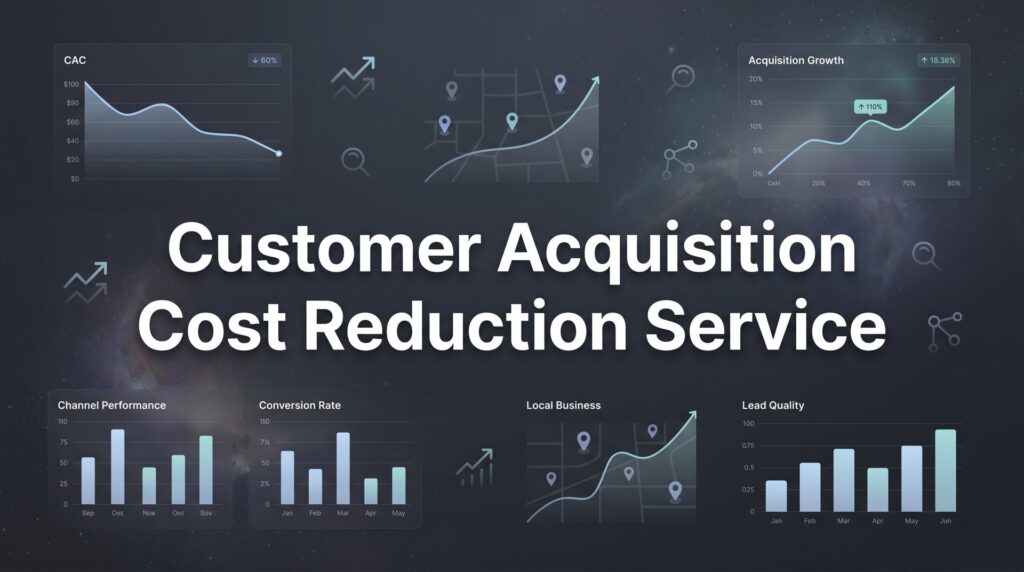
CAC is straightforward to calculate: divide your total marketing and sales spend by the number of new customers gained in that period. If you spent $5,000 last month and landed 10 new customers, your CAC is $500. The real question is whether you can get that number down to $300 or $250 without sacrificing lead quality. The answer is almost always yes.
Whether you’re running Google Ads, investing in SEO, or relying on referrals, there are concrete, repeatable steps to slash your acquisition costs while actually improving the quality of leads coming through your door. This isn’t about spending less. It’s about spending smarter.
The process we’ll walk through is the same framework Clicks Geek uses with local businesses: audit what you’re spending now, fix the leaks in your funnel, sharpen your ad targeting, improve your conversion rates, and build systems that compound over time. By the end, you’ll have a clear action plan to reduce your customer acquisition cost starting this week.
Step 1: Audit Your Current Acquisition Costs Across Every Channel
Before you can reduce your CAC, you need to know what it actually is, broken down by channel. A blended average tells you almost nothing useful. If your overall CAC is $400 but your Google Ads CAC is $600 while your referral CAC is $80, those numbers demand completely different responses.
Start by pulling data from every channel you invest in: paid search (PPC), organic SEO, social media ads, Google Business Profile, offline marketing, and referrals. For each one, you need three numbers: total spend in the period, total leads generated, and total new paying customers acquired.
What data you actually need: Ad spend reports from your platforms, CRM data showing which leads converted to customers, call tracking tied to specific campaigns, and proper attribution setup so you know which channel gets credit for each customer. Without call tracking and conversion tracking in place, you’re essentially guessing, and that guesswork almost always inflates your real CAC by misattributing customers to the wrong channels.
The most common discovery: Many local businesses find that a significant portion of their marketing budget flows toward channels producing very few paying customers. A social media campaign might generate plenty of engagement and even some leads, but when you trace those leads through to actual closed deals, the CAC can be surprisingly high compared to a well-managed PPC campaign or a simple referral system. Understanding what cost per acquisition really means is the first step toward getting this right.
How to run the audit: Build a simple spreadsheet with one row per channel. Columns should include monthly spend, leads generated, customers acquired, cost per lead, and CAC per channel. Run this for the last three months so you can see trends rather than a single snapshot.
Once you have this data, rank your channels from lowest to highest CAC. Your most expensive channels aren’t automatically the ones to cut, but they are the ones that need immediate scrutiny. Some high-CAC channels may still be worth keeping if they bring in high-value customers. Others may simply be wasting money on prospects who never convert.
This audit is your baseline. Every optimization in the steps that follow should be measured against it.
Step 2: Eliminate Wasted Ad Spend That’s Inflating Your Numbers
For most local businesses running paid advertising, wasted spend is the single biggest driver of an inflated CAC. You’re paying for clicks that never had a realistic chance of converting into customers, and those clicks quietly destroy your cost efficiency month after month.
The most common sources of wasted spend in local PPC campaigns are surprisingly consistent. Irrelevant search terms triggered by overly broad match types, geographic targeting that extends well beyond your actual service area, running ads at times when your business can’t respond to leads, and bidding on informational keywords that attract researchers rather than buyers. If this sounds familiar, you may want to dig into why your ads aren’t getting customers for a deeper diagnosis.
Irrelevant search terms: If you’re a plumber in Phoenix and your ads are showing for “how to fix a leaky faucet yourself,” you’re paying for someone who specifically doesn’t want to hire you. Pull your search terms report in Google Ads and look at what queries actually triggered your ads. You’ll often find terms that have nothing to do with your service.
Geographic targeting issues: Many campaigns default to broader geographic settings than intended, or they use “presence or interest” targeting that shows ads to people who are merely interested in your area, not actually located there. Tighten your geo-targeting to your actual service radius and switch to “presence only” targeting. Businesses with a tight service radius should also explore geofencing advertising services to lock down their geographic spend even further.
Poor ad scheduling: If your business operates Monday through Friday, 8am to 6pm, but your ads run 24/7, you’re paying for clicks that come in when no one can answer the phone or respond to a form. Clicks that don’t get a timely response rarely convert. Align your ad schedule with your actual business hours.
The fastest immediate wins: Build out a robust negative keyword list to block irrelevant searches. Geo-fence your campaigns to your real service area. Pause ad schedules during hours when response rates are low. These three actions alone can often reduce wasted spend meaningfully within the first week.
Pausing underperforming campaigns entirely is often the fastest single action to reduce CAC. It feels counterintuitive to spend less on advertising, but if a campaign is generating clicks without generating customers, every dollar it spends is raising your overall CAC. Cutting it frees budget to double down on what’s actually working.
Step 3: Sharpen Your Targeting to Reach Higher-Intent Prospects
There’s a fundamental difference between someone browsing the internet and someone actively looking to hire a local service business right now. Your CAC drops significantly when your ads reach the second group almost exclusively.
High-intent traffic comes from people searching commercial keywords: terms that signal they’re ready to buy, book, or hire. Think “emergency plumber near me,” “best HVAC company in [city],” or “orthodontist accepting new patients [neighborhood].” These are different from informational searches like “how does HVAC work” or “signs your pipes need repair.” The first group wants to hire someone. The second group wants to learn something.
Restructuring your PPC campaigns around commercial intent: Audit your current keyword list and categorize every term as either commercial intent (ready to buy) or informational intent (researching). If you’re bidding heavily on informational terms, you’re paying for traffic that’s unlikely to convert anytime soon. Shift your budget toward commercial intent keywords and watch your conversion rates climb. A dedicated PPC campaign optimization service can accelerate this process significantly.
Audience refinement tactics that work for local businesses:
Demographic targeting: If your service skews toward homeowners aged 35 and up, adjust your bid modifiers to prioritize that demographic. You don’t have to exclude everyone else, but you can bid more aggressively for the audience most likely to convert.
In-market audiences: Google identifies users who are actively researching and comparing options in specific categories. Layering in-market audiences onto your search campaigns lets you bid higher for people who are already in buying mode.
Customer match lists: Upload your existing customer list to Google Ads and use it to find similar audiences or to exclude current customers from certain campaigns. This helps you focus new acquisition spend on people who look like your best customers but haven’t hired you yet.
The counterintuitive insight here is that going narrower often reduces CAC dramatically. A smaller, more targeted audience with a higher conversion rate will almost always outperform a broad audience with a low conversion rate. You pay for fewer clicks, but a higher percentage of those clicks become paying customers.
Step 4: Fix Your Landing Pages to Convert More Traffic You’re Already Paying For
Here’s a piece of math worth writing down: if your landing page converts at 5% and you improve it to 10%, your CAC drops by half. You don’t spend a single extra dollar on advertising. You just stop wasting half the traffic you’re already buying.
Conversion rate optimization (CRO) is often the highest-leverage activity available to local businesses because it multiplies the value of every other investment you make. Better targeting brings better traffic. Better landing pages convert that traffic. The two together compound your results. If you’re evaluating outside help, understanding conversion rate optimization services pricing will help you weigh the investment against the CAC savings.
The elements that directly impact local business conversion rates:
Headline-to-ad message match: If your ad says “Emergency Plumber Available 24/7,” your landing page headline should say something very similar. When someone clicks an ad and arrives at a page that feels unrelated, they leave immediately. Message match keeps them engaged and reassures them they’re in the right place.
Single, clear call to action: Every landing page should have one primary action you want the visitor to take, whether that’s calling your number, submitting a form, or booking an appointment. Multiple CTAs create decision paralysis. Pick one and make it prominent.
Trust signals: Local businesses live and die by trust. Your landing page should display Google reviews, star ratings, certifications, years in business, and any relevant credentials prominently. If you’re a Google Premier Partner agency or carry industry certifications, show them. They reduce the perceived risk of hiring you.
Mobile optimization: The majority of local service searches happen on mobile devices. If your landing page is slow, hard to navigate, or requires pinching and zooming on a phone, you’re losing a large portion of your traffic before they ever read your headline. A mobile ad optimization service can help you stop losing leads on small screens.
Fast load speed: Page speed directly affects both conversion rates and Quality Scores in Google Ads. A slow page costs you twice: once in lost conversions and again in higher cost-per-click.
The most common local business landing page mistakes: Sending all ad traffic to the homepage instead of a dedicated landing page. Cluttered pages that try to explain every service at once. Missing or hard-to-find phone numbers. These mistakes are fixable in days, not months.
Simple A/B testing: Start with your headline and your CTA button text. Run two versions simultaneously and let the data tell you which converts better. Even small improvements in conversion rate translate directly to a lower CAC. A professional landing page split testing service can run these experiments systematically for you.
Step 5: Improve Lead Quality So You Stop Paying for Dead-End Prospects
A low CAC number can be deceiving. If you’re generating cheap leads that never show up, can’t afford your service, or aren’t in your service area, your real cost per acquired customer is much higher than your dashboard suggests. True CAC should only count leads that actually become paying customers.
Lead quality is a hidden cost that many local businesses don’t account for properly. Every unqualified lead that comes through costs you time in follow-up calls, no-show appointments, and sales conversations that go nowhere. When you factor in that wasted time alongside your marketing spend, the real CAC on poor-quality leads can be staggering. If you’re attracting the wrong audience entirely, this guide on fixing wrong customers responding to your ads walks through the exact steps to correct it.
Qualifying questions in your forms: Add two or three short qualifying questions to your contact forms. Ask for the service they need, their timeline, their location, and their budget range if appropriate. This small friction weeds out casual inquiries and ensures the leads you follow up with are genuinely in the market for your service.
Call script qualification: Train whoever answers your phones to ask qualifying questions early in the conversation. A quick “What’s your timeline?” and “Are you located in [service area]?” can save hours of wasted sales time each week.
Ad copy that pre-filters your audience: Your ad copy is your first qualifying filter. Mention your service area, your price range if it’s a differentiator, or the specific type of customer you serve. An ad that says “Premium Kitchen Remodeling Starting at $25,000” will attract fewer clicks than a generic ad, but the clicks it does attract are far more likely to become paying customers. Fewer clicks, lower spend, higher close rate, lower real CAC.
The no-show problem: For appointment-based businesses, no-shows directly inflate CAC because you’ve paid to acquire a lead who never generates revenue. Automated confirmation texts, reminder sequences, and deposit requirements for certain service types can all reduce no-show rates meaningfully. Every no-show you prevent is a customer acquisition cost you don’t have to pay twice.
When you recalculate your CAC using only leads that actually closed into paying customers, the number often looks very different from what your marketing dashboard shows. That honest number is the one worth optimizing.
Step 6: Build Organic and Referral Channels That Reduce Paid Dependency
Paid advertising is powerful because it delivers results immediately. But it also means your customer acquisition costs are tied directly to how much you spend. The moment you pause campaigns, leads stop. The businesses that achieve the lowest long-term CAC are the ones that build organic and referral channels alongside their paid efforts.
For local service businesses, the lowest-CAC channels are almost always local SEO, Google Business Profile, and customer referrals. They take longer to build than a PPC campaign, but once they’re generating leads, the marginal cost per customer approaches near zero. Deciding how to balance these investments is one of the most important choices you’ll make — this breakdown of local SEO vs paid ads for customer acquisition can help you think through the tradeoffs.
Local SEO as a CAC reducer: When your website ranks organically for high-intent local searches, you’re capturing the same traffic you’d otherwise pay for in Google Ads, without paying per click. Investing in local SEO while running paid campaigns means your blended CAC drops over time as organic traffic grows. The paid campaigns deliver immediate results while SEO builds a lower-cost foundation underneath them.
Google Business Profile optimization: For local businesses, a well-optimized Google Business Profile is one of the highest-ROI activities available. Appearing in the local map pack for relevant searches drives calls and visits from people who are actively looking for your service right now. This traffic costs nothing per click.
Simple referral program structures: Your happiest customers are your best marketing asset, and most local businesses don’t use them systematically. A straightforward referral program, something like a service discount or gift card for each referral that converts, can turn your existing customer base into a near-zero-cost acquisition channel. Referred customers also tend to close faster and have higher lifetime value because they arrive with built-in trust.
Retargeting warm prospects: People who visited your website but didn’t convert are far more likely to become customers than cold traffic. Retargeting campaigns that follow these warm prospects with relevant ads typically have much lower CPCs and higher conversion rates than cold traffic campaigns. Exploring Google Ads remarketing services is a cost-efficient way to re-engage people who were already interested.
The compounding effect of building these channels is significant. Twelve months from now, a business that invested in local SEO and a referral program alongside its paid campaigns will have a meaningfully lower blended CAC than one that relied entirely on paid advertising.
Step 7: Track, Measure, and Optimize Your CAC Every Single Month
Everything in this guide only works if you measure it consistently. CAC reduction isn’t a one-time project you complete and move on from. It’s an ongoing process of measurement, adjustment, and iteration. Markets change, competition shifts, and what worked six months ago may not be the most efficient approach today.
Set up a simple monthly CAC dashboard: You don’t need sophisticated software to start. A spreadsheet with these columns is enough: channel name, monthly spend, leads generated, customers acquired, cost per lead, and CAC per channel. Review it at the same time every month. Look for trends, not just snapshots. Knowing your cost per lead in marketing at the channel level is what separates businesses that optimize from those that guess.
Warning signals that your CAC is trending in the wrong direction:
Rising cost per click without a corresponding rise in conversion rate usually means increased competition or reduced ad relevance. Address it by tightening keyword targeting or improving Quality Scores.
More leads but fewer customers points to a lead quality problem. Review your targeting and ad copy to ensure you’re attracting the right audience.
Flat or declining organic traffic while paid costs rise means your blended CAC is increasing. This is a signal to invest more in SEO and Google Business Profile.
When you catch these trends early in a monthly review, you can reallocate budget before the problem compounds. When you miss them for three or four months, you’ve wasted significant spend that could have been redirected.
When to bring in a specialized service: If your CAC has plateaued despite your efforts, or if you simply don’t have the bandwidth to optimize continuously, a customer acquisition cost reduction service can manage this entire process for you. Google Premier Partner agencies like Clicks Geek often have access to platform beta features, dedicated Google support, and optimization techniques developed across hundreds of campaigns. That expertise typically produces results faster than a DIY approach, and the investment in professional management frequently pays for itself through reduced wasted spend alone.
Your CAC Reduction Action Plan: Putting It All Together
Reducing your customer acquisition cost isn’t about finding one silver bullet. It’s about systematically tightening every stage of your marketing funnel until the whole system runs more efficiently. The steps build on each other: better data from the audit informs smarter targeting, smarter targeting sends better traffic to your landing pages, better landing pages convert more of that traffic, and improved lead quality means more of those conversions become actual paying customers.
Here’s your action checklist to take into this week:
1. Audit your CAC by channel so you know your real baseline, not a blended average that hides where the waste is.
2. Cut wasted ad spend immediately by adding negative keywords, tightening geo-targeting, and aligning your ad schedule with business hours. This is the fastest win available.
3. Shift budget toward commercial intent keywords and refine your audience targeting to reach people who are ready to hire, not just browsing.
4. Audit your landing pages for message match, single CTA, trust signals, mobile performance, and load speed. Fix the obvious issues first.
5. Add qualifying questions to your forms and train your team to qualify leads on the phone. Let your ad copy do some of the pre-filtering work.
6. Start building organic channels now. Invest in local SEO and Google Business Profile alongside your paid campaigns. Launch a simple referral program for existing customers.
7. Review your CAC dashboard monthly and catch negative trends before they compound into expensive problems.
Follow these steps consistently and you should see meaningful CAC reduction within the first 30 to 90 days. The businesses that stick with the process and optimize monthly are the ones that build a genuine competitive advantage over time because lower acquisition costs mean you can outspend competitors or simply keep more of what you earn.
Tired of spending money on marketing that doesn’t produce real revenue? Clicks Geek builds lead systems that turn traffic into qualified leads and measurable sales growth. If you want to see what this would look like for your business, we’ll walk you through how it works and break down what’s realistic in your market.