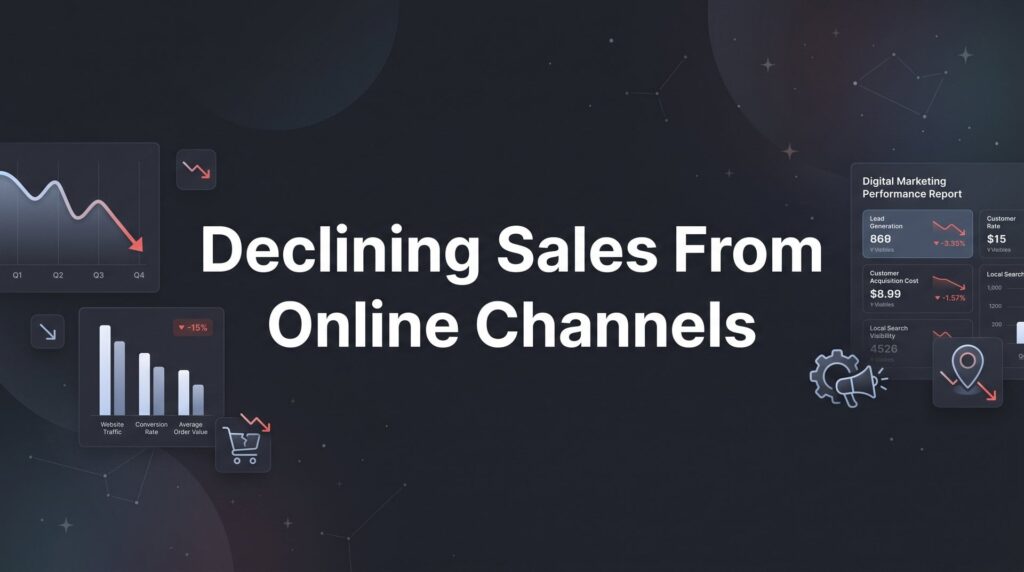
You refresh your analytics dashboard for the third time this morning, hoping the numbers will somehow look different. They don’t. Online revenue is down 23% compared to last quarter, and your marketing spend has actually increased. Your Google Ads campaigns that used to deliver a steady stream of customers now seem to burn through budget without producing results. The Facebook ads that once felt like a money printer have gone cold. Even your organic traffic, which you counted on as a reliable baseline, has been steadily eroding.
For local business owners who’ve built their customer acquisition around digital channels, this scenario triggers a specific kind of anxiety. You’ve invested thousands—maybe tens of thousands—into building your online presence. You’ve learned the platforms, optimized your campaigns, and created content. And now, despite doing everything that worked before, the revenue just isn’t there.
The good news? Declining online sales is almost always a solvable problem. The bad news? Most businesses waste significant money trying to fix the wrong issue. They pour more budget into ads when the real problem is conversion rate. They redesign their website when the actual issue is targeting the wrong audience. They hire an SEO agency when their traffic is fine but their offer has become irrelevant.
This guide will help you diagnose what’s actually broken in your online revenue system and implement fixes that target the real problem. Because throwing money at generic solutions is how you turn a revenue decline into a full-blown crisis.
The Hidden Forces Draining Your Online Revenue
Your online sales aren’t declining in a vacuum. Several powerful external forces are reshaping the digital landscape, and they’re hitting local businesses particularly hard.
The most brutal shift is market saturation combined with increased competition. Every platform you advertise on has become exponentially more crowded over the past few years. Your local market that once had three businesses advertising on Google now has fifteen. The Facebook audience you could reach for $8 per thousand impressions now costs $24. National brands with massive budgets have discovered local markets and are outbidding you for the same customers.
This isn’t just about more competitors. It’s about the fundamental economics of digital advertising changing. When customer acquisition costs rise faster than your ability to increase prices or lifetime value, your margins compress. What used to be profitable customer acquisition becomes break-even or worse. Understanding how to fix low ROI from digital advertising becomes essential for survival in this environment.
Platform algorithm changes compound this pressure in ways most business owners don’t fully appreciate. Google’s search algorithm updates can quietly reduce your organic visibility by 40% overnight. Facebook’s shift toward prioritizing personal content over business posts means your organic reach has essentially evaporated. Even your email open rates have dropped as inbox providers get more aggressive about filtering promotional content.
These aren’t temporary fluctuations. They represent permanent shifts in how these platforms operate. Google increasingly prioritizes large, authoritative sites over smaller local businesses. Facebook wants you paying for reach rather than earning it organically. The “free” traffic sources you built your business on have been systematically monetized.
Consumer behavior has evolved in ways that make yesterday’s winning strategies obsolete. Your target customers now research differently, compare options more thoroughly, and have higher expectations for website experience and mobile functionality. They’re also more skeptical of advertising and less responsive to the tactics that worked even two years ago.
The pandemic accelerated digital adoption across all demographics, which sounds like it should help online businesses. But it also meant every local competitor suddenly got serious about digital marketing. The plumber who used to rely entirely on word-of-mouth now has a sophisticated Google Ads campaign. The local retailer who never bothered with e-commerce now ships nationwide.
Economic conditions add another layer of complexity. When consumer spending tightens, discretionary purchases decline first. Higher interest rates affect big-ticket items. Inflation changes how people evaluate value. These macro factors hit some businesses harder than others, but they’re affecting online conversion rates across nearly every industry.
Understanding these external forces matters because it sets realistic expectations. If your market has fundamentally changed, you can’t just optimize your way back to 2022 performance using 2022 strategies. You need to adapt to the new reality.
Diagnosing Your Specific Revenue Leak
Before you change anything, you need to know exactly where the breakdown is occurring. Most businesses skip this diagnostic step and jump straight to solutions, which is why they waste money fixing problems they don’t actually have.
The first critical distinction is between traffic decline and conversion decline. These require completely different solutions, yet businesses constantly confuse them. Pull your analytics and compare two metrics: total website visitors and conversion rate. If traffic is down but conversion rate is stable, you have a traffic problem. If traffic is steady but conversions have dropped, you have a conversion problem. If both are declining, you’re dealing with multiple issues that need to be addressed separately.
This distinction matters enormously. A traffic problem means you need to fix or expand your acquisition channels. A conversion problem means something on your website or in your offer is broken. Spending thousands on more advertising when you have a conversion problem just amplifies the waste. Redesigning your website when you have a traffic problem doesn’t address the actual issue.
Once you understand whether you’re dealing with traffic or conversion, drill down by channel. Your analytics should show traffic and revenue by source: Google Ads, Facebook Ads, organic search, email, direct traffic, and any other channels you use. Look at each channel’s performance over the past six months.
Which specific channels are declining? Is it all paid advertising or just one platform? Has your organic search traffic dropped while paid remains stable? Is email still converting but social media has gone cold? Each channel decline points to a different root cause and requires a different fix. If you’re wondering why you’re not getting customers online, this channel-by-channel analysis often reveals the answer.
Pay particular attention to the quality metrics, not just volume. A channel might show steady traffic but declining conversion rate, indicating you’re attracting the wrong audience. Or you might see fewer visitors but higher conversion rate, suggesting your targeting has improved but your reach has narrowed.
Customer journey mapping reveals where potential buyers are dropping off. Set up your analytics to track the full path from initial visit to purchase or lead submission. Where do people exit? Do they land on your homepage and immediately bounce? Do they browse products but never add to cart? Do they start the checkout process but abandon before completing?
Each drop-off point tells a story. High bounce rates on landing pages suggest a disconnect between your ad messaging and page content. Cart abandonment indicates pricing concerns, unexpected shipping costs, or checkout friction. People who visit multiple times but never convert might be comparison shopping or waiting for a promotion.
For lead generation businesses, the journey looks different but the diagnostic approach is the same. Track how many people view your service pages, how many click your contact information or request quote button, and how many actually submit a form or call. The gap between interest and action often reveals the real problem.
This diagnostic phase should take a few hours, not a few minutes. The clarity you gain from understanding your specific situation will save you from months of ineffective fixes and wasted budget.
When Your Ads Stop Working: Paid Channel Troubleshooting
Paid advertising channels can deteriorate quickly, and the decline often accelerates once it starts. Understanding the specific failure modes helps you intervene before a struggling campaign becomes a money pit.
Ad fatigue and audience saturation are silent killers that most businesses don’t recognize until significant damage is done. Your target audience has seen your ads dozens or hundreds of times. What once grabbed attention now gets scrolled past without a second thought. Your click-through rates decline, your cost per click increases, and your conversion rate drops because the only people still clicking are those who haven’t seen your ad enough times to develop banner blindness.
The symptoms are subtle at first. Your cost per acquisition creeps up 10%, then 20%, then suddenly you’re paying double what you used to for the same result. Your impression share remains high but engagement metrics steadily decline. You’re still reaching your audience, they’re just no longer responding.
Facebook and Instagram are particularly vulnerable to creative fatigue because users see the same ads repeatedly in their feeds. Google Search is less susceptible because intent-based advertising has built-in variety, but even search ads can suffer from message fatigue if you’re targeting a limited local market. When your ads aren’t converting to sales, creative fatigue is often the culprit.
Bidding strategy mistakes silently drain budget in ways that don’t show up in surface-level metrics. Automated bidding strategies like Target CPA or Maximize Conversions can work brilliantly when properly configured, but they can also spiral out of control when market conditions change or when they’re given insufficient conversion data to optimize effectively.
The most common mistake is setting target costs that are no longer realistic given current market competition. If you’re telling Google to acquire customers at $50 each but the actual market rate is $85, the algorithm will either stop showing your ads or show them to increasingly unqualified audiences in an attempt to hit your target.
Manual bidding has its own pitfalls. Businesses set their bids based on what worked six months ago and never adjust them as competition increases. They bid the same amount for all keywords regardless of intent or conversion likelihood. They fail to adjust bids for mobile versus desktop, time of day, or geographic location.
Landing page disconnects kill conversions even when your ads perform perfectly. This is one of the most frustrating scenarios because your advertising metrics look fine—decent click-through rates, reasonable cost per click—but the traffic just doesn’t convert.
The disconnect usually falls into one of three categories. Message mismatch happens when your ad promises one thing but your landing page delivers something different. If your ad emphasizes free shipping but your landing page doesn’t mention it, people bounce. If your ad targets a specific service but your landing page is a generic homepage, you’ve lost them.
Design and trust issues create friction even when the message matches. A landing page that looks outdated, unprofessional, or sketchy triggers immediate skepticism. Missing trust signals like reviews, credentials, or security badges make people hesitate. Poor mobile experience frustrates the majority of traffic that comes from phones.
Offer relevance problems occur when your ad is fine and your landing page is fine, but the actual offer no longer resonates with your market. Your pricing has become uncompetitive. Your service package doesn’t match what people are actually looking for. Your value proposition fails to differentiate you from the fifteen competitors they’re also considering.
Fixing paid channel problems requires testing and iteration. Refresh your ad creative every 4-6 weeks minimum. Audit your bidding strategies against current market conditions monthly. A/B test landing pages to identify what messaging and design elements actually drive conversions. The businesses that maintain strong paid channel performance are those that treat optimization as an ongoing process, not a one-time setup.
Organic Traffic Decline: Reclaiming Your Search Visibility
Organic search traffic can feel like the most frustrating channel to diagnose because the causes of decline are often invisible and the solutions take months to show results. But understanding the specific mechanisms of organic decline helps you prioritize the right fixes.
Content relevance decay is a concept most business owners don’t consider. The article you wrote two years ago that ranked on page one and drove steady traffic has slowly lost relevance. Search intent has shifted. Competitors have published more comprehensive content. Google’s understanding of what users actually want when they search that term has evolved.
This isn’t about your content becoming factually wrong. It’s about it no longer being the best answer to the question searchers are asking. Maybe your guide to “choosing a contractor” focused on credentials and experience, but users now care more about pricing transparency and project timelines. Your content is still accurate, but it’s answering yesterday’s version of the question.
Industry-specific search intent shifts happen constantly. Local service searches increasingly include “near me” and mobile intent. Product searches now expect detailed specifications, comparison content, and user reviews. Informational searches want comprehensive guides rather than brief blog posts.
Your content library requires ongoing maintenance to remain relevant. Pages that drove traffic two years ago need updating to reflect current search intent. Topics that used to work as standalone articles now need to be part of comprehensive guides. Thin content that once ranked because competition was low now gets buried because the bar has risen.
Technical SEO issues accumulate over time like dust on a shelf. Each individual issue might be minor, but collectively they compound into significant visibility losses. Site speed gradually degrades as you add features and images. Mobile usability problems emerge as you update your design. Broken links multiply as you restructure content.
Core Web Vitals have become a ranking factor that many local businesses ignore. If your pages take more than three seconds to load or shift layout as they load, you’re losing rankings to faster competitors. These technical factors matter more for competitive terms where Google has many quality options to choose from.
Crawlability and indexing issues can silently tank your organic traffic. Maybe your developer accidentally blocked important pages in robots.txt. Your site structure has become so complex that Google can’t efficiently crawl deep pages. Duplicate content issues have confused search engines about which version of your pages to rank.
Local search factors particularly impact service-based businesses, and the local algorithm operates differently than general organic search. Your Google Business Profile optimization directly affects local pack rankings. The consistency of your business name, address, and phone number across the web influences local visibility. Having a strategy for managing online customer reviews has become a stronger ranking signal than ever before.
Local competitors who invest in their Google Business Profile, actively collect reviews, and maintain citation consistency will outrank you even if your website is technically superior. The local algorithm weighs proximity, relevance, and prominence differently than traditional organic search.
Geographic targeting complexity has increased as Google gets better at understanding location intent. Searches without explicit location modifiers still return local results based on the searcher’s location. Your service pages need clear geographic signals. Your content needs to demonstrate local relevance and authority.
Recovering organic search visibility requires patience and systematic effort. Audit your top-performing pages from a year ago and identify which have declined. Update content to match current search intent. Fix technical issues that affect crawlability and user experience. Optimize your local presence if you serve a geographic market. Track rankings for your target terms monthly to measure progress, but understand that meaningful organic recovery typically takes three to six months of consistent effort.
The Conversion Rate Crisis Most Businesses Ignore
Traffic problems get attention because they’re obvious. Conversion rate problems often go unnoticed because traffic numbers look fine and business owners assume the issue must be with their advertising or SEO. But a declining conversion rate can destroy profitability even when traffic remains strong.
Website experience factors that erode trust are often invisible to business owners who are intimately familiar with their own site. You know your business is legitimate, but first-time visitors are making trust assessments in seconds based on subtle signals. An outdated design suggests you’re not a serious business. Missing or buried contact information makes people suspicious. Lack of social proof makes them question whether anyone actually uses your service.
Trust signals matter more than most businesses realize. Customer reviews and testimonials provide third-party validation that your marketing claims can’t. Professional photography signals that you invest in your business. Clear return policies and guarantees reduce perceived risk. Security badges and privacy policies matter especially for e-commerce and businesses collecting sensitive information.
The absence of these trust signals doesn’t actively repel visitors, but it creates subtle friction that reduces conversion rates by 20%, 30%, or more. People don’t explicitly think “this site lacks trust signals,” they just feel slightly uncomfortable and decide to keep shopping around.
Mobile optimization gaps alienate the majority of online shoppers because mobile traffic now represents 60-70% of website visits for most local businesses. If your site isn’t genuinely optimized for mobile, you’re creating a terrible experience for most of your potential customers.
True mobile optimization goes far beyond responsive design. Your forms need to be easy to complete on a small screen. Your click targets need to be large enough for finger taps. Your images need to load quickly on cellular connections. Your navigation needs to work without a mouse hover state.
Common mobile conversion killers include forms that require excessive typing, phone numbers that aren’t click-to-call, pages that require pinch-and-zoom to read, and checkout processes designed for desktop that become nightmares on mobile. Each friction point reduces your mobile conversion rate, and since mobile is the majority of your traffic, even small mobile conversion improvements have outsized impact on overall revenue.
Checkout and lead form friction turns interested prospects into bounces at the exact moment they’re ready to convert. This is the most expensive type of conversion failure because these people have already decided they want what you offer. They’re not comparison shopping anymore. They’re trying to give you money or submit their information, and your process is making it difficult. If you’re running an e-commerce store, a high shopping cart abandonment rate is often the biggest revenue leak to address.
Form friction comes in many varieties. Asking for unnecessary information that people don’t want to provide. Requiring account creation before allowing a purchase. Multi-step processes that aren’t clearly communicated. Error messages that don’t explain what went wrong. Unclear next steps after form submission.
For e-commerce, unexpected costs revealed at checkout are conversion killers. Shipping costs that weren’t disclosed earlier. Taxes that make the final price significantly higher than expected. Required insurance or handling fees. Limited payment options that don’t include the customer’s preferred method.
For lead generation, the friction is often about commitment level. A form asking for a phone number when the prospect isn’t ready for a sales call. Requesting a detailed project description before they’ve even confirmed you serve their area. Unclear response timeframes that make them wonder if anyone will actually follow up.
Fixing conversion rate problems delivers the fastest ROI of any optimization effort because you’re getting more value from traffic you’re already paying for. A 20% improvement in conversion rate is equivalent to a 20% increase in traffic, except it doesn’t cost you anything in additional advertising spend. Run heat mapping and session recording tools to see how real users interact with your site. A/B test different form designs and checkout flows. Simplify everything. Remove every field, every step, every piece of friction that isn’t absolutely necessary.
Building a Recovery Plan That Actually Works
Understanding what’s broken is only valuable if you implement fixes in the right order. Most businesses either try to fix everything at once and accomplish nothing, or they chase random optimizations without a coherent strategy.
A prioritization framework helps you focus on changes that will actually move the needle. Evaluate each potential fix on two dimensions: impact and effort. High-impact, low-effort changes are your quick wins. High-impact, high-effort changes are your foundational fixes that require more time but deliver lasting results. Low-impact changes, regardless of effort, should be deprioritized or ignored entirely.
Quick wins for most businesses include refreshing fatigued ad creative, fixing obvious mobile usability issues, and simplifying lead forms. These can be implemented within days and often show measurable improvement within weeks. They’re also confidence builders that create momentum for larger initiatives.
Foundational fixes take longer but address root causes. Rebuilding your targeting strategy based on current market conditions. Overhauling your landing page experience. Creating comprehensive content that matches current search intent. These initiatives might take months to fully implement and show results, but they create sustainable improvement rather than temporary bumps. Professional sales funnel optimization services can accelerate this process significantly.
The trap is spending all your time on quick wins and never addressing foundational issues. Your revenue might stabilize, but you won’t achieve real growth. Conversely, focusing only on foundational fixes means you’re bleeding revenue for months while waiting for long-term initiatives to pay off.
Balance both. Implement quick wins immediately to stop the bleeding. Simultaneously begin work on foundational fixes that will drive long-term recovery and growth.
Setting realistic recovery timelines and benchmarks prevents frustration and premature strategy changes. Different channels recover at different speeds, and understanding this helps you maintain appropriate expectations.
Paid advertising optimization can show improvement within weeks. If you fix targeting issues, refresh creative, and optimize landing pages, you should see measurable changes in cost per acquisition within 2-4 weeks. If you don’t see any improvement in that timeframe, your diagnosis was probably wrong or your fixes weren’t actually addressing the core problem.
Organic search recovery typically takes 3-6 months minimum. Google needs time to recrawl your updated content, reassess your site’s authority, and adjust rankings. Technical SEO fixes might show faster results if they were preventing indexing, but competitive ranking improvements for valuable terms require sustained effort over months.
Conversion rate optimization can show results quickly for simple fixes but takes longer for comprehensive overhauls. Simplifying a form might improve conversions within days. Rebuilding your entire checkout experience might take weeks to implement and test properly.
Set benchmarks based on your specific situation. If your conversion rate dropped from 3% to 1.8%, your initial goal might be recovering to 2.2% within 60 days. If your Google Ads cost per acquisition increased from $65 to $110, your target might be getting back to $85 within 30 days. These benchmarks help you measure progress and adjust tactics if you’re not seeing expected improvement.
When to handle recovery in-house versus bringing in specialized expertise depends on your internal capabilities and the complexity of your situation. Simple fixes like refreshing ad creative or simplifying forms can often be handled internally if you have basic marketing skills. Complex issues like technical SEO problems, advanced conversion rate optimization, or sophisticated paid advertising management typically require specialized expertise. Knowing how to generate qualified leads online often requires a combination of both approaches.
The cost of hiring experts needs to be weighed against the cost of continued revenue decline and the opportunity cost of slow recovery. If you’re losing $10,000 per month in revenue and it takes you six months to figure out and fix the problem versus two months with expert help, the expert help pays for itself many times over.
Be honest about your internal capabilities. Many business owners underestimate the complexity of digital marketing channels and waste months attempting fixes that an experienced specialist could implement properly in weeks. Others hire agencies prematurely for problems they could easily solve themselves with basic troubleshooting.
Putting It All Together
Declining online sales feels like an existential threat when you’ve built your customer acquisition around digital channels. The dashboard numbers that used to represent growth and momentum now trigger anxiety. The marketing spend that used to feel like an investment now feels like waste.
But here’s what separates businesses that recover from those that continue spiraling: accurate diagnosis followed by systematic fixes. The companies that throw money at generic solutions—more ads, website redesigns, SEO packages—without understanding their specific problem typically make things worse. They amplify broken conversion processes with more traffic. They redesign websites that didn’t need redesigning. They optimize for search terms that don’t drive revenue.
The businesses that recover fastest start with diagnosis. They identify whether they have a traffic problem or a conversion problem. They audit each channel separately to understand specific failure modes. They map the customer journey to find the exact points where potential buyers exit. This diagnostic work takes hours, not weeks, but it prevents months of wasted effort.
Your recovery plan should balance quick wins with foundational fixes. Stop the bleeding with immediate optimizations to fatigued ads, broken mobile experiences, and high-friction forms. Simultaneously address root causes like outdated targeting strategies, content relevance decay, and systematic conversion barriers.
Set realistic expectations based on channel recovery timelines. Paid advertising can improve within weeks. Organic search takes months. Conversion rate optimization delivers fast ROI for simple fixes but requires sustained testing for comprehensive improvement. Measure progress against benchmarks specific to your situation, not arbitrary industry standards.
Be honest about when you need specialized expertise. Some problems require deep platform knowledge, technical skills, or testing infrastructure that most businesses don’t have in-house. The cost of expert help is almost always lower than the cost of extended revenue decline while you figure things out through trial and error.
Your online revenue decline is solvable. The question is whether you’ll diagnose accurately and fix systematically, or continue throwing money at symptoms while the root causes persist. Tired of spending money on marketing that doesn’t produce real revenue? We build lead systems that turn traffic into qualified leads and measurable sales growth. If you want to see what this would look like for your business, we’ll walk you through how it works and break down what’s realistic in your market.