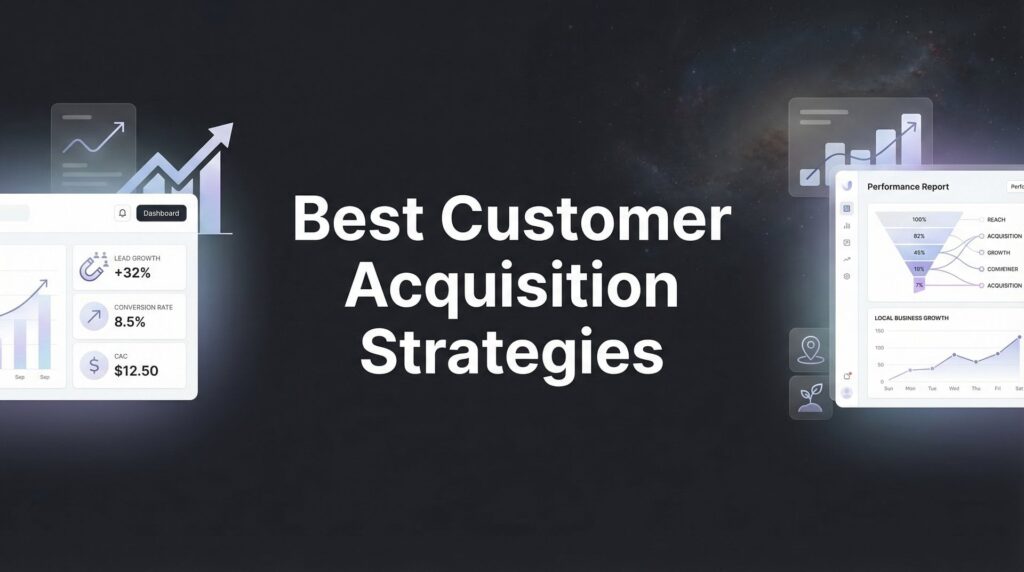
You’re spending $3,000 a month on digital marketing. Your dashboard shows 50,000 impressions, 2,400 clicks, and your social media following grew by 300 people. Your marketing agency sends you a colorful report highlighting all this “engagement.” But when you look at your bank account, you see a problem: you gained exactly four new customers last month, and two of them were barely profitable after you factor in your costs.
Sound familiar?
This is the gap that frustrates business owners everywhere. Marketing that looks busy on paper but doesn’t translate to actual revenue growth. The clicks are there. The traffic exists. But the cash register isn’t ringing louder, and your business isn’t growing faster.
A customer acquisition marketing agency operates differently. Instead of optimizing for impressions or engagement, they focus on one metric that actually matters to your business: bringing in new paying customers at a cost that makes sense for your bottom line. Not brand awareness. Not reach. Not “building your online presence.” Just profitable customer growth.
This guide breaks down what these agencies actually do, how they differ from traditional marketing firms, and how to identify a partner who will focus on filling your sales pipeline rather than filling reports with meaningless numbers.
The Fundamental Shift: Marketing That Pays for Itself
Customer acquisition marketing represents a completely different philosophy from traditional digital marketing. While conventional agencies talk about brand building, thought leadership, and long-term positioning, customer acquisition agencies ask one question: “How many new customers did we bring in, and what did each one cost?”
This distinction matters more than most business owners realize.
Traditional digital marketing agencies often measure success through metrics like website traffic, social media followers, email list growth, and content engagement. These numbers feel productive. They trend upward in reports. But they don’t directly correlate to revenue unless someone converts that attention into actual purchases.
Customer acquisition marketing flips this approach. The starting point isn’t visibility—it’s conversion. Every campaign, every dollar spent, every strategy deployed gets evaluated against a simple standard: did it bring in customers profitably?
The math becomes straightforward. If you spend $500 on advertising and acquire five customers who each generate $300 in profit, you’ve created a $1,500 return from a $500 investment. That’s a 3:1 return on ad spend, and it’s the kind of number that actually grows your business. Compare this to spending $500 to get 10,000 impressions—a metric that tells you nothing about whether your business made money.
This approach works particularly well for specific types of businesses. Local service companies with proven offerings benefit immensely because they can track exactly which marketing dollars produce which customers. A plumbing company knows what a new customer is worth. A dental practice understands patient lifetime value. A law firm can calculate case profitability.
Businesses ready to scale find this model transformative. Once you identify a profitable acquisition channel, you can increase investment proportionally. If spending $2,000 per month profitably brings in 20 customers, spending $4,000 should bring in 40 customers at similar economics. Traditional brand-building doesn’t scale this predictably.
The model also helps businesses struggling with conversion problems. Many companies generate traffic but can’t convert visitors into buyers. A customer acquisition agency diagnoses where the breakdown happens—whether it’s targeting the wrong audience, using ineffective landing pages, or failing to follow up on leads properly. Understanding what customer acquisition cost actually means is the first step toward fixing these issues.
The core philosophy centers on measurable outcomes. Cost per acquisition tells you exactly what you’re paying to bring in each new customer. Customer lifetime value reveals whether those customers are worth acquiring. Return on ad spend shows whether your marketing investment is profitable or just expensive activity.
When you shift to this mindset, marketing stops being a cost center that drains resources and becomes a growth engine that produces predictable results. The agency becomes accountable for actual business outcomes, not just marketing activity.
The Arsenal: Services That Convert Attention Into Revenue
Customer acquisition agencies deploy a focused toolkit designed specifically for one purpose: turning prospects into paying customers. Unlike full-service agencies that spread resources across brand strategy, content marketing, and awareness campaigns, these specialists concentrate on the channels and tactics that directly drive conversions.
PPC advertising forms the foundation of most customer acquisition strategies. Google Ads and Facebook/Meta Ads offer something traditional marketing can’t match: immediate visibility to people actively searching for your solution or matching your ideal customer profile. The difference lies in how these campaigns get structured.
A customer acquisition agency doesn’t just set up ads and hope for clicks. They architect campaigns around conversion goals. Every keyword selection, every audience definition, every ad variation gets tested against one question: does this bring in customers at our target cost per acquisition?
This means aggressive testing of ad copy that speaks directly to customer pain points. It means landing pages designed for one purpose—capturing leads or driving purchases. It means bid strategies optimized for conversions, not just traffic. When you’re paying for clicks, every visitor who doesn’t convert represents wasted money. These agencies obsess over conversion rates because improving them directly improves profitability.
Conversion rate optimization separates good agencies from exceptional ones. Think about the math: if your website converts 2% of visitors into customers, and CRO work improves that to 3%, you’ve just increased your customer acquisition by 50% without spending another dollar on advertising. That’s why agencies focused on customer acquisition invest heavily in CRO expertise.
This work involves systematic testing of landing page elements. Headlines get A/B tested to find messaging that resonates. Form fields get reduced to minimize friction. Call-to-action buttons get repositioned and reworded. Trust signals like testimonials and guarantees get strategically placed. Every element exists to remove barriers between a visitor and a conversion.
The process is methodical. Run a test. Measure results. Implement the winner. Test the next element. Over time, these incremental improvements compound into dramatically better conversion rates. A business that initially converted 2% of traffic might reach 4% or 5% after months of optimization—effectively doubling or tripling customer acquisition from the same traffic volume.
Landing page development and funnel optimization extend this conversion focus throughout the customer journey. Generic website pages rarely convert well because they try to serve multiple purposes. A dedicated landing page eliminates distractions and guides visitors toward one specific action. Understanding the customer acquisition funnel helps you see where prospects drop off and how to fix it.
Effective agencies build landing pages matched to specific campaigns and audiences. Someone searching for “emergency plumber” sees a landing page focused on fast response times and 24/7 availability. Someone searching for “bathroom remodel plumber” sees a page showcasing renovation projects and design expertise. The message matches the intent, which dramatically improves conversion rates.
Funnel optimization looks at the entire path from first click to final purchase. Where do people drop off? Which steps create friction? How can you simplify the journey? Sometimes the problem isn’t the landing page—it’s what happens after someone submits a form. Poor follow-up systems, slow response times, or confusing next steps can kill conversions even when marketing brings in qualified leads.
Lead generation systems tie everything together. For businesses with longer sales cycles, the goal isn’t immediate purchases—it’s capturing contact information from qualified prospects. These agencies build lead capture mechanisms that balance two competing priorities: collecting enough information to qualify leads while keeping forms short enough that people actually complete them.
The follow-up systems matter as much as the initial capture. Automated email sequences nurture leads who aren’t ready to buy immediately. CRM integration ensures sales teams can act on hot leads quickly. Tracking systems attribute conversions back to specific marketing sources so you know which channels produce the best customers.
What you won’t typically find in a customer acquisition agency’s service list: brand strategy workshops, content marketing calendars, social media community management, or PR campaigns. Not because these things lack value, but because they don’t directly drive measurable customer acquisition. These agencies specialize in the marketing that produces immediate, trackable results.
Scorekeeping: The Metrics That Reveal Real Performance
Customer acquisition agencies live and die by numbers that traditional marketing firms often ignore. The difference between vanity metrics and revenue-driving metrics determines whether your marketing investment builds your business or just builds impressive-looking reports.
Cost per lead tells you exactly what you’re paying to capture contact information from a potential customer. If you spend $1,000 on advertising and generate 50 leads, your cost per lead is $20. This metric matters because it reveals efficiency. A campaign generating leads at $15 each outperforms one generating leads at $40 each, assuming lead quality remains consistent.
But here’s where many businesses get tripped up: not all leads are created equal. A $15 lead that never converts into a customer is worthless. A $50 lead that turns into a $5,000 customer is gold. This is why cost per lead must be evaluated alongside conversion rates and customer value.
Cost per acquisition cuts through this complexity by measuring what you pay to acquire an actual paying customer. This is the metric that matters most. If your average customer is worth $1,000 in profit and you’re acquiring them for $200 each, you’ve built a profitable growth engine. If you’re paying $1,200 to acquire a $1,000 customer, you’re slowly going bankrupt no matter how many “leads” you generate.
Calculating cost per acquisition requires tracking the full journey from ad click to final sale. Many businesses struggle here because they can’t connect marketing activity to actual revenue. They know they spent $5,000 on ads and gained 15 new customers that month, but they can’t definitively say which customers came from which marketing channels.
This is where attribution and tracking systems become essential. Proper tracking reveals which campaigns, keywords, and channels produce customers versus which ones just produce activity. You might discover that Google Ads for “emergency service” keywords convert at 8% while Facebook ads convert at 2%. Implementing call tracking for marketing campaigns helps you connect phone leads back to specific ad sources.
Lead-to-customer conversion rates reveal how effectively your sales process turns interested prospects into paying clients. If you generate 100 leads but only convert five into customers, you have a 5% conversion rate. Improving this to 10% doubles your customer acquisition without spending more on marketing.
Many businesses blame marketing for poor results when the real problem lives in their sales process. Marketing might be delivering perfectly qualified leads, but slow follow-up, poor sales skills, or pricing issues prevent conversions. A good customer acquisition agency helps diagnose where the breakdown occurs.
Return on ad spend provides the ultimate measure of campaign profitability. The calculation is simple: revenue generated divided by advertising cost. If you spend $2,000 on ads and those campaigns generate $8,000 in revenue, you have a 4:1 ROAS. For most businesses, a 3:1 ROAS or higher indicates profitable marketing.
Customer lifetime value adds crucial context to these metrics. A customer who makes one $100 purchase looks very different from a customer who spends $100 monthly for three years. The second customer is worth $3,600 in total revenue, which justifies a much higher acquisition cost.
Understanding lifetime value transforms how you evaluate marketing performance. A campaign that looks marginally profitable based on initial purchase value might be incredibly profitable when you factor in repeat business. This is why customer acquisition agencies often help clients improve retention and repeat purchase rates—it makes customer acquisition more profitable. Pairing acquisition with customer retention marketing strategies maximizes the value of every customer you bring in.
Vanity metrics tell a different story. Impressions, reach, engagement rate, and follower growth all measure attention, not revenue. A post that reaches 50,000 people sounds impressive until you realize it generated zero customers. A social media account with 10,000 followers means nothing if those followers never buy anything.
The trap is that vanity metrics feel productive. Numbers go up. Graphs trend upward. Reports look impressive. But unless those metrics connect to actual customer acquisition and revenue growth, they’re just expensive distractions.
A customer acquisition marketing agency keeps the focus where it belongs: on the numbers that determine whether your business grows profitably or burns through marketing budget without corresponding returns.
Due Diligence: Separating Performance Partners From Report Generators
Not every agency claiming to focus on customer acquisition actually delivers results. The market is full of firms that talk about performance but operate like traditional marketing agencies—generating activity, producing reports, and avoiding accountability for actual business outcomes. Learning to spot the difference protects you from wasting months and thousands of dollars on the wrong partnership.
Red flags appear in how agencies talk about their work. When an agency emphasizes “brand building” or “long-term positioning” without connecting these concepts to measurable customer acquisition, they’re probably not performance-focused. When they tout awards, creative excellence, or industry recognition instead of client results, they’re selling prestige instead of outcomes.
Vague reporting is another warning sign. Reports filled with impressions, reach, and engagement percentages but lacking cost per acquisition or return on ad spend numbers tell you the agency isn’t measuring what matters. If you can’t quickly determine from their reporting whether marketing is profitable, the agency isn’t focused on profitability.
Long-term contracts with no performance benchmarks should raise immediate concerns. A true performance-focused agency will tie their engagement to specific goals and be willing to be evaluated against those goals. Contracts that lock you in for 12 months with no clear success criteria protect the agency, not you. Look for a marketing agency with no long-term contract that earns your business month after month.
Agencies that resist discussing revenue impact or claim they “can’t control what happens after the lead is generated” are avoiding accountability. While it’s true that agencies don’t control your sales process, good agencies want to understand your full funnel and help optimize the entire customer acquisition system, not just the top of the funnel.
Green lights appear in agencies willing to have uncomfortable conversations about results. They ask about your customer lifetime value, profit margins, and sales process during initial discussions. They want to understand your business economics because they know customer acquisition only works when the math makes sense.
Transparent reporting is non-negotiable. You should be able to see exactly how much you’re spending, how many leads or customers you’re acquiring, and what each one costs. The best agencies provide dashboard access where you can check performance anytime, not just when they send monthly reports.
Focus on profitability distinguishes serious agencies from pretenders. They talk about return on ad spend, not just click-through rates. They discuss cost per acquisition targets, not just traffic goals. They want to understand what a customer is worth to your business because that determines how aggressively they can acquire customers profitably.
Willingness to discuss actual revenue impact shows an agency that understands their role in your business growth. They should ask how many customers you need to hit your revenue goals and whether your current marketing can deliver those numbers. They should be able to project what’s realistic based on your budget and market conditions.
During the evaluation process, ask pointed questions that reveal an agency’s true priorities. “What percentage of your clients can you show a positive return on ad spend for?” separates agencies with proven results from those with impressive presentations. If they can’t answer this question with specifics, they’re not measuring what matters.
“How do you measure success for clients in my industry?” reveals whether they understand your business model and customer acquisition challenges. Generic answers about “increasing visibility” or “building engagement” suggest they’ll apply cookie-cutter strategies. Specific answers about cost per acquisition targets and conversion rate benchmarks show real expertise.
“What happens if campaigns don’t hit performance targets?” tests their accountability. Agencies confident in their abilities will have clear processes for optimization and adjustment. Those who deflect or blame external factors probably aren’t performance-focused.
“Can I speak with current clients about their results?” provides the ultimate verification. Agencies with strong track records will gladly connect you with satisfied clients. Those who resist probably don’t have clients who would give glowing reviews about actual business results.
Google Premier Partner status indicates agencies that meet specific performance standards and manage significant advertising budgets. Understanding the Google Partner marketing agency benefits helps you evaluate this credential properly. While this credential doesn’t guarantee results, it does signal experience and Google’s recognition of their capabilities.
CRO expertise matters tremendously because conversion optimization amplifies everything else. An agency that can improve your conversion rates by 50% effectively makes all your marketing 50% more profitable. Ask about their testing methodology, tools they use, and examples of conversion improvements they’ve delivered for clients.
The evaluation process should feel like a business discussion, not a sales pitch. The right agency asks as many questions as they answer because they’re trying to determine if they can actually help your business, not just whether they can close a deal.
The First Quarter: Setting Expectations for Early Results
Understanding what happens during the first 90 days of an agency partnership prevents frustration and sets realistic expectations. Customer acquisition marketing isn’t magic—it’s a systematic process that requires time for setup, testing, and optimization before delivering consistent results.
The onboarding process typically begins with comprehensive audits. The agency examines your current marketing efforts, website performance, and conversion paths. They’re looking for what’s working, what’s broken, and where opportunities exist. This isn’t busywork—it’s essential diagnosis that informs strategy.
Expect questions about your business that might feel intrusive. What’s your average customer worth? How long do customers typically stay with you? What’s your sales process? How quickly does your team follow up on leads? These questions matter because customer acquisition strategy depends on understanding your business economics and operational capabilities.
Tracking setup often consumes significant time in the first few weeks. Proper attribution requires implementing conversion tracking, connecting your CRM, and ensuring data flows correctly between systems. This technical foundation is crucial—without it, you can’t measure results accurately or optimize effectively.
Many businesses want to skip this setup phase and jump straight to running campaigns. Resist this temptation. Launching campaigns without proper tracking is like driving blindfolded. You might get somewhere, but you won’t know where you are or how you got there.
Strategy development happens in parallel with technical setup. The agency researches your market, analyzes competitors, and develops targeting approaches. They’re determining which channels to prioritize, what messaging to test, and how to structure campaigns for maximum conversion potential.
Initial campaigns typically launch in weeks three to five. Don’t expect immediate results. Early campaigns serve two purposes: generating initial data and testing hypotheses about what will work. The first few weeks of campaign activity are essentially controlled experiments that inform optimization.
Realistic timelines for seeing results vary by industry and competition level. In some markets, you might see qualified leads within the first week. In others, it might take a month to gather enough data to draw meaningful conclusions. Most businesses should expect to see initial results within 30-45 days and meaningful performance patterns within 60-90 days.
The optimization cycle is where real performance emerges. Initial campaigns rarely perform at their peak. The agency analyzes what’s working and what isn’t, then makes adjustments. They might refine targeting, rewrite ad copy, adjust landing pages, or shift budget between campaigns. Each cycle improves performance incrementally.
This iterative process is why month three often shows dramatically better results than month one. The agency has gathered data, identified what works, eliminated what doesn’t, and optimized based on real performance. This is also why long-term contracts without early performance benchmarks are problematic—you need to see progress by month three.
Communication and reporting should be structured and regular. Weekly updates during the first month keep you informed as campaigns launch and initial data comes in. Bi-weekly or monthly reporting makes sense once campaigns stabilize. The key is transparency—you should always know what’s being tested, what’s working, and what’s being adjusted.
Good agencies don’t just send reports—they interpret results and recommend actions. A report showing cost per lead increased by 20% should come with analysis of why it happened and what’s being done to address it. You’re paying for expertise, not just data compilation.
Your involvement matters during this phase. The agency needs feedback on lead quality. Are the leads they’re generating actually qualified prospects? Is your sales team able to convert them? What objections are prospects raising? This information helps the agency refine targeting and messaging. If you’re seeing poor quality leads from marketing, communicate this immediately so adjustments can be made.
Set clear expectations about what success looks like at each milestone. By day 30, you should see campaigns launched and initial data flowing. By day 60, you should see clear patterns about what’s working and optimization in progress. By day 90, you should see performance trending toward or exceeding target cost per acquisition and return on ad spend goals.
If you’re not seeing progress by day 90, have a serious conversation about what’s not working and why. A good agency will be as frustrated as you are and have a clear plan for course correction. An agency that makes excuses or asks for more time without concrete changes probably isn’t going to deliver results.
Scaling Success: Building a Long-Term Growth Partnership
Once initial campaigns prove profitable, the real opportunity emerges: scaling customer acquisition systematically. But successful scaling requires active partnership, not passive observation. Your role as the business owner becomes critical to maximizing results over time.
Providing feedback about lead quality helps the agency refine targeting. You interact with prospects daily and understand which leads convert easily versus which ones waste time. When you share patterns you’re noticing—certain industries respond better, specific pain points resonate more, particular objections come up repeatedly—the agency can adjust campaigns accordingly.
Sharing customer insights creates optimization opportunities. When you identify that customers who mention a specific problem become your best long-term clients, the agency can emphasize that problem in ad messaging. When you notice that customers from certain sources have higher lifetime value, budget can shift toward those channels.
Staying engaged with performance data prevents complacency. Review reports regularly. Ask questions about changes in metrics. Understand what’s being tested and why. Agencies perform better when they know clients are paying attention and care about results.
Scaling happens when campaigns consistently deliver profitable customer acquisition. If you’re spending $3,000 monthly and acquiring customers at $150 each with a 4:1 return on ad spend, increasing budget to $6,000 should roughly double customer acquisition at similar economics. Learning how to scale customer acquisition properly prevents the common mistakes that kill profitability during growth phases.
The key word is “roughly.” Scaling isn’t perfectly linear. As you increase spend, you typically see some efficiency loss because you’re moving beyond the easiest-to-reach prospects. A campaign that delivers $4 in revenue for every $1 spent at $3,000 monthly might deliver $3.50 for every $1 at $6,000 monthly. This is normal and expected.
Smart scaling happens gradually. Double budget, stabilize performance, then consider the next increase. Agencies that push for massive budget increases without proven results are gambling with your money. Conservative scaling based on demonstrated performance protects profitability while enabling growth.
Expanding to additional channels makes sense once core campaigns prove successful. If Google Ads delivers strong results, testing Facebook Ads or YouTube advertising might unlock additional customer sources. If search campaigns work well, trying display remarketing could recapture prospects who didn’t convert initially. A multi-channel marketing strategy diversifies your acquisition sources and reduces dependence on any single platform.
Channel expansion should follow the same testing methodology as initial campaigns. Start with modest budgets, gather data, optimize, then scale what works. Don’t spread budget across too many channels too quickly—it dilutes learning and makes optimization difficult.
The timing for expansion depends on your business capacity and market opportunity. If you’re already struggling to handle lead volume from existing campaigns, adding more channels creates operational problems, not growth. Scale customer acquisition in step with your ability to serve new customers well.
Long-term partnerships evolve as your business grows. Initial campaigns might focus purely on customer acquisition. Over time, the agency might help with retention marketing, referral programs, or upselling existing customers. The relationship deepens as they understand your business better and identify new opportunities.
Regular strategy reviews keep the partnership fresh. Market conditions change. Competition evolves. Customer preferences shift. Quarterly or semi-annual strategy sessions ensure campaigns adapt to these changes rather than running on autopilot.
The best agency relationships feel like having a growth partner on your team. They celebrate your wins because your success is their success. They push you to think bigger about what’s possible. They challenge you when they see opportunities you’re missing. They’re invested in your long-term growth, not just collecting monthly retainer fees.
This is the fundamental difference between a customer acquisition marketing agency and a traditional marketing vendor. Vendors deliver services. Partners drive outcomes. The right agency becomes an extension of your business, focused on the same goal you are: profitable growth through systematic customer acquisition.
Your Next Move: From Marketing Activity to Revenue Growth
The difference between marketing that feels busy and marketing that builds your business comes down to one thing: focus on profitable customer acquisition rather than activity for its own sake. Every business reaches a point where the question isn’t whether to invest in marketing, but whether that investment will actually produce revenue growth.
A customer acquisition marketing agency changes the equation. Instead of spending money on brand awareness campaigns with vague promises of “long-term value,” you invest in systematic approaches to bringing in new customers at costs that make sense for your business. The metrics become clear. The results become measurable. The return on investment becomes calculable.
This model works because it aligns agency success with your business success. When an agency gets paid regardless of whether they deliver customers, they have no incentive to optimize for your profitability. When their results get measured by cost per acquisition and return on ad spend, they’re forced to focus on what actually drives revenue.
The evaluation process matters tremendously. Choose an agency based on their track record of delivering measurable business results, not their creative awards or impressive client roster. Ask the hard questions about performance metrics, accountability, and what happens when campaigns underperform. Demand transparency in reporting and clarity about how success gets measured.
Once you find the right partner, commit to the process. Customer acquisition marketing isn’t instant—it requires time for setup, testing, and optimization. But when it works, it creates a predictable growth engine that scales with your business ambitions.
Your role in the partnership determines how successful it becomes. Stay engaged with performance data. Share insights about lead quality and customer feedback. Be willing to invest in scaling what works. The businesses that see the best results treat their agency as a strategic partner, not just a vendor they check in with monthly.
The alternative is continuing what you’re doing now. If your current marketing delivers the customer growth you need at costs that make sense, keep doing it. But if you’re spending money on marketing that produces impressive reports without corresponding revenue growth, something needs to change.
Tired of spending money on marketing that doesn’t produce real revenue? We build lead systems that turn traffic into qualified leads and measurable sales growth. If you want to see what this would look like for your business, we’ll walk you through how it works and break down what’s realistic in your market.
The businesses that grow fastest aren’t the ones with the biggest marketing budgets or the flashiest campaigns. They’re the ones that figured out how to acquire customers profitably and then systematically scaled that process. Customer acquisition marketing makes this possible by focusing relentlessly on the metrics that matter: bringing in new customers at costs that build your business rather than drain your resources.
The question isn’t whether customer acquisition marketing works—it’s whether you’re ready to shift from marketing activity to revenue growth. The right agency partnership makes that shift possible, turning marketing from an expense you tolerate into an investment that predictably expands your business.
Want More Leads for Your Business?
Most agencies chase clicks, impressions, and “traffic.” Clicks Geek builds lead systems. We uncover where prospects are dropping off, where your budget is being wasted, and which channels will actually produce ROI for your business, then we build and manage the strategy for you.