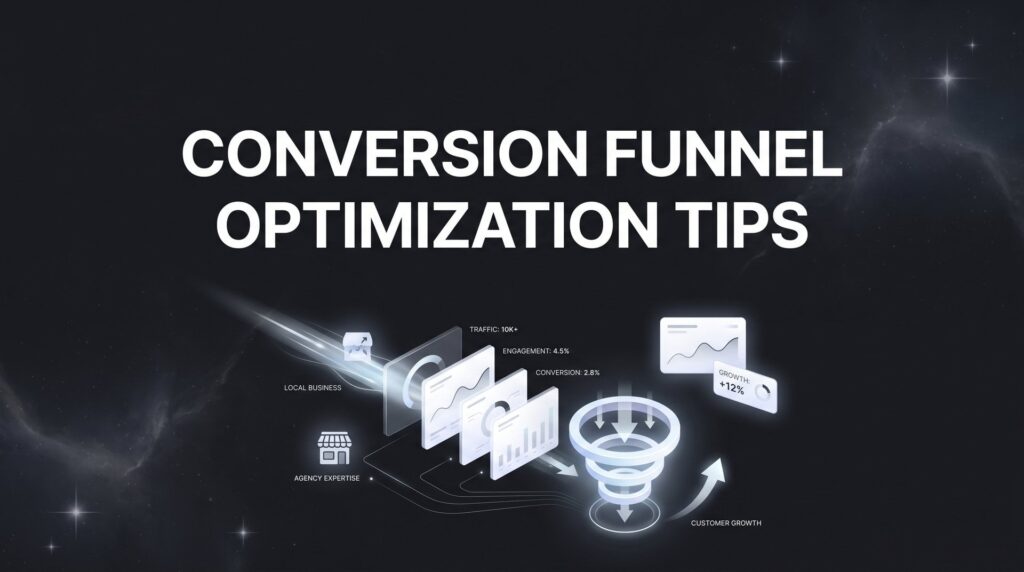
Most businesses treat their conversion funnel like a set-it-and-forget-it machine—and then wonder why leads leak out at every stage. The reality? Your funnel is either actively making you money or quietly bleeding it.
For local businesses competing against bigger players with deeper pockets, optimizing each funnel stage isn’t optional—it’s the difference between profitable growth and expensive frustration.
These seven conversion funnel optimization tips focus on what actually moves the needle: identifying where prospects drop off, removing friction that kills momentum, and creating a seamless path from stranger to paying customer. No fluff, no theory—just actionable strategies that Clicks Geek has seen transform underperforming funnels into revenue-generating systems.
1. Map Your Funnel’s Leak Points Before Touching Anything Else
The Challenge It Solves
Too many businesses start optimizing based on gut feelings or what they read in a blog post. They redesign landing pages, add pop-ups, or change button colors without knowing where the real problems are. This shotgun approach wastes time and often makes things worse. You can’t fix what you haven’t measured.
The biggest mistake? Assuming you know where people drop off. Your assumptions about friction points are usually wrong, and optimization without data is just expensive guessing.
The Strategy Explained
Start by tracking every stage of your funnel with proper analytics setup. You need to see exactly where prospects enter, how they move through each step, and precisely where they abandon the journey. This isn’t about installing Google Analytics and calling it done—it’s about setting up goal tracking, event monitoring, and conversion path analysis.
Look at your funnel in segments. What’s the drop-off rate from ad click to landing page view? From landing page to form submission? From form submission to phone call or purchase? Each transition point tells you something specific about what’s working and what’s broken. Understanding these sales funnel optimization problems is the first step toward fixing them.
The key is prioritizing fixes based on revenue impact, not just conversion rate. A 5% improvement at a high-volume, high-value stage beats a 20% improvement at a low-traffic step.
Implementation Steps
1. Set up conversion tracking for every meaningful action in your funnel—not just final purchases, but form views, form starts, form completions, phone clicks, and chat initiations.
2. Run a funnel visualization report for at least 30 days of data to identify patterns, looking specifically for stages where you lose more than 50% of prospects.
3. Calculate the revenue value of improving each stage by multiplying potential conversion lift by average customer value, then tackle the highest-impact opportunities first.
Pro Tips
Don’t just look at overall numbers—segment your funnel analysis by traffic source. Your Google Ads traffic might convert beautifully while Facebook traffic dies at the landing page, revealing a message match problem rather than a funnel design issue. Also, compare mobile versus desktop paths separately since they often behave like completely different funnels.
2. Align Landing Page Messaging with Ad Intent
The Challenge It Solves
You’re paying for clicks on ads that promise one thing, then landing prospects on pages that talk about something else entirely. This disconnect kills conversions instantly. When someone clicks an ad about “emergency plumbing repair,” they shouldn’t land on your homepage talking about your company history and full service catalog.
Message mismatch creates cognitive friction. The prospect has to work to figure out if they’re in the right place, and every second of confusion increases the likelihood they’ll bounce. You’ve already paid for the click—now you’re throwing it away with poor message continuity.
The Strategy Explained
Your landing page should feel like a natural continuation of the ad that brought the prospect there. Use the same language, highlight the same offer, and maintain visual consistency. If your ad mentions a specific percentage discount, that number should appear prominently on the landing page. If your ad talks about “same-day service,” that phrase needs to be in your headline.
This goes beyond just matching keywords. The emotional tone matters too. If your ad creates urgency around a time-sensitive problem, your landing page can’t suddenly shift to a casual, exploratory tone. The prospect’s mental state when they click should match the mental state your page assumes.
Think of it like a conversation. Your ad is the opening line, and your landing page is the next sentence. If those two sentences don’t connect logically, the conversation dies. Mastering conversion rate optimization for landing pages starts with this fundamental alignment.
Implementation Steps
1. Audit every active ad campaign and identify the core promise or benefit highlighted in each ad group’s messaging.
2. Create dedicated landing pages for each distinct ad message rather than sending all traffic to generic pages, ensuring the headline directly echoes the ad’s main claim.
3. Match visual elements between ads and landing pages including colors, imagery style, and any specific products or services featured in the ad creative.
Pro Tips
Use dynamic text replacement on landing pages to automatically insert the exact search term someone used into your headline. This creates perfect message match at scale without building hundreds of individual pages. Just make sure the inserted terms still read naturally—don’t sacrifice clarity for keyword stuffing.
3. Reduce Form Friction Without Sacrificing Lead Quality
The Challenge It Solves
You need information to qualify leads and follow up effectively, but every form field you add drops your conversion rate. The classic advice says “fewer fields equals more conversions,” but that often means more junk leads and wasted sales time. For local businesses where sales teams are small and time is precious, a flood of unqualified leads is worse than fewer high-quality ones.
The real challenge isn’t choosing between quantity and quality—it’s designing a form experience that captures essential information without making prospects feel like they’re filling out a mortgage application.
The Strategy Explained
Progressive profiling solves this by breaking information collection into stages. Start with the bare minimum on your initial form—typically name, email, and phone. Then, as prospects engage further with your business through follow-up emails, retargeting, or return visits, you collect additional details in smaller, less intimidating chunks.
Mobile-first form design is equally critical. Most traffic now comes from phones, yet many forms are still designed for desktop and then awkwardly squeezed onto small screens. Large tap targets, single-column layouts, and smart field formatting make mobile form completion dramatically easier.
Auto-fill compatibility, clear field labels that don’t disappear when someone starts typing, and smart defaults all reduce the mental effort required to complete your form. These are core conversion funnel optimization techniques that directly impact your bottom line.
Implementation Steps
1. Reduce your initial contact form to only the fields you absolutely need for first contact—usually name, phone, email, and one qualifying question specific to your service.
2. Implement mobile-optimized form design with tap targets at least 48 pixels tall, single-column layout, and field types that trigger appropriate mobile keyboards automatically.
3. Set up progressive profiling in your CRM or email platform to collect additional information through follow-up interactions rather than demanding everything upfront.
Pro Tips
Test your forms on actual mobile devices using cellular connections, not just WiFi. The experience is different, and you’ll catch issues like fields covered by the mobile keyboard or buttons that require precision tapping. Also, consider adding a simple qualifying question that filters leads while still being easy to answer—something like “What’s your timeline?” with simple options like “This week,” “This month,” or “Just researching.”
4. Build Trust Signals at Every Funnel Stage
The Challenge It Solves
Local businesses face a unique trust challenge. Prospects are comparing you against national brands with massive marketing budgets and established reputations. You might deliver better service, but if your website doesn’t build credibility quickly, prospects never get far enough to find that out.
Throwing random testimonials and badges on your page isn’t enough. Different stages of the funnel require different types of trust signals because prospects have different concerns at each point in their journey.
The Strategy Explained
At the awareness stage, prospects need to know you’re legitimate and professional. This is where industry certifications, years in business, and recognizable client logos matter. They’re not ready for detailed case studies—they just need to feel safe enough to keep exploring.
At the consideration stage, prospects want proof you can solve their specific problem. This is where relevant reviews, before-after examples, and specific outcome stories become powerful. They’re comparing you to alternatives, so trust signals need to differentiate you. Reviewing conversion rate optimization case studies can show you how other businesses have built this credibility effectively.
At the decision stage, prospects need reassurance about the transaction itself. Guarantees, clear pricing, transparent processes, and easy ways to contact a real human remove the final barriers to conversion.
The key is matching the trust signal to the prospect’s current question. Early-stage visitors asking “Are you real?” need different proof than late-stage visitors asking “Will this work for me?”
Implementation Steps
1. Place professional credentials and certifications prominently on landing pages where cold traffic arrives, establishing baseline credibility immediately.
2. Feature specific, relevant customer reviews on service pages and comparison content where prospects are actively evaluating options, focusing on reviews that address common objections.
3. Add guarantees, clear next-step explanations, and direct contact options on conversion pages where prospects are ready to commit but need final reassurance.
Pro Tips
Local credentials carry extra weight for local businesses. Highlighting that you’re locally owned, showing your actual office location, featuring team photos of real employees, and mentioning community involvement all build trust in ways that national competitors can’t match. Also, video testimonials from recognizable local customers outperform written reviews because they’re harder to fake and create stronger emotional connection.
5. Create Urgency Without Being Sleazy
The Challenge It Solves
Prospects procrastinate. Even when they’re genuinely interested and you’re clearly the right solution, they’ll often delay making a decision. “I’ll think about it” kills more deals than outright objections. Without some motivation to act now, prospects drift away and never come back.
But fake countdown timers and manufactured scarcity destroy trust faster than they create conversions. Prospects can smell manipulation, and once they catch you being dishonest about urgency, they question everything else you’ve told them.
The Strategy Explained
Legitimate urgency comes from real business constraints and actual value. Limited appointment availability isn’t fake—you genuinely only have so many time slots. Seasonal service windows are real—there actually is a best time to handle certain projects. Early-bird pricing for events or programs reflects actual business economics.
The difference between ethical urgency and sleazy tactics is simple: if the deadline or limitation is real, it’s ethical. If you’re making it up to manipulate behavior, it’s not.
Strong urgency also explains why acting now benefits the prospect beyond just “the offer expires.” For time-sensitive problems, urgency comes from the cost of delay—the longer they wait to fix the leak, the more damage occurs. For seasonal services, urgency comes from availability—wait too long and you’re stuck until next season. This psychological approach is one of the most effective marketing funnel optimization strategies available.
Implementation Steps
1. Identify real constraints in your business that create natural urgency such as limited service capacity, seasonal factors, or upcoming price changes, then communicate these honestly.
2. Quantify the cost of inaction for prospects by explaining what happens if they delay—not through fear-mongering, but through realistic outcome explanation.
3. Offer genuine limited-time value like bonus services, priority scheduling, or consultation packages that you can actually deliver on without the limitation being arbitrary.
Pro Tips
Transparency builds trust even within urgency messaging. Instead of just saying “Limited spots available,” say “We only take on 3 new clients per month to maintain quality, and we’re down to our last opening for June.” The specificity makes it believable. Also, honor your deadlines absolutely—if you say an offer expires Friday, it better actually expire Friday, or you’ve trained prospects to ignore your future urgency claims.
6. Implement Smart Retargeting for Mid-Funnel Recovery
The Challenge It Solves
The vast majority of prospects don’t convert on their first visit. They land on your site, browse around, maybe even start a form, then disappear. Without retargeting, you’ve lost them forever despite having already paid to get them there in the first place.
But generic retargeting that shows the same ad to everyone regardless of what they did on your site is barely better than nothing. Someone who spent 30 seconds on your homepage needs different messaging than someone who spent 10 minutes reading service details and started your contact form.
The Strategy Explained
Segment your retargeting audiences based on funnel stage and behavior. Create separate audiences for people who only viewed your homepage, people who visited specific service pages, people who started but didn’t complete forms, and people who consumed multiple pieces of content.
Each segment gets messaging appropriate to where they are in the buying journey. Homepage-only visitors get awareness-stage content that educates about the problem and positions your solution. Service page visitors get consideration-stage content that addresses specific objections and differentiates you from alternatives. Form abandoners get decision-stage content that removes final barriers and creates urgency. If you’re struggling with this, consider working with sales funnel optimization services that specialize in these recovery strategies.
Frequency management is critical. Showing someone the same ad 50 times in a week doesn’t increase conversions—it creates ad fatigue and annoyance. Cap frequency at reasonable levels and rotate creative to maintain freshness.
Implementation Steps
1. Create distinct retargeting audiences based on page depth and engagement level, separating casual browsers from serious prospects who viewed multiple pages or spent significant time on site.
2. Develop stage-appropriate ad messaging for each audience segment, moving from educational content for early-stage visitors to specific offers and urgency for late-stage prospects.
3. Set frequency caps at 3-5 impressions per person per week and rotate at least 2-3 ad variations per audience to prevent ad fatigue while maintaining presence.
Pro Tips
Exclude people who already converted from your retargeting audiences. Nothing screams “we don’t have our act together” like continuing to advertise services to someone who’s already a customer. Also, use shorter retargeting windows for time-sensitive services and longer windows for considered purchases—someone researching emergency repairs has a different decision timeline than someone planning a major renovation.
7. Speed Up Your Funnel’s Technical Performance
The Challenge It Solves
You can have perfect messaging, compelling offers, and beautiful design, but if your pages load slowly or break on mobile devices, none of it matters. Prospects won’t wait around for slow pages to load—they’ll hit the back button and choose a competitor whose site actually works.
Technical performance issues are silent conversion killers. Unlike obvious problems like broken forms or unclear messaging, slow load times just quietly bleed away prospects before they ever engage with your content. You’re paying for clicks that never even see your value proposition.
The Strategy Explained
Page speed affects every stage of your funnel. Faster pages rank better in search, cost less in paid advertising through improved Quality Scores, and convert better because prospects don’t abandon before content loads. Even a one-second delay in load time measurably impacts conversion rates.
Mobile performance deserves special attention because mobile users are less patient than desktop users and often on slower connections. A page that loads acceptably on desktop WiFi might be unusable on a phone with spotty 4G coverage. These website conversion optimization issues are often overlooked but critically important.
Common performance killers include oversized images, render-blocking scripts, excessive third-party tracking codes, and unoptimized hosting. Most of these are fixable without rebuilding your entire site.
Implementation Steps
1. Run your key landing pages through Google PageSpeed Insights and identify the specific issues slowing down load times, focusing first on mobile performance scores.
2. Compress and properly size all images, implement lazy loading for below-the-fold content, and minimize render-blocking JavaScript that prevents initial page display.
3. Audit and remove unnecessary third-party scripts including redundant analytics codes, unused chat widgets, and excessive social media tracking pixels that add load time without adding value.
Pro Tips
Test your site on actual mobile devices using cellular connections, not just WiFi. The experience is dramatically different, and you’ll discover performance issues that don’t show up in desktop testing. Also, prioritize speed on your highest-traffic pages first—a one-second improvement on a page getting 10,000 visits per month has more revenue impact than optimizing a page getting 100 visits.
Putting These Funnel Optimization Tips Into Action
Here’s the reality: implementing all seven strategies at once is overwhelming and counterproductive. Start with the data-driven diagnosis in strategy one. You can’t optimize what you haven’t measured, and trying to fix everything simultaneously makes it impossible to know what’s actually working.
Once you’ve identified your biggest leak points, prioritize based on revenue impact and implementation difficulty. Quick wins like fixing message match between ads and landing pages or improving page speed can often be done within days and show immediate results. More complex implementations like progressive profiling or sophisticated retargeting segmentation can follow once you’ve captured the low-hanging fruit.
The key is treating funnel optimization as an ongoing process, not a one-time project. Your funnel will always have room for improvement, and market conditions change constantly. What works today might need adjustment in three months.
Focus on one stage at a time, make changes systematically, and measure results before moving to the next optimization. This disciplined approach prevents the chaos of changing too many variables at once and ensures you actually learn what drives results in your specific business.
Tired of spending money on marketing that doesn’t produce real revenue? We build lead systems that turn traffic into qualified leads and measurable sales growth. If you want to see what this would look like for your business, we’ll walk you through how it works and break down what’s realistic in your market.