
You’re checking your analytics again. Traffic looks solid. Lead forms are getting submissions. Your ad spend is consistent. But when you look at actual sales? Crickets. Or at least, nowhere near what the numbers should be producing.
Here’s the truth most digital marketing advice won’t tell you: your problem probably isn’t traffic volume. It’s what happens after someone clicks.
Every sales funnel has leaks. Some are tiny drips that cost you a few deals here and there. Others are gaping holes that drain thousands of dollars in wasted ad spend every single month. The businesses that grow aren’t necessarily the ones getting more traffic—they’re the ones who’ve identified exactly where prospects are falling through the cracks and sealed those gaps.
This isn’t another generic “optimize your funnel” article. This is a diagnostic guide. By the time you finish reading, you’ll know exactly which stage of your funnel is bleeding money, why it’s happening, and what to do about it. Because the difference between a struggling business and a thriving one often comes down to fixing three or four specific conversion killers that most owners don’t even know exist.
The Anatomy of a Leaky Funnel: Where Most Businesses Lose Money
Think of your sales funnel like a water pipe system. Water comes in at the top (traffic), flows through various sections (engagement stages), and ideally comes out at the bottom (sales). When the pipe is solid, you get predictable flow. When it’s full of holes, you’re paying for water that never reaches its destination.
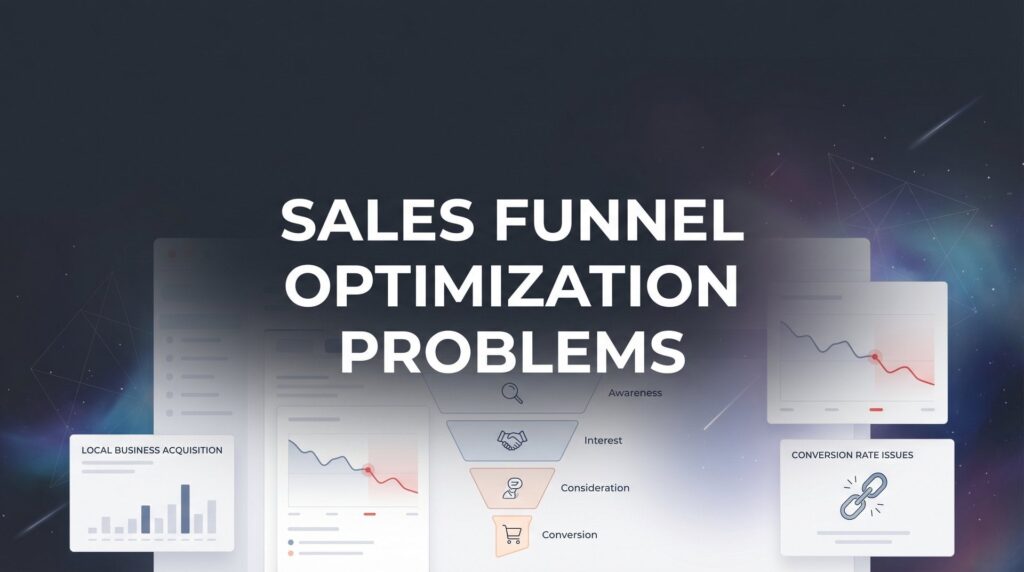
Most funnels break down at four distinct stages, and each one has its own unique problems.
Awareness Stage: This is where people first encounter your business. The problem here isn’t usually volume—it’s relevance. You might be attracting hundreds of visitors who were never going to buy from you in the first place. Wrong audience, wrong message, wrong timing.
Interest Stage: Prospects know you exist and are considering whether you’re worth their attention. This is where messaging alignment matters most. If your landing page promises one thing but delivers another, or if your value proposition doesn’t immediately answer “why should I care?”—they’re gone.
Decision Stage: They’re interested, but now they’re comparing options. This is the nurturing zone where most local businesses completely fall apart. No follow-up system. Generic emails. Zero education about why you’re different. Prospects go cold not because they weren’t interested, but because you never gave them a reason to stay warm.
Action Stage: They’re ready to buy or contact you, and then… something stops them. Complicated checkout process. Confusing contact forms. Unclear pricing. No sense of urgency. The finish line is in sight, but you’ve placed unnecessary obstacles right before it.
Here’s what makes funnel leaks so dangerous: they compound. Lose 20% of traffic at the top because your targeting is off. Lose another 30% at the landing page because the message doesn’t match. Lose 40% more in the nurturing phase because your follow-up is weak. By the time you reach the bottom, you’re converting 2% of your original traffic when you should be converting 15%.
That’s not a small difference. That’s the difference between a marketing budget that feels like throwing money into a void and one that generates predictable, profitable growth. Understanding the complete customer acquisition funnel helps you see exactly where these breakdowns occur.
The businesses that win don’t try to fix everything at once. They diagnose which stage is causing the biggest revenue drain, fix that first, then move to the next problem. This systematic approach produces results faster than generic “best practices” ever could.
Top-of-Funnel Breakdowns: When Your Traffic Never Becomes Leads
You’re getting clicks. Your Google Ads are running. Your Facebook campaigns are active. Traffic is flowing. But when you look at actual lead submissions? Almost nothing.
The top of your funnel is where most businesses waste the most money, and they don’t even realize it.
The Wrong Audience Problem: Your ads are attracting people who were never going to buy from you. Maybe your targeting is too broad. Maybe your ad copy is appealing to bargain hunters when you’re a premium service. Maybe you’re showing up for search terms that sound relevant but attract the wrong intent entirely. High traffic with zero qualified interest isn’t a win—it’s expensive noise.
This happens constantly with local businesses running their own PPC campaigns. They see “1,000 clicks this month” and think they’re doing great, not realizing that 800 of those clicks came from people who will never convert because the targeting was fundamentally misaligned from the start. Following a proper Google Ads optimization guide can help eliminate this wasted spend.
Landing Page Disconnects: Your ad promises one thing. Your landing page delivers something completely different. The visitor arrived expecting a specific solution, and instead they’re hit with generic corporate speak, unclear value propositions, or messaging that doesn’t match what they just clicked on. The disconnect creates instant friction, and friction kills conversions.
Picture this: someone clicks an ad about “same-day HVAC repair in Austin” and lands on a homepage talking about your company’s 40-year history and full range of services. They don’t care about your history right now. Their air conditioning is broken. They need to know you can fix it today. Message match matters more than most businesses realize.
Vanity Metrics That Lie: Traffic numbers feel good. They’re easy to report. They make it look like marketing is working. But traffic without conversion is just an expensive visitor counter. The real question isn’t “how many people saw our site?” It’s “how many people who saw our site were actually qualified prospects, and what percentage of them took the next step?”
When you’re bleeding money at the top of your funnel, it doesn’t matter how good the rest of your sales process is. You’re filling the pipe with water that was never going to flow through in the first place.
Middle-of-Funnel Stalls: The Nurturing Gap That Kills Deals
They filled out your form. They downloaded your guide. They requested a quote. And then… nothing. They went cold.
The middle of the funnel is where interest turns into intent, but only if you actually nurture that relationship. Most local businesses completely abandon prospects at this stage, then wonder why their close rates are terrible.
The Follow-Up Failure Epidemic: Someone submits a lead form on Tuesday afternoon. You respond on Thursday morning with a generic “thanks for your interest” email. By Thursday, they’ve already talked to three of your competitors, gotten quotes, and made a decision. Speed matters. Relevance matters more.
But it’s not just about responding fast. It’s about what you say when you respond. Generic follow-up emails that don’t address the specific problem the prospect mentioned, don’t provide value, and don’t move the conversation forward are basically invisible. They get deleted or ignored because they don’t give the prospect any reason to engage.
Education vs. Advancement: Many businesses confuse “nurturing” with “sending emails.” They set up automated sequences that blast prospects with educational content, blog posts, and industry insights. That’s fine for brand awareness, but it doesn’t move deals forward.
Effective middle-funnel content does three things: it addresses specific objections, it demonstrates your unique approach to solving their problem, and it creates a clear next step. If your email sequence is just “here’s another helpful article,” you’re educating prospects who will eventually buy from someone else. Learning how to increase sales with digital marketing requires understanding this critical distinction.
The Trust Deficit: At this stage, prospects are asking themselves one critical question: “Can this company actually solve my problem?” If you haven’t demonstrated proof—through case examples, specific process explanations, or clear differentiation from competitors—they don’t believe you can.
This is where most local businesses fall into the “we’re great, trust us” trap. They talk about their experience, their team, their commitment to quality. But none of that answers the prospect’s real question: “What makes you different from the other three companies I’m considering, and why should I believe you’ll get better results?”
The middle of the funnel is where deals are won or lost, but most businesses treat it like a waiting room. They assume if someone was interested once, they’ll stay interested forever. They won’t. Every day you’re not actively moving them toward a decision, your competitors are.
Bottom-of-Funnel Failures: So Close Yet So Far From the Sale
They’re ready. They’ve decided you’re the right choice. They click “submit” or “checkout” or “schedule consultation” and then… they abandon the process at the last possible second.
Bottom-of-funnel failures are the most frustrating because you did everything right up until the final moment. The prospect was convinced, engaged, and ready to convert. Then something in your process created just enough friction to make them reconsider.
Checkout and Form Abandonment Triggers: Your contact form asks for fifteen fields of information when you really only need three. Your checkout process requires account creation before purchase. Your quote request form has unclear required fields that create error messages. Each tiny point of friction is another opportunity for second thoughts to creep in.
People abandon forms for remarkably simple reasons. The form looked too long. They didn’t want to create another password. They weren’t sure if the information was secure. They got distracted by a phone call and never came back. Every unnecessary step between “I want this” and “done” is a conversion killer. Working with landing page optimization services can help identify and eliminate these friction points.
Pricing Presentation Problems: This is where transparency becomes critical. If your pricing isn’t clear, prospects assume it’s expensive. If your pricing is clear but not justified, they assume it’s not worth it. The sweet spot is showing exactly what they get and why it’s priced that way.
Many local businesses hide pricing because they’re afraid of scaring people off. The irony? The lack of pricing information scares off more qualified prospects than transparent pricing ever would. People don’t mind paying premium prices if they understand the value. They hate feeling like they’re about to be sold something they can’t afford.
The Missing Urgency Factor: “I’ll think about it” is the death sentence of sales. Without a clear reason to act now, prospects will genuinely intend to come back later and then forget you exist. Not because they weren’t interested, but because life got in the way and you gave them permission to delay.
Urgency doesn’t mean fake countdown timers or manufactured scarcity. It means making the cost of waiting clear. If they’re researching HVAC repair, the cost of waiting is another day without air conditioning. If they’re looking at marketing services, the cost of waiting is another month of wasted ad spend. Real urgency comes from helping prospects understand what they’re losing by not deciding.
The bottom of your funnel should be the easiest part of the journey. If it’s not, you’re losing deals you’ve already won.
Diagnosing Your Specific Funnel Problems: A Practical Framework
Stop guessing. Start measuring. The only way to fix your funnel is to know exactly where it’s broken, and that requires looking at the right metrics at each stage.
Top-of-Funnel Metrics: Track click-through rate on ads and search results, bounce rate on landing pages, and time on page. If your CTR is high but bounce rate is also high, you’re attracting the wrong audience or your landing page doesn’t match expectations. If time on page is under 30 seconds, your message isn’t connecting.
Middle-of-Funnel Metrics: Look at email open rates, click rates on email CTAs, and response rates to outreach. If emails are being opened but not clicked, your content isn’t compelling enough. If they’re not being opened at all, your subject lines are weak or you’re sending at the wrong time. If people are clicking but not responding, your calls-to-action aren’t clear or your offers aren’t relevant.
Bottom-of-Funnel Metrics: Form completion rate, cart abandonment rate, and quote-to-close rate tell you everything about your final conversion step. If people are starting forms but not finishing them, the form is too complex. If they’re completing quotes but not closing, your pricing or process has a problem. Using the right conversion rate optimization tools makes tracking these metrics significantly easier.
Here’s how to identify your biggest leak: calculate conversion rates between each stage. If you’re losing 70% of traffic before they even engage with content, that’s your top-of-funnel problem. If you’re losing 60% of leads during the nurturing phase, that’s your middle problem. If you’re losing 40% at the final decision point, that’s your bottom problem.
Fix the biggest leak first. This is critical. Many businesses try to optimize everything simultaneously and end up improving nothing significantly. If your biggest drop-off is at the landing page stage, fixing your email nurture sequence won’t move the needle. Fix the landing page, measure the improvement, then move to the next problem.
The Prioritization Framework: Rank your funnel problems by potential impact, not by ease of fixing. Improving your landing page conversion rate from 2% to 4% will generate far more revenue than tweaking email subject lines, even if the email fix is easier. Go after the highest-impact problems first, even if they require more work.
Track changes over time, not just snapshots. A single week of data doesn’t tell you much. A month of consistent tracking reveals patterns. Three months of data shows you whether your fixes are actually working or just creating temporary fluctuations.
Building a Conversion Engine That Compounds Over Time
Fixing your funnel once isn’t enough. The businesses that dominate their markets treat optimization as an ongoing process, not a one-time project.
The Testing Rhythm: Implement a systematic testing schedule. Every month, identify one element to test: a headline variation, a different CTA, a new email sequence, a simplified form. Run the test for long enough to get statistically meaningful results, implement the winner, and move to the next test.
This approach compounds. A 5% improvement in landing page conversion plus a 5% improvement in email response rates plus a 5% improvement in close rate doesn’t add up to 15% more revenue. It multiplies. Those small, consistent improvements create exponential growth over time. Following a comprehensive conversion funnel optimization strategy ensures you’re testing the right elements in the right order.
When to DIY vs. Get Professional Help: You can absolutely improve your own funnel if you have the time, the analytical skills, and the testing discipline. But here’s the reality: most business owners are too close to their own processes to see the blind spots. You know why you do things a certain way. You can’t see them through a prospect’s eyes.
Professional conversion rate optimization identifies the problems you don’t even know exist. The form field that seems normal to you but creates friction for prospects. The messaging that makes perfect sense internally but confuses customers. The pricing presentation that works in your head but creates hesitation in reality. Understanding conversion optimization service cost helps you budget appropriately for this investment.
The Compound Returns of Systematic Improvement: A business that converts 2% of traffic today and improves that to 4% over six months has doubled their revenue without spending another dollar on advertising. A business that converts 4% and improves to 6% has increased revenue by 50%. These aren’t theoretical numbers—they’re what happens when you systematically identify and fix conversion problems.
The difference between businesses that grow and businesses that stagnate isn’t usually the marketing budget. It’s whether they’re converting 2% or 8% of the traffic they’re already getting.
Putting It All Together
Sales funnel optimization problems are solvable. Not with guesswork. Not with generic best practices. With diagnosis, prioritization, and systematic fixing of the specific leaks draining your revenue.
The businesses winning in your market right now aren’t necessarily the ones with the biggest ad budgets or the most traffic. They’re the ones converting a higher percentage of the prospects they already have. They’ve identified where their funnel breaks down, fixed those problems, and built systems that continuously improve conversion rates over time.
Your funnel has leaks. Every funnel does. The question is whether you’re going to keep pouring money into the top while it drains out the sides, or whether you’re going to seal those gaps and turn your marketing budget into predictable, profitable growth.
Stop spending money on marketing that doesn’t produce real revenue. The businesses that grow aren’t the ones getting more traffic—they’re the ones converting more of what they already have. If you want to see what this would look like for your business, we’ll walk you through how it works and break down what’s realistic in your market. We build lead systems that turn traffic into qualified leads and measurable sales growth.
Because at the end of the day, your funnel problems aren’t about needing more—more traffic, more leads, more budget. They’re about converting more of what you’re already paying for. Fix the leaks, and everything else gets easier.


