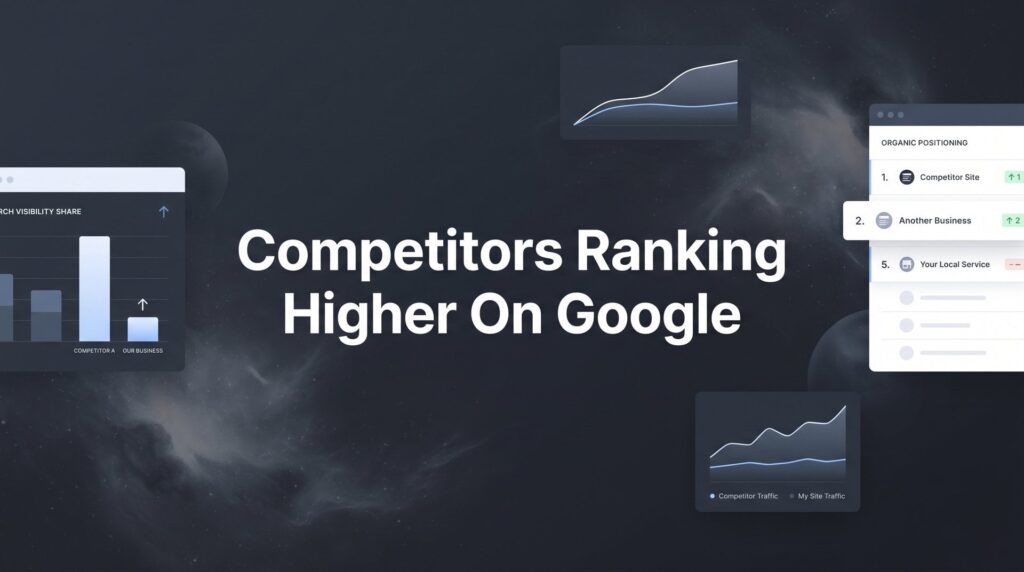
You search for your own business on Google, and there they are. Your competitors, sitting comfortably above you in the results, collecting the calls and form submissions that should be coming to you. It’s not just annoying. It’s costing you real money every single day those rankings stay the way they are.
Here’s what most business owners get wrong about this situation: they assume competitors are ranking higher because they have a bigger budget, a fancier website, or some insider connection. Rarely true. Competitors ranking higher on Google have typically done specific, learnable things to earn that position. And the gap between where you are and where they are is almost always closeable.
This guide is built for local business owners who are done watching competitors dominate while their phone stays quiet. Whether you run an HVAC company, a plumbing operation, a restoration service, a law firm, or any other local business, the playbook is the same. Google rewards businesses that do the right things consistently. The question is whether you know what those things are.
What follows is a seven-step action plan that goes from diagnosis to execution. We’ll start by figuring out exactly where you’re losing ground, then move through the specific changes that actually shift rankings: on-page fixes, content improvements, Google Business Profile optimization, backlinks, technical performance, and ongoing tracking. Each step builds on the last.
No vague theory. No generic advice you’ve already heard. Just the moves that matter for local businesses competing in real markets against real competitors. Let’s get into it.
Step 1: Run a Competitive Gap Analysis to See Exactly Where You’re Losing
Before you fix anything, you need to understand precisely what you’re up against. A competitive gap analysis tells you which keywords your competitors rank for that you don’t, which pages they have that you’re missing, and how their overall authority compares to yours. Without this, you’re guessing.
Start with the free tools you already have access to. Open Google Search Console and look at your performance data. Filter by queries and sort by impressions. You’ll see what Google thinks your site is relevant for. Then manually search your most important service keywords and note who consistently appears above you. These are your primary competitors for this analysis.
From there, a tool like Semrush, Ahrefs, or even the free tier of Ubersuggest can show you the keyword gap. Enter a competitor’s domain and your own, and look for keywords they rank for in positions one through twenty that your site doesn’t appear for at all. This is your opportunity list.
You’re looking at three dimensions simultaneously:
Keyword rankings: Which specific terms are they capturing that you’re invisible for? Pay attention to service-specific keywords, location-based keywords, and question-based searches in your niche.
Content depth: Do they have dedicated pages for services you offer but haven’t written about? Do their pages go deeper than yours on topics you both cover? A quick side-by-side comparison of word count, structure, and specificity often reveals the gap clearly.
Backlink profiles: How many referring domains do they have compared to you? Are they earning links from local directories, industry sites, or news sources that you haven’t tapped? Understanding this is critical if competitors are outranking you consistently.
Document everything in a simple spreadsheet. Column one: the keyword. Column two: their ranking position. Column three: the URL of their page that ranks. Column four: whether you have a comparable page. This document becomes your roadmap for the steps that follow.
Your success indicator here is a clear list of ten to twenty keyword gaps, with specific competitor pages identified for each. If you can name the exact pages beating you and why, you’re ready to move forward.
Step 2: Fix Your On-Page SEO Foundation Before Anything Else
You can create great content and build backlinks all day, but if your on-page fundamentals are broken, you’re building on sand. On-page SEO is what tells Google what each page is about, who it’s for, and why it should rank. If your competitors have done this well and you haven’t, that alone explains a significant portion of the ranking gap.
Start with a page-by-page audit of your most important service pages. For each one, compare your title tag against the competitor page that outranks you. Is your title specific? Does it include the primary keyword naturally? Does it match what someone searching that term actually wants to find? Title tags are still one of the clearest signals you can send to Google about a page’s purpose.
Then check your header structure. Your H1 should clearly state what the page is about, and your H2s should organize the content logically around related subtopics. If your page has one H1 and then a wall of unbroken text, compare that to a competitor page with clear sections, subheadings, and organized information. The difference in readability, and in how Google processes the page, is significant.
Keyword cannibalization is a common issue that quietly kills rankings. This happens when multiple pages on your site target the same or very similar keywords, and Google doesn’t know which one to rank. Every service page should have a clear, unique primary keyword focus. If you have three pages that all seem to be about “emergency plumbing,” consolidate or differentiate them. For plumbing businesses specifically, having a clear Google Ads management strategy can complement your organic efforts while you close the SEO gap.
Search intent matters more now than it did a few years ago. If the competitors ranking above you for a keyword have detailed, comprehensive guides and your page is a thin two-paragraph service description, Google will likely prefer their content. Match the format and depth that’s already winning for that keyword.
For local businesses specifically, LocalBusiness schema markup is worth implementing on every relevant page. Schema helps Google understand your business type, service area, hours, and contact information in a structured way. It’s not a magic ranking boost, but it fills in context that Google values for local search.
Also check image alt text, internal linking, and URL structures. Alt text should describe images accurately with natural keyword inclusion where relevant. Internal links should connect related pages logically, helping both users and search crawlers navigate your site. URLs should be clean and descriptive, not strings of numbers and parameters.
One pitfall to avoid: keyword stuffing. Repeating your target keyword unnaturally throughout a page is a tactic that worked years ago and actively works against you now. Write for the person reading the page. Use natural language, include related terms and synonyms, and let the content quality do the work.
Your success indicator: every key service page has a unique, intent-matched title tag, a logical header structure, schema markup implemented, and no keyword cannibalization conflicts across the site.
Step 3: Create Content That Actually Deserves to Rank
Here’s the hard truth about content: Google doesn’t rank pages because they exist. It ranks pages because they’re genuinely useful to searchers. If your competitors are outranking you on content, it’s usually because their pages answer questions more completely, provide more specific information, or are structured more clearly than yours.
Go back to the keyword gaps you identified in Step 1. For each priority keyword, open the top-ranking page and study it. What format are they using? Is it a long-form guide, a service page with FAQs, a comparison piece? How long is it? What specific questions does it answer? What does it include that a searcher would genuinely find helpful?
Your job is not to copy that page. Your job is to build something better. That might mean going deeper on a topic, adding more specific local information, including clearer explanations, or addressing questions the competitor page ignores. Think about what your actual customers ask you when they call. Those questions are content opportunities.
The content gaps from your analysis are particularly valuable here. If a competitor has a dedicated page for a service you offer but haven’t written about, that’s a direct opportunity. Create that page. Optimize it properly. Give it real depth and local specificity.
Location-specific content is an area where many local businesses underinvest and where competitors often leave gaps. If you serve multiple neighborhoods or cities, consider creating pages that speak directly to those areas with genuinely local details, not just a generic page with the city name swapped in. Reference local landmarks, community context, specific service needs in that area. Google and local searchers both respond to content that feels genuinely relevant to a place. Deciding between organic content and paid channels is another key consideration, and understanding the tradeoffs of Facebook Ads vs Google Ads for local business can help you allocate resources wisely.
Adding unique value is what separates content that ranks from content that just exists. If you’ve been in your industry for fifteen years, you have knowledge and perspectives that a generic content writer doesn’t. Share specific insights from your experience. Explain common mistakes you see in your service area. Provide clarity on questions that confuse your customers. This kind of original expertise is exactly what Google is increasingly rewarding.
When you publish new content or significantly improve existing pages, submit them to Google Search Console for indexing. Don’t just publish and hope Google finds it eventually.
Your success indicator: you’ve published or substantially improved pages that directly compete with the top-ranking content for your priority keywords, with better depth, local specificity, or unique value than what currently ranks.
Step 4: Dominate Your Google Business Profile and Local Pack
For local businesses, this step might be the single highest-leverage action on the entire list. The Google Map Pack, the three local business listings that appear at the top of local search results, often drives more phone calls than organic website rankings. Many business owners focus exclusively on website SEO while their competitors quietly win in the local pack.
Start with a complete audit of your Google Business Profile. Log in and go through every section. Your primary category should precisely match your core business type. Add all relevant secondary categories. Fill out your services list completely, including descriptions for each service. Your business description should naturally incorporate your main keywords while reading as a genuine description of what you do and who you serve.
Photos matter more than most people realize. Businesses with more photos and regularly updated images tend to see stronger engagement in the local pack. Add photos of your team, your work, your vehicles, your location. Update them regularly. Google notices active profiles. If your map listing isn’t showing up where it should, our guide on Google Maps not ranking covers the specific fixes you need.
Reviews are one of the most powerful local ranking signals, and they’re also the thing most businesses handle passively. Don’t wait for happy customers to leave reviews on their own. Build a system. After every completed job, send a direct link to your Google review page via text or email. Train your team to ask. Make it easy and frictionless for the customer. Respond to every review, positive and negative. Thoughtful responses to negative reviews often matter more to potential customers than the negative review itself.
NAP consistency, meaning your business Name, Address, and Phone number appearing identically across all online directories, matters for local SEO. Check your listings on Yelp, Facebook, Bing Places, Apple Maps, industry-specific directories, and anywhere else your business appears. Inconsistencies confuse Google and can suppress your local rankings.
Post updates to your Google Business Profile at least weekly. These can be short: a recently completed project, a seasonal promotion, a helpful tip for homeowners, a response to a common question. Active profiles signal to Google that the business is current and engaged.
A common mistake is treating GBP as a set-it-and-forget-it task. Your competitors who consistently appear in the local pack are almost certainly maintaining their profiles actively. Match that effort and then exceed it.
Your success indicator: your GBP is fully complete in every section, you’re generating new reviews consistently each month, your NAP is consistent across major directories, and you’re showing up in local pack results for your primary service keywords.
Step 5: Build Authority with Strategic Backlinks
Backlinks, links from other websites pointing to yours, remain one of the strongest signals Google uses to evaluate a site’s authority and trustworthiness. If your competitors have significantly more quality backlinks than you do, that’s a meaningful part of why they outrank you. This is also one of the harder gaps to close quickly, which is exactly why you should start now.
Begin with the easy wins. Local business directories are a starting point: Google Business Profile, Bing Places, Yelp, the Better Business Bureau, and any industry-specific directories relevant to your trade. Your local chamber of commerce often offers member listings with links. Supplier and manufacturer partner pages sometimes list certified or preferred contractors. These aren’t glamorous, but they’re legitimate, relevant links that establish your local presence.
From there, think about community involvement as a link-building strategy. Sponsoring a local sports team, participating in a community event, partnering with a local charity, or getting involved with a trade association often results in a link from an organization’s website. These links carry real weight because they’re genuinely earned and locally relevant.
Go back to your competitor backlink analysis from Step 1. Look at where their links are coming from. Are there local news sites that have covered businesses in your industry? Industry blogs that accept guest contributions? Partner directories you haven’t listed in? Each of these is a specific opportunity you can pursue. While you build organic authority, running paid campaigns through a Google Ads management service can keep leads flowing in the meantime.
What to avoid: link schemes, paid link networks, and bulk directory submissions to low-quality sites. Google is sophisticated at identifying manipulative link patterns, and the risk of a penalty far outweighs any short-term gain. Focus on relevance and genuine authority. Two links from respected local sources are worth more than fifty links from irrelevant, low-quality sites.
Link building is a slow, ongoing effort. Set a realistic goal of earning a handful of quality backlinks each month from relevant sources. Over time, this compounds into a meaningful authority advantage.
Your success indicator: you’re earning new backlinks consistently each month from relevant, authoritative sources, and your referring domain count is trending upward compared to your competitors.
Step 6: Improve Technical Performance So Google Doesn’t Hold You Back
You can do everything else right and still lose rankings to a competitor whose website simply works better. Technical SEO isn’t the most exciting part of this process, but it’s the foundation everything else sits on. If Google’s crawlers struggle to access your site, or if your pages load slowly on mobile, you’re handing competitors an advantage they don’t deserve.
Start with Google PageSpeed Insights. Enter your key service pages and review the results for both mobile and desktop. Pay particular attention to Core Web Vitals: Largest Contentful Paint, which measures loading speed; Cumulative Layout Shift, which measures visual stability; and Interaction to Next Paint, which measures responsiveness. Google uses these metrics as ranking signals, and a site that fails them may be deprioritized in favor of a faster competitor.
Mobile performance is non-negotiable. The majority of local searches happen on mobile devices. If your site is slow, hard to navigate, or displays poorly on a phone, you’re losing both rankings and conversions. Test your site on an actual phone, not just a desktop browser preview.
Open Google Search Console and check the Coverage report for crawl errors. Broken pages, redirect chains, and blocked resources all create friction for Google’s crawlers. Fix these systematically. Also verify that your XML sitemap is submitted and that your robots.txt file isn’t accidentally blocking important pages from being indexed.
Review your site architecture. Is there a logical hierarchy from your homepage to service category pages to individual service pages? Can a user, or a search crawler, reach any important page within a few clicks from the homepage? A clean, logical structure helps Google understand the relationships between your pages and distribute ranking authority effectively. Similarly, poor landing page structure can tank your paid campaigns too — learning how to improve Google Ads performance often starts with the same technical fundamentals.
HTTPS security is a baseline requirement. If your site still runs on HTTP, that needs to be fixed immediately. It’s both a ranking signal and a trust signal for visitors.
One pitfall worth highlighting: website redesigns. Many businesses invest in a beautiful new website and then wonder why their rankings dropped. Redesigns can break URL structures, remove content, slow down page speed, or disrupt internal linking. If you’re planning a redesign, treat SEO preservation as a core requirement, not an afterthought.
Your success indicator: Core Web Vitals pass for your key pages, there are zero critical crawl errors in Search Console, your site is fully mobile-responsive, and HTTPS is properly implemented.
Step 7: Track, Measure, and Adjust Monthly
SEO without measurement is just guessing. The businesses that consistently close ranking gaps and eventually overtake competitors are the ones that track their progress systematically and adjust based on what the data shows. This final step is what turns a one-time effort into a compounding advantage.
Set up rank tracking for your priority keywords. Tools like Semrush, Ahrefs, or dedicated rank trackers like BrightLocal for local SEO will monitor your positions weekly. You want to see movement, even small movement, as a signal that your efforts are working. Stagnant rankings after implementing changes are a signal to dig deeper.
Review Google Search Console monthly. Look at impressions, clicks, and average position trends for your target keywords. Are you appearing for more queries over time? Is your average position improving? Are clicks increasing as rankings rise? This data tells the story of your SEO progress more honestly than any other source. The same data-driven mindset applies to paid search — mastering Google Ads optimization techniques requires the same commitment to tracking and iterating.
Track which specific actions are moving the needle. If you published three new pages and two of them are gaining impressions while one isn’t, that’s information. Double down on what’s working. Revisit what isn’t and figure out why.
Set ninety-day milestones. SEO improvements rarely happen overnight, but you should see measurable directional progress within a quarter of focused effort. Realistic targets depend on your competitive gap, but movement in average position, increased impressions, and new keyword appearances are all positive signals in the early months.
One important reality check: SEO is not a one-time project. Your competitors are also optimizing. The businesses that dominate local search results aren’t sitting still; they’re consistently doing the things in this guide. Your goal is to outpace them over time, not just catch up once.
If you’ve executed these steps consistently for three to six months and haven’t seen meaningful movement, the gap may require a more advanced strategy or a fresh set of expert eyes. That’s a reasonable point to consider bringing in professional help rather than continuing to push without results. Exploring Google Ads agency alternatives can also supplement your organic strategy while you work to close the ranking gap.
Your success indicator: you have a monthly reporting rhythm, you can clearly see ranking trends moving in the right direction, and you’re making informed decisions about where to focus next based on real data.
Your Action Plan: Putting It All Together
Closing the gap when competitors are ranking higher on Google isn’t about one magic fix. It’s about systematically executing across multiple fronts, each one reinforcing the others. On-page SEO gives Google the right signals. Strong content gives it something worth ranking. A fully optimized Google Business Profile captures local pack visibility. Backlinks build the authority that earns trust. Technical performance removes the friction that holds rankings back. And consistent tracking ensures you’re learning and improving every month.
Use this checklist to stay on track:
Competitive gap analysis completed: Keyword and content gaps documented in a working spreadsheet.
On-page SEO audited and optimized: Every key service page has a unique title tag, proper headers, schema markup, and no cannibalization issues.
New or improved content published: Priority keyword gaps are being addressed with pages that genuinely deserve to rank.
Google Business Profile fully optimized: Complete in every section, active review generation in place, NAP consistent across directories.
Backlink building in motion: Consistent monthly progress earning links from relevant, authoritative sources.
Technical audit passed: Core Web Vitals in the green, no critical crawl errors, mobile experience solid.
Monthly tracking established: Rank tracking and Search Console reviews happening on a regular schedule.
This is real work. It takes time and consistent effort. But every step you take is ground your competitors have to work harder to take back.
If you’d rather have a team that lives and breathes this handle it for you, Clicks Geek specializes in helping local businesses stop losing leads to competitors and start dominating their local search results. If you want to see what this would look like for your specific business, we’ll walk you through exactly how it works and what’s realistic in your market.