Most local service businesses aren’t short on marketing options. They’re short on marketing that actually books jobs. The difference between a channel that fills your calendar and one that burns through your budget comes down to fit: the right approach for your trade, your market, and where you are in your growth.
This list covers nine approaches that consistently produce real leads for local service businesses. Each one is paired with the tools and partners that make it work in practice. Whether you run an HVAC company, a roofing crew, a plumbing shop, or any other trade, the goal is the same: more booked jobs, not more traffic.
One thing worth knowing before you dive in: 40 to 70% of local service leads still come in by phone. Any marketing approach that doesn’t account for that reality is already leaving money on the table.
1. Clicks Geek
Best for: Local service businesses that want a single agency managing paid and organic growth with industry-specific expertise.
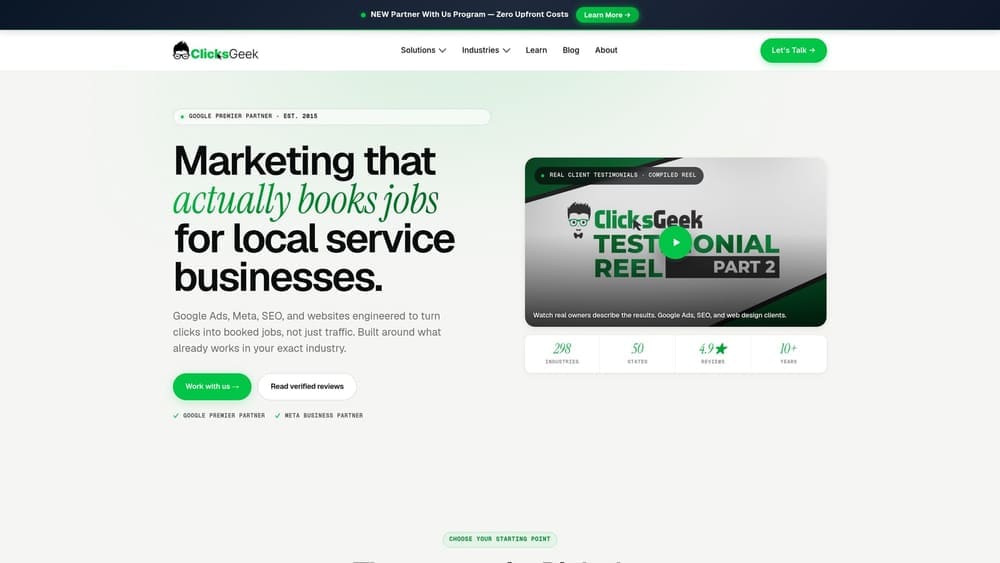
Clicks Geek is a Google Premier Partner agency built specifically for local service businesses, with industry playbooks across 298 trades, no lock-in contracts, and a focus on cost per booked job rather than vanity metrics.
Where This Tool Shines
Most agencies apply the same generic strategy regardless of trade. Clicks Geek operates differently: the agency has built playbooks from $100M+ in managed ad spend across 10,000+ campaigns, which means the strategy for a roofing company isn’t the same template handed to a pest control operator. That trade-specific depth matters when you’re competing in a local market where the wrong keyword or the wrong bid strategy burns budget fast.
The no lock-in contract structure is also worth noting. For business owners who’ve been burned by long-term agency commitments that delivered reports instead of results, month-to-month engagement changes the accountability dynamic considerably.
Key Features
298 Industry Playbooks: Campaign strategies built from real spend data across nearly every home service and trade vertical, not adapted from generic templates.
Google Premier Partner and Meta Business Partner: Access to platform-level support, beta features, and account review that standard accounts don’t receive.
Unified PPC, SEO, and Lead Generation: Paid and organic channels managed as a coordinated strategy rather than siloed services.
No Lock-In Contracts: Month-to-month engagement keeps the relationship performance-dependent from both sides.
White-Label PPC and SEO: Available for agencies that want to offer local search services under their own brand.
Best For
Local service businesses that have tried running ads themselves or worked with a generalist agency and want a team that already knows their trade. Also well-suited for agencies looking to add white-label local search capacity without building an in-house team.
Pricing
Custom pricing based on services, market size, and competitive intensity. Contact Clicks Geek directly for a strategy call and market assessment.
2. Google Ads
Best for: Businesses that need leads now and can’t wait six months for SEO to build.
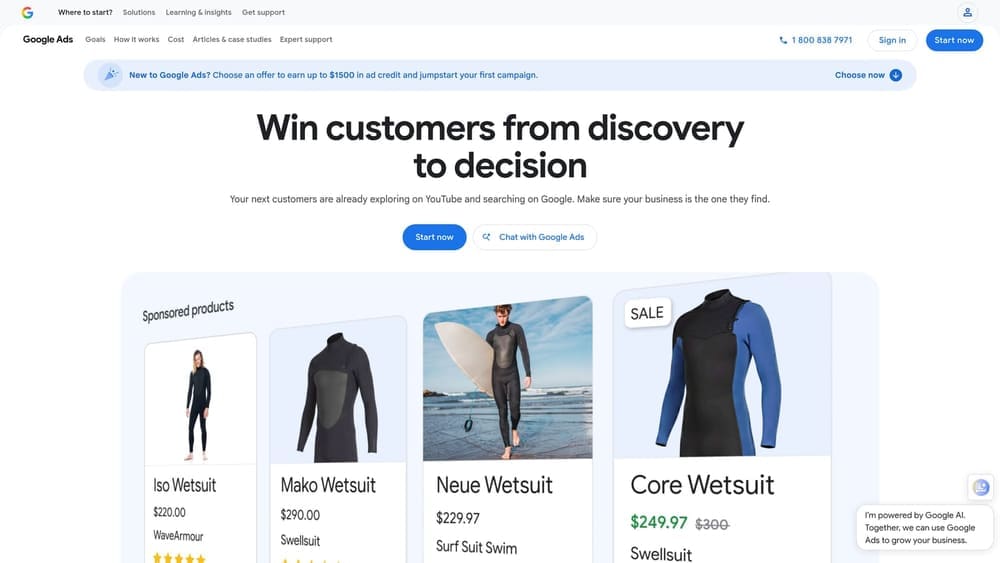
Google Ads is the most direct way to put your business in front of someone actively searching for your service at the moment they need it.
Where This Tool Shines
The intent signal is what separates Google Ads from every other paid channel. Someone searching “emergency plumber near me” at 11pm isn’t browsing. They’re ready to call whoever shows up first. Paid search captures that moment in a way no social platform can replicate. For trades where jobs are unplanned or urgent, this is usually the right first channel.
Ramp time runs 30 to 90 days before campaigns stabilize, so set that expectation early. Once dialed in, you have real-time control over budget, geography, and the specific services you want to promote. If you want to go deeper on setup and structure, this breakdown of Google Ads for service businesses covers the mechanics in detail.
Key Features
High-Intent Keyword Targeting: Reaches searchers at the exact moment they’re looking for your service, not just browsing.
Geographic Precision: Target by zip code, radius, or custom service area to avoid paying for clicks outside your coverage zone.
Call-Only and Call Extension Formats: Built for phone-first lead generation, which matters when 40 to 70% of your leads come in by phone.
Performance Max Campaigns: Extends reach across Search, Display, YouTube, and Maps from a single campaign structure.
Fast Feedback Loop: Data starts accumulating immediately, unlike SEO where you’re waiting months for ranking movement.
Best For
Any local service business that needs booked jobs within the next 90 days. Especially effective for emergency trades like plumbing, HVAC, and electrical where search intent is high and purchase decisions are immediate.
Pricing
Pay-per-click. Home services CPL typically runs $18 to $35 based on Clicks Geek benchmark data. Minimum effective budgets vary by market and trade competitiveness.
3. Google Local Services Ads (LSA)
Best for: Qualified local service businesses that want to pay only for verified leads, not clicks.
Google Local Services Ads is Google’s pay-per-lead program for home service businesses, featuring the Google Guarantee badge at the top of search results, above standard paid ads.
Where This Tool Shines
LSA sits in a unique position in the search results: above regular Google Ads, with a badge that signals Google has verified the business’s license and background check. For a consumer deciding between three plumbers they’ve never heard of, that badge does real work. It’s not just visibility; it’s credibility at the moment of decision.
The pay-per-lead model also changes the risk profile compared to standard PPC. You’re not paying for clicks that bounce. Google provides a dispute process for leads that are clearly invalid or outside your service area, which gives you some recourse on wasted spend.
Key Features
Pay-Per-Lead Model: You’re charged for verified leads, not clicks, which removes a layer of wasted spend from the equation.
Google Guarantee Badge: Appears at the top of search results and signals verified licensing and background screening to potential customers.
Prime Real Estate: LSA listings appear above standard Google Ads, giving qualifying businesses a visibility advantage.
Eligibility Requirements: Background check and license verification required, which filters out less credible competitors in your category.
Lead Dispute Process: Flag and dispute leads that don’t meet eligibility criteria to recover credit on invalid contacts.
Best For
Established local service businesses with verified licensing that want to complement their Google Ads presence with a pay-per-lead layer. Works especially well for trades with strong Google Guarantee coverage like plumbing, HVAC, electrical, and cleaning.
Pricing
Pay-per-lead with no monthly management fee from Google. Lead costs vary by trade and market. Budget is set weekly and can be adjusted based on lead volume and quality.
4. Google Business Profile and Local SEO
Best for: Businesses willing to invest consistently over 6 to 12 months in exchange for lower long-term cost per lead.
Google Business Profile is the foundation of local SEO and the primary driver of Map Pack placement, which captures roughly 42% of local search clicks.
Where This Tool Shines
The Map Pack is prime real estate. Three businesses show up there for most local searches, and the click share those positions command is significant. Getting into that pack requires a well-optimized Google Business Profile, consistent NAP information across the web, review velocity, and ongoing SEO work. None of that happens overnight, but the payoff compounds in a way paid ads don’t.
At 12 or more months of consistent investment, local SEO CPL typically reaches $7 to $15, well below what most paid channels deliver. That’s the long-game argument for building this channel in parallel with paid from day one, even if it doesn’t generate leads immediately.
Key Features
Map Pack Placement: Positions your business where roughly 42% of local search clicks go, according to Clicks Geek benchmark data.
Review Management: Review volume and recency directly influence both ranking and conversion rate once a searcher lands on your profile.
Profile Completeness: Service area, hours, photos, services, and Q&A all contribute to how Google evaluates your relevance for local queries.
Posts and Updates: Regular activity signals to Google that the profile is actively managed, which matters for ranking.
Compounding Returns: Unlike paid ads, strong local SEO positions tend to hold and improve with continued effort rather than disappearing when spend stops.
Best For
Any local service business, but particularly those that are established and want to reduce reliance on paid channels over time. Also critical for businesses in markets where Google Ads CPL is high due to competition.
Pricing
Google Business Profile is free. SEO investment varies by agency or in-house effort. Expect 6 to 12 months before meaningful ranking movement in competitive markets.
5. Meta Ads (Facebook and Instagram)
Best for: Visual trades where seeing finished work creates demand, or businesses targeting specific homeowner demographics.
Meta Ads covers Facebook and Instagram advertising, and it operates differently from search. You’re reaching people before they’ve searched, which means the creative has to create the desire rather than just capture it.
Where This Tool Shines
For trades like remodeling, landscaping, painting, and roofing, before-and-after creative formats perform well because the finished product is visually compelling. A homeowner scrolling Facebook who sees a dramatic kitchen remodel or a freshly landscaped yard may not have been actively searching, but the image plants the seed. That’s demand generation, and it works for the right trades.
Meta’s audience targeting by geography, demographics, and home ownership status also lets you get specific about who sees your ads. Lead form ads reduce friction for mobile users by keeping them inside the platform rather than redirecting to a website. For more on getting Meta campaigns right for service businesses, this guide on Facebook Ads for local services is worth reading. CPL typically runs $10 to $25 for home service businesses based on Clicks Geek benchmark data.
Key Features
Demographic and Interest Targeting: Reach homeowners by geography, age, income range, and interests relevant to your trade.
Before/After Creative Formats: Visual proof of work performs well for trades where the finished result is the selling point.
Lead Form Ads: Capture contact information without sending users to a landing page, reducing drop-off on mobile.
Retargeting: Keep your brand visible to people who’ve visited your website but haven’t called yet.
Flexible Budgets: Most local service businesses start at $500 to $1,500 per month in ad spend and scale from there based on results.
Best For
Remodelers, landscapers, painters, roofers, and other visual trades where the finished work creates desire. Also useful for businesses running promotions or seasonal offers to a defined geographic audience.
Pricing
Pay-per-click or pay-per-lead. Budget is fully flexible. CPL typically runs $10 to $25 for home service businesses. Speed of follow-up on leads is critical to conversion rate.
6. CallRail
Best for: Any business running paid ads that needs to know which campaigns, keywords, or channels are actually driving calls.
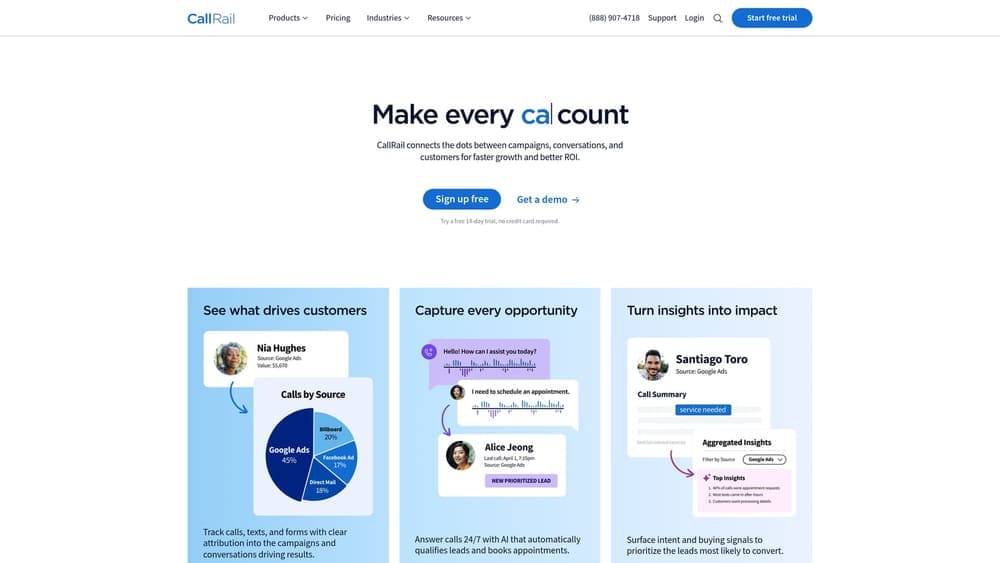
CallRail is call tracking and analytics software that shows exactly which marketing channel, campaign, or keyword drove each inbound call, so you’re not guessing where your leads came from.
Where This Tool Shines
When 40 to 70% of your leads come in by phone, knowing which ad or keyword triggered each call isn’t optional. Without call tracking, you’re looking at click data and guessing at results. CallRail closes that gap with dynamic number insertion, which swaps the phone number on your website based on how a visitor arrived, so every call gets attributed to the right source.
The call recording and transcription features add another layer of utility. You can review calls to assess lead quality, check how your team is handling inquiries, and identify patterns in what prospects are asking about. That’s operational intelligence, not just marketing data.
Key Features
Dynamic Number Insertion: Tracks calls to specific keywords, ads, and campaigns by showing unique numbers to different traffic sources.
Call Recording and Transcription: Review calls for quality, identify common objections, and assess how leads are being handled on your end.
Multi-Channel Attribution: Connects call data across Google Ads, SEO, Facebook, and direct traffic in one dashboard.
CRM and Google Ads Integration: Feeds call conversion data back into Google Ads so the algorithm optimizes toward actual leads, not just clicks.
Form Tracking: Captures non-phone leads in the same dashboard so you have a complete picture of lead volume by source.
Best For
Any local service business running paid ads across more than one channel. Essential for businesses that want to measure cost per lead accurately and optimize budget allocation based on real conversion data rather than click volume.
Pricing
Plans start at approximately $45 per month. Pricing scales with call volume and features. Most small service businesses find a mid-tier plan covers their needs.
7. Jobber
Best for: Home service businesses that need to manage quotes, scheduling, and payments without stitching together multiple disconnected tools.
Jobber is field service management software built specifically for home service and trade businesses, covering the full cycle from quoting through payment collection.
Where This Tool Shines
Generating leads is only half the problem. If a quote sits in your email for three days without a follow-up, or if scheduling a job requires five back-and-forth text messages, you’re losing revenue that marketing already paid to acquire. Jobber handles the operational side of converting leads into booked and completed jobs, which makes your marketing spend more efficient without changing the ads at all.
The automated review request feature is particularly useful. After a job closes, Jobber can automatically prompt the customer to leave a review, which feeds directly into the Google Business Profile and local SEO strategy. That’s one less manual task that often gets skipped when a crew is busy.
Key Features
Trade-Specific CRM: Client records with full job history, notes, and contact information organized for service businesses, not generic sales teams.
Online Quoting with Follow-Up Reminders: Send quotes digitally and trigger automatic follow-ups on estimates that haven’t been accepted.
Scheduling and Dispatch: Manage single-tech or multi-crew scheduling with a visual calendar and route optimization.
Automated Review Requests: Trigger review asks after job completion to build Google and Facebook review volume consistently.
Integrated Invoicing and Payments: Invoice and collect payment in the same platform, reducing the administrative back-and-forth after a job closes.
Best For
Home service businesses with at least one technician in the field. Particularly valuable for businesses that are growing and finding that manual scheduling, quoting, and follow-up are becoming bottlenecks.
Pricing
Plans start at approximately $49 per month. Higher tiers add automation, reporting, and multi-user features. Pricing scales with team size and feature requirements.
8. BrightLocal
Best for: Businesses or agencies that want granular local SEO data, including rank tracking by zip code and citation auditing.
BrightLocal is a local SEO platform with rank tracking, citation management, and reputation monitoring built specifically for local search, not general SEO.
Where This Tool Shines
Most SEO tools show you rankings at a broad regional or national level, which is almost meaningless for a business that serves three zip codes. BrightLocal tracks rankings at the zip code or city level, so you can see exactly where you’re winning and where you’re losing visibility in your actual service area. That specificity matters when you’re trying to prioritize where to focus SEO effort.
The citation audit is equally useful. Inconsistent NAP (name, address, phone) information across directories is one of the more common local SEO problems that’s easy to fix once you know where the inconsistencies are. BrightLocal surfaces those issues clearly so they can be corrected systematically.
Key Features
Hyper-Local Rank Tracking: Track rankings by zip code or city rather than broad regional averages that don’t reflect your actual competitive position.
Citation Audit: Identifies inconsistent NAP listings across directories that can suppress local rankings.
Google Business Profile Monitoring: Tracks changes, review activity, and profile completeness over time.
Competitor Rank Comparison: See how your rankings compare to specific competitors in your service area.
White-Label Reporting: Agencies can present BrightLocal data under their own brand for client reporting.
Best For
Local service businesses actively investing in SEO who want to track progress accurately. Also widely used by local SEO agencies managing multiple client accounts.
Pricing
Plans start at approximately $39 per month for a single business. Agency plans are available at higher tiers with multi-location and white-label capabilities.
9. Birdeye
Best for: Businesses that want to systematize review generation and manage their online reputation across multiple platforms from one place.
Birdeye is a reputation management and review generation platform that automates review requests and centralizes responses across Google, Facebook, and other directories.
Where This Tool Shines
Reviews are not just a trust signal for potential customers. They’re a ranking factor for Google Business Profile. A business with 12 reviews and a 4.2 average is going to lose Map Pack visibility to a competitor with 200 reviews and a 4.8 average, even if every other SEO signal is comparable. Birdeye automates the ask, which is the step that most service businesses skip because it requires manual effort after every job.
The centralized inbox for responding to reviews across multiple platforms is also practical. When you’re running a crew and fielding calls, logging into Google, Facebook, and Yelp separately to respond to reviews doesn’t happen consistently. Birdeye puts all of that in one place, which makes it more likely to actually get done.
Key Features
Automated Review Request Sequences: Sends text and email review requests after service completion without manual intervention from your team.
Centralized Review Inbox: Respond to reviews across Google, Facebook, and other platforms from a single dashboard.
Review Monitoring and Alerts: Get notified when new reviews come in so nothing goes unaddressed for days.
Listings Management: Keeps NAP consistent across directories, which supports local SEO alongside the review benefits.
Competitor Review Reporting: Track how your review volume and rating compare to competitors in your market.
Best For
Any local service business that wants to build review volume systematically rather than relying on customers to leave reviews unprompted. Particularly valuable for businesses with multiple locations or high job volume where manual follow-up isn’t feasible.
Pricing
Custom pricing based on business size and number of locations. Contact Birdeye directly for a quote.
Which Approach Fits Where You Are Right Now
No single channel wins for every trade in every market. The businesses that consistently fill their schedules pick one or two paid channels to generate immediate leads, build their local SEO presence in parallel, and use operational tools to make sure those leads actually convert into revenue.
If you’re early-stage or in a competitive market, Google Ads and LSA give you the fastest feedback loop. You’ll know within 30 to 90 days whether the economics work in your market. If you’re established and want to reduce cost per lead over time, local SEO is where the compounding returns live. Facebook works best for trades where seeing the finished work creates the desire to buy.
The tools in the middle of this list, CallRail, Jobber, BrightLocal, and Birdeye, aren’t optional extras once you’re spending real money on marketing. CallRail tells you which channels are actually producing calls. Jobber makes sure those calls turn into booked and completed jobs. BrightLocal shows you where your SEO is winning and where it isn’t. Birdeye builds the review volume that makes your Google Business Profile competitive.
Start with the channel that fits your current situation. Measure cost per booked job rather than traffic or impressions. Add channels only when the first one is running profitably. For a broader look at how to think about channel prioritization, this breakdown of cost-effective marketing channels for small businesses covers the tradeoffs in more depth. And if you want to think through which channel gives you the fastest return, this piece on which marketing investments produce the fastest results is worth your time.
If you want a team that has already mapped the strategy for your specific trade, Clicks Geek has built playbooks across 298 industries from $100M+ in managed spend. No lock-in contracts, and the focus is always on jobs booked, not reports generated. If you want to see what this would look like for your business, we’ll walk you through how it works and break down what’s realistic in your market.