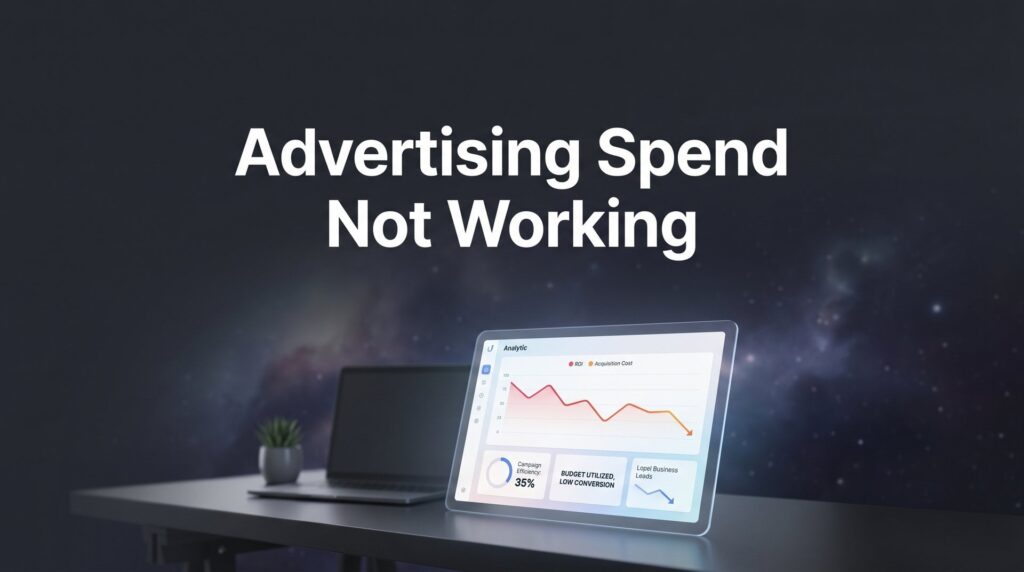
You open your ad dashboard on a Tuesday morning, coffee in hand, and see the number staring back at you: thousands of dollars spent this month. Then you look at your phone log. Quiet. You check your contact form submissions. A handful of tire-kickers, maybe one real lead. The math doesn’t add up, and the frustration is real.
Here’s the thing: you’re not alone, and the problem almost certainly isn’t that paid advertising doesn’t work. The problem is that something specific is broken in your setup, and right now you’re paying full price for a system that’s delivering partial results.
This isn’t a pitch to spend more. It’s a diagnostic guide. Over the next few sections, we’re going to walk through the most common reasons advertising spend stops delivering, from targeting errors and landing page failures to tracking blind spots and platform mismatches. These are the exact issues the team at Clicks Geek, a Google Premier Partner agency, encounters when auditing underperforming ad accounts. The patterns repeat constantly, and more importantly, they’re fixable.
So before you pause your campaigns out of frustration or double down on a budget that’s already bleeding, let’s figure out where the real problem is.
The 5 Silent Budget Killers Draining Your Ad Spend
Most wasted ad spend doesn’t disappear in one dramatic moment. It leaks slowly, quietly, through a handful of structural problems that compound over time. Here are the ones that show up most often.
Broad Audience Targeting: When you cast too wide a net, you pay for attention from people who will never buy from you. A local HVAC company running ads to an entire metro region without geographic tightening, demographic filters, or intent signals will rack up clicks from renters, competitors, and people just browsing. Each of those clicks costs real money. Narrowing your audience feels counterintuitive at first, but it consistently brings down cost per lead because you’re reaching people who actually match your customer profile.
Weak or Mismatched Ad Creative: Your ad makes a promise. Your landing page either keeps it or breaks it. When someone clicks an ad that says “Same-Day Plumbing Repairs” and lands on a generic homepage with a contact form buried at the bottom, they leave. You paid for that click. The disconnect between ad message and landing page experience is one of the most common and costly mistakes in paid advertising, and it’s entirely preventable with proper message matching. Understanding why your ads are not converting often starts with this exact issue.
Ignoring Negative Keywords: In Google Ads, your ads can show up for searches that are loosely related to your keywords but completely irrelevant to your business. A law firm targeting “personal injury attorney” might also show up for “personal injury attorney salary” or “how to become a personal injury attorney” without proper negative keyword lists in place. These clicks drain budget without any realistic chance of conversion. Regularly reviewing your search term report and building out negative keyword lists is one of the highest-leverage actions you can take in any Google Ads account.
Poor Placement Exclusions on Display and Social: Facebook and Google’s Display Network will put your ads in front of a massive audience if you let them. That sounds good until you realize your local restaurant ad is showing up in mobile games played by teenagers, or your B2B service ad is running on irrelevant content sites. Placement exclusions give you control over where your budget actually goes. Without them, the platforms optimize for their own metrics, not yours. If your Facebook campaigns specifically are underperforming, it’s worth learning how to stop Facebook ads from wasting budget.
Automated Bidding Without Enough Data: Smart bidding strategies in Google Ads can be powerful, but they require sufficient conversion data to function correctly. When accounts don’t have enough tracked conversions, automated bidding strategies can make poor decisions at scale, overpaying for low-quality clicks and underinvesting in the searches that actually convert. This is a nuanced problem that many self-managed accounts run into without realizing it.
The common thread across all five of these issues: they’re invisible if you’re only looking at spend and click volume. You need to dig deeper.
Your Landing Page Is the Real Problem (Not Your Ads)
Here’s a conversation that happens constantly in ad account reviews. A business owner says their ads aren’t working. The click-through rate looks fine. The cost per click is reasonable. But leads? Almost none. The culprit, more often than not, is the page people land on after they click.
Ads drive traffic. Landing pages convert it. These are two completely separate jobs, and treating them as one is where most businesses go wrong.
Think about what happens from the user’s perspective. They search for something specific, see your ad, click it with a real intent to solve a problem, and then land on a page that loads slowly, looks cluttered, has no clear next step, and gives them no reason to trust you. They leave in seconds. You paid for that visit. It counted as a “click” in your dashboard, but it was never going to become a customer.
Slow Load Times: Page speed is a conversion killer. Users, especially on mobile, abandon pages that take more than a few seconds to load. If your landing page is running on a slow server or is loaded with unoptimized images and scripts, you’re losing a significant portion of your paid traffic before they even see your offer.
No Clear Call-to-Action: Every landing page needs one primary action you want the visitor to take. Call now. Fill out this form. Book your appointment. When a page has five different options, a navigation menu, links to blog posts, and three different phone numbers, visitors get confused and leave. Simplicity converts.
Lack of Trust Signals: People don’t hand over their contact information or pick up the phone for a business they don’t trust. Reviews, star ratings, certifications, guarantees, and real photos of your team or work all serve as trust signals that reduce friction. A landing page without them is asking visitors to take a leap of faith they’re not willing to take.
Generic Messaging: If your landing page could belong to any competitor in your industry, it’s not doing its job. Specificity builds confidence. “We’ve served over 400 homeowners in [your city] since 2018” is more compelling than “We provide quality service.” The more your page speaks directly to the visitor’s situation, the more likely they are to convert.
This is where conversion rate optimization, or CRO, becomes one of the highest-return investments you can make. Rather than spending more to drive additional traffic to a broken page, CRO focuses on converting the traffic you’re already paying for. Improving your landing page conversion rate from two percent to four percent effectively doubles your leads without touching your ad budget. Businesses looking to improve lead quality alongside conversion rates should explore strategies to get better quality leads from their advertising.
Tracking Blind Spots That Make Good Campaigns Look Bad
Here’s a scenario that plays out more often than most business owners realize: a campaign is actually generating leads, but broken tracking makes it look like it isn’t. The business owner pauses the campaign. Leads dry up. They assume it wasn’t working. In reality, they just couldn’t see what was happening.
Proper conversion tracking is the foundation of every functional paid advertising program. Without it, you’re making decisions based on incomplete, misleading, or outright wrong data.
The most common tracking failures include broken conversion tags that were never properly verified, form submissions that fire a “thank you” page but don’t trigger a conversion event, phone calls that never get attributed to the correct campaign, and UTM parameters that are missing or inconsistently applied. Implementing proper call tracking for ad campaigns is one of the most impactful steps you can take to close these attribution gaps.
There’s also the vanity metrics problem. Clicks and impressions are easy to find in any ad dashboard, and they feel like progress. But they’re not revenue metrics. What you actually need to track is cost per lead, cost per acquisition, and return on ad spend. These numbers tell you whether your advertising is profitable, not just active.
Cost Per Lead (CPL): How much are you paying, on average, for each new inquiry or contact? This number needs to make sense relative to your average customer value. A $150 cost per lead is excellent if your average job is worth $3,000. It’s unsustainable if your average transaction is $200.
Cost Per Acquisition (CPA): Of the leads that come in, how many actually become paying customers, and what did it cost to acquire each one? This is the number that truly connects advertising spend to business revenue.
Return on Ad Spend (ROAS): For every dollar spent on advertising, how many dollars in revenue came back? This metric only works if your tracking is clean and your CRM data connects back to your ad platform data. If your campaigns consistently show poor ROAS, it may be time to investigate whether your PPC campaigns are actually profitable or just generating activity.
Proper attribution, meaning knowing which specific campaign, ad group, or keyword drove a phone call or form submission, is what separates businesses that scale confidently from those that guess and hope. Setting this up correctly from the start is one of the first things a qualified PPC partner will do.
The Platform Mismatch Problem
Not every advertising platform works for every business. This sounds obvious, but it’s one of the most consistent sources of wasted spend for local businesses and small service providers.
Google Ads and Facebook Ads are both powerful, but they work in fundamentally different ways and serve different roles in the customer journey. Confusing the two, or choosing the wrong one for your business type, means you’re fighting the platform’s nature rather than working with it.
Google Ads captures existing demand. When someone types “emergency electrician near me” or “best divorce attorney in Phoenix,” they have a problem and they’re actively looking for a solution right now. Search advertising puts you in front of people at the exact moment of highest intent. For local service businesses, this is often the most direct path to a qualified lead. Exploring the best local advertising platforms can help you determine which channels align with your customer’s buying behavior.
Facebook Ads create demand. Users on Facebook aren’t searching for anything. They’re scrolling through content, and your ad interrupts that experience. This works well for offers with broad appeal, products that benefit from visual demonstration, or businesses building awareness over time. But for a local plumber or an emergency locksmith, interrupting someone’s Facebook scroll with an ad is a much harder conversion path than appearing when they’re actively searching for help.
This doesn’t mean Facebook is wrong for local businesses. It means the strategy has to match the platform. Retargeting website visitors on Facebook after they’ve already searched on Google can be highly effective. Implementing remarketing campaign strategies that bridge platforms is one of the smartest ways to maximize your overall ad spend. Running cold Facebook ads to a broad local audience for a high-urgency service typically isn’t.
Other platform mismatches to consider: LinkedIn is expensive on a cost-per-click basis and works best for B2B offers with longer sales cycles. YouTube advertising can build strong brand awareness but requires compelling video creative and a longer conversion window. Display advertising is generally better for retargeting than for cold audience prospecting.
The question to ask is simple: where is my customer when they’re ready to buy, and what are they doing at that moment? Your advertising platform should match that answer.
The DIY Trap: When Managing Your Own Ads Costs More Than Hiring Help
Managing your own ads to save money is one of the most common and costly decisions a business owner can make. The logic makes sense on the surface: cut out the agency fee, keep more of the budget for actual ad spend. The reality is usually the opposite.
Modern PPC platforms are genuinely complex. Google Ads alone has dozens of campaign types, bidding strategies, audience layers, match type nuances, and optimization levers. Facebook’s ad platform changes constantly. Understanding how to use these tools effectively takes significant time and ongoing education. Most business owners don’t have that time, and the platforms don’t make it easy to know when you’re making expensive mistakes. If you’re evaluating whether professional help makes sense, understanding paid advertising agency pricing can help you weigh the true cost of DIY versus expert management.
The compounding cost of learning on your own budget is real. Every week of suboptimal targeting, incorrect bidding, or missing negative keywords is money spent that won’t come back. The gap between a well-managed account and a poorly managed one isn’t small. It often represents a significant difference in cost per lead and overall campaign profitability.
There’s also the opportunity cost. Time spent learning ad platforms, reviewing data, and troubleshooting campaigns is time not spent running your business, serving customers, or doing the work that actually generates revenue.
When evaluating a PPC management partner, here’s what to prioritize:
Transparency: You should always have access to your own accounts. Any agency that keeps you locked out of your ad data or won’t share performance reports is a red flag.
Performance Focus: Look for partners who talk about cost per lead, cost per acquisition, and revenue impact, not just impressions and click-through rates. If an agency’s reporting focuses heavily on vanity metrics, their incentives may not align with yours.
Proven Expertise: Credentials like Google Premier Partner status aren’t just badges. They indicate that an agency manages a significant volume of ad spend, meets Google’s performance standards, and has access to advanced support and resources that standard accounts don’t get.
The right partner doesn’t just manage your campaigns. They help you understand what’s working, why it’s working, and how to build on it.
A Step-by-Step Ad Spend Audit You Can Do Today
You don’t need to wait for an outside agency to start diagnosing your campaigns. Here’s a practical six-step audit you can run through right now to identify where your budget is leaking.
1. Review Your Search Term Report: In Google Ads, navigate to the search terms report under any search campaign. Look at the actual queries triggering your ads. Are there irrelevant searches eating up budget? Build a list of negatives based on what you find. This single step often reveals significant waste immediately.
2. Check Your Conversion Tracking Setup: Go into your Google Ads or Facebook Ads account and verify that conversion actions are firing correctly. Use Google Tag Assistant or Facebook Pixel Helper to confirm that tags are live and triggering on the right pages. If your tracking is broken, everything else you measure is unreliable.
3. Analyze Landing Page Bounce Rates: In Google Analytics or your website analytics platform, look at the bounce rate for pages receiving paid traffic. A very high bounce rate on a paid landing page suggests a disconnect between what the ad promised and what the page delivered, or a technical issue like slow load time.
4. Evaluate Audience Targeting Settings: Review who your ads are actually reaching. Check geographic targeting to confirm you’re not paying for traffic outside your service area. Review demographic data to see if the people clicking your ads match your actual customer profile. On Facebook, check whether your audience is too broad or too narrow.
5. Compare Cost Per Lead Across Campaigns: If you’re running multiple campaigns, break down the cost per lead for each one. You’ll almost always find that some campaigns are generating leads at a fraction of the cost of others. Shift budget toward what’s working and investigate what’s driving the difference. For a deeper dive into diagnosing overspend, review our guide on how to diagnose spending too much on advertising.
6. Assess Lead-to-Customer Conversion: This is the step most business owners skip. Are the leads coming in actually converting to paying customers? If you’re getting inquiries but few of them close, the problem may be in your sales process, your lead quality, or a mismatch between your offer and what the ads are promising.
Red flags that signal a full overhaul rather than incremental tweaks: conversion tracking has never been properly set up, cost per lead is multiples higher than your industry benchmark, the same campaigns have been running without meaningful changes for many months, or you genuinely don’t know which campaigns are driving revenue. Businesses seeing these patterns consistently should explore profitable advertising strategies that are built on solid foundations from the start.
When these conditions exist, small adjustments won’t move the needle. A clean rebuild with proper foundations will outperform a patched-together account every time.
Putting It All Together
Advertising spend not working is almost never a sign that paid advertising itself is broken. It’s a sign that something specific in the execution is off, and that something is identifiable and fixable.
The businesses that get strong, consistent returns from their ad spend aren’t spending more than everyone else. They’re spending smarter. They’ve matched their platform to their customer’s buying intent, built landing pages that convert, set up tracking that shows them the truth, and committed to ongoing optimization rather than set-it-and-forget-it campaigns.
Stop throwing more budget at a system with structural problems. Diagnose first, then invest.
If you’ve worked through this guide and you’re still not sure where your specific leaks are, that’s exactly the kind of problem Clicks Geek was built to solve. As a Google Premier Partner agency with a focus on ROI-driven results and conversion rate optimization, we audit underperforming accounts regularly and know how to separate the fixable from the fundamental.
If you want to see what this would look like for your business, we’ll walk you through how it works and break down what’s realistic in your market. No vague promises, no inflated projections. Just a clear-eyed look at what’s happening in your account and what it would take to fix it.