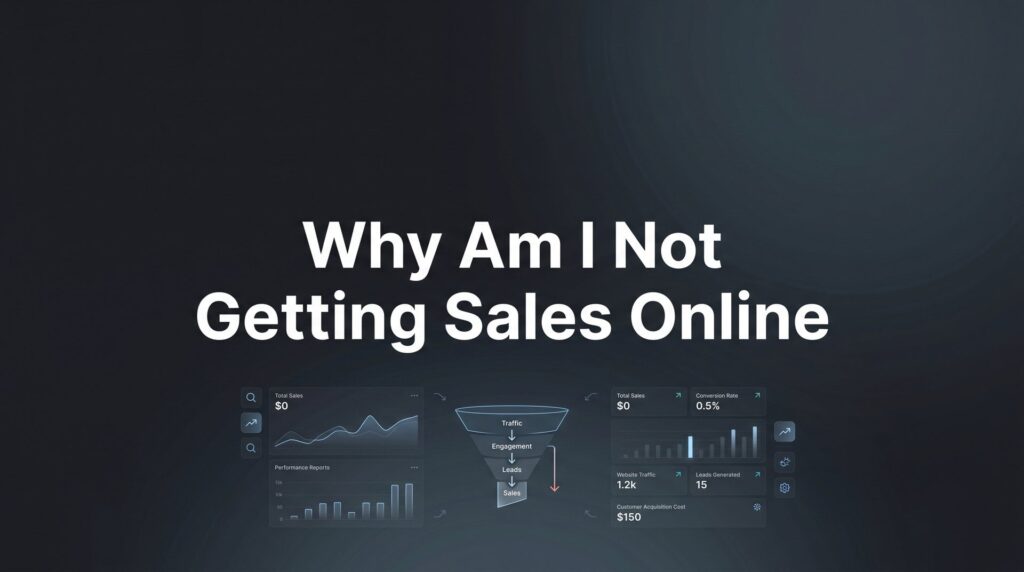
You’re watching the visitor counter climb. Traffic is flowing to your website—maybe you’re even running paid ads that are burning through your budget. But when you check your sales dashboard, the numbers tell a different story. Zero conversions. Again.
It’s one of the most frustrating experiences in online business. You’re doing what everyone says you should do: driving traffic, posting content, maybe even investing in advertising. Yet somehow, visitors arrive at your site and leave without buying. They don’t fill out your contact form. They don’t add items to their cart. They just… disappear.
Here’s the good news: if you’re getting traffic but not sales, you don’t have a fundamental business problem. You have a conversion problem, and conversion problems can be diagnosed and fixed. Most online sales failures stem from a handful of specific, identifiable issues—and once you know what’s actually broken, you can fix it. Let’s dig into the seven hidden reasons your website isn’t converting visitors into customers, and more importantly, what you can do about each one.
The Traffic Quality Problem: Why More Visitors Doesn’t Mean More Sales
Picture this: you’re getting 1,000 visitors a month to your website. Sounds promising, right? But what if 900 of those visitors have absolutely no intention of buying what you sell?
This is the traffic quality trap, and it’s one of the most common reasons businesses struggle with online sales. Not all website visitors are created equal. A hundred highly motivated, ready-to-buy visitors will generate far more revenue than a thousand casual browsers who stumbled onto your site by accident.
High-Intent vs. Low-Intent Traffic: Someone searching for “best running shoes for marathon training” is fundamentally different from someone searching for “running.” The first person has a specific need and is likely ready to purchase. The second person might be looking for running tips, running events, or just browsing casually.
If your traffic comes primarily from broad, generic keywords or untargeted advertising, you’re essentially inviting window shoppers to your store. They might look around, but they were never planning to buy. Understanding why you’re not getting qualified leads is the first step to fixing this problem.
The Social Media Traffic Illusion: Many businesses celebrate when they get a spike in traffic from a viral social media post. But social traffic often converts poorly because people weren’t actively searching for a solution—they were scrolling for entertainment and happened to click.
So how do you know if traffic quality is your problem? Look at these warning signs:
Bounce Rate Above 70%: If most visitors leave without viewing a second page, they’re not finding what they expected or needed.
Average Session Duration Under 30 Seconds: People aren’t even staying long enough to understand what you offer.
Zero Engagement: No clicks on your calls-to-action, no form submissions, no interaction with your content whatsoever.
The fix starts with understanding who your actual buyers are and where they spend their time online. If you’re running ads, tighten your targeting to focus on people actively searching for solutions you provide. If you’re relying on SEO, shift your focus from high-volume generic keywords to lower-volume, high-intent phrases that indicate purchase readiness.
Think of it this way: would you rather have 100 people walk into your physical store who are actively shopping for what you sell, or 1,000 people who are just killing time? Quality always beats quantity when it comes to traffic that converts.
The Trust Barrier: Why Strangers Won’t Hand You Their Money
You wouldn’t buy a car from someone operating out of an unmarked van in a parking lot. Yet many websites essentially ask visitors to do exactly that—trust a faceless entity with their credit card information without providing any reason to believe they’re legitimate.
Trust is the invisible currency of online sales. Without it, even the best product at the perfect price won’t convert.
The Missing Trust Signals: When visitors land on your site, they’re unconsciously scanning for proof that you’re real, reliable, and worth their money. No customer reviews? That’s a red flag. No visible contact information? Another strike. Stock photos of impossibly perfect people instead of real team members? Trust erodes further.
Many business owners underestimate how much these seemingly small details matter. In the physical world, you can shake hands, make eye contact, and build rapport. Online, you have seconds to establish credibility before a visitor clicks away to your competitor. Implementing proper solutions for managing online customer reviews can dramatically improve your credibility.
Professional Design Matters More Than You Think: A website that looks like it was built in 2005 doesn’t just seem outdated—it seems untrustworthy. Broken links, typos, and clunky navigation signal that if you can’t be bothered to maintain your website, you probably won’t be bothered to deliver quality products or service.
This doesn’t mean you need a $50,000 custom website. But it does mean your site needs to look professional, function smoothly, and feel current.
Quick Wins for Building Trust: Start with the low-hanging fruit. Add customer testimonials with real names and photos (or at least initials if privacy is a concern). Display security badges near checkout areas. Create an “About Us” page that shows real people behind your business.
Transparency Builds Confidence: Hidden costs kill conversions. If shipping fees only appear at checkout, you’ve just given visitors a reason to abandon their cart. If your return policy is buried in fine print, people assume it’s because you’re hiding something unfavorable.
Put your pricing, policies, and contact information front and center. Make it stupidly easy for people to reach you—and then actually respond when they do. Every unanswered email or unreturned call confirms a visitor’s suspicion that you’re not really invested in customer service.
Social Proof Works: Humans are tribal creatures. We look to others to validate our decisions. That’s why “as seen in” logos, customer count indicators, and user-generated content (like photos of real customers using your product) can dramatically improve conversion rates.
The trust gap is especially critical for new businesses or lesser-known brands. If you’re not Amazon or Apple, you need to work harder to prove you’re legitimate. But once you establish that foundation of trust, converting visitors becomes significantly easier.
The Leaky Bucket: How Your Website Pushes Customers Away
Imagine drilling holes in a bucket and then wondering why it won’t hold water. That’s what many websites do to their potential customers—create obstacles at every turn and then wonder why people leave without buying.
Your website might be actively sabotaging your sales without you realizing it. If you’re experiencing traffic but no sales, this is often the culprit.
The Speed Problem: Every second your website takes to load, you’re losing potential customers. People are impatient online. If your site takes more than three seconds to load, a significant portion of visitors will simply leave and find a competitor whose site loads faster.
This isn’t about being picky—it’s about basic human psychology. A slow website signals poor quality, and nobody wants to do business with a company that can’t even get the basics right.
Navigation Nightmares: Can a first-time visitor figure out what you sell within five seconds of landing on your homepage? Can they find your pricing, contact information, or product categories without hunting through multiple menus?
If the answer is no, you’re making people work too hard. And when people have to work to give you money, they usually just don’t bother.
The Hidden Call-to-Action: Your “Buy Now” button shouldn’t require a treasure hunt. Yet countless websites bury their most important calls-to-action below the fold, in sidebars, or in places visitors never look.
Make it obvious what you want visitors to do next. Use contrasting colors for your CTA buttons. Place them prominently where people naturally look. Repeat them throughout your page for longer content.
Mobile Is No Longer Optional: Here’s where things get critical. Most of your traffic probably comes from mobile devices. If your website looks terrible or functions poorly on a phone, you’re essentially telling the majority of your potential customers to shop elsewhere.
Common mobile failures include text that’s too small to read, buttons too close together to tap accurately, forms that are frustrating to fill out on a touchscreen, and images that don’t resize properly. Each of these issues is a conversion killer.
The Checkout Catastrophe: For e-commerce sites, the checkout process is where dreams go to die. Requiring account creation before purchase? You just lost half your customers. Asking for information you don’t actually need? More abandonment. Showing unexpected fees at the last step? Cart abandonment guaranteed.
Every field in your checkout form, every extra click, every moment of confusion is an opportunity for customers to change their minds.
Finding Your Leaks: Use basic analytics to identify where people are dropping off. Google Analytics can show you which pages have the highest exit rates. Heatmap tools can reveal where people click (or don’t click). Session recordings can show you exactly how real visitors experience your site.
The patterns will tell you the story. If everyone leaves on your pricing page, you have a pricing communication problem. If they abandon during checkout, you have a friction problem. If they bounce immediately from your homepage, you have a clarity or relevance problem.
Fix the biggest leaks first, then work your way down. Even small improvements in website usability can produce significant lifts in conversion rates.
Your Offer Isn’t Speaking to What People Actually Want
You know your product is good. You’ve put in the work, refined the features, and built something you’re proud of. So why aren’t people buying?
Because “good” isn’t enough. Your product needs to be clearly, obviously, immediately valuable to the specific person viewing your website right now.
Features vs. Benefits—The Classic Mistake: Most businesses describe what their product is rather than what it does for the customer. Your software has “advanced analytics capabilities”? Great. What does that actually mean for someone running a small business who’s drowning in data they don’t understand?
Translate every feature into a tangible benefit. “Advanced analytics” becomes “Know exactly which marketing campaigns are making you money and which ones are wasting your budget—no guesswork required.”
The Value Communication Gap: Your homepage says what you do. Your product pages list features. But nowhere do you clearly articulate why someone should choose you over the dozen other options they’re comparing. This disconnect is often why ads aren’t converting to sales—the messaging doesn’t match what customers actually need to hear.
What specific problem do you solve better than anyone else? What makes your approach different? What results can customers expect? If you can’t answer these questions clearly and specifically, your visitors certainly can’t either.
Pricing Perception Problems: Price isn’t just a number—it’s a signal. Price too high without clear justification, and people assume you’re overcharging. Price too low, and they wonder what’s wrong with your product.
The solution isn’t necessarily to change your price—it’s to better communicate your value. If you’re premium-priced, you need to clearly demonstrate why you’re worth the premium. If you’re budget-friendly, you need to assure people they’re not sacrificing quality for savings.
The Urgency Vacuum: When there’s no compelling reason to buy now, people default to “I’ll think about it” (which really means “I’ll forget about it”). This doesn’t mean using manipulative countdown timers or fake scarcity tactics—it means giving people a genuine reason to act today rather than next month.
Limited-time promotions work. Seasonal relevance works. Showing the cost of inaction works. “Every day you wait to fix your website’s conversion problems is another day of lost revenue” is more compelling than “Our service is really good.”
Friction in the Decision Process: How many questions does someone need answered before they feel comfortable buying? Are those answers readily available, or do they need to dig through FAQs and send emails to find them?
Common friction points include unclear pricing structures, confusing product options, missing information about shipping or delivery, and vague descriptions of what’s actually included in a purchase.
The easier you make the buying decision, the more people will make it. Remove every possible objection before it becomes a reason to leave without purchasing.
Testing Your Offer’s Clarity: Show your website to someone who’s never seen it before. Give them 10 seconds. Then ask: What do we sell? Who is it for? Why would someone buy it?
If they can’t answer all three questions, your offer isn’t clear enough. Simplify your messaging. Lead with benefits. Make the value proposition impossible to miss.
The Timing Problem: When You’re Pushing Too Hard or Not Enough
Most people don’t buy on their first visit to a website. They browse, compare, research, and think. Then maybe—maybe—they come back and purchase.
If your only sales strategy is hoping someone buys during their first visit, you’re leaving massive amounts of money on the table.
Understanding Buyer Readiness: People exist at different stages of the buying journey. Some are just becoming aware they have a problem. Others are researching potential solutions. Still others are comparing specific vendors and ready to purchase.
If you’re trying to close a sale with someone who’s still in the awareness stage, you’re asking for commitment before they’re ready. It’s like proposing marriage on a first date—technically possible, but usually unsuccessful. This misalignment is a common reason why leads aren’t turning into sales.
The Multiple Touchpoint Reality: Think about your own buying behavior for anything significant. You probably visited the website multiple times. Maybe you read reviews on other sites. Perhaps you signed up for a newsletter or downloaded a guide. You might have compared prices across competitors.
Your customers do the same thing. They need multiple exposures to your brand before they feel comfortable buying. The question is: are you creating those touchpoints, or are you just hoping people remember to come back?
Building a Follow-Up System: The simplest way to stay connected with potential customers is email. Offer something valuable in exchange for their email address—a guide, a discount, a useful tool. Then actually follow up with content that helps them, not just sales pitches.
This doesn’t need to be complicated. A simple welcome series that educates people about your product category, addresses common objections, and shares customer success stories can dramatically improve eventual conversion rates.
Retargeting the Interested: Someone who visited your pricing page but didn’t buy is fundamentally different from someone who bounced from your homepage in three seconds. They showed interest. They’re worth pursuing.
Retargeting ads allow you to stay visible to people who’ve already visited your site. Done well, they remind interested prospects to come back and complete their purchase. Done poorly, they’re annoying and ineffective.
The key is relevance. Show different messages to people based on what they looked at on your site. Someone who viewed a specific product should see ads for that product, not generic brand awareness messaging.
Nurture Sequences That Actually Nurture: The best email sequences don’t just push for the sale—they build relationship and trust over time. Share helpful content. Answer common questions. Demonstrate expertise. Make people glad they’re on your list, not annoyed by constant sales pressure.
Then, when they’re ready to buy, you’re the obvious choice because you’ve already proven your value.
Knowing When to Push: There’s a balance between patient nurturing and actually asking for the sale. Some businesses are too aggressive, pushing for conversion before trust is established. Others are too passive, never clearly asking people to take the next step.
Pay attention to engagement signals. Someone who’s opened every email, clicked multiple links, and returned to your site several times is showing buying signals. That’s when you make a direct offer.
Someone who signed up for your newsletter yesterday and hasn’t engaged since? They need more nurturing before they’re ready for a hard sell.
Diagnosing Your Specific Problem: The Quick Sales Audit
You’ve now seen six major reasons websites fail to convert. But which one is actually killing your sales? Let’s figure it out.
Start With Your Traffic Sources: Log into your analytics and look at where your visitors are coming from. If most of your traffic is from broad, generic keywords or untargeted social media, you likely have a traffic quality problem. If you’re getting traffic from specific, intent-driven searches but still not converting, the issue is probably elsewhere.
Check Your Bounce Rate: A bounce rate above 70% suggests people aren’t finding what they expected or your site isn’t immediately clear about what you offer. This points to either a traffic relevance problem or a messaging clarity problem.
Examine Time on Site: If people are spending less than a minute on your site, they’re not engaging with your content. This could indicate trust issues, poor design, or unclear value proposition. If they’re spending several minutes but still not converting, the issue is likely in your offer or your calls-to-action. Many businesses also struggle with customers not filling out forms, which requires specific optimization strategies.
Track the Conversion Funnel: Where exactly do people drop off? If they’re leaving from your homepage, you have a clarity or relevance problem. If they’re abandoning during checkout, you have a friction or trust problem. If they’re viewing multiple pages but never clicking your CTAs, your calls-to-action aren’t compelling or visible enough.
Look at Mobile vs. Desktop Performance: Compare conversion rates between mobile and desktop visitors. If mobile converts significantly worse, you have a mobile experience problem that needs immediate attention.
Review Your Cart Abandonment Rate: For e-commerce sites, if people are adding items to cart but not completing purchase, you’re dealing with either unexpected costs, complicated checkout, or last-minute trust issues.
The Quick Fix Priority List: Based on your diagnosis, tackle issues in this order. First, fix any obvious technical problems—broken links, slow load times, mobile usability issues. These are conversion killers that affect everything else. Second, clarify your value proposition and make your calls-to-action more prominent. Third, add trust signals and improve your credibility markers. Fourth, implement a basic email capture and follow-up system. Fifth, refine your traffic sources to focus on higher-intent visitors.
When to Get Help: Some problems you can fix yourself with basic tools and common sense. Others require specialized expertise. If you’ve identified the issue but lack the technical skills to implement the solution, that’s when professional help makes sense. Learning how to increase sales with digital marketing often requires a systematic approach that addresses multiple conversion factors simultaneously.
Similarly, if you’ve made obvious improvements but still aren’t seeing results, you might be dealing with a more complex conversion optimization challenge that requires deeper analysis and testing.
Moving Forward: From Diagnosis to Revenue
Poor online sales aren’t a mystery. They’re almost always the result of specific, fixable problems in your traffic quality, trust signals, website usability, offer clarity, or follow-up systems.
The businesses that succeed online aren’t necessarily the ones with the best products or the biggest budgets. They’re the ones that systematically identify what’s not working and fix it. They test, measure, and improve. They understand that conversion optimization isn’t a one-time project—it’s an ongoing process of making it easier for the right people to buy.
Start with honest diagnosis. Use the audit framework above to identify your biggest conversion bottleneck. Then fix that one thing before moving to the next. Small improvements compound over time into significant revenue growth.
Remember: every visitor who comes to your site and doesn’t buy represents a failure somewhere in your system. But it also represents an opportunity. Fix the system, and those visitors become customers.
Tired of spending money on marketing that doesn’t produce real revenue? We build lead systems that turn traffic into qualified leads and measurable sales growth. If you want to see what this would look like for your business, we’ll walk you through how it works and break down what’s realistic in your market.
The path from struggling website to revenue-generating machine starts with understanding exactly where you’re losing potential customers. Now you have the framework to figure that out. The question is: what are you going to fix first?
Want More Leads for Your Business?
Most agencies chase clicks, impressions, and “traffic.” Clicks Geek builds lead systems. We uncover where prospects are dropping off, where your budget is being wasted, and which channels will actually produce ROI for your business, then we build and manage the strategy for you.