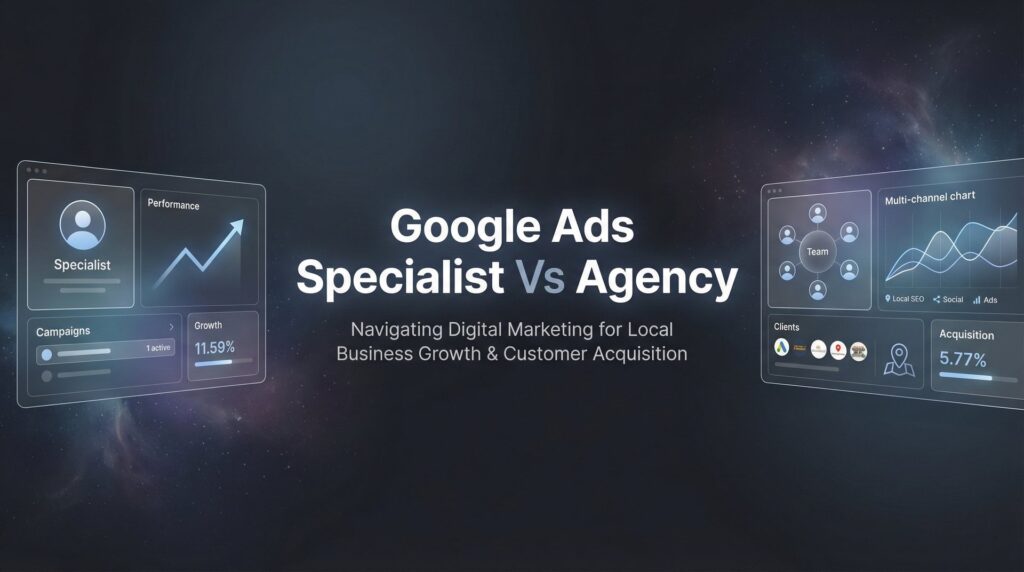
You’re staring at your Google Ads dashboard, watching your daily budget drain while leads trickle in at a pace that makes you question whether paid advertising is even worth it. The campaigns you set up yourself aren’t performing like the YouTube tutorials promised, and now you’re facing a decision that could make or break your marketing ROI: should you hire a solo Google Ads specialist or partner with a full-service agency?
This isn’t just about finding someone to manage your campaigns. It’s about choosing a partner who understands your market, respects your budget, and can actually deliver the qualified leads your business needs to grow. The wrong choice means months of wasted ad spend and missed opportunities. The right choice transforms your Google Ads account from a money pit into your most profitable customer acquisition channel.
Both specialists and agencies bring distinct advantages to the table, and the “best” option depends entirely on your specific business situation. A solo specialist might give you focused attention and lower overhead costs, while an agency like Clicks Geek offers comprehensive resources, specialized team members, and proven systems built from managing hundreds of campaigns.
The following seven strategies will help you cut through the marketing noise and make an informed decision based on your actual business needs—not just what sounds good in a sales pitch.
1. Audit Your Campaign Complexity Before Choosing
The Challenge It Solves
Many business owners underestimate the complexity of their Google Ads needs until they’re already locked into a partnership that can’t deliver. A plumber serving three counties needs fundamentally different campaign architecture than a dentist targeting a single zip code. If you hire a specialist who excels at simple local campaigns but your business actually requires multi-location tracking, audience segmentation, and dynamic ad customization, you’ll hit a ceiling fast.
The reverse problem is equally costly. Paying agency-level fees for a straightforward single-service campaign with limited geographic targeting is like hiring a construction crew to hang a picture frame.
The Strategy Explained
Before you talk to any potential partners, map out your actual campaign requirements. Start with your service offerings—do you provide one core service or multiple distinct services that appeal to different customer segments? Then consider your geographic footprint. Are you targeting a single city, multiple locations, or a regional service area?
Next, think about your customer journey complexity. Do most customers convert immediately, or do they research for weeks before making a decision? This determines whether you need simple conversion tracking or sophisticated attribution modeling that follows customers across multiple touchpoints.
Finally, assess your need for complementary services. If your campaigns require custom landing pages, conversion rate optimization, or integration with CRM systems, you’re looking at agency-level complexity regardless of your business size. Understanding the full scope of Google Ads management services available helps you identify what level of support you actually need.
Implementation Steps
1. List every service you offer and every location you serve—if you count more than three distinct service categories or five service areas, you’re entering agency territory.
2. Review your current conversion tracking setup (or lack thereof)—if you need to track phone calls, form submissions, chat conversations, and offline conversions separately, that’s a complexity indicator.
3. Document any existing marketing tools you use (CRM, email platforms, analytics software)—the more integration points you need, the more you benefit from an agency’s technical resources.
Pro Tips
Don’t confuse campaign quantity with campaign complexity. Running ten identical campaigns across ten locations is actually simpler than running three highly customized campaigns for different service lines. The key differentiator is whether your campaigns require unique strategies or just scaled execution of the same approach.
2. Calculate the True Cost of Each Option
The Challenge It Solves
The sticker price of specialist versus agency services rarely tells the full financial story. A specialist charging a lower monthly retainer might seem like the budget-friendly choice until you factor in the costs of tools they don’t provide, services they can’t perform, and the time you’ll spend managing the relationship. Similarly, an agency’s higher fee might actually deliver better value when you account for the comprehensive services included in that investment.
Business owners often make this decision based on monthly management fees alone, ignoring the total cost of ownership.
The Strategy Explained
Build a complete cost comparison that includes both direct and indirect expenses. For specialists, the monthly fee is just the starting point. Add the cost of tools they’ll need access to (analytics platforms, call tracking software, landing page builders). Factor in your own time—how many hours per week will you spend in status meetings, reviewing reports, and providing direction?
For agencies, look beyond the management fee to understand what’s actually included. Does the package cover landing page creation and optimization? What about ad copywriting, audience research, and conversion rate optimization? Some agencies charge separately for these services, while others (like Clicks Geek) include them as part of a comprehensive approach. Our detailed breakdown of Google Ads management pricing can help you understand what different fee structures actually include.
Consider the opportunity cost of choosing wrong. A specialist who maxes out their capabilities six months in forces you to restart the entire selection process. An agency that delivers marginal results because they’re juggling too many clients costs you in lost revenue, not just fees paid.
Implementation Steps
1. Request detailed pricing breakdowns from both specialists and agencies—ask specifically what services are included versus charged separately, and get clarity on any percentage-of-spend models.
2. Calculate your time investment for each option based on their reported communication cadence—if a specialist needs weekly hour-long meetings versus an agency’s monthly strategic reviews, that’s a real cost difference.
3. Project the total six-month cost including management fees, required tools, your time at your hourly rate, and any additional services you’ll need to purchase separately.
Pro Tips
Ask about performance guarantees or trial periods. Some agencies offer initial performance assessments or shortened first contracts that let you evaluate results before committing long-term. This reduces your financial risk significantly compared to signing a year-long agreement based purely on promises.
3. Evaluate Accountability and Communication Styles
The Challenge It Solves
The most technically skilled Google Ads manager in the world becomes worthless if you can’t get clear answers about campaign performance when you need them. Many business owners discover too late that their specialist is juggling so many clients that response times stretch into days, or that their agency assigns them to junior account managers who can’t answer strategic questions without “checking with the team.”
Communication breakdowns lead directly to poor campaign performance because optimization opportunities get missed and strategic pivots happen too slowly.
The Strategy Explained
Define your communication requirements before evaluating partners. How often do you need performance updates—weekly, biweekly, monthly? What level of detail do you need in those reports? Some business owners want high-level metrics and strategic recommendations, while others prefer granular data they can analyze themselves.
Consider your decision-making style. If you prefer collaborative strategy sessions where you’re involved in major campaign decisions, you need a partner who structures their process around client input. If you’d rather delegate completely and just review results, you need someone comfortable with autonomous execution.
Specialists typically offer more direct access—you’re usually communicating with the person actually managing your campaigns. Agencies provide structured reporting and dedicated account management, which can mean more polished deliverables but potentially slower response times for urgent questions. Reading Google Ads agency reviews can reveal patterns in how different providers handle client communication.
Implementation Steps
1. During initial consultations, ask specific questions about communication protocols—who will you interact with, how quickly do they typically respond to emails, and what’s their process for urgent campaign issues?
2. Request sample reports from both specialists and agencies you’re considering—this shows you exactly what visibility you’ll have into campaign performance and whether the reporting style matches your preferences.
3. Test their responsiveness during the sales process—if they’re slow to respond or vague in their answers before you’re a client, that pattern will only intensify after you sign.
Pro Tips
Ask about their client roster size and account load per manager. A specialist managing 20+ accounts or an agency account manager juggling 15+ clients simply cannot provide the attention level that drives exceptional results. Quality partners limit their client load specifically to maintain high service standards.
4. Assess Scalability for Future Growth
The Challenge It Solves
Your business won’t stay the same size forever—at least, that’s not the plan. Choosing a Google Ads partner based solely on your current needs ignores the reality that successful campaigns drive growth, and growth changes your requirements. A specialist who’s perfect for your single-location operation today might become a bottleneck when you expand to three locations next year.
Switching Google Ads partners mid-growth is disruptive, expensive, and often sets your campaigns back months while the new partner learns your business and rebuilds momentum.
The Strategy Explained
Map out your realistic growth trajectory for the next 12-24 months. Are you planning to expand service offerings, add locations, or significantly increase ad spend? Each of these growth scenarios has implications for your Google Ads management needs.
Specialists often hit natural scaling limits. One person can only manage so many campaigns effectively, and their expertise might be concentrated in specific campaign types or industries. If your growth requires diversification into new Google Ads formats (YouTube, Display, Shopping campaigns), a specialist who primarily runs Search campaigns won’t scale with you.
Agencies are built for scale. They maintain teams with diverse specializations, so as your needs expand from basic Search campaigns into comprehensive multi-channel strategies, they can deploy additional resources without disrupting your existing campaigns. The question becomes whether they’ll maintain service quality as they scale your account, or whether you’ll get lost among their larger clients. This is where understanding the agency vs freelancer tradeoffs becomes critical for long-term planning.
Implementation Steps
1. Share your growth plans candidly during partner evaluations—ask directly whether their current structure can accommodate your projected expansion without requiring you to switch providers.
2. Request examples of how they’ve scaled with existing clients—agencies should be able to show case studies of accounts they’ve grown from small monthly spends to substantial budgets over time.
3. Understand their capacity constraints—specialists should be honest about the maximum number of campaigns or ad spend they can effectively manage, while agencies should explain how they allocate additional resources as accounts grow.
Pro Tips
Growth often requires services beyond basic campaign management—landing page optimization, conversion rate testing, and marketing automation integration become critical as you scale. Choose a partner who either provides these services in-house or has established partnerships with providers who do, ensuring seamless execution as your needs evolve.
5. Verify Industry Experience and Track Record
The Challenge It Solves
Google Ads expertise isn’t one-size-fits-all. A specialist who crushes it for e-commerce brands might struggle with lead generation for service businesses because the strategies, metrics, and optimization approaches are fundamentally different. Similarly, an agency with an impressive client roster of national brands might lack the local market knowledge that makes campaigns profitable for small businesses.
Partnering with someone who’s learning your industry on your dime is an expensive education you shouldn’t have to fund.
The Strategy Explained
Prioritize demonstrated experience in your specific industry or business model. If you run a home services business, you want a partner who understands seasonal demand fluctuations, emergency service bidding strategies, and how to optimize for high-intent local searches. If you’re in professional services, you need someone who knows how to navigate longer sales cycles and higher customer lifetime values.
Look for concrete evidence of results, not just claims. Google Premier Partner status (like Clicks Geek maintains) indicates an agency meets Google’s performance standards and manages substantial ad spend across multiple clients. Understanding the Google Partner agency benefits helps you recognize which certifications actually matter for campaign performance.
Be wary of partners who claim expertise in every industry. True specialization means turning down business that doesn’t fit their wheelhouse, which is actually a positive signal that they prioritize results over revenue.
Implementation Steps
1. Ask for case studies or references from businesses in your industry—don’t accept generic success stories from unrelated verticals as proof of relevant expertise.
2. Verify their Google Partner status if they claim it, and ask about their certification levels—this information is publicly verifiable and indicates their standing with Google.
3. During consultations, listen for specific insights about your industry’s Google Ads challenges—generic advice applies to anyone, but specific observations about your market’s competitive landscape and customer behavior indicate real experience.
Pro Tips
Ask about their approach to competitive research in your market. A partner with real industry experience should be able to discuss your competitors’ likely strategies and positioning without even looking at your account first. If they need to “do some research and get back to you,” they’re starting from scratch.
6. Test Risk Tolerance and Contract Flexibility
The Challenge It Solves
Signing a twelve-month contract with a Google Ads partner you’ve never worked with is like getting married after a first date. Some businesses have been burned by previous marketing relationships and need the security of knowing they can exit if results don’t materialize. Others are comfortable committing longer-term in exchange for better pricing or priority service.
The contract structure you choose should reflect both your risk tolerance and your confidence level in the partner’s ability to deliver.
The Strategy Explained
Evaluate contract terms as a reflection of the partner’s confidence in their own results. Partners who offer month-to-month agreements or short initial trial periods are signaling that they’re willing to prove their value before asking for long-term commitment. Those who require extended contracts might offer lower rates in exchange for that security, but they’re also betting you won’t want to leave even if results disappoint.
Consider your business’s financial flexibility. Longer contracts often come with better pricing, but they also lock you into monthly expenses regardless of business conditions. If your cash flow fluctuates seasonally or you’re in a growth phase where budgets might shift quickly, contract flexibility becomes more valuable than a modest discount.
Pay attention to exit clauses and transition processes. Some contracts include penalties for early termination or require extensive notice periods. Others make it easy to pause or cancel services if your business needs change. The latter approach demonstrates confidence that clients will stay because of results, not contractual obligations. Learning how to hire a Google Partner agency that offers fair terms protects your business from predatory contracts.
Implementation Steps
1. Request contract terms in writing before initial consultations end—compare the flexibility, notice requirements, and any performance guarantees or service level agreements included.
2. Ask specifically about trial periods or performance assessments—some agencies offer 30-60 day initial engagements that let you evaluate working relationship and early results before committing long-term.
3. Clarify what happens to your campaign data, creative assets, and account access if you decide to part ways—you should retain full ownership and easy transition capabilities regardless of how the relationship ends.
Pro Tips
The most confident partners often structure contracts with performance milestones rather than just time commitments. If an agency or specialist is willing to tie their compensation or contract renewal to hitting specific KPIs you both agree on upfront, that’s a strong signal they believe in their ability to deliver.
7. Match Your Management Style to the Right Partner
The Challenge It Solves
Some business owners want to be deeply involved in every campaign decision, reviewing ad copy before it goes live and approving bid adjustments personally. Others prefer to set strategic direction and then get out of the way, trusting their partner to execute without constant check-ins. Neither approach is wrong, but mismatching your style with your partner’s working method creates friction that undermines results.
A hands-on business owner paired with a specialist who expects autonomous execution will feel out of control. A delegator matched with an agency that requires extensive client input for every decision will find the process frustratingly slow.
The Strategy Explained
Honestly assess how much control you want over day-to-day campaign management versus strategic oversight. If you enjoy marketing and want to understand the tactical details of your campaigns, you need a partner who welcomes that involvement and structures their process to include collaborative decision-making. If marketing isn’t your strength or interest, you need someone who can own the entire execution while keeping you informed at the strategic level.
Specialists often work better with hands-on clients because the direct relationship allows for quick back-and-forth on tactical decisions. Agencies typically excel with delegators who value the systematic approach and comprehensive reporting that lets them monitor results without managing execution. Our Google Ads optimization guide explains the tactical decisions that happen behind the scenes so you can determine how involved you want to be.
Consider your internal marketing resources too. If you have a marketing coordinator or team who’ll work alongside your Google Ads partner, you need someone comfortable with collaborative execution. If you’re flying solo, you might prefer a partner who can operate more independently.
Implementation Steps
1. During initial conversations, describe your preferred working style explicitly—explain how involved you want to be and ask how their typical client relationships are structured.
2. Discuss decision-making authority for common scenarios—who approves new ad copy, budget adjustments, or strategic pivots, and what’s the timeline for those decisions?
3. Ask about their onboarding process and ongoing collaboration tools—this reveals whether they’re set up for the level of involvement you prefer, from shared project management platforms to scheduled strategy sessions.
Pro Tips
Your management style might evolve as the relationship matures. Start with more involvement during the first few months to build trust and understanding, then gradually delegate more as you become confident in their judgment. Choose a partner flexible enough to adapt to this natural progression rather than one locked into a rigid process.
Putting It All Together: Your Action Plan
The specialist versus agency decision isn’t about which option is objectively better—it’s about which one aligns with your specific business situation, growth trajectory, and working preferences. A solo specialist might be your perfect partner if you’re running focused local campaigns with straightforward goals and you value direct access to the person managing your account. An agency becomes the right choice when you need comprehensive resources, scalability, and proven systems that can handle complexity as your business grows.
Use these seven strategies as a decision framework, not a checklist where one option needs to win every category. Maybe your campaign complexity suggests an agency, but your budget and hands-on management style point toward a specialist. Weight each factor based on what matters most to your business right now and where you’re headed in the next 12-24 months.
The wrong choice costs you time, money, and growth opportunities. The right choice transforms your Google Ads account into a predictable, profitable customer acquisition system that scales with your business.
Here’s your quick-reference decision guide: If you’re a single-location business with one core service, a monthly ad spend under a few thousand dollars, and you want to be deeply involved in campaign decisions, start your search with qualified specialists. If you’re multi-location, offering multiple services, planning significant growth, or you need comprehensive marketing support beyond just campaign management, focus your evaluation on agencies with proven track records in your industry.
Tired of spending money on marketing that doesn’t produce real revenue? We build lead systems that turn traffic into qualified leads and measurable sales growth. If you want to see what this would look like for your business, we’ll walk you through how it works and break down what’s realistic in your market.
The partner you choose today shapes your business growth for the next year and beyond. Make the decision based on strategy, not just price, and prioritize partners who demonstrate they understand your market, respect your budget, and can actually deliver the results your business needs to thrive.
Want More Leads for Your Business?
Most agencies chase clicks, impressions, and “traffic.” Clicks Geek builds lead systems. We uncover where prospects are dropping off, where your budget is being wasted, and which channels will actually produce ROI for your business, then we build and manage the strategy for you.