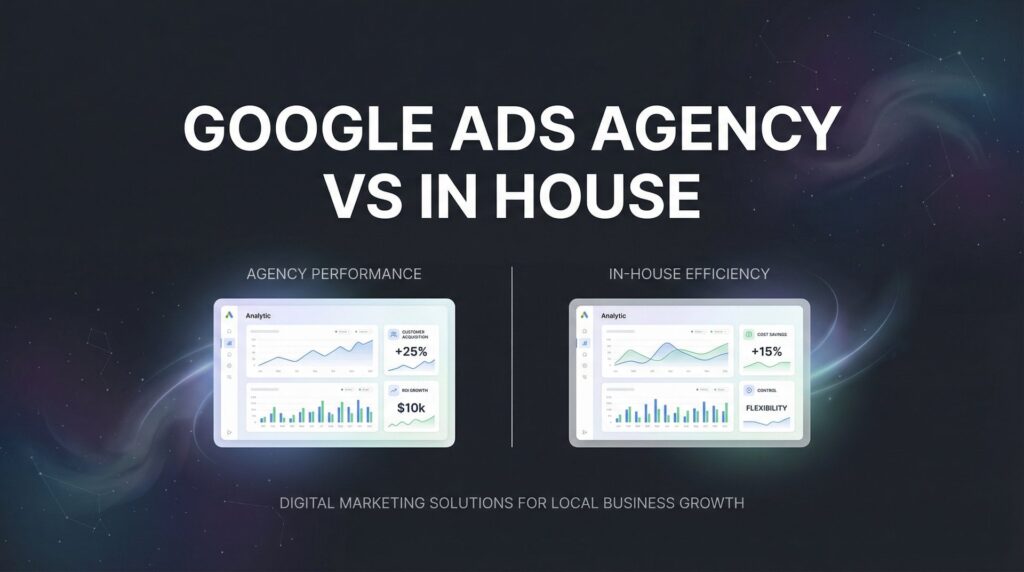
You’re staring at your Google Ads dashboard, watching budget burn while wondering if there’s a better way. Should you hire someone in-house to take control? Or partner with an agency that promises expertise you don’t have internally? The question keeps you up at night because the wrong choice means wasted budget, missed opportunities, and explaining to stakeholders why performance isn’t where it needs to be.
Here’s the truth: there’s no universal answer. The agency versus in-house debate isn’t about which option is objectively better—it’s about which aligns with your specific situation, growth trajectory, and internal capabilities.
What makes this decision tricky is that both paths can work brilliantly or fail spectacularly depending on factors most businesses don’t consider upfront. A scrappy startup might thrive with a sharp in-house hire, while a scaling company could waste months trying to build expertise that an agency already has in place.
This guide breaks down seven critical factors that separate smart decisions from expensive mistakes. We’re cutting through the sales pitches and generic advice to give you a framework based on what actually drives Google Ads performance. By the end, you’ll know exactly which path makes sense for your business—and why.
1. Total Cost of Ownership Analysis
The Challenge It Solves
Most businesses compare an agency’s monthly fee against a potential employee’s salary and think they’ve done the math. They haven’t. The real financial picture includes dozens of hidden costs that turn an apparently cheaper in-house option into a budget-busting commitment—or reveal that an agency’s premium pricing actually delivers better value per dollar invested.
Without understanding total cost of ownership, you’re making a six-figure decision based on incomplete data. That’s how companies end up paying $60K for an in-house hire who lacks the tools and training to compete, or overpaying an agency for services they could handle internally with proper planning.
The Strategy Explained
True cost comparison requires accounting for every dollar both options consume over a 12-month period. For in-house management, that means salary plus benefits, recruitment costs, software subscriptions, training programs, management overhead, and the productivity cost during ramp-up time. For agencies, it includes monthly fees, setup costs, and any additional services like landing page optimization or creative development.
The math gets interesting when you factor in efficiency. An experienced agency might optimize campaigns faster and more effectively than a new hire, meaning the same ad budget generates better returns. Conversely, an in-house expert who knows your product intimately might identify opportunities an agency would miss. Understanding Google Ads management pricing helps you benchmark what agencies typically charge across different budget levels.
What surprises most business owners is how quickly in-house costs accumulate. Beyond base salary, you’re looking at payroll taxes, health insurance, 401k matching, recruitment fees, onboarding time, and the software stack needed to do the job properly. That $55K salary position often costs $75K-$85K when you account for everything.
Implementation Steps
1. Build a complete cost spreadsheet for both options covering 12 months, including salary/fees, benefits, tools, training, recruitment, and management time required.
2. Calculate the opportunity cost of ramp-up time—if an in-house hire takes 90 days to reach full effectiveness, what does suboptimal performance cost you during that period?
3. Factor in your current ad spend and growth projections—agencies often make more sense at higher budgets where their percentage-based fees scale proportionally while in-house costs remain relatively fixed.
4. Include the cost of mistakes—an inexperienced in-house manager learning on your dime might waste thousands in poorly optimized campaigns before finding their footing.
Pro Tips
Don’t forget to account for turnover risk. If your in-house hire leaves after 18 months, you’re back to square one with recruitment costs and knowledge loss. Agencies provide continuity even when individual team members change. Also consider that many businesses underestimate the software costs—enterprise-level tools for bid management, analytics, and reporting can easily run $500-$1,500 monthly on top of salary.
2. Expertise Depth Evaluation
The Challenge It Solves
Google Ads has evolved into a complex ecosystem requiring knowledge across audience targeting, automated bidding strategies, conversion tracking, attribution modeling, creative testing, and cross-platform integration. The platform you remember from five years ago barely resembles what advertisers manage today. This creates a critical question: can you find and afford the level of expertise your campaigns actually need?
Hiring a marketing generalist who “knows some PPC” often means getting someone who understands the basics but lacks the specialized knowledge to compete against sophisticated competitors. Meanwhile, true Google Ads specialists with 5+ years of hands-on experience command salaries that might exceed your budget.
The Strategy Explained
Agencies typically employ teams with specialized roles—strategists who plan campaigns, analysts who interpret data, copywriters who craft ad creative, and technical specialists who handle tracking implementation. This depth of expertise is nearly impossible to replicate with a single in-house hire unless you’re prepared to pay top-tier salaries.
The expertise gap becomes most apparent when you need advanced capabilities. Agencies with Google Premier Partner status often gain early access to beta features and receive dedicated support from Google representatives—advantages individual advertisers rarely access. Understanding the Google Partner agency benefits helps you evaluate whether these certifications translate to real performance advantages for your campaigns.
However, in-house teams offer something agencies can’t easily match: deep product and customer knowledge. An internal hire lives and breathes your brand daily, understands nuanced customer objections, and can pivot messaging based on real-time market feedback without waiting for agency approval cycles.
Implementation Steps
1. Honestly assess your campaign complexity—are you running straightforward search campaigns or managing sophisticated multi-platform strategies with complex attribution requirements?
2. Define the expertise level you actually need by listing specific capabilities: automated bidding optimization, audience segmentation, conversion rate optimization, creative testing frameworks, attribution modeling, etc.
3. Research what it costs to hire someone with those qualifications in your market—you might discover that specialist-level talent is either unavailable or priced beyond your budget.
4. If considering an agency, evaluate their team structure and ask specific questions about who will actually work on your account—not just the impressive strategist who pitches you.
Pro Tips
Look for agencies that provide transparent access to their team members, not just an account manager who relays messages. The best partnerships involve direct collaboration with the strategists and analysts doing the actual work. For in-house hires, consider whether you can provide ongoing training and development—Google Ads expertise requires continuous learning as the platform evolves, and a hire who stagnates will fall behind quickly.
3. Speed to Results Assessment
The Challenge It Solves
Time is money, especially when your competitors are already running optimized campaigns while you’re still figuring out your approach. The speed at which you can deploy effective Google Ads campaigns directly impacts revenue, market share, and competitive positioning. A three-month delay in getting campaigns running properly might mean thousands of missed opportunities and customers who’ve already chosen competitors.
This timing challenge hits differently depending on your business situation. A company launching a new product needs immediate performance. A business experiencing seasonal peaks can’t afford to spend the high season training someone. The question becomes: how much is speed worth to you?
The Strategy Explained
Agencies offer immediate deployment advantages. They already have the team, tools, and processes in place. You can typically launch campaigns within weeks of signing a contract—sometimes faster if your tracking and landing pages are ready. There’s no recruitment process, no onboarding period, no learning curve about how Google Ads works fundamentally.
In-house hiring follows a different timeline. First, you spend 4-8 weeks recruiting and interviewing candidates. Then another 2-4 weeks for notice periods and start dates. Once hired, your new team member needs time to understand your business, set up proper tracking, learn your customer base, and develop initial campaign strategies. Realistically, you’re looking at 90-120 days before an in-house hire reaches full effectiveness—and that assumes you hired someone with solid existing Google Ads experience.
The performance gap during those first few months matters more than most businesses realize. Suboptimal campaigns don’t just underperform—they actively waste budget while competitors capture market share. If you’re spending $10K monthly on ads during a 90-day ramp-up period, inefficient management might mean $15K-$20K in lost opportunity cost. Proper Google Ads campaign setup from day one prevents these costly learning-curve mistakes.
Implementation Steps
1. Calculate your speed-to-performance urgency by identifying upcoming deadlines, seasonal peaks, or competitive pressures that make immediate results critical.
2. Map out realistic timelines for both options—for in-house, add recruitment time, notice periods, onboarding, and ramp-up; for agencies, factor in their current capacity and onboarding process.
3. Estimate the cost of delayed performance by calculating potential revenue from optimized campaigns versus what you’ll likely achieve during ramp-up periods.
4. Consider hybrid approaches if speed matters but you want to build in-house eventually—some businesses start with an agency for immediate results while simultaneously recruiting and training an internal hire.
Pro Tips
If you choose the in-house route, consider hiring someone who’s actively managing Google Ads in their current role rather than someone who “used to do PPC a few years ago.” The platform changes rapidly, and outdated knowledge can be worse than starting fresh. For agency partnerships, ask about their onboarding timeline and what they need from you to move quickly—delays often happen because businesses underestimate the tracking and asset preparation required on their end.
4. Scalability and Flexibility Planning
The Challenge It Solves
Your Google Ads needs today look nothing like what they’ll be in 18 months if your business grows as planned. Maybe you’re running search campaigns now but need Shopping ads, YouTube, and display retargeting next quarter. Perhaps you’re in one geographic market but expanding to three more regions soon. Or your budget might fluctuate dramatically based on seasonality, requiring rapid scaling up and down.
The wrong management structure becomes a growth bottleneck. An in-house hire maxed out managing current campaigns can’t take on expansion without dropping quality. An agency locked into a rigid contract might not flex efficiently with your changing needs. Planning for scalability now prevents painful transitions later.
The Strategy Explained
Agencies excel at scalability because they have team depth and cross-functional resources. When you need to expand from search to YouTube, they already have video specialists on staff. When you triple your budget, they can assign additional analysts without you managing hiring and training. When you need to pause campaigns during slow seasons, you’re not paying salary for underutilized headcount.
This flexibility extends to expertise on demand. Need conversion rate optimization for your landing pages? Many agencies include that capability. Want to test Google Shopping campaigns? They’ve done it hundreds of times. Expanding to international markets? They can navigate language and cultural considerations you haven’t encountered. Reviewing Google Ads management services helps you understand what capabilities different providers offer as you scale.
In-house teams offer different scalability advantages. Once you’ve hired someone, their capacity is yours to allocate however you need. They can shift focus between platforms, work on related marketing projects during slower periods, and build institutional knowledge that compounds over time. However, their bandwidth is finite—one person can only manage so much complexity before performance suffers.
Implementation Steps
1. Map your 12-18 month growth roadmap including planned budget increases, new product launches, geographic expansion, and additional advertising platforms you’ll need.
2. Assess whether a single in-house hire could realistically handle that expansion or if you’d need to hire additional team members as you scale.
3. Evaluate agency pricing models for scalability—some charge percentage-of-spend which scales naturally, others use fixed retainers that may need renegotiation as you grow.
4. Consider seasonal fluctuation patterns—if your business has dramatic peaks and valleys, determine whether you want to pay consistent agency fees or manage headcount flexibility in-house.
Pro Tips
Ask agencies specifically how they handle rapid scaling—what’s their process for increasing budget by 3x over 60 days? How do they staff up for seasonal peaks? The best agencies have systems for this rather than scrambling reactively. For in-house teams, build scalability into your hiring from the start by looking for candidates with multi-platform experience who can grow into broader roles rather than specialists who’ll hit a ceiling quickly.
5. Control and Communication Preferences
The Challenge It Solves
Some business owners need their hands on the wheel, making real-time adjustments based on gut instinct and market feedback. Others prefer strategic oversight while trusting experts to handle execution details. Your communication style and control preferences dramatically impact whether an agency relationship thrives or becomes a source of frustration—and whether an in-house hire gets the autonomy they need to perform or feels micromanaged into mediocrity.
Misalignment here creates friction that undermines performance regardless of technical expertise. An agency accustomed to strategic quarterly planning won’t mesh well with an owner who wants daily campaign tweaks. An in-house hire expecting autonomy will struggle with a manager who questions every decision.
The Strategy Explained
In-house management provides maximum control and immediate communication. You can walk over to someone’s desk, discuss campaign adjustments in real-time, and implement changes within minutes. There’s no waiting for agency response times, no formal approval processes, no wondering what’s happening behind the scenes. For business owners who want direct oversight of every decision, this control is invaluable.
Agency relationships operate through structured communication frameworks—typically weekly or biweekly calls, monthly reporting, and defined escalation paths for urgent issues. You’re trading direct control for professional expertise and systems. The best agencies provide transparency through shared dashboards and regular updates, but you’re fundamentally trusting their judgment rather than making every tactical decision yourself. This mirrors the broader digital marketing agency vs in-house marketing decision that affects all your marketing channels.
The communication preference extends to reporting and accountability. In-house teams can provide customized reporting tailored exactly to your needs, but you’re responsible for defining what matters and holding them accountable. Agencies typically deliver standardized reports that may or may not emphasize the metrics you care most about, though good agencies customize based on your goals.
Implementation Steps
1. Honestly assess your management style—do you prefer being deeply involved in tactical decisions or setting strategic direction and reviewing results?
2. Define your communication expectations including frequency of updates, level of detail required, and response time needs for questions or concerns.
3. Evaluate your comfort with delegation by considering past experiences with contractors, agencies, or team members—did you thrive with autonomy or struggle with lack of control?
4. If considering an agency, discuss their communication structure upfront and ensure it matches your needs rather than assuming you can change their established processes.
Pro Tips
The worst scenario is hiring in-house for control but then not having time to actually provide direction and oversight—that creates an accountability vacuum where performance suffers. Conversely, micromanaging an agency defeats the purpose of hiring expertise. Be realistic about the time you can dedicate to Google Ads management and choose the option that matches your available involvement level.
6. Technology and Tools Access
The Challenge It Solves
Professional Google Ads management requires far more than just access to the Google Ads platform. You need bid management software, analytics tools, conversion tracking systems, competitive intelligence platforms, creative testing frameworks, and reporting dashboards. The technology stack that powers effective campaigns often costs thousands monthly—and that’s before considering the expertise required to use these tools properly.
Many businesses underestimate this infrastructure requirement until they’re months into in-house management and realize they’re competing against agencies with enterprise-level tools they can’t afford or don’t know how to use. The technology gap translates directly into performance gaps.
The Strategy Explained
Agencies amortize expensive software across multiple clients, giving you access to enterprise-level tools at a fraction of what they’d cost individually. They typically use platforms for automated bid management, advanced analytics, competitive intelligence, call tracking, heat mapping, and creative testing that would cost $2,000-$5,000 monthly if you purchased them separately. You’re essentially getting access to a full marketing technology stack as part of their service.
Beyond the tools themselves, agencies have invested in training their teams to use these platforms effectively. A bid management system only delivers value if someone knows how to configure it properly, interpret its recommendations, and override automated decisions when needed. That expertise represents years of accumulated knowledge. Following a comprehensive Google Ads optimization guide helps in-house teams understand what tools and techniques drive real performance improvements.
In-house teams must build their own technology stack, which means researching options, negotiating contracts, integrating systems, and learning how to use them. This takes time and money, and you might not even know which tools you need until you’ve been managing campaigns for months. However, once established, that infrastructure is yours to use across all marketing efforts, not just Google Ads.
Implementation Steps
1. Research the technology stack required for professional Google Ads management at your scale—include bid management, analytics, tracking, testing, and reporting tools.
2. Calculate the total cost of purchasing and maintaining these tools in-house, including subscription fees, integration costs, and training time.
3. Ask prospective agencies specifically which tools they use and how those tools will benefit your campaigns—generic answers suggest they might not have sophisticated infrastructure.
4. Consider whether you need these tools exclusively for Google Ads or if they’ll provide value across your broader marketing efforts, which changes the cost-benefit analysis.
Pro Tips
Don’t assume all agencies have cutting-edge technology—some rely primarily on Google Ads’ built-in tools with minimal additional infrastructure. Ask for specific platform names and how they’re used in campaign management. For in-house teams, start with essential tools and add complexity as you prove ROI rather than building an expensive stack upfront that you might not fully utilize.
7. Risk Mitigation Strategy
The Challenge It Solves
Every management approach carries risks that could derail your Google Ads performance and waste budget. In-house hiring creates single-point-of-failure vulnerability—what happens when your PPC manager gets sick, goes on vacation, or quits suddenly? Agency relationships introduce different risks around accountability, transparency, and alignment of incentives. Understanding and planning for these risks prevents expensive surprises.
The businesses that succeed with either approach are those who identify potential failure points upfront and build safeguards rather than discovering problems after they’ve already cost thousands in wasted spend or missed opportunities.
The Strategy Explained
In-house management concentrates knowledge and access in one person. If they leave, you lose institutional knowledge about what’s worked, why certain decisions were made, and how campaigns are structured. You’re also vulnerable during absences—campaigns still need monitoring and optimization when someone’s on vacation. This risk intensifies if your hire isn’t documenting their work or if you don’t understand Google Ads well enough to maintain campaigns yourself in an emergency.
Agencies distribute risk across teams, providing continuity when individual team members change. However, they introduce different vulnerabilities. You’re trusting an external party with significant budget and limited visibility into their actual activities. Some agencies prioritize their own profitability over your results, recommend unnecessary services, or lack the accountability structures to ensure consistent performance. Learning how to hire a Google Partner agency that actually delivers helps you vet potential partners and avoid common pitfalls.
The risk calculation also includes the cost of poor performance. An inexperienced in-house hire might waste months and thousands of dollars learning through trial and error on your budget. A misaligned agency might optimize for metrics that don’t matter to your business, generating impressive-looking reports while failing to deliver actual revenue growth.
Implementation Steps
1. For in-house hiring, require comprehensive documentation of campaign structures, strategy decisions, and optimization processes—this creates knowledge continuity if someone leaves.
2. Build backup plans for coverage during absences including cross-training another team member on basic campaign monitoring or establishing a relationship with a freelance consultant for emergency coverage.
3. For agency partnerships, establish clear performance metrics tied to business outcomes rather than vanity metrics, and build regular review cycles to ensure accountability.
4. Maintain your own access to Google Ads accounts and analytics platforms regardless of who manages them—never allow anyone to lock you out of your own data.
Pro Tips
Red flags for agency risk include reluctance to provide transparent reporting, resistance to giving you admin access to your own accounts, or contracts that make it difficult to leave if performance doesn’t meet expectations. For in-house teams, the biggest risk mitigation is hiring someone with proven Google Ads experience rather than someone who “can probably figure it out”—the learning curve is expensive when it’s happening on your budget.
Putting It All Together: Making Your Decision
The agency versus in-house decision isn’t about finding the universally correct answer—it’s about identifying which approach aligns with your specific situation across these seven critical factors. Let’s bring this into focus with practical guidance.
If you’re spending under $5,000 monthly on Google Ads, have straightforward campaign needs, and possess strong internal marketing capabilities, an in-house approach can work well. The key is hiring someone with legitimate Google Ads experience and providing them with adequate tools and training. This path makes most sense when you value control and direct communication over specialized expertise and have the management bandwidth to provide proper oversight.
For businesses spending $5,000+ monthly, scaling aggressively, or lacking internal marketing expertise, agencies typically deliver better ROI. The combination of specialized knowledge, established processes, enterprise-level tools, and team depth becomes increasingly valuable as complexity and budget increase. This is especially true if you need multi-platform expertise or rapid scaling capabilities that a single in-house hire can’t provide.
Here’s a quick self-assessment to clarify your best path forward. You’re likely better suited for in-house management if you can answer yes to most of these: monthly ad spend under $5K, straightforward single-platform campaigns, strong internal marketing knowledge, time to provide active management and oversight, comfort with a 90-120 day ramp-up period, and preference for maximum control over strategic delegation.
Conversely, agency partnership makes more sense if these describe your situation: monthly ad spend above $5K, multi-platform or complex campaign needs, limited internal PPC expertise, need for immediate performance, rapid growth or seasonal scaling requirements, preference for strategic oversight over tactical control, and desire for enterprise-level tools and team depth.
The reality is that many successful businesses use hybrid approaches—starting with an agency to establish performance quickly while building internal capabilities, or maintaining in-house management for core campaigns while leveraging agency expertise for specialized initiatives or overflow capacity.
What matters most is choosing based on honest assessment of your situation rather than assumptions about what “should” work. The wrong choice wastes budget regardless of which path you take. The right choice transforms Google Ads from a cost center into a predictable growth engine that delivers qualified leads and measurable revenue.
If you want to see what this would look like for your business, we’ll walk you through how it works and break down what’s realistic in your market. Tired of spending money on marketing that doesn’t produce real revenue? We build lead systems that turn traffic into qualified leads and measurable sales growth.
Want More Leads for Your Business?
Most agencies chase clicks, impressions, and “traffic.” Clicks Geek builds lead systems. We uncover where prospects are dropping off, where your budget is being wasted, and which channels will actually produce ROI for your business, then we build and manage the strategy for you.