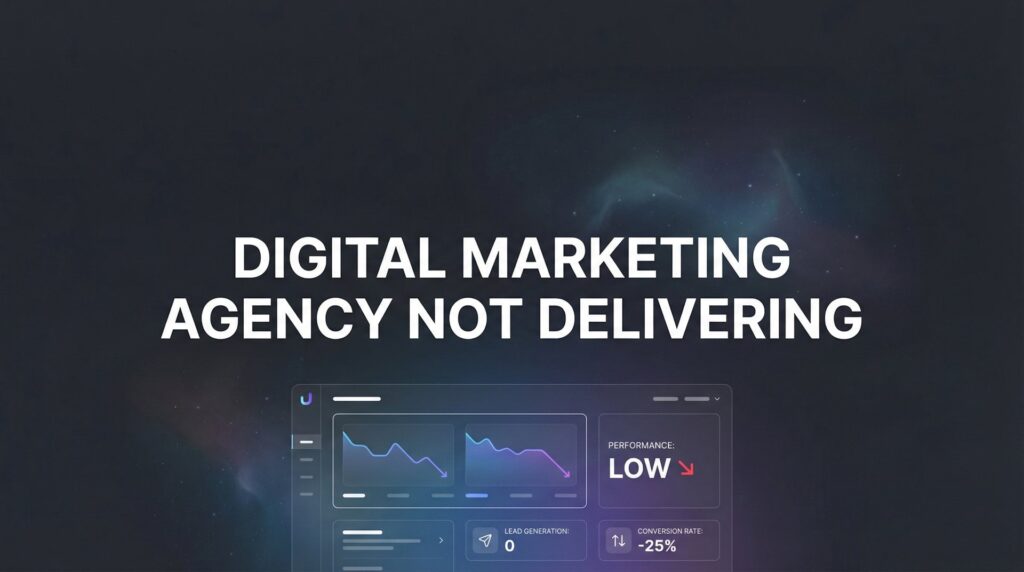
You’ve been paying your digital marketing agency $3,000, maybe $5,000, possibly even $10,000 every month. Six months in, you’re still waiting for the flood of leads they promised. The reports arrive like clockwork—colorful charts, impressive-looking graphs, lots of numbers. But when you actually look at your phone? Crickets. When you check your email inbox? Nothing but spam. Your bank account shows the monthly debit clear as day, but your pipeline remains stubbornly empty.
Here’s what nobody wants to tell you: this situation is alarmingly common. Business owners across every industry are stuck in relationships with agencies that look busy, sound professional, and deliver absolutely nothing that matters to your bottom line. The frustrating part? You can’t quite put your finger on what’s wrong. The agency has explanations for everything. They use terms you don’t fully understand. They assure you things are “trending in the right direction.”
But your gut knows something’s off. You’re not getting the results you were promised, and you’re starting to wonder if you’ve made an expensive mistake. This article will help you figure out whether your agency is genuinely underperforming or if you need to adjust your expectations. More importantly, it’ll show you exactly what to do next—whether that means fixing the relationship or making a strategic exit.
The Warning Signs Your Agency Relationship Has Gone Sideways
The first red flag usually shows up in communication patterns. Your agency used to respond within hours during the sales process. Now? You’re lucky to get a reply within 48 hours. When you do finally connect, the answers feel rehearsed and vague. You ask about lead quality, and they pivot to talking about “brand awareness” and “long-term strategy.” You question why the phone isn’t ringing, and they send you a report showing thousands of impressions.
This is the vanity metrics trap, and it’s where many agency relationships start to crumble. Impressions don’t pay your bills. Clicks don’t cover payroll. Website visits don’t keep your lights on. But these are the metrics underperforming agencies love to highlight because they’re easy to generate and look impressive on a dashboard. Meanwhile, the numbers that actually matter—cost per lead, cost per acquisition, return on ad spend—are either missing from reports entirely or buried in footnotes with creative explanations for why they’re “still developing.”
Pay attention to how your agency reacts when you push for clarity. Do they welcome specific questions about business outcomes, or do they get defensive? Do they explain their strategy in terms you can understand, or do they hide behind jargon? A confident, competent agency will walk you through exactly how their work connects to your revenue. An agency that’s failing will deflect, make excuses, and try to shift the conversation back to metrics that don’t matter.
Another telltale sign: nothing ever changes. You log into your Google Ads account (assuming they gave you access—if they didn’t, that’s its own red flag), and the campaigns look identical to how they did three months ago. Same ad copy. Same keywords. Same targeting. Same landing pages. The “optimization” they mentioned in last month’s call apparently meant leaving everything exactly as it was. This is the set-it-and-forget-it syndrome, and it’s how you know your account isn’t getting the active management you’re paying for.
Real campaign management means constant testing, refinement, and adjustment. Ad copy gets refreshed. Keywords get pruned. Bids get optimized. Landing pages get improved. If your campaigns are static, your agency has moved on to other clients while continuing to cash your checks. Understanding what marketing agency fees actually cover can help you identify whether you’re getting the active management you’re paying for.
What Turns Good Agencies Into Dead Weight
Understanding why agencies fail helps you figure out whether your situation is fixable. Sometimes the problem isn’t malicious—it’s structural. Many agencies grow too fast, taking on more clients than their team can actually handle. What started as a boutique operation with personalized attention becomes a client mill where your account gets passed to the most junior person on staff.
This is the account overcrowding problem, and it’s epidemic in the digital marketing industry. During your sales calls, you spoke with the agency owner or a senior strategist who impressed you with their expertise and vision. But once you signed? That person disappeared. Now you’re working with someone who graduated six months ago and is managing 40 other accounts while trying to figure out how Google Ads actually works.
The experience gap matters enormously in performance marketing. Running profitable campaigns requires understanding audience psychology, competitive dynamics, offer positioning, and platform mechanics. It requires knowing what to test, how to interpret results, and when to make aggressive moves versus patient refinements. Junior staff simply don’t have this knowledge yet, no matter how smart they are or how many certifications they’ve collected. This is why some businesses explore the digital marketing agency vs in-house marketing debate when agency relationships fail.
Another common failure point: the strategy-execution disconnect. The agency sold you on their expertise, but they’re actually generalists trying to serve everyone. They run Facebook ads for e-commerce stores, Google Ads for law firms, SEO for SaaS companies, and email campaigns for nonprofits. This jack-of-all-trades approach means they lack deep expertise in any specific area—including yours.
Performance marketing isn’t generic. What works for local service businesses is completely different from what works for e-commerce. B2B lead generation requires different strategies than B2C customer acquisition. An agency that claims to do everything well probably does nothing exceptionally. And in competitive markets, exceptional is what you need to win.
Then there’s the misaligned expectations problem. During sales conversations, agencies often paint optimistic pictures of what’s possible. They show case studies from their best clients. They talk about rapid growth and explosive results. What they don’t mention: those results required perfect market conditions, substantial budgets, extended timeframes, or all three. When your results don’t match those rosy projections, the agency blames your budget, your market, your offer, or your timeline—anything except their unrealistic promises.
The Accountability Conversation That Changes Everything
Before you fire your agency, you owe it to yourself (and your budget) to have one brutally honest conversation. But this can’t be a venting session or an emotional confrontation. You need to approach this strategically, with specific questions and clear expectations.
Start by requesting raw data access if you don’t already have it. You should own and control your Google Ads account, your analytics, your Facebook Business Manager, and any other platform where campaigns are running. If your agency resists giving you this access, that tells you everything you need to know—they’re hiding something. Legitimate agencies understand that clients should always maintain ownership of their data and accounts.
Once you have access, prepare for your meeting by identifying specific performance gaps. Don’t just say “we’re not getting results.” Come with numbers: “We’ve spent $24,000 over six months and generated 12 leads, which means our cost per lead is $2,000. Our average customer value is $3,500, so we’re barely breaking even before considering our time and overhead. This isn’t sustainable.” If you’re struggling to connect spend to outcomes, you may have a marketing conversion tracking problem that needs fixing first.
Ask your agency to explain their optimization process. What specific changes have they made in the last 60 days? What tests are currently running? What hypotheses are they pursuing? If they can’t provide detailed answers—if they talk in generalities about “monitoring performance” and “making adjustments”—you’re not getting active management.
Pay attention to how they respond to your concerns. A good agency will acknowledge shortfalls, explain contributing factors honestly, and present a concrete plan for improvement with specific timelines. They’ll say things like: “You’re right that lead volume is below target. We’ve identified that our landing page conversion rate is the bottleneck—it’s converting at 2.3% when we need it above 5% to hit your cost per lead goals. We’re launching three new landing page variants this week to test different headline approaches and form layouts. We should have statistically significant data within two weeks.”
A failing agency will deflect, make excuses, and try to reset expectations downward. They’ll blame your industry, your competition, your budget, seasonal factors, platform changes, or the alignment of the planets. They’ll suggest that maybe your goals were unrealistic or that you need to be more patient. This is excuse-making masquerading as expertise.
If the conversation goes well and you believe the agency is capable of improvement, set clear 30/60/90 day benchmarks. Be specific: “By the end of next month, we need to see cost per lead drop to $800 or below. By 60 days, we need at least 15 qualified leads per month. By 90 days, we need to see a clear path to positive ROI.” Make it clear that if these benchmarks aren’t met, you’ll be transitioning to another partner.
Making Your Exit Without Blowing Up Your Marketing
Sometimes the accountability conversation reveals that your agency simply can’t deliver what you need. Maybe they lack the expertise. Maybe they’re too busy. Maybe they’re just not good at what they do. When it’s clear the relationship can’t be salvaged, it’s time to plan your exit—but you need to do this strategically to avoid costly disruption.
Your first priority: securing ownership and access to everything. Before you announce you’re leaving, make sure you have admin access to your Google Ads account, your Facebook Business Manager, your analytics properties, your tag manager, and any other platforms. Download all historical data, campaign structures, and creative assets. If your agency created landing pages on their servers, get copies of those pages or prepare to rebuild them.
Review your contract carefully. Many agency agreements have termination clauses that require 30 or 60 days notice. Some contracts include provisions about account ownership or data access. Understanding these terms prevents surprises and helps you plan your transition timeline. If your contract is unclear about asset ownership, get clarification in writing before you announce your departure. Consider looking for a marketing agency with no long-term contract for your next partnership to maintain flexibility.
Plan for continuity. The worst-case scenario is stopping your current campaigns on Friday and having nothing running on Monday. That gap costs you money and momentum. Ideally, you’ll have your new agency or in-house team ready to take over before you end the existing relationship. If that’s not possible, at least ensure you understand how to keep campaigns running at a basic level during the transition.
When you do make the switch, look for agencies that demonstrate the opposite of what failed in your previous relationship. If your old agency was unresponsive, prioritize partners who guarantee response times and regular communication. If your old agency couldn’t explain their strategy, look for partners who walk you through their thinking and welcome questions. If your old agency was a generalist, find specialists who focus on your industry or marketing channel.
During your vetting process, ask about their account management structure. Who will actually be working on your account day-to-day? What’s their experience level? How many other accounts are they managing? What does their optimization process look like? How often will you have strategy calls? What does their reporting include? These operational questions reveal far more than impressive case studies or smooth sales presentations. Our guide on how to hire a digital marketing agency covers the essential questions to ask during this process.
Pay special attention to how potential agencies talk about results. Do they make specific promises about lead volume or cost per acquisition? That’s a red flag—no honest agency can guarantee specific numbers before they’ve run campaigns in your market. Do they talk about testing, learning, and optimization timelines? That’s more realistic. Do they ask detailed questions about your business model, customer lifetime value, and current conversion rates? That shows they’re thinking about actual ROI, not just generating activity.
What High-Performance Agency Relationships Actually Look Like
Once you’ve been burned by an underperforming agency, you might wonder if good agency partnerships even exist. They do—but they look different from what most business owners expect. The relationship isn’t about the agency doing mysterious marketing magic while you wait for results. It’s about structured collaboration with clear accountability on both sides.
Start with reporting standards. Your agency should provide regular reports (at minimum monthly, ideally with weekly snapshots) that focus on business metrics, not vanity metrics. You should see cost per lead, conversion rates, cost per acquisition, and return on ad spend front and center. Supporting metrics like impressions and clicks provide context, but they’re never the headline. The report should clearly show: how much you spent, how many leads you generated, what those leads cost, and how that compares to your targets and previous periods.
Beyond reports, you need regular strategy conversations. This isn’t a 15-minute call where the agency talks at you. It’s a collaborative session where you discuss what’s working, what’s not, and what to test next. Your agency should explain their strategic thinking in plain language and welcome your input about your business, your customers, and your market dynamics. You’re the expert on your business; they’re the expert on marketing execution. Both perspectives matter. A performance-based marketing agency often structures these conversations around revenue outcomes rather than activity metrics.
Transparency is non-negotiable. You should have view access (at minimum) to all advertising accounts and analytics platforms. You should understand how campaigns are structured, what targeting parameters are in place, and what the current testing priorities are. This isn’t about micromanaging—it’s about informed partnership. When you can see what’s happening, you can have more productive conversations about strategy and optimization.
The best agency relationships include clear KPI agreements established upfront. What metrics matter most to your business? What targets are you trying to hit? What’s your acceptable cost per acquisition based on your customer lifetime value? These numbers should guide everything the agency does. When you have alignment on what success looks like, it’s easy to evaluate whether the relationship is working. Understanding digital marketing agency pricing structures helps you set realistic expectations for what different investment levels can achieve.
Specialization matters more than most business owners realize. An agency that focuses on local service businesses understands the unique dynamics of local search, call tracking, and service area targeting. An agency that specializes in e-commerce knows platform-specific strategies for product feeds, shopping campaigns, and cart abandonment. An agency that concentrates on B2B lead generation understands longer sales cycles, lead nurturing, and sales-qualified lead criteria. This focused expertise consistently outperforms generalist approaches because specialists have solved your specific challenges dozens of times before.
Look for agencies that talk about their process, not just their results. Anyone can cherry-pick impressive case studies. What you want to understand is how they approach new accounts, how they diagnose problems, how they prioritize optimization opportunities, and how they make strategic decisions. Process reveals competence in ways that case studies never can.
Moving Forward With Marketing That Actually Works
If you’re reading this article, you’re probably frustrated, possibly angry, and definitely wondering if you’ll ever find a marketing partner who delivers what they promise. Here’s what you need to understand: agency underperformance isn’t something you should accept as normal. Results-focused marketing partnerships do exist, and business owners who demand accountability and transparency eventually find them.
The warning signs we covered—communication breakdowns, vanity metrics, static campaigns—these aren’t just minor annoyances. They’re indicators that your agency has either lost interest in your success or lacks the capability to deliver it. When you spot these patterns, you have two choices: have the hard accountability conversation with clear performance benchmarks, or make a strategic transition to a partner who prioritizes measurable outcomes.
If you decide to switch agencies, do it methodically. Secure your data and account access first. Understand your contractual obligations. Plan for continuity so your marketing doesn’t go dark during the transition. And when you’re vetting new partners, ask the operational questions that reveal whether they have the structure, expertise, and commitment to actually move your business forward.
What should an effective agency relationship feel like? You should understand what’s happening with your campaigns and why. You should see clear connections between marketing spend and business outcomes. You should have regular, productive conversations about strategy and optimization. You should feel like your agency is genuinely invested in your success, not just collecting monthly retainers.
The difference between mediocre marketing and high-performance marketing isn’t mysterious. It comes down to specialized expertise, active management, transparent communication, and relentless focus on the metrics that actually matter to your business. When you find an agency that delivers all four, you’ll wonder why you tolerated anything less. Tired of spending money on marketing that doesn’t produce real revenue? We build lead systems that turn traffic into qualified leads and measurable sales growth. If you want to see what this would look like for your business, we’ll walk you through how it works and break down what’s realistic in your market.
Want More Leads for Your Business?
Most agencies chase clicks, impressions, and “traffic.” Clicks Geek builds lead systems. We uncover where prospects are dropping off, where your budget is being wasted, and which channels will actually produce ROI for your business, then we build and manage the strategy for you.