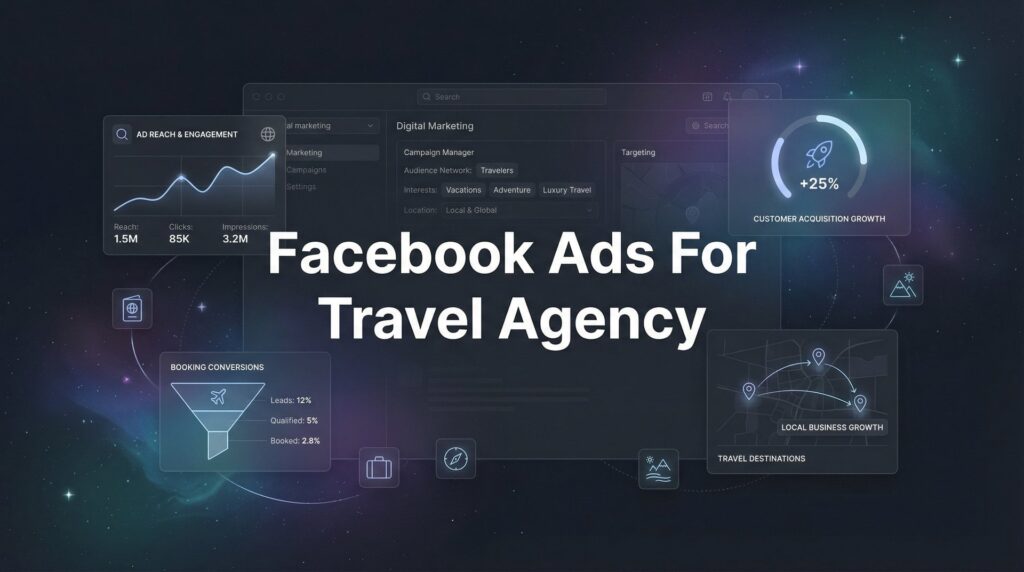
Your travel agency has incredible destinations to offer—pristine beaches, mountain adventures, cultural experiences that change lives. But here’s the frustrating reality: those dream trips don’t sell themselves. Travelers scroll past generic vacation ads every single day, immune to stock photos of palm trees and vague promises of “unforgettable experiences.” What breaks through? Facebook ads that speak directly to someone’s specific travel dreams, at exactly the moment they’re ready to start planning.
Facebook’s advertising platform gives travel agencies an unfair advantage. You can target honeymooners researching Maldives resorts, families planning Disney trips, or retirees dreaming about Mediterranean cruises. The visual format lets you showcase destinations in their full glory. The tracking capabilities show you exactly which ads generate booking inquiries versus which ones just rack up meaningless likes.
This guide walks you through building Facebook ad campaigns that actually fill your booking calendar. You’ll learn the technical foundation that most agencies skip, the audience targeting strategies that find ready-to-book travelers, and the creative approaches that make people stop scrolling and start planning. No fluff, no theory—just the exact steps we use to generate real bookings for travel businesses.
Whether you’re promoting luxury European river cruises, adventure tours in Costa Rica, or all-inclusive Caribbean packages, this framework works. Let’s turn your Facebook ad spend into measurable revenue.
Step 1: Set Up Your Facebook Business Infrastructure
Before you spend a single dollar on ads, your tracking foundation needs to be bulletproof. Most travel agencies jump straight to creating ads and wonder why they can’t tell which campaigns actually drive bookings. The Business Manager setup isn’t exciting, but it’s the difference between guessing and knowing.
Start by creating or claiming your Facebook Business Manager account at business.facebook.com. Connect your travel agency’s Facebook page—this becomes your ad identity. If you’re running ads through your personal account, you’re missing critical features and risking your entire ad account if Facebook flags something.
Next comes the most important technical piece: installing the Meta Pixel on your website. This tiny piece of code tracks every action visitors take after clicking your ads. When someone clicks your Bali package ad, views three different tours, and then submits a booking inquiry, the Pixel records that entire journey. Without it, you only know someone clicked—you have no idea if they actually became a customer.
Install the Pixel on every page of your website, but pay special attention to your conversion pages: booking inquiry forms, quote request pages, and completed reservation confirmations. If you use a booking platform like TripAdvisor or Viator, work with your developer to ensure tracking works across domains. Many travel agencies lose tracking when customers move from their website to a third-party booking system.
Configure custom conversions for the actions that matter to your business. Create separate conversion events for “View Package Details” (low-intent research), “Request Quote” (medium-intent consideration), and “Complete Booking” (high-intent conversion). This granular tracking lets you optimize campaigns for the specific outcome you want—not just website traffic.
Set up your payment method in Business Manager and establish your starting daily budget. For most travel agencies testing Facebook ads for the first time, start with $30-50 per day. This gives you enough data to learn what works without blowing your entire marketing budget in a week. You’ll scale up once you identify winning campaigns.
One final critical step: verify your domain in Business Manager. Facebook requires this for certain tracking features and gives you more control over how your links appear when shared. This takes five minutes and prevents headaches later when you’re trying to launch time-sensitive seasonal campaigns.
Step 2: Define Your Ideal Traveler Audiences
Generic targeting kills travel campaigns. “People interested in travel” is useless—that’s half of Facebook. You need laser-focused audiences that match the specific type of traveler who books your packages. A luxury safari company and a budget backpacking tour operator serve completely different customers, even though both are “travel agencies.”
Build your core audiences by stacking travel-related interests strategically. Instead of broad “travel” interests, target specific destinations your packages serve: “Santorini Greece,” “Machu Picchu,” “Amalfi Coast.” Layer in travel publications that your ideal customers read: Conde Nast Traveler for luxury travelers, Lonely Planet for adventure seekers, Travel + Leisure for aspirational mid-market travelers.
Include competitor pages and complementary brands. If you sell luxury European river cruises, target people who follow Viking Cruises, AmaWaterways, and European hotel brands like Belmond. They’ve already demonstrated interest in exactly what you offer. Don’t worry about “giving competitors attention”—you’re finding qualified buyers, not random browsers.
Demographics matter enormously in travel. A 25-year-old solo traveler and a 55-year-old couple planning retirement travel want completely different experiences. Layer age ranges that match your typical customer. Add household income targeting for luxury packages—if you’re selling $10,000 African safaris, targeting people making $35,000 annually wastes everyone’s time.
Life stage targeting unlocks powerful audience segments. Target “Newlyweds (1 year)” for honeymoon packages. Target “Parents with preschoolers” for family-friendly all-inclusive resorts. Target “Empty nesters” for couples’ adventure travel. Facebook knows these life stages based on profile information and behavior—use it.
Geographic targeting depends on your business model. If you’re a local travel agency serving regional travelers, target your metro area. If you’re an online-only agency selling worldwide, start with English-speaking countries with strong purchasing power: United States, Canada, United Kingdom, Australia.
Create custom audiences from your existing customer list. Upload email addresses of past bookers—Facebook matches them to profiles and lets you advertise directly to people who already trust you. This audience converts at 3-5x the rate of cold traffic because you’ve already proven your value.
Build website custom audiences based on behavior. Create one audience of people who visited any page in the last 180 days (broad retargeting), another of people who viewed specific destination pages in the last 30 days (warm prospects), and a third of people who started but didn’t complete a booking inquiry (hot leads who need a nudge).
Once you have at least 100 past customers in a custom audience, create lookalike audiences. Facebook analyzes what your best customers have in common and finds similar people who’ve never heard of you. Start with a 1% lookalike (most similar) and test up to 3-5% as you scale. Lookalikes often become your highest-performing cold audience.
Step 3: Craft Destination-Focused Ad Creative That Converts
Your ad creative needs to stop someone mid-scroll through cat videos and political arguments. In travel advertising, emotion wins. People don’t book trips because they need them—they book because they want to feel something: adventure, relaxation, romance, discovery. Your creative must trigger that emotional response instantly.
Lead with stunning visual content. Use high-resolution photos that showcase destinations in their best light—literally. Golden hour beach shots, vibrant market scenes, dramatic mountain vistas. Avoid generic stock photos that scream “stock photo.” If you don’t have original photography, invest in licensed content from platforms like Unsplash or purchase destination-specific imagery. The visual is 80% of what determines if someone stops scrolling.
Video content drives higher engagement for awareness campaigns. A 15-30 second video showing quick cuts of a destination—snorkeling in turquoise water, sunset over ancient ruins, local food markets, luxury resort amenities—creates desire better than static images. Keep it fast-paced; people’s attention spans on social media measure in seconds, not minutes.
Your ad copy needs to sell the transformation, not just the trip. Don’t write “7-day tour of Italy including Rome, Florence, and Venice.” Write “Taste handmade pasta in a 500-year-old Roman trattoria. Stand in the Sistine Chapel with 20 people instead of 2,000. Watch the sunset over the Grand Canal from your private water taxi.” Sell the specific moments they’ll remember forever.
Include concrete details that build trust and urgency. Vague promises like “amazing deals” don’t convert. Specific offers do: “7 nights in Santorini, cave hotel included, from $2,499 per couple—48 hours only.” Transparency around pricing, what’s included, and booking deadlines overcomes the natural skepticism people have toward travel ads.
Test carousel ads against single-image ads. Carousels work brilliantly for showcasing multiple destinations or different aspects of one trip (accommodations, activities, dining, excursions). They encourage interaction—people swipe through, spending more time with your ad. Single-image ads work better when you have one stunning hero image and a clear, focused offer.
Your headline needs to promise a specific outcome. “Explore Europe” is forgettable. “Experience Italy Like a Local: Small-Group Tours for Travelers Who Hate Tourist Traps” speaks to a specific desire. Call out your ideal customer in the headline so they instantly know this ad is for them.
The call-to-action button matters more than you think. “Learn More” works for awareness campaigns where you’re driving to blog content. “Book Now” works for hot audiences ready to commit. “Get Quote” works perfectly for high-consideration travel packages where people need customization. Match your CTA to where the audience sits in the buying journey.
Social proof crushes objections. If you have testimonials, weave them into ad copy: “Just returned from the trip of a lifetime—every detail was perfect!” Include star ratings if you have them. Mention how many travelers you’ve sent to this destination. Proof that others have booked and loved it reduces the perceived risk of booking with you.
Step 4: Structure Your Campaign for the Travel Buyer Journey
Travelers don’t see one ad and immediately book a $5,000 vacation. The decision journey spans weeks or months: initial inspiration, research and comparison, narrowing options, final decision. Your campaign structure needs to match this reality, with different ads for different stages.
Awareness campaigns target cold audiences who don’t know you exist. The goal isn’t bookings—it’s building desire and brand recognition. Show stunning destination content with minimal sales pressure. A video tour of the Amalfi Coast with copy like “Imagine waking up to this view every morning” works perfectly. You’re planting seeds, not asking for the sale. Target your broad interest-based audiences and lookalikes here.
These awareness ads should drive to valuable content, not hard sales pages. Send people to a blog post about “10 Hidden Gems on the Amalfi Coast” or a destination guide. Capture their email with a downloadable itinerary. Build trust first. The Pixel tracks everyone who engages, creating your retargeting pool for the next stage.
Consideration campaigns retarget people who engaged with awareness content. They’ve watched your destination video, read your blog post, or visited your website. Now they need specifics: package details, pricing, what’s included, why book with you versus competitors. Carousel ads showcasing different package tiers work brilliantly here. So do comparison posts: “Guided Group Tour vs. Custom Private Itinerary: Which Fits Your Travel Style?”
Include social proof heavily in consideration ads. Feature customer testimonials, photo galleries from past trips, or video reviews. This stage is where travelers evaluate whether you’re legitimate and deliver what you promise. Proof matters more than pretty pictures now.
Conversion campaigns target your warmest audiences: people who viewed specific package pages, added trips to wishlists, started booking forms but didn’t complete them, or spent significant time on your site. These ads need urgency and clear calls-to-action. “Only 3 Spots Left for September Departure” or “Book by Friday and Save $500 Per Couple” gives them a reason to act now instead of “someday.”
Drive conversion ads directly to booking pages or inquiry forms. Remove friction. If they need to click through three pages to request a quote, you’ll lose them. Make the path from ad to conversion as short as possible.
Budget allocation across funnel stages typically breaks down to 40% awareness, 30% consideration, 30% conversion for most travel agencies. You need constant top-of-funnel activity feeding your retargeting audiences. But the bottom-funnel conversion campaigns generate your actual bookings, so they deserve substantial budget despite smaller audience size.
Set up your campaign structure in Ads Manager with separate campaigns for each funnel stage. This lets you optimize each campaign for its specific goal: awareness campaigns optimize for video views or landing page views, consideration campaigns optimize for engagement or link clicks, conversion campaigns optimize for actual booking inquiries or completed reservations.
Step 5: Launch, Monitor, and Optimize Your Campaigns
Launch day isn’t the finish line—it’s the starting gun. Your first campaigns are experiments designed to reveal what resonates with your specific audience. The agencies that succeed treat the first two weeks as a learning phase, not a final product.
Start each ad set with 3-5 ad variations testing different creative approaches. Test different destination images, headline angles, and offer presentations. One ad might emphasize luxury and relaxation, another adventure and discovery, another cultural immersion and authenticity. You won’t know which message connects until you test it with real money against real audiences.
Monitor performance daily during the first week. Check your Ads Manager every morning. Look at click-through rate first—if people aren’t clicking, your creative isn’t compelling enough or you’re targeting the wrong audience. Aim for at least 1% CTR on cold audiences, 2-3% on warm retargeting audiences. Below that, something’s broken.
Track cost per result based on your campaign objective. For awareness campaigns, watch cost per landing page view. For consideration campaigns, monitor cost per engagement or link click. For conversion campaigns, obsess over cost per lead or cost per booking inquiry. These metrics tell you if your ads are efficient or burning money.
Facebook’s relevance score (now called quality ranking) indicates how well your ad resonates. Low scores mean your creative doesn’t match your audience, or your targeting is off. High scores mean you’re showing the right message to the right people. If you’re consistently scoring “below average,” pause and rethink your approach.
Kill underperforming ads ruthlessly once you have enough data. The magic number is typically 1,000-2,000 impressions. If an ad has shown to 2,000 people and generated zero clicks or engagement, it’s not suddenly going to start working. Turn it off and reallocate that budget to your winners. Many agencies waste thousands of dollars letting bad ads run because they’re afraid to make decisions.
Scale winning ads gradually. When you find an ad that’s generating booking inquiries at an acceptable cost, don’t immediately 5x the budget. Increase by 20-30% every 3-4 days. Aggressive budget increases reset Facebook’s algorithm and tank performance. Slow, steady scaling maintains efficiency while expanding reach.
Adjust your audiences based on what the data reveals. If your “luxury travelers interested in Italy” audience is crushing it while your “budget travelers interested in Italy” audience flops, you’ve learned something valuable about your offer and positioning. Double down on what works. Exclude people who already converted so you’re not wasting impressions on people who already booked.
Watch for audience fatigue in retargeting campaigns. If you’re showing the same ad to the same 5,000 people for weeks, performance will decline as they become blind to it. Refresh creative every 2-3 weeks. Rotate new destination imagery, update offers, change up your messaging. Keep it fresh.
Step 6: Scale Winners and Build Seasonal Campaigns
Once you’ve identified campaigns that profitably generate bookings, the game shifts from testing to scaling. But scaling isn’t just spending more—it’s building a sustainable system that consistently fills your calendar with qualified travelers.
Increase budget on proven winners using the 20-30% rule every 3-4 days. If a campaign is generating booking inquiries at $45 each and you’re happy with that cost, gradually increase daily budget from $50 to $65 to $85 over two weeks. Monitor closely—sometimes scaling reveals that your success was specific to a smaller audience segment, and costs rise as you expand. If cost per lead increases by more than 30%, you’ve scaled too fast.
Expand successful audiences by creating broader versions. If your 1% lookalike audience performs well, test a 2-3% lookalike with a separate ad set. If “people interested in Santorini” works, test “people interested in Greek Islands.” Expansion lets you maintain growth without exhausting your best audiences.
Plan seasonal campaigns around travel booking patterns. January is enormous for travel agencies—New Year’s resolutions drive vacation planning, and people are ready to book summer trips. Launch awareness campaigns in December targeting your best audiences, then hit them hard with conversion campaigns in early January. Spring (March-April) is when families plan summer vacations. Fall (September-October) is when people book holiday travel and winter getaways.
Build destination-specific seasonal campaigns. Promote European summer trips starting in February. Push Caribbean winter escapes starting in August. Highlight ski resort packages in September. Timing your campaigns to match when people naturally start planning those trips dramatically improves conversion rates.
Create evergreen Facebook remarketing ads that run continuously. Set up a campaign that automatically shows ads to anyone who visited your website in the last 30 days but didn’t convert. This “always-on” retargeting captures people at different stages of their decision process. Someone might visit in January, get busy, and return to the idea in March—your retargeting ad reminds them you exist.
Document everything that works. Create a simple spreadsheet tracking which audiences, creative approaches, offers, and messaging angles drive the best results. When you launch campaigns for a new destination, you’ll have a proven playbook instead of starting from scratch. Note seasonal patterns: “Bali campaigns perform best January-March and July-August” becomes valuable institutional knowledge.
Test new destinations and packages using your proven framework. Once you know that video ads showcasing luxury accommodations convert well for your European packages, apply that same creative approach to a new Asia campaign. Your testing phase shortens dramatically because you’re building on validated learnings.
Putting It All Together
You now have the complete system for running Facebook ads that generate actual bookings for your travel agency. This isn’t theory—it’s the exact framework that separates agencies with profitable ad campaigns from those burning money on pretty pictures that don’t convert.
The key is treating this as a system, not a one-time campaign. Your competitors launch ads randomly, hoping something works. You’re building a machine: proper tracking foundation, strategic audience targeting, emotionally compelling creative, funnel-based campaign structure, data-driven optimization, and systematic scaling. That’s how you win.
Start with Step 1 today. Get your Business Manager and Meta Pixel properly configured. Without accurate tracking, you’re flying blind—you’ll never know which ads actually drive bookings versus which ones just generate meaningless engagement. This foundation takes a few hours to set up correctly but saves you thousands in wasted ad spend.
Work through each step methodically over the next two weeks. Don’t skip to the “fun” creative part without building proper audiences. Don’t launch conversion campaigns before you’ve built awareness and consideration audiences through the funnel. The sequence matters. Each step builds on the previous one.
Within 30 days, you’ll have campaigns running that target the right travelers with the right message at the right time in their decision journey. You’ll know your cost per booking inquiry. You’ll understand which destinations and offers resonate with your audience. You’ll have a system you can replicate for every new package you launch.
The travel agencies that dominate their markets don’t have bigger budgets—they have better systems. They track properly, target strategically, test creatively, and optimize relentlessly. You now have the roadmap to do exactly that.
Tired of spending money on marketing that doesn’t produce real revenue? We build lead systems that turn traffic into qualified leads and measurable sales growth. If you want to see what this would look like for your business, we’ll walk you through how it works and break down what’s realistic in your market.
Want More Leads for Your Business?
Most agencies chase clicks, impressions, and “traffic.” Clicks Geek builds lead systems. We uncover where prospects are dropping off, where your budget is being wasted, and which channels will actually produce ROI for your business, then we build and manage the strategy for you.