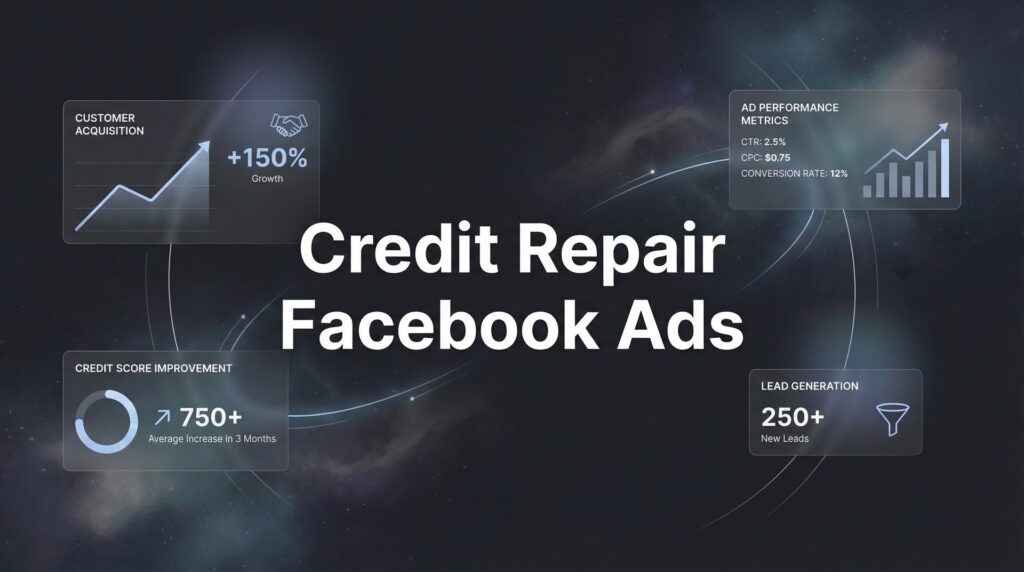
Credit repair businesses face a unique advertising challenge: reaching people who need help with their credit but may feel embarrassed or skeptical about seeking assistance. Facebook’s targeting capabilities make it one of the most powerful platforms for connecting with these potential clients—but only if you know how to navigate the platform’s strict financial services policies while crafting messages that resonate.
The difference between credit repair ads that drain your budget and those that fill your calendar with consultations comes down to strategy. Most credit repair businesses burn through thousands of dollars on Facebook ads before realizing they’re either violating platform policies or attracting the wrong type of leads.
This guide breaks down seven proven approaches to credit repair Facebook advertising that help you reach the right audience, stay compliant, and convert clicks into paying clients. These strategies work because they address the real challenges of this market: building trust with skeptical prospects, navigating restrictive ad policies, and qualifying leads before they waste your time.
1. Master Facebook’s Financial Services Ad Policies First
The Challenge It Solves
Nothing kills momentum faster than having your ad account suspended because you didn’t understand Facebook’s Special Ad Category requirements. Credit repair falls under Facebook’s strict financial services policies, which means standard targeting options simply don’t work. Many advertisers discover this the hard way—after their ads get rejected or their entire account gets flagged.
The platform treats credit-related services differently than other businesses, restricting your ability to target by age, gender, or specific locations. If you don’t proactively declare your ads as part of the Special Ad Category, Facebook’s detection systems will eventually catch it, and the consequences range from ad disapprovals to permanent account restrictions.
The Strategy Explained
Before launching any credit repair campaign, you must designate your ads under Facebook’s Special Ad Category for credit. This isn’t optional—it’s a hard requirement that fundamentally changes how your targeting works. When you select this category, Facebook automatically removes certain targeting parameters to comply with fair housing and credit advertising laws.
What changes? You lose the ability to target specific age ranges, genders, or precise zip codes. Instead, Facebook uses a 15-mile radius around your selected location. This might seem limiting, but it’s the price of staying compliant and keeping your account active.
The smart approach is to treat these restrictions as guardrails, not roadblocks. Focus on interest-based targeting, behavioral signals, and custom audiences built from your existing data. These targeting methods remain available and often produce better results than demographic targeting anyway. Understanding the nuances of Facebook ads for financial services can help you navigate these restrictions more effectively.
Implementation Steps
1. Before creating any ad, go to the Special Ad Category dropdown in Ads Manager and select “Credit.” This designation applies at the ad set level, so you’ll need to do it for every campaign.
2. Review Facebook’s advertising policies specifically for financial services at business.facebook.com/policies/ads to understand what claims you can and cannot make about credit improvement.
3. Build your targeting strategy around interests, behaviors, and custom audiences rather than demographics. Think “people interested in financial planning” or “small business owners” rather than “women aged 35-50.”
4. Create a compliance checklist for your ad creative: avoid guarantees about credit score improvements, don’t promise specific point increases, and ensure all claims are substantiated and realistic.
Pro Tips
Save yourself headaches by making compliance your default setting. Create ad account documentation that explains why you’re in the Special Ad Category, and train anyone who touches your ads on these requirements. If you’re working with a marketing agency, verify they understand these restrictions before they start spending your budget. The businesses that succeed with credit repair ads treat compliance as a competitive advantage—not an inconvenience.
2. Build Custom Audiences From Your Existing Client Data
The Challenge It Solves
Cold traffic is expensive and unpredictable, especially when you’re selling a service that requires significant trust. Starting every campaign by targeting strangers means you’re fighting an uphill battle against skepticism, price sensitivity, and low intent. Your best prospects aren’t random people scrolling Facebook—they’re people who look like the clients already paying you.
Most credit repair businesses sit on a goldmine of client data without realizing it. Email lists, phone numbers, past clients, current clients—this information becomes exponentially more valuable when you upload it to Facebook and let the platform find similar people.
The Strategy Explained
Custom audiences let you upload your existing client data to Facebook, which then matches those email addresses and phone numbers to user profiles. From there, you can create lookalike audiences—Facebook’s algorithm identifies users who share characteristics with your best clients and creates a targetable audience of similar prospects.
This approach works because it’s based on actual behavior, not assumptions. Instead of guessing who needs credit repair, you’re letting Facebook find people who statistically resemble those who’ve already hired you. The platform analyzes thousands of data points—interests, behaviors, demographics, online activity—to build audiences that mirror your customer base.
The quality difference is dramatic. Lookalike audiences typically generate higher engagement rates, lower cost-per-lead, and better conversion rates compared to interest-based cold targeting. You’re reaching people who are predisposed to respond to your message because they’re similar to those who already did. This is one of the most effective ways to address the low quality leads problem that plagues many credit repair businesses.
Implementation Steps
1. Export your client data including email addresses and phone numbers. Clean the list by removing duplicates and ensuring proper formatting. The more data points you include, the better Facebook’s matching algorithm performs.
2. In Facebook Ads Manager, navigate to Audiences and create a Custom Audience using your customer list. Upload the CSV file and let Facebook match the data to user profiles. Expect a match rate between 40-70% depending on data quality.
3. Once your custom audience processes, create a Lookalike Audience based on it. Start with a 1% lookalike for the highest quality, which represents the top 1% of Facebook users most similar to your clients. For broader reach, test 2-5% lookalikes later.
4. Segment your custom audiences by client value if possible. Create separate audiences for your highest-paying clients versus one-time purchasers, then build lookalikes from each. The “best client” lookalike will likely outperform a general customer lookalike.
Pro Tips
Refresh your custom audiences monthly as your client list grows. A larger source audience produces better lookalikes. If you have fewer than 100 clients in your source audience, consider waiting until your list grows or combining multiple data sources like email subscribers and consultation requests. The sweet spot for lookalike audience creation is 1,000+ source profiles, but you can start seeing results with as few as 100.
3. Target Life Events That Trigger Credit Awareness
The Challenge It Solves
People don’t think about their credit score until they need it. Most potential clients ignore credit issues until a specific life event forces the topic to the surface—applying for a mortgage, getting rejected for a car loan, or preparing to start a business. Catching prospects at these moments dramatically improves your conversion rates because you’re solving an immediate, pressing problem rather than creating awareness of a future need.
Random targeting means you’re spending money reaching people who aren’t currently motivated to fix their credit. They might need your service eventually, but “eventually” doesn’t pay your bills or fill your consultation calendar this month.
The Strategy Explained
Facebook’s interest and behavior targeting lets you identify users going through life events that commonly trigger credit awareness. Someone researching first-time home buying is likely to check their credit score soon. A person interested in starting a business will need financing. Parents looking at private schools might be considering education loans.
These targeting parameters put your ads in front of people at moments when credit scores move from “background concern” to “urgent priority.” Your message becomes relevant precisely when they’re most receptive to it. Instead of convincing someone they need credit repair, you’re offering a solution to a problem they’re actively experiencing.
This approach also helps with ad creative. When you know the specific trigger event, you can craft messages that speak directly to that situation: “Planning to buy a home? Your credit score determines your interest rate” resonates differently than generic “fix your credit” messaging. Similar targeting strategies work well for real estate Facebook ads where timing and life events are equally critical.
Implementation Steps
1. Identify the top 3-5 life events that drive credit awareness in your market. Common triggers include home buying, auto purchases, business formation, major purchases requiring financing, and job changes that involve credit checks.
2. Build separate ad sets for each life event category using Facebook’s interest targeting. For home buying, target interests like “first-time home buyer,” “mortgage broker,” “real estate,” and “home inspection.” For auto purchases, include “auto loan,” “car dealership,” and specific vehicle brands.
3. Create ad creative specific to each life event. A home-buying audience needs messaging about mortgage approval and interest rates. A business-starting audience responds to messaging about business credit and financing approval. Generic ads won’t perform as well as targeted messages.
4. Layer behavioral targeting when available. Facebook offers behaviors like “likely to move” or “small business owners” that complement interest-based targeting and help you reach people actively going through these transitions.
Pro Tips
Test seasonal timing for different life events. Home buying activity peaks in spring and early summer. Auto purchases spike around tax refund season and year-end. Business formation increases in January as people pursue New Year goals. Adjust your budget allocation to match these natural cycles and capture prospects when they’re most active.
4. Craft Ad Creative That Builds Trust Instantly
The Challenge It Solves
Credit repair carries a skepticism problem. Prospects have heard promises before, seen scammy ads, and dealt with companies that overpromise and underdeliver. Your biggest competitor isn’t other credit repair businesses—it’s the prospect’s doubt that anyone can actually help them. Breaking through that skepticism with a static image and generic ad copy is nearly impossible.
Traditional direct response advertising focuses on benefits and calls-to-action, but credit repair requires a different approach. Before prospects care about your service, they need to believe you’re legitimate, that you understand their situation, and that real people have gotten real results working with you.
The Strategy Explained
Video testimonials from actual clients provide social proof that overcomes skepticism in ways that written copy never can. When prospects see and hear real people describing their credit improvement journey, the service becomes tangible and believable. Educational content that explains how credit scoring works or reveals common credit report errors positions you as an expert rather than a salesperson.
This strategy works because it leads with value and proof rather than pitching. You’re not asking prospects to trust you—you’re showing them evidence that makes trust the logical conclusion. A 60-second video of a client explaining how you helped them qualify for a mortgage does more for conversion rates than any headline about “fast credit repair.” Mastering Facebook video ads marketing is essential for credit repair businesses looking to build this kind of trust.
Facebook’s algorithm also favors video content, particularly videos that maintain viewer attention. Testimonial videos and educational content typically generate higher engagement rates, which reduces your cost-per-impression and extends your reach within the same budget.
Implementation Steps
1. Record 3-5 client testimonial videos featuring people who achieved specific, measurable results. Focus on the transformation: where their credit was, what changed, and what they were able to accomplish afterward. Keep videos between 45-90 seconds for optimal Facebook performance.
2. Create educational videos that address common credit misconceptions or explain processes. Topics like “What Actually Impacts Your Credit Score” or “How to Read Your Credit Report” provide value while establishing your expertise. These videos should be 60-120 seconds maximum.
3. Design video thumbnails that look professional and trustworthy. Avoid clickbait-style thumbnails with exaggerated text or shocking imagery. Use clear headshots of real people or simple, clean graphics that match your brand.
4. Write ad copy that complements the video without repeating it. Use the copy to provide context, ask a relevant question, or highlight a specific benefit. Let the video do the heavy lifting on proof and explanation.
Pro Tips
Add captions to all videos since most Facebook users watch with sound off. Test different video lengths—some audiences respond better to quick 30-second testimonials while others engage more with detailed 2-minute explanations. Start each video with a hook in the first 3 seconds that stops the scroll: a surprising statistic, a relatable problem, or a compelling question.
5. Use Lead Forms With Strategic Qualification Questions
The Challenge It Solves
High lead volume means nothing if those leads never convert to paying clients. Many credit repair businesses celebrate 50 or 100 leads per month until they realize that 90% are unqualified, unreachable, or not serious about moving forward. Chasing bad leads wastes time, burns out your sales team, and makes your marketing look less effective than it actually is.
The temptation with Facebook lead forms is to keep them short—just name and email—to maximize conversion rates. But this approach prioritizes quantity over quality, filling your CRM with contacts who aren’t ready, willing, or able to become clients.
The Strategy Explained
Strategic qualification questions added to your lead forms create a filter that reduces lead volume while dramatically improving lead quality. By asking 2-3 questions that require prospects to self-identify their situation, you eliminate tire-kickers and attract people who are genuinely ready to discuss credit repair services.
This approach recognizes a fundamental truth: not everyone who clicks your ad should become a lead. Someone casually curious about credit repair isn’t worth the same follow-up effort as someone actively preparing to buy a home and needing credit improvement within 90 days. Qualification questions help you identify the difference before you waste time on outreach. If you’re struggling with this issue, our guide on fixing poor quality leads from marketing provides additional strategies.
The key is balancing friction with filtering. Too many questions kills conversion rates. Too few questions generates worthless leads. The sweet spot is typically 2-3 multiple-choice questions that take 10 seconds to answer but reveal critical information about intent and fit.
Implementation Steps
1. Identify the 2-3 questions that best predict whether a prospect will convert to a paying client. Common qualifiers include current credit score range, timeline for needing improved credit, specific goal driving the need, and whether they’ve worked with a credit repair company before.
2. Structure questions as multiple choice rather than open-ended to reduce friction. For timeline, offer options like “Within 30 days,” “1-3 months,” “3-6 months,” or “Just exploring options.” This makes answering quick while giving you actionable data.
3. Set up your lead form with name and email first, then add your qualification questions. Facebook’s lead form format lets you add custom questions easily. Keep the total form length to 5-7 fields maximum including contact information.
4. Create a lead scoring system based on responses. A prospect who needs credit improvement within 30 days for a home purchase gets immediate follow-up. Someone “just exploring options” with no specific timeline goes into a nurture sequence instead of immediate sales outreach.
Pro Tips
Test different qualification questions to find which ones best predict conversion. Start with timeline and specific goal, then experiment with adding credit score range or previous experience with credit repair. Monitor your lead-to-client conversion rate more closely than your cost-per-lead—a campaign generating 20 qualified leads at $30 each outperforms one generating 50 unqualified leads at $15 each if the qualified leads convert at 3x the rate.
6. Implement a Retargeting Funnel for Hesitant Prospects
The Challenge It Solves
Credit repair isn’t an impulse purchase. Most prospects need multiple touchpoints before they’re ready to commit to a service that requires monthly payments and takes months to show results. Someone who watches your video ad or visits your landing page today might not be ready to book a consultation until they’ve seen your message 3-4 more times over the next two weeks.
Single-touch campaigns leave money on the table. You pay to generate awareness and interest, then abandon prospects before they’ve had enough exposure to make a decision. The businesses winning with Facebook ads understand that the first ad view is just the beginning of the conversation, not the end.
The Strategy Explained
A retargeting funnel creates a sequence of ads that follows prospects through their decision-making process. Someone who watches 50% of your video gets retargeted with a testimonial ad. Someone who visits your landing page but doesn’t submit a lead form sees an ad addressing common objections. Someone who submitted a form but hasn’t booked a consultation gets reminded to schedule. Our comprehensive guide on Facebook remarketing ads covers these strategies in detail.
This approach works because it matches message to awareness level. A prospect who’s never heard of you needs different messaging than someone who’s already engaged with your content. Retargeting lets you customize the conversation based on demonstrated interest and behavior.
The results compound over time. As your retargeting audiences grow, you build a perpetual pipeline of warm prospects who are seeing your message repeatedly. This consistent exposure builds familiarity and trust, making conversion more likely when the prospect is finally ready to take action.
Implementation Steps
1. Install the Facebook Pixel on your website to track visitor behavior. This creates audiences of people who visited your landing page, watched your videos, or engaged with your content. Set up custom conversions for key actions like landing page visits, consultation bookings, and form submissions.
2. Create audience segments based on engagement level. Build separate audiences for video viewers (25%, 50%, 75%, 95% thresholds), landing page visitors, people who engaged with your Facebook page, and people who submitted lead forms but haven’t scheduled consultations.
3. Design ad sequences that move prospects forward. Your first retargeting ad might share a client success story. The second might address common objections like cost or timeline. The third might offer a limited-time consultation incentive. Each ad should assume the prospect has seen previous messaging.
4. Set frequency caps to avoid ad fatigue. Show each retargeting ad no more than 3-4 times per person per week. Use Facebook’s frequency controls to prevent overwhelming prospects with the same message repeatedly.
Pro Tips
Exclude people who’ve already converted from your retargeting campaigns to avoid wasting budget on existing clients. Create urgency in later retargeting ads with time-limited offers or consultation availability. Test different retargeting windows—some prospects convert within 7 days while others need 30-45 days of exposure. Start with a 14-day retargeting window and adjust based on your conversion data.
7. Track the Metrics That Actually Matter for Credit Repair
The Challenge It Solves
Facebook’s Ads Manager drowns you in data—impressions, reach, clicks, engagement, cost-per-click, click-through rate. Most of these metrics tell you nothing about whether your ads are actually generating revenue. A campaign with a 5% click-through rate and $2 cost-per-click looks impressive until you realize it generated zero consultations and zero clients.
Vanity metrics create a false sense of success. You can optimize for clicks and engagement all day while your business starves for actual paying clients. The disconnect happens because Facebook’s default metrics measure ad performance, not business performance. What matters isn’t how many people clicked—it’s how many people became clients and how much revenue they generated.
The Strategy Explained
Revenue-focused tracking shifts your attention from platform metrics to business outcomes. Instead of celebrating low cost-per-click, you track cost-per-consultation and cost-per-client. Instead of measuring impressions, you measure how many consultations came from Facebook and how many converted to paying clients.
This approach requires connecting your ad data to your business data. You need to know which leads came from which campaigns, which leads booked consultations, which consultations converted to clients, and what those clients are worth. Without this tracking, you’re making decisions based on incomplete information.
The businesses that succeed with Facebook ads build dashboards that show the full funnel: ad spend → leads → consultations → clients → revenue. This visibility lets you identify which campaigns actually drive business growth versus which ones just generate activity. If your campaigns aren’t producing results, understanding why your Facebook ads are not converting is the first step toward fixing them.
Implementation Steps
1. Define your key performance indicators based on business outcomes. For credit repair, this typically includes cost-per-lead, lead-to-consultation rate, consultation-to-client rate, cost-per-client, and client lifetime value. These metrics connect ad spend to actual revenue.
2. Set up conversion tracking that follows prospects through your entire funnel. Use Facebook’s conversion tracking to monitor form submissions, consultation bookings, and client acquisitions. Create custom conversions for each funnel stage so you can see where prospects drop off.
3. Build a reporting system that combines Facebook data with your CRM data. Track which campaigns generated which leads, then follow those leads through to consultation and client status. A simple spreadsheet works fine—the goal is visibility into the complete journey from click to client.
4. Calculate your maximum allowable cost-per-client based on lifetime value. If the average client is worth $2,000 and you want a 3:1 return on ad spend, you can afford to spend up to $667 to acquire a client. This number becomes your North Star for campaign optimization.
Pro Tips
Review your metrics weekly but make optimization decisions monthly. Facebook’s algorithm needs time and data to optimize, so daily tweaking usually hurts performance. Focus on trends over time rather than day-to-day fluctuations. If a campaign is generating consultations at your target cost-per-client, let it run even if the cost-per-click seems high. The only metric that ultimately matters is profitable client acquisition.
Putting Your Credit Repair Facebook Ads Strategy Into Action
Success with credit repair Facebook ads comes down to a specific sequence: compliance first, audience building second, creative testing third, then optimization from there. Start by ensuring every campaign uses the Special Ad Category designation—this non-negotiable step protects your account and keeps you advertising long-term.
Next, build your custom audiences from existing client data before spending heavily on cold traffic. A 1% lookalike audience based on your best 100-200 clients will outperform interest-based targeting in most cases. This foundation gives you a warm audience to test creative and messaging against.
Launch your first campaign with educational video content or client testimonials rather than hard-sell direct response ads. Credit repair requires trust-building, and that happens through demonstration and proof, not through aggressive sales copy. Test 3-4 different video ads to see which messages resonate most with your audience.
Add strategic qualification questions to your lead forms from day one. The short-term hit to lead volume is worth the long-term gain in lead quality. A campaign generating 15 qualified leads per month beats one generating 50 unqualified leads if your team can actually convert those 15 into clients.
Build your retargeting funnel as soon as you have 500-1,000 people in your pixel audiences. These warm prospects convert at higher rates and lower costs than cold traffic. The businesses seeing the best results treat Facebook as a relationship-building platform, not a quick-hit lead machine.
Track consultations and client acquisitions, not clicks and impressions. Your dashboard should show how many consultations each campaign generated, how many converted to clients, and what the total revenue was. This clarity lets you scale what works and kill what doesn’t based on actual business impact.
Focus on consistency over perfection. A simple campaign running continuously with monthly optimization beats an elaborate campaign that launches and stops repeatedly. Give your campaigns 30-45 days to gather data before making major changes. The credit repair businesses winning with Facebook ads are those that commit to the channel long enough to learn what works in their specific market.
Tired of spending money on marketing that doesn’t produce real revenue? We build lead systems that turn traffic into qualified leads and measurable sales growth. If you want to see what this would look like for your business, we’ll walk you through how it works and break down what’s realistic in your market.
Want More Leads for Your Business?
Most agencies chase clicks, impressions, and “traffic.” Clicks Geek builds lead systems. We uncover where prospects are dropping off, where your budget is being wasted, and which channels will actually produce ROI for your business, then we build and manage the strategy for you.