You’ve been running Facebook and Instagram ads for months. Maybe you’re boosting posts when business feels slow, or you set up a campaign once and let it run on autopilot. Meanwhile, your competitor down the street seems to have an endless stream of new customers walking through their door—and you can’t figure out what they’re doing differently.
Here’s the reality: they’re not just throwing money at social media and hoping something sticks. They understand that effective ads management for Facebook Instagram isn’t about random boosted posts or crossing your fingers. It’s about treating Meta’s advertising ecosystem like the sophisticated customer acquisition machine it actually is.
The businesses that dominate their local markets with social advertising aren’t lucky—they’re strategic. They know how to structure campaigns that guide potential customers from awareness to action. They understand audience targeting well enough to find buyers before competitors do. And they track the metrics that actually matter: cost per lead, return on ad spend, and revenue generated—not just likes and shares.
This guide cuts through the noise and shows you exactly what professional ads management looks like. Whether you’re managing campaigns yourself or evaluating whether it’s time to bring in expertise, you’ll understand the systems that separate businesses wasting ad spend from those scaling profitably.
The Meta Advertising Ecosystem: One Platform, Two Powerhouse Channels
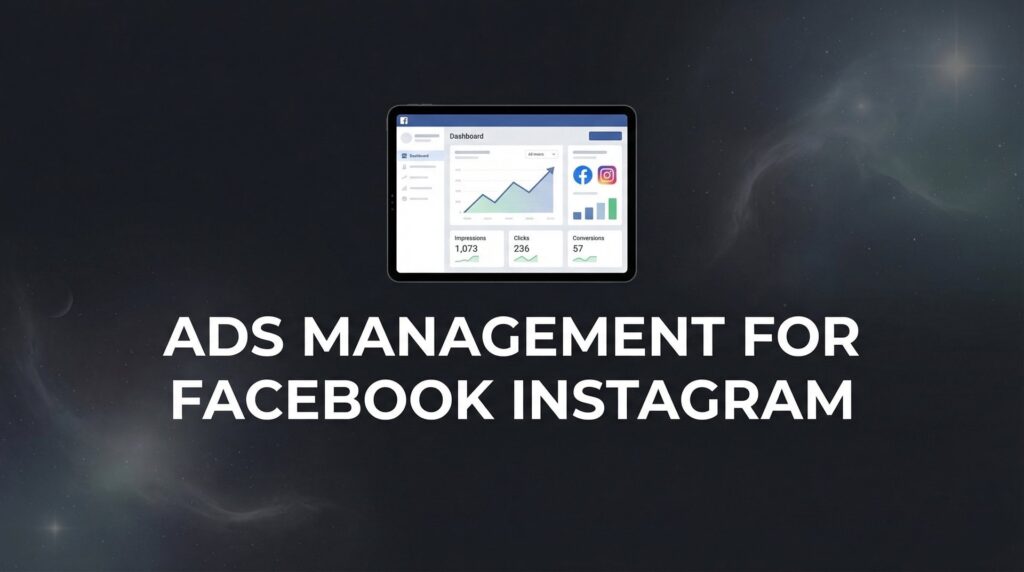
Here’s what many business owners don’t realize: when you advertise on Facebook and Instagram, you’re not managing two separate platforms. You’re working within Meta’s unified advertising ecosystem, controlled through a single interface called Ads Manager.
This matters because one campaign can run simultaneously across both Facebook and Instagram. You don’t need separate budgets, separate audiences, or separate creative for each platform. The system is designed to show your ads wherever your ideal customers are most active and most likely to take action.
Think of it like this: Meta’s algorithm is constantly evaluating billions of data points—who’s engaging with similar content, what time of day they’re active, which device they’re using, whether they typically watch videos or scroll past them. It uses this information to optimize ad delivery in real-time, shifting budget toward the placements and audiences that perform best.
Understanding Placement Options: Your ads can appear in multiple locations across both platforms—Facebook Feed, Instagram Feed, Facebook Stories, Instagram Stories, Reels, Messenger, and even the Audience Network. Each placement has different user behavior patterns and performance characteristics.
When you’re starting out, automatic placements typically work best. This lets Meta’s algorithm test your ads across different locations and allocate budget to wherever they perform strongest. The system learns faster with more data, and restricting placements too early limits that learning process.
But here’s where it gets strategic: once you have performance data, manual placement selection becomes powerful. If your Instagram Stories ads consistently generate leads at half the cost of Facebook Feed, you can shift budget accordingly. If video ads crush it in Reels but fall flat everywhere else, you adjust.
The key is understanding that Facebook and Instagram aren’t competing channels—they’re complementary parts of the same customer journey. Someone might see your ad first in their Instagram Feed during their morning scroll, then encounter it again in Facebook Stories that evening, and finally convert after seeing it in their Facebook Feed the next day. For businesses trying to decide between platforms, understanding Google Ads vs Facebook Ads for lead generation can help clarify where to allocate your budget.
This cross-platform presence creates the repetition needed for conversion without requiring you to manually coordinate campaigns across multiple systems. Meta handles the orchestration; you focus on strategy, targeting, and creative that converts.
Building Campaign Structures That Actually Generate Customers
Most local businesses make the same critical mistake: they launch ads trying to sell immediately to people who’ve never heard of them. It’s the digital equivalent of proposing marriage on the first date—and it produces similar results.
Professional ads management follows a three-tier campaign structure that mirrors how people actually make buying decisions: Awareness, Consideration, and Conversion. Each stage serves a specific purpose, and skipping stages costs you money.
Awareness Campaigns: These introduce your business to people who don’t know you exist yet. The goal isn’t immediate sales—it’s getting on their radar. You’re building an audience of people who’ve engaged with your content, watched your videos, or visited your website. These campaigns typically use objectives like Video Views, Reach, or Traffic.
Consideration Campaigns: This is where you nurture the audience you built in the awareness stage. You’re providing value, demonstrating expertise, and building trust. Campaign objectives here include Engagement, Messages, or Lead Generation. You’re moving people closer to a purchase decision without forcing it prematurely.
Conversion Campaigns: Now you’re ready to ask for the sale—but only to people who’ve already been warmed up. These campaigns target your engaged audience with specific offers, using objectives like Conversions, Catalog Sales, or Store Traffic.
Here’s why this structure matters: the cost to convert a cold audience member is dramatically higher than converting someone who already knows, likes, and trusts you. By investing in awareness and consideration first, you build a qualified audience that converts at lower costs.
Choosing the Right Campaign Objective: Meta offers multiple campaign objectives, and selecting the wrong one wastes money fast. If your goal is collecting leads, choose the Lead Generation objective—not Traffic or Engagement. If you want in-store visits, use the Store Traffic objective. The algorithm optimizes for whatever objective you select, so misalignment between your goal and your objective setting produces poor results.
Budget Strategy That Doesn’t Burn Cash: Daily budgets give you consistent spend and easier budget management. Lifetime budgets allow Meta more flexibility to optimize delivery timing. For most Facebook ads for local business campaigns, daily budgets work better because they provide predictable costs.
But here’s the critical piece: Meta campaigns go through a learning phase where the algorithm gathers data to optimize delivery. During this phase, performance is unstable and costs are typically higher. The learning phase completes after your ad set generates approximately 50 optimization events within seven days.
This means if you’re optimizing for purchases and only getting five purchases per week, your campaign never exits the learning phase—and never optimizes properly. You need sufficient budget to generate enough conversion events for the algorithm to learn. Underfunding campaigns is one of the fastest ways to waste money.
Audience Targeting: The Difference Between Reaching People and Reaching Buyers
You can have the best ad creative in the world, but if you’re showing it to the wrong people, you’re burning money. Effective audience targeting is what separates businesses that generate profitable leads from those wondering why their ads don’t work.
Meta provides three primary audience types, and understanding when to use each is fundamental to ads management for Facebook Instagram that actually drives revenue.
Custom Audiences: These are audiences built from people who already have a connection to your business. You can create custom audiences from your customer email list, website visitors, people who’ve engaged with your Instagram or Facebook content, or those who’ve watched your videos.
This is your warmest audience—people who already know you exist. They convert at the highest rates and lowest costs. If you’re not running campaigns to your custom audiences, you’re leaving money on the table. A simple Facebook remarketing ads campaign to website visitors who didn’t convert can often produce your best return on ad spend.
Lookalike Audiences: This is where Meta’s algorithm really shines. You provide a source audience—typically your best customers or highest-value website visitors—and Meta finds people who share similar characteristics, behaviors, and interests.
Lookalike audiences are built in percentage ranges: 1% represents the people most similar to your source audience, while 10% casts a wider net with less similarity. For most local businesses, the sweet spot is the 1-3% range. You get enough scale to spend meaningful budget while maintaining strong similarity to your best customers.
The quality of your source audience determines the quality of your lookalike. Building a lookalike from your entire customer list produces different results than building one from just your highest-spending customers. The more specific and valuable your source audience, the better your lookalike performs.
Interest and Behavior Targeting: When you’re reaching completely cold audiences, you’re selecting people based on their interests, behaviors, demographics, and location. This is where many businesses get targeting wrong—they either go too broad or too narrow.
Going too broad means you’re showing ads to people unlikely to need your service. Going too narrow restricts the algorithm’s ability to optimize and find your best customers within that audience. The strategy is layering: combine location targeting with relevant interests and behaviors that indicate purchase intent.
For example, if you run a local gym, you might target people within ten miles of your location, interested in fitness and wellness, who have recently moved to the area. Each layer narrows your audience to people more likely to convert, but you’re maintaining enough scale for the algorithm to optimize effectively.
The biggest mistake businesses make is creating dozens of tiny, hyper-specific audiences. Meta’s algorithm needs volume to learn and optimize. Better to create broader, well-layered audiences and let the algorithm find your buyers within them than to manually segment yourself into audiences too small to generate meaningful data.
Creative That Stops the Scroll and Drives Action
Your targeting can be perfect, but if your creative doesn’t capture attention in the first second, you’ve already lost. People scroll through hundreds of posts daily—your ad needs to stop that scroll immediately or it becomes invisible.
In 2026, video-first creative isn’t optional anymore—it’s the baseline expectation. Short-form video consistently outperforms static images across both Facebook and Instagram. The platforms favor video in their algorithms, users engage with video at higher rates, and video allows you to communicate more information in less time.
But not just any video works. The first three seconds determine whether someone keeps watching or scrolls past. You need a hook that creates immediate curiosity, addresses a pain point, or presents something visually unexpected.
The Hook-Story-Offer Framework: This structure works across virtually every type of ad creative because it mirrors how humans process information and make decisions.
The hook grabs attention—it might be a provocative question, a surprising statement, or a visual that creates pattern interruption. “Still paying for leads that never call back?” or “This one change doubled our client’s foot traffic” immediately signals relevance to the right audience.
The story builds connection and demonstrates value. You’re not just listing features—you’re showing the transformation or explaining the problem you solve. This is where you build credibility and create the emotional connection that drives action.
The offer provides the clear next step. What exactly do you want people to do? Book a consultation? Claim a limited-time discount? Visit your location? The offer should be specific, valuable, and time-bound when possible.
Platform-Specific Creative Considerations: While you can run the same creative across both platforms, understanding the nuances improves performance.
Instagram Reels favor vertical video with quick cuts, trending audio, and visual storytelling. The audience skews younger and expects content that feels native to the platform—polished but not overly corporate. Agencies looking to offer these services can explore white label Instagram ads solutions to expand their offerings.
Facebook Feed still performs well with slightly longer-form content and more detailed copy. The audience tends to be older and more receptive to educational content and detailed explanations.
Instagram Stories work best with vertical, mobile-first creative that feels personal and immediate. Poll stickers, question prompts, and interactive elements boost engagement.
The key is testing creative variations across placements and letting data tell you what works. What crushes it in Reels might fall flat in Facebook Feed, and vice versa. Professional ads management means constantly testing new creative approaches and refreshing ads before creative fatigue sets in.
Creative fatigue happens when your audience has seen your ad so many times that they start ignoring it—engagement drops, costs rise, and performance declines. The solution is having a pipeline of fresh creative ready to deploy. Most high-performing campaigns refresh creative every two to four weeks.
Tracking and Optimization: Turning Data Into Profitable Decisions
Running ads without proper tracking is like driving blindfolded—you might move forward, but you have no idea if you’re headed in the right direction. And in a privacy-first world where tracking has become more complex, getting this right is non-negotiable.
Meta Pixel and Conversions API: The Meta Pixel is a piece of code installed on your website that tracks visitor actions—page views, form submissions, purchases, phone calls. It’s the foundation of conversion tracking and retargeting.
But iOS privacy changes have limited how effectively browser-based tracking works. That’s where Conversions API comes in—it sends conversion data directly from your server to Meta, bypassing browser restrictions. Using both together provides the most accurate tracking possible in 2026.
Without proper tracking setup, you can’t measure return on ad spend, you can’t optimize for conversions, and you can’t build accurate custom audiences. This is where many DIY campaigns fall apart—the technical setup gets skipped, and you’re flying blind. Implementing call tracking for marketing campaigns adds another layer of visibility into which ads actually drive phone leads.
Metrics That Actually Matter: Meta provides dozens of metrics, but most are vanity metrics that don’t correlate with revenue. Impressions, reach, and engagement might feel good, but they don’t pay your bills.
Focus on these core metrics: Cost Per Lead tells you how much you’re paying to acquire each potential customer. Return on Ad Spend (ROAS) shows how much revenue you generate for every dollar spent. Cost Per Acquisition reveals what you pay to acquire an actual customer, not just a lead.
These metrics connect directly to profitability. If your average customer value is $500 and your cost per acquisition is $100, you have a profitable campaign with room to scale. If your cost per acquisition is $600, you’re losing money on every customer—no amount of volume fixes that.
A/B Testing Methodology: Testing is how you improve performance over time, but random testing wastes budget. You need a systematic approach.
Test one variable at a time. If you change your audience, creative, and headline simultaneously, you can’t identify what caused the performance change. Run your test long enough to gather statistically significant data—typically at least four to seven days and several hundred conversions per variation.
What to test: audience segments, ad creative variations, headline and copy approaches, offer structures, and placement strategies. Start with the elements likely to have the biggest impact—creative and audience typically move the needle most.
When to kill underperformers: if an ad set hasn’t generated results after spending 2-3 times your target cost per conversion, it’s probably not going to. Don’t let hope drain your budget. Turn it off and reallocate that spend to what’s working. If you’re struggling with this issue, understanding why Facebook ads aren’t converting can help diagnose the problem.
Optimization is ongoing. What works this month might not work next month as audience fatigue sets in, competition changes, or seasonal factors shift. Professional ads management means daily monitoring of performance, weekly optimization adjustments, and monthly strategic reviews.
DIY vs. Professional Management: What Makes Sense for Your Business
Let’s be honest about what managing Facebook and Instagram ads actually requires. It’s not posting a few ads and checking in once a week. It’s daily monitoring, constant creative development, technical tracking setup, audience testing, performance analysis, and strategic optimization.
If you’re going to manage campaigns yourself, here’s the real time investment: expect to spend 10-15 hours per week minimum for a single campaign running across both platforms. That includes creative development, audience research, daily performance monitoring, A/B testing setup, optimization adjustments, and reporting analysis.
Can you afford to take that time away from running your business? For some business owners, the answer is yes—especially in the early stages when budget is tight and learning the platform provides valuable insights. But for most established businesses, that’s 10-15 hours not spent on customer service, operations, or business development.
Warning Signs You Need Expert Intervention: Your costs are rising month over month while results decline. You’re getting clicks but no conversions, suggesting tracking or landing page issues. You want to scale but don’t know how to increase budget without destroying performance. Your creative consistently underperforms and you’re not sure why. Understanding how to scale Facebook ads properly can prevent these costly mistakes.
These aren’t just inconveniences—they’re expensive problems. Every week you run underperforming campaigns, you’re burning money that could be generating profitable leads with proper management.
What to Look for in Professional Ads Management: Certifications matter—Meta Blueprint certification shows the team understands the platform’s technical capabilities. But certifications alone don’t guarantee results.
Track record is critical. Ask for case studies in your industry or similar business types. What kind of return on ad spend have they generated for clients? Can they show documented results, not just testimonials? The low quality leads problem is something experienced managers know how to solve through proper targeting and qualification.
Reporting transparency separates professionals from amateurs. You should receive regular reports showing exactly where your money went, what results it generated, and what optimizations are being implemented. If an agency is vague about reporting or makes it difficult to understand your actual performance, that’s a red flag.
Communication structure matters too. Will you have a dedicated account manager? How often will you receive updates? What’s the process for creative approval and strategy adjustments? Clear expectations prevent frustration later.
The right ads management partner doesn’t just run your campaigns—they become an extension of your marketing team, bringing expertise you don’t have time to develop internally while you focus on what you do best: running your business.
Putting It All Together: From Ad Spend to Revenue Growth
Ads management for Facebook Instagram isn’t a set-it-and-forget-it task. It’s an ongoing optimization process that requires strategic thinking, technical expertise, and constant adaptation to platform changes and market conditions.
The businesses that waste ad spend treat social advertising like a lottery ticket—they throw money at it and hope something good happens. The businesses that scale profitably treat it like the systematic customer acquisition machine it is. They understand campaign structure, audience targeting, creative development, and performance optimization.
They know that effective ads management means building campaigns that guide potential customers through awareness, consideration, and conversion. They track metrics that matter—cost per lead, return on ad spend, and customer acquisition cost—not vanity metrics like reach and impressions. They test continuously, refresh creative before fatigue sets in, and optimize based on data rather than guesswork.
The difference between struggling with social ads and scaling profitably often comes down to having the right expertise managing your campaigns. Whether that expertise comes from investing the time to master the platform yourself or partnering with professionals who live and breathe Meta advertising, the fundamentals remain the same: strategic targeting, compelling creative, accurate tracking, and relentless optimization.
Your competitors who seem to have an endless stream of new customers? They’re not lucky. They’re leveraging Meta’s advertising ecosystem the way it was designed to be used—as a predictable, scalable customer acquisition system.
Tired of spending money on marketing that doesn’t produce real revenue? We build lead systems that turn traffic into qualified leads and measurable sales growth. If you want to see what this would look like for your business, we’ll walk you through how it works and break down what’s realistic in your market.
Want More Leads for Your Business?
Most agencies chase clicks, impressions, and “traffic.” Clicks Geek builds lead systems. We uncover where prospects are dropping off, where your budget is being wasted, and which channels will actually produce ROI for your business, then we build and manage the strategy for you.