You’ve spent thousands on marketing. Your website gets traffic. Your social media posts get likes. But when you look at your bank account, the math doesn’t add up. The leads aren’t coming in. The phone isn’t ringing. And you’re starting to wonder if digital marketing is just smoke and mirrors.
Here’s the truth: most businesses fail at digital marketing not because the tactics don’t work, but because they skip the most critical step—the strategic consultation that maps out what actually makes sense for their specific business.
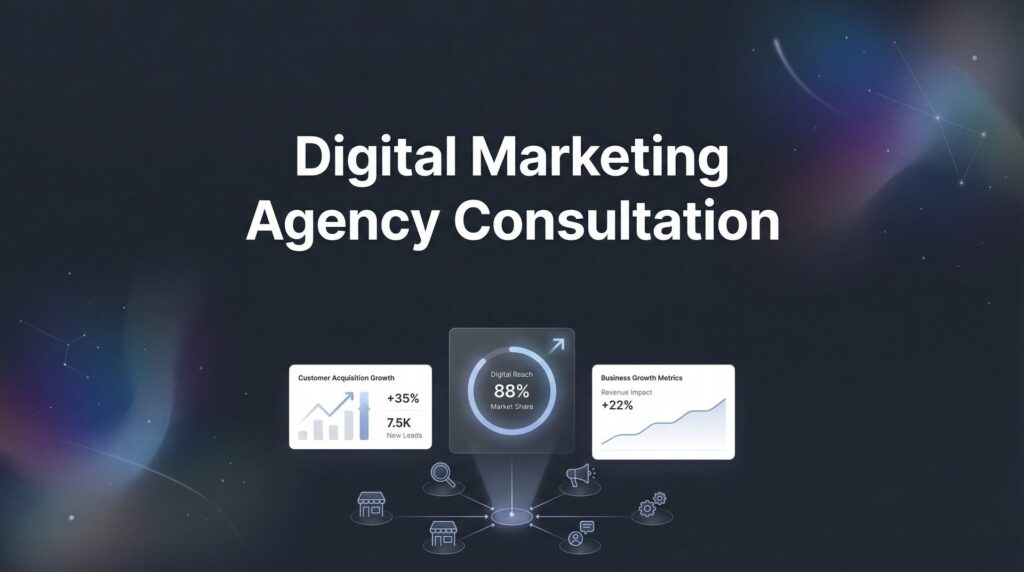
A digital marketing agency consultation isn’t a sales pitch disguised as advice. It’s a diagnostic session where you and a potential partner dissect your business, identify what’s broken, and determine whether there’s a path to profitable growth. The difference between businesses that scale and those that burn through marketing budgets comes down to this initial conversation. Get it right, and you’ll build a marketing engine that generates predictable revenue. Get it wrong, and you’ll waste months chasing tactics that were never going to work for your market.
The Anatomy of a High-Impact Marketing Consultation
A professional marketing consultation follows a structured process that has nothing to do with selling you services and everything to do with understanding your business reality. The best consultations unfold in three distinct phases: discovery, audit, and strategic recommendation.
During the discovery phase, a quality agency asks questions that make you think differently about your business. They want to know your revenue targets, your average customer value, how long customers typically stay with you, and what percentage of leads actually convert to sales. They’re not being nosy—they’re building a financial model to determine whether marketing can realistically move the needle for you.
Think of it like visiting a doctor. A good physician doesn’t immediately prescribe medication. They ask about symptoms, review your medical history, run tests, and only then recommend treatment. Marketing works the same way.
The audit phase is where things get interesting. A results-focused agency will request access to your Google Analytics, review your current ad accounts if you have them, analyze your website’s conversion path, and study your competitors’ digital presence. They’re looking for gaps—places where you’re losing potential customers without realizing it. Understanding what digital marketing audit services reveal can help you prepare for this critical evaluation.
Here’s what separates a genuine strategic assessment from a sales pitch: a sales pitch tells you what the agency does. A strategic assessment tells you what your business needs. If someone spends the entire meeting talking about their services without asking detailed questions about your operations, you’re in the wrong room.
Quality agencies ask uncomfortable questions. They want to know why your current marketing isn’t working. They ask about your sales process—how leads are handled, how quickly they’re followed up, what happens when someone fills out a contact form. They dig into your competitive advantages and whether you can articulate what makes you different from the three other businesses doing exactly what you do.
The strategic recommendation phase is where everything comes together. Based on what they’ve learned, a professional agency will outline which marketing channels make sense for your business, what kind of budget would be required to compete effectively, and what realistic timelines look like for seeing results. They’ll also tell you if something won’t work—and that honesty is worth more than any sales pitch.
Preparing Your Business Data Before the Call
Walking into a marketing consultation unprepared is like going to a job interview without a resume. You might still get hired, but you’re making it harder on yourself and limiting what can be accomplished in the time you have.
Start by gathering your essential performance metrics. You need to know where your current customers come from. How many came from referrals? How many found you through Google? How many called after seeing your truck or storefront? This baseline data tells an agency what’s already working organically—and what needs amplification.
Your cost per acquisition matters more than you think. If you’re currently spending money on any form of marketing, calculate what each new customer costs you. Divide your total marketing spend by the number of new customers acquired. This number becomes the benchmark that any new strategy needs to beat. Understanding digital marketing agency pricing helps you evaluate whether proposed costs align with industry standards.
Customer lifetime value is the metric that changes everything. If your average customer spends three thousand dollars with you over two years, you can afford to spend more to acquire them than if they’re one-time purchasers. Many local businesses underinvest in marketing because they only think about the initial transaction, not the total relationship value.
Website and analytics access requirements are non-negotiable for a thorough consultation. If you have Google Analytics installed, make sure you can provide view access. If you’re running any paid advertising, have your account credentials ready. An agency that can see your actual data will give you infinitely better recommendations than one working from assumptions.
Document your sales process before the meeting. Write down exactly what happens when a lead comes in. Who contacts them? How quickly? What’s the follow-up sequence? How many leads turn into quotes, and how many quotes turn into sales? These conversion rates reveal whether your problem is lead volume or lead quality—and the solution is completely different depending on which one you’re facing.
Identify your conversion bottlenecks with brutal honesty. Maybe your website doesn’t have a clear call-to-action. Maybe your contact form asks for too much information. Maybe leads wait three days for a callback and go with your competitor who answered in thirty minutes. These operational issues need to be fixed before you pour more money into driving traffic. If you’re struggling to diagnose the problem, learning why marketing isn’t working for your business can provide valuable clarity.
Red Flags vs. Green Lights: Evaluating Agency Expertise
Not all marketing agencies are created equal, and some will actively damage your business while charging you for the privilege. Learning to spot the difference between competent partners and smooth-talking charlatans will save you thousands of dollars and months of frustration.
The biggest red flag is guaranteed rankings or instant results claims. If an agency promises you’ll be number one on Google in thirty days, run. Search engine optimization takes time, and anyone guaranteeing specific rankings either doesn’t understand how Google works or is lying to close the sale. The same applies to guaranteed lead volumes or revenue promises—no ethical agency makes guarantees about metrics they don’t fully control.
Watch out for agencies that refuse to discuss timelines realistically. Digital marketing isn’t magic. SEO typically takes three to six months to show meaningful results. Paid advertising can generate leads faster, but it requires testing and optimization. If someone tells you everything will be perfect immediately, they’re setting you up for disappointment.
Another warning sign is the cookie-cutter package. If an agency offers the same service bundle to every business regardless of industry, size, or goals, they’re not doing strategy—they’re doing assembly-line marketing. Your roofing company shouldn’t get the same approach as a dental practice or a law firm.
Now for the green lights. A results-focused partner will share specific case study details, not vague success stories. They’ll tell you about a business similar to yours, what challenges they faced, what strategies were implemented, and what measurable results were achieved. They’ll show you actual data, not just testimonials.
Industry experience matters, especially for local businesses. An agency that has worked with businesses in your market understands seasonal patterns, local competition, and what messaging resonates with your specific customer base. They know what works because they’ve done it before. When evaluating options, understanding the local marketing agency vs national agency debate helps you choose the right fit.
Transparency about timelines and realistic expectations is a massive green light. When an agency tells you that the first month will be focused on setup and testing, the second month on optimization, and that you should expect to see meaningful results around month three, they’re being honest. That honesty is the foundation of a productive partnership.
Ask questions that reveal local market understanding. What’s the competitive landscape like in your city? What’s the average cost-per-click for your industry in your geographic area? What local search volume exists for your services? An agency that can answer these questions has done their homework. One that can’t is guessing.
The best indicator of quality is when an agency asks more questions than they answer. If they’re genuinely trying to understand your business before recommending solutions, they’re thinking strategically. If they’re pitching services before understanding your situation, they’re thinking about their commission.
How Consultations Shape Your Custom Marketing Strategy
The insights gathered during a consultation directly determine which marketing channels will actually work for your business. This connection between discovery and strategy is where the real value emerges—because what works for one local business often fails spectacularly for another.
Channel recommendations should flow logically from your business model and customer behavior. If you’re an emergency service provider where customers need help immediately, paid search advertising makes sense because people actively searching for your service have high intent. If you’re a luxury service where customers research extensively before buying, content marketing and SEO might be the better long-term investment.
For businesses with high customer lifetime value and long sales cycles, strategies that build authority and nurture relationships over time deliver better ROI than tactics focused purely on immediate conversions. For businesses with lower transaction values and shorter decision cycles, the opposite is true—you need volume and speed. Learning how to increase sales with digital marketing provides a framework for matching tactics to your business model.
This is why cookie-cutter packages fail. A standard package might include social media management, blog posts, and some paid advertising. But if your customers don’t make buying decisions based on social media content, and your industry has low search volume for blog topics, you’re paying for activities that won’t move your revenue needle.
Custom strategies win because they prioritize based on your specific situation. Maybe your consultation reveals that you’re already ranking well organically but getting terrible conversion rates from your website. The solution isn’t more traffic—it’s conversion rate optimization. Maybe you discover that your competitors are dominating paid search while you’re invisible. The solution isn’t more blog posts—it’s a targeted PPC campaign.
Quality agencies understand the difference between quick wins and long-term growth, and they’ll structure strategies that deliver both. Quick wins might include optimizing your Google Business Profile, fixing obvious website conversion issues, or launching a targeted paid campaign to generate immediate leads while longer-term SEO and content efforts build momentum.
The prioritization conversation is critical. You can’t do everything at once, and trying to spread your budget across too many channels means none of them get enough investment to succeed. A strategic consultation should end with clear priorities: these are the two or three things we focus on first, here’s why, and here’s what we expect to achieve.
From Consultation to Execution: What Happens Next
A great consultation doesn’t end with a handshake and a promise to follow up. It transitions into a concrete proposal that outlines exactly what happens if you move forward—and this proposal tells you everything you need to know about whether the agency is serious about your success.
Professional proposals include detailed scope definitions. You should see exactly what services will be provided, what deliverables you’ll receive, and what’s specifically excluded. Vague proposals that promise “marketing services” or “lead generation” without specifics are red flags. You need to know whether you’re getting ten hours of work per month or forty, whether reporting is weekly or monthly, and who your main point of contact will be.
Timeline breakdowns show you what happens when. A quality proposal maps out the first ninety days in detail: week one focuses on account setup and tracking implementation, weeks two through four on campaign launch and initial optimization, month two on scaling what’s working and cutting what isn’t. This level of detail demonstrates that the agency has a real plan, not just good intentions.
Budget breakdowns should separate agency fees from media spend. You need to know how much you’re paying for the agency’s expertise versus how much is going directly into advertising platforms. Some agencies bundle everything together, which makes it impossible to evaluate whether you’re getting good value. Transparency here is non-negotiable. Understanding marketing agency fees explained helps you decode what you’re actually paying for.
Expected KPIs give you objective measures of success. These should be specific to your business goals. If your goal is lead generation, the KPIs might be cost per lead, lead volume, and lead-to-sale conversion rate. If your goal is brand awareness in a new market, the KPIs might be search impression share, branded search volume growth, and website traffic from target locations.
Setting realistic expectations for the first ninety days protects both parties. Most digital marketing strategies need at least three months to show meaningful results. The first month is typically setup and learning. The second month is optimization based on initial data. The third month is where you start seeing the strategy hit its stride. Agencies that promise massive results in thirty days are either lying or planning to use tactics that will damage your brand long-term.
Communication cadence and reporting structures should be defined upfront. How often will you meet? Weekly? Biweekly? Monthly? What metrics will be reported? How will you access performance data between meetings? The best partnerships have clear communication rhythms that keep everyone aligned without creating unnecessary meeting overhead. Implementing call tracking for marketing campaigns ensures you can measure phone leads alongside digital conversions.
Putting It All Together: Your Consultation Action Plan
Preparation separates productive consultations from wasted time. Before you schedule that first call, work through this checklist to ensure you’re ready to make the most of the conversation.
Gather your current marketing performance data. Pull the last three to six months of website analytics, compile any existing advertising reports, and document where your current customers are coming from. Calculate your cost per acquisition if you’re running any paid marketing. Determine your customer lifetime value by looking at how much the average customer spends over their entire relationship with your business.
Document your business goals with specific numbers. “Get more customers” isn’t a goal—it’s a wish. “Add twenty new customers per month at an acquisition cost under five hundred dollars each” is a goal. The more specific you can be about what success looks like, the better an agency can determine whether they can deliver it.
Prepare your questions in advance. Ask about their experience with businesses like yours. Request specific case studies with actual results data. Inquire about their approach to reporting and communication. Find out how they handle underperforming campaigns. Ask what happens if you need to pause or cancel services. Knowing how to hire a digital marketing agency that delivers results starts with asking the right questions.
If you’re consulting with multiple agencies, create a comparison framework before the meetings start. Score each agency on the same criteria: industry experience, case study relevance, strategic approach, pricing transparency, communication style, and your gut feeling about whether they actually care about your success. This structured approach prevents you from making decisions based purely on who had the slickest presentation.
The one question that reveals whether an agency is truly invested in your success is simple but powerful: “What would you do if you were in my position with my budget?” An agency that gives you an honest answer—even if that answer is “I’d focus on these two things and ignore everything else for now”—is thinking about your success. An agency that tries to sell you everything they offer is thinking about their revenue.
Your Next Move: From Information to Implementation
A digital marketing agency consultation is fundamentally an investment in clarity. You’re not buying services in that first meeting—you’re buying an honest assessment of whether digital marketing can realistically grow your business, what it would take to make that happen, and whether the agency across the table is capable of executing the strategy.
Approach every consultation as a two-way interview. Yes, the agency is evaluating whether they can help you. But you’re also evaluating whether they’re the right partner for your business. You’re assessing their expertise, their honesty, their strategic thinking, and whether their approach aligns with how you want to grow.
The businesses that win with digital marketing aren’t necessarily the ones with the biggest budgets. They’re the ones that start with strategy, commit to the right channels for their specific situation, and partner with agencies that view their success as the primary metric that matters. A performance based marketing agency aligns their compensation with your results, creating accountability that traditional retainer models lack.
Don’t let past disappointments with marketing agencies prevent you from exploring what’s possible with the right partner. The consultation process exists precisely to filter out bad fits before money is wasted. Use it. Ask hard questions. Demand specifics. Walk away from anyone who can’t provide them.
Tired of spending money on marketing that doesn’t produce real revenue? We build lead systems that turn traffic into qualified leads and measurable sales growth. If you want to see what this would look like for your business, we’ll walk you through how it works and break down what’s realistic in your market.
The difference between businesses that grow and businesses that stagnate often comes down to a single conversation. Make yours count.
Want More Leads for Your Business?
Most agencies chase clicks, impressions, and “traffic.” Clicks Geek builds lead systems. We uncover where prospects are dropping off, where your budget is being wasted, and which channels will actually produce ROI for your business, then we build and manage the strategy for you.