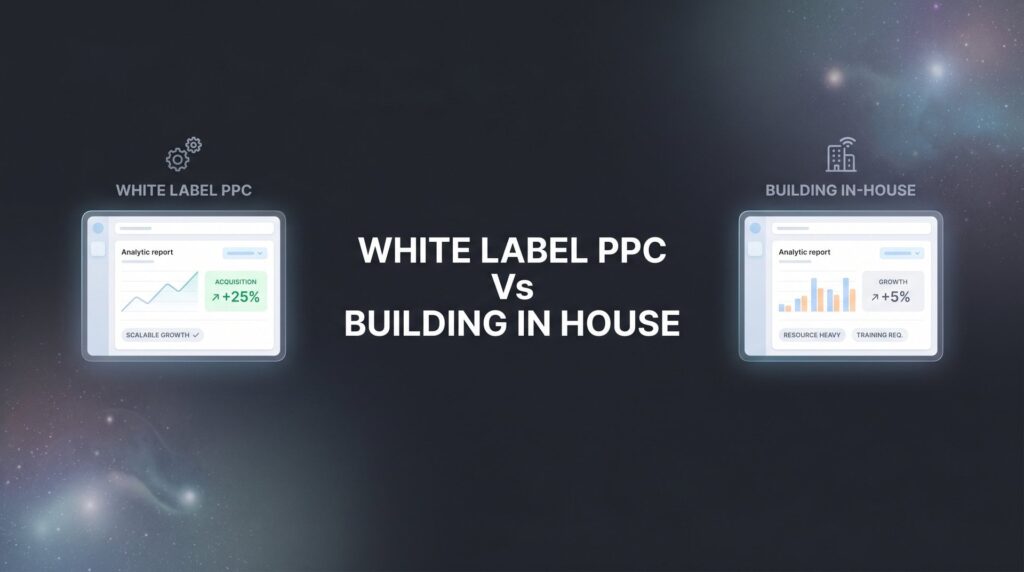
You’ve been staring at your P&L for the third time this week, trying to make sense of your PPC delivery costs. Should you bite the bullet and hire that specialist who wants $75K plus benefits? Or commit to a white label partnership that’ll take 30% of your ad management revenue? The white label PPC vs building in-house decision isn’t just another operational choice—it’s a strategic fork in the road that will shape your agency’s profitability, scalability, and stress levels for years to come.
Here’s what makes this decision so difficult: both paths can work brilliantly, and both can become expensive mistakes. The difference isn’t which option is inherently better—it’s which option fits your specific agency reality right now.
Too many agency owners make this call based on gut feeling, competitor watching, or whatever sounds more impressive to prospects. Then six months later, they’re either drowning in hiring headaches or watching their margins evaporate to white label fees. The smart move? Work through these seven decision strategies systematically before you commit to either path.
1. Run the True Cost Analysis
The Challenge It Solves
Most agencies dramatically underestimate the real cost of building in-house or overestimate the simplicity of white label partnerships. You see a $65K salary and think “that’s my cost”—forgetting about payroll taxes, benefits, software licenses, training time, management overhead, and the very real cost of turnover. Or you see a 25% white label fee and assume that’s pure profit loss—ignoring the opportunity cost of the time you’d spend managing an in-house team.
The result? Agencies make decisions on incomplete data, then wonder why their actual costs look nothing like their projections.
The Strategy Explained
Build two comprehensive financial models—one for each approach—that capture every dollar you’ll actually spend. For in-house, your true cost is typically 1.3-1.4x the base salary once you factor in everything. That $65K PPC specialist actually costs you $85-90K when you include employer taxes, health insurance, 401k matching, software subscriptions, and the desk they’re sitting at.
But don’t stop there. Add the cost of management time (how many hours will you or a manager spend on oversight, training, and quality control?), the cost of mistakes during the learning curve, and the statistical reality of turnover (industry average is 18-24 months for specialists, which means recruiting and training costs every two years).
For white label, calculate the actual margin compression, but also factor in what you gain: zero hiring risk, instant scalability, no training overhead, and the ability to redirect your time toward client acquisition and retention. If that white label partnership frees up 15 hours of your week that you can spend closing two additional clients, what’s that worth in annual revenue? Understanding white label PPC pricing structures helps you model these scenarios accurately.
Implementation Steps
1. Create a spreadsheet with three columns: In-House Year 1, In-House Year 2, and White Label Partnership. List every cost category including salary/fees, benefits, software, training, management time (valued at your hourly rate), recruiting costs, and opportunity costs.
2. Research actual salary expectations in your specific market using Glassdoor, Indeed, and local agency job postings—don’t use national averages if you’re in a high or low cost-of-living area.
3. Get real white label pricing from at least three providers, including their fee structures, minimum commitments, and what’s included versus what costs extra.
4. Calculate your break-even point: at what monthly PPC management revenue does one model become more profitable than the other? This number is your decision threshold.
Pro Tips
Build in a 20% contingency buffer for in-house costs—things always cost more than initial projections. For white label, negotiate pricing based on volume commitments if you have predictable client flow. The agencies that get this right don’t just compare sticker prices—they model out 12-month and 24-month scenarios with realistic growth assumptions.
2. Assess Your Client Volume and Revenue Stability
The Challenge It Solves
Hiring in-house creates fixed costs that need consistent revenue to justify. If your PPC client roster fluctuates significantly month-to-month, or if you’re still in the unpredictable early growth phase, a full-time salary becomes a financial anchor during slow periods. Conversely, if you have 15+ stable PPC clients with strong retention, paying white label fees on all that volume might be leaving significant money on the table.
The Strategy Explained
Map your PPC revenue over the past 12 months and project forward based on your pipeline. Look for patterns: Is your revenue growing steadily, fluctuating seasonally, or still highly variable? Calculate your monthly PPC management revenue and your average client retention period.
As a general framework, white label PPC for agencies makes most financial sense when you have fewer than 10 PPC clients or when your revenue is unpredictable. The variable cost structure protects you during lean months—you only pay for active client work. In-house starts making sense when you have 12+ stable clients generating consistent monthly revenue that can support a full-time salary even during slower periods.
But here’s the nuance: it’s not just about total volume, it’s about revenue concentration. If you have 15 clients but three of them represent 60% of your PPC revenue, you’re one cancellation away from not being able to support that in-house salary.
Implementation Steps
1. Create a 12-month revenue chart showing your monthly PPC management income, highlighting your lowest revenue month—that’s your stress-test number.
2. Calculate your client concentration risk: what percentage of PPC revenue comes from your top three clients? If it’s over 50%, you have concentration risk that favors the flexibility of white label.
3. Project your realistic growth trajectory for the next 12 months based on your current close rate and pipeline, not your aspirational goals.
4. Determine your “safety threshold”—the minimum monthly PPC revenue you need to comfortably support an in-house salary including slow months.
Pro Tips
If you’re right at the borderline where in-house could work but feels risky, that’s exactly when the hybrid model (Strategy 4) becomes most valuable. You can test capacity and stability before committing to fixed costs. The agencies that regret hiring too early usually did it based on their best month’s revenue rather than their average month.
3. Evaluate Your Agency’s Core Competency and Positioning
The Challenge It Solves
Not every service needs to be delivered in-house, but your core differentiators probably should be. If your agency is positioned as “PPC experts who also do web design,” your PPC delivery quality directly impacts your brand credibility and referral generation. But if you’re a full-service agency where PPC is one of twelve services you offer, the strategic value of in-house delivery changes significantly.
The Strategy Explained
Ask yourself: Do clients choose your agency specifically because of your PPC expertise, or do they choose you for other reasons and PPC is a supplementary service? Is PPC mentioned prominently in your positioning, website hero section, and sales conversations, or is it part of a broader service menu?
When PPC is central to your brand, in-house delivery gives you tighter quality control, faster response times, and the ability to build proprietary methodologies that become competitive advantages. Your team’s expertise becomes a marketing asset—you can showcase their certifications, share their insights in content, and use their knowledge to close deals.
When PPC is supplementary, white label lets you offer comprehensive services without diluting focus from your actual core competencies. You maintain quality through strong partner selection and oversight, but you’re not building internal expertise in an area that isn’t central to your market positioning. This is where understanding what white label PPC actually involves becomes essential for making an informed choice.
Implementation Steps
1. Review your last 20 closed deals and identify how many clients specifically chose you for PPC expertise versus how many wanted your primary service and added PPC secondarily.
2. Analyze your website and marketing materials—where does PPC appear in your hierarchy of services and messaging? If it’s not in your top three emphasized capabilities, it’s probably not core.
3. Survey your current PPC clients about why they chose your agency—if the answers are mostly about your other services or general trust rather than PPC-specific expertise, that’s revealing.
4. Consider your long-term vision: in three years, do you want to be known as PPC specialists, or is PPC always going to be one component of a broader offering?
Pro Tips
Some of the most successful agencies are brutally honest about what they’re truly great at and strategic about what they outsource. There’s no shame in white labeling a service that isn’t your core strength—the shame is in delivering mediocre work because you’re spread too thin. Your clients care about results, not whether the person running their campaigns sits in your office or your partner’s office.
4. Test the Hybrid Model Before Full Commitment
The Challenge It Solves
The biggest mistake agencies make is treating this as a binary choice when it doesn’t have to be. Going all-in on either model before you have real operational data is unnecessarily risky. You might hire someone only to discover your actual volume doesn’t support them, or commit to white label only to realize you’re leaving serious margin on the table with your largest accounts.
The Strategy Explained
The hybrid approach means running both models simultaneously for a defined testing period—typically 6-12 months. You might hire a part-time or contract PPC specialist to handle your top 3-5 accounts while using white label for the rest. Or you could keep strategic accounts in-house while white labeling overflow work and specialized campaign types (like YouTube or Shopping campaigns) that require niche expertise.
This gives you real data on both models: What does in-house management overhead actually feel like? How much time do you spend on quality control, training, and team management? How does white label communication and turnaround time work in practice? What do your profit margins look like with each approach? Many agencies exploring the white label PPC vs in-house debate find the hybrid model provides clarity they couldn’t get from projections alone.
The hybrid model also creates natural flexibility. During growth spurts, you can quickly scale up white label volume without hiring pressure. During stable periods, you can shift more work in-house to improve margins. You’re not locked into a single structure that might not fit changing conditions.
Implementation Steps
1. Identify your 3-5 highest-value PPC clients (by revenue and strategic importance) as candidates for in-house management, keeping the rest white label initially.
2. Hire a part-time specialist or experienced contractor (20-30 hours/week) to manage this subset, which reduces your fixed cost risk while giving you real operational experience.
3. Track specific metrics for both groups over 90 days: client satisfaction scores, campaign performance, your time investment, profit margins, and any quality issues.
4. Set decision criteria in advance: “If in-house margins are X% higher and client satisfaction remains strong, we’ll expand in-house. If white label performs equally well with less overhead, we’ll shift more accounts there.”
Pro Tips
The hybrid model works especially well if you have distinct client tiers—premium clients might get in-house attention while standard clients receive white label service. This lets you offer differentiated service levels that match your pricing structure. Many agencies discover their ideal long-term model is actually permanent hybrid, not a full transition to one approach.
5. Map the Talent Acquisition Reality in Your Market
The Challenge It Solves
You can run all the financial models you want, but if you can’t actually find, hire, and retain qualified PPC specialists in your market at a price you can afford, the in-house model is dead on arrival. Many agencies assume they can hire when they’re ready, only to discover that experienced PPC talent is scarce, expensive, or uninterested in agency work in their location.
The Strategy Explained
Before you commit to building in-house, spend 2-3 weeks researching your actual hiring reality. Post a real or test job listing for a PPC specialist at the salary you’ve budgeted. What kind of response do you get? Are applicants qualified, or are you getting entry-level candidates who’ll need extensive training? What are competing agencies and in-house marketing departments in your area paying for similar roles?
The talent landscape varies dramatically by location and remote work policies. If you’re in a major metro with lots of agencies and tech companies, you’re competing for talent with bigger budgets and more established brands. If you’re in a smaller market, your local talent pool might be limited, but you could have less competition. If you’re open to remote workers, you access a national talent pool but face national salary expectations.
Also consider the ongoing talent management reality: PPC specialists often leave agencies for in-house positions that offer better work-life balance, or they move to larger agencies with more growth opportunities. Your retention strategy needs to be realistic, not aspirational. This is precisely why many agencies ultimately decide to hire a white label PPC agency instead of battling the talent market.
Implementation Steps
1. Research salary data on Glassdoor, Indeed, and Payscale for “PPC Specialist” or “Paid Search Manager” in your specific location—not national averages.
2. Post a test job listing (you can always say the role was filled) and evaluate the quality and quantity of responses over two weeks.
3. Network with other local agency owners to understand their hiring experiences, average time-to-fill for PPC roles, and retention challenges.
4. Calculate your realistic recruiting costs: if you use a recruiter (typically 20-25% of first-year salary) or invest your own time (how many hours at what opportunity cost?), what does that add to your true cost analysis?
Pro Tips
If you discover that qualified PPC talent in your market commands salaries 30% higher than you budgeted, or that you’d need to offer remote work to access quality candidates, that’s critical information for your decision. Some agencies find that the talent acquisition challenge alone makes white label the more reliable path, even when the pure financial math favors in-house.
6. Stress-Test Your Quality Control Systems
The Challenge It Solves
The quality control question gets framed as “in-house gives you more control,” but that’s only true if you actually have systems to exercise that control. Plenty of agencies hire in-house and then realize they don’t have the expertise to properly oversee the work, or they lack the processes to catch mistakes before clients do. Meanwhile, the right white label partner might have more robust QA systems than you could build internally.
The Strategy Explained
Quality control isn’t about which model you choose—it’s about what systems you build regardless of model. For in-house teams, you need documented processes, regular account audits, performance benchmarks, and someone with enough PPC knowledge to effectively manage and review the work. If you’re the agency owner and you don’t personally have deep PPC expertise, who’s checking the checker?
For white label partnerships, quality control means rigorous partner vetting, clear performance standards in your agreement, regular reporting reviews, and direct client feedback loops. The best white label relationships include scheduled check-ins, shared access to campaign dashboards, and defined escalation processes when issues arise. When evaluating options, researching top white label PPC companies helps you identify partners with proven quality control systems.
Both models can deliver excellent quality, and both can deliver terrible quality—the difference is in your systems, not in the delivery model itself.
Implementation Steps
1. Document your quality standards: What specific metrics define successful PPC management for your clients? What response times do you promise? What reporting frequency and depth?
2. Create an account audit checklist that can be used monthly or quarterly regardless of who’s doing the work—this becomes your quality control mechanism for either model.
3. If considering white label, interview potential partners specifically about their QA processes, mistake handling, and how they ensure consistency across accounts.
4. Establish client feedback mechanisms (quarterly satisfaction surveys or regular check-in calls) that give you quality signals independent of whoever’s managing the campaigns.
Pro Tips
The agencies that maintain high quality in either model are the ones who stay close to client results and campaign performance, regardless of who’s in the weeds daily. If you’re too removed from the actual work to know whether it’s good or not, that’s a problem with your oversight systems, not necessarily a reason to choose one model over another. Build the systems first, then choose the model that fits within those systems.
7. Build Your Exit Strategy for Either Path
The Challenge It Solves
Markets change, your agency evolves, and what works today might not work in two years. If you lock yourself into a model with no realistic way to pivot, you’re creating unnecessary risk. The agency that hires three PPC specialists and builds their entire operation around in-house delivery can’t easily shift if market conditions change. Similarly, the agency that becomes completely dependent on a single white label partner is vulnerable if that relationship deteriorates.
The Strategy Explained
Think through your exit strategy before you commit. If you go in-house, what happens if your client volume drops 40% due to economic conditions or increased competition? Can you pivot those specialists to other revenue-generating activities, or are you stuck with overhead you can’t support? What’s your backup plan if your star PPC person leaves for an in-house role?
If you go white label, what happens if your partner raises prices, quality declines, or they go out of business? Do you have a backup partner relationship, or would you be scrambling to find alternatives while trying to maintain client service? How hard would it be to bring work in-house if the economics shift dramatically? Conducting a thorough white label PPC providers comparison before committing helps you identify backup options.
The goal isn’t to plan for failure—it’s to maintain strategic flexibility so you can adapt as conditions change without disrupting client service or destroying profitability.
Implementation Steps
1. If choosing in-house, build job descriptions and roles that include flexibility—can your PPC specialist also manage other digital channels if needed? Can they contribute to content, client strategy, or business development during slower periods?
2. If choosing white label, establish relationships with at least two potential partners even if you only use one actively—this gives you options if you need to switch quickly.
3. Maintain your own PPC knowledge even if you outsource delivery—take courses, stay current with platform changes, and understand enough to evaluate partner quality and make informed decisions.
4. Document your processes and maintain organized campaign documentation regardless of model—this makes transitions (whether bringing work in-house, switching partners, or hiring new team members) far less disruptive.
Pro Tips
The most successful agencies treat their delivery model as a strategic decision that gets revisited annually, not a permanent identity. Your model should serve your business goals, not define them. Build optionality into your structure from day one, and you’ll be able to adapt quickly when circumstances change—and they always do.
Making Your Decision With Confidence
The white label PPC vs building in-house question doesn’t have a universal right answer—it has YOUR right answer based on your specific numbers, market position, and operational reality. The agencies that make this decision well aren’t the ones who follow conventional wisdom or copy what competitors are doing. They’re the ones who work through these strategies systematically and let the data guide their choice.
Start with Strategy 1—run that true cost analysis this week. Get real numbers, not estimates. Then move to Strategy 2 and assess your actual volume and revenue stability. If you’re borderline on both, Strategy 4’s hybrid approach gives you real operational data before you commit fully.
Don’t skip Strategy 5 just because you think you can hire when you’re ready. The talent market might tell you something important about your realistic options. And regardless of which path you choose, Strategies 6 and 7 ensure you maintain quality and flexibility as you scale.
The agencies that thrive aren’t necessarily those who chose in-house or white label—they’re the ones who made an informed decision based on real data, built strong systems to execute their chosen model well, and stayed flexible enough to adapt when conditions changed. Your competitive advantage isn’t which model you choose—it’s how well you execute whichever model fits your situation.
What matters most right now? Stop debating hypotheticals and start gathering actual data. Run those cost projections. Research your local talent market. Talk to potential white label partners and get real pricing. Test the hybrid model if you’re uncertain. The clarity you need is in the specifics of your situation, not in general advice about which approach is “better.”
If you want to see what this would look like for your agency’s specific situation—whether that’s optimizing your current PPC delivery model or building a more profitable client acquisition system—we’ll walk you through exactly how it works and what’s realistic for your market. We focus on marketing that actually converts into measurable revenue growth, not just traffic and clicks that go nowhere.