Most local service business owners have spent money on marketing that produced traffic, impressions, or followers — but not booked jobs. That’s the wrong scorecard. ROI in this context means one thing: cost per acquired customer versus what that customer is worth to your business. A $25 lead that books a $400 job is good. A $10 lead that never picks up the phone is not.
This list covers marketing services by how reliably they produce measurable returns for local service businesses — trades, home services, professional services, and similar verticals. We’ve ordered them by typical speed-to-ROI and cost-per-lead performance. Clicks Geek is listed first because it’s what we do, and we’d rather be upfront about that than bury it at number four. Every other service on this list is here because it genuinely works for the right business at the right stage.
If you want to understand which channels tend to produce results fastest, and which ones take longer but pay off over time, this breakdown will give you a clearer picture than most of what’s out there. For a broader look at cost-effective marketing channels for small businesses, that’s a useful companion read.
1. Clicks Geek
Best for: Local service businesses that want managed PPC and SEO without starting from scratch.
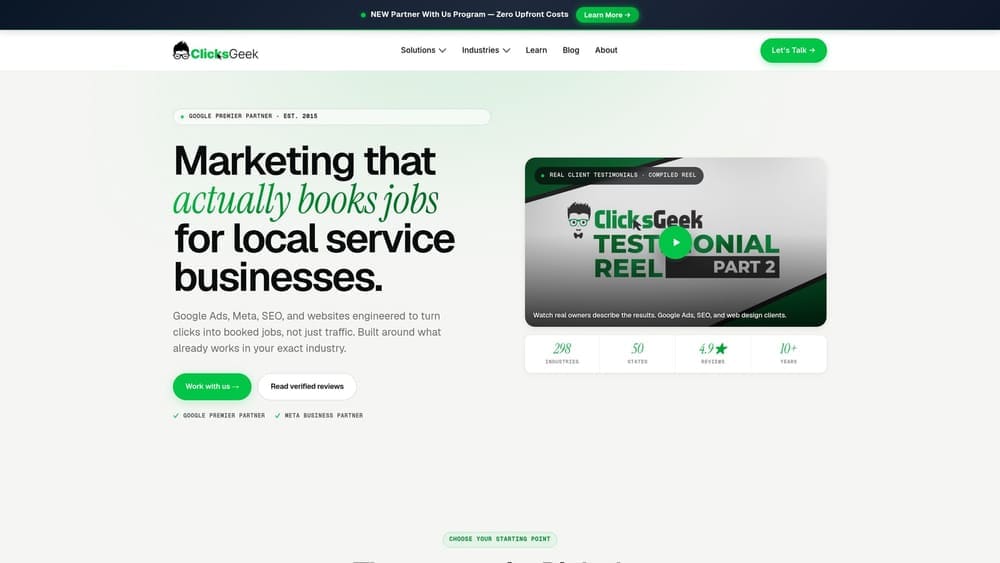
Clicks Geek is a Google Premier Partner agency founded in 2015, specializing in paid search and SEO for local service businesses across 298 industry verticals, with over $100M in managed ad spend and 10,000+ campaigns run.
Where This Tool Shines
The difference between a managed agency and running ads yourself is usually the difference between a campaign that loses money for six months and one that produces qualified calls in the first 30 days. Clicks Geek’s industry-specific playbooks mean your HVAC campaign isn’t built on the same template as a law firm’s — it’s built on what’s actually worked for HVAC businesses in competitive local markets.
There are no lock-in contracts. That’s not a marketing line — it means the engagement stays because the results stay. Reporting is built around what matters to a service business owner: booked jobs, cost per lead, and revenue, not impressions or click-through rates.
Key Features
Industry-Specific Playbooks: 298 service verticals covered, meaning campaigns are built on category-specific data rather than generic structures.
Premier Partner and Meta Business Partner Status: Access to Google and Meta support tiers, beta features, and performance benchmarks most agencies don’t see.
No Lock-In Contracts: Month-to-month engagement keeps accountability on the agency’s side, not the client’s.
ROI-Focused Reporting: Dashboards track cost per lead, call volume, and booked jobs — not vanity metrics.
White-Label PPC and SEO: Agencies can resell Clicks Geek’s services under their own brand, with full backend fulfillment.
Best For
Local service business owners who want to hand off paid search and SEO to a team that knows their industry, without signing a long-term contract. Also a strong fit for smaller agencies that need a white-label fulfillment partner with a real track record.
Pricing
Custom based on scope and market. No lock-in contracts. Contact for a strategy call to understand what’s realistic for your category and geography.
2. Google Ads (Search)
Best for: High-intent lead capture from people actively searching for your service right now.
Google Ads is the pay-per-click platform that puts your business in front of people the moment they search for what you offer — the most direct path from ad spend to inbound phone calls for most local service businesses.
Where This Tool Shines
Search ads work because they intercept demand that already exists. Someone searching “emergency plumber near me” at 9pm on a Tuesday is not browsing — they need help now. Google Search puts you in front of that person at exactly the right moment. That’s fundamentally different from most other channels, which require you to create demand first.
Ramp time runs 30-90 days before campaigns reach full optimization, but you’ll typically see calls within the first week of launch if targeting and bidding are set up correctly. For a deeper look at how this plays out in practice, Google Ads for service-based businesses covers the setup and strategy in detail.
Key Features
High-Intent Targeting: Reach people searching for your specific service in your specific service area — not a broad demographic.
Pay-Per-Click Model: You’re charged only when someone clicks, so uninterested viewers don’t cost you anything.
Call Extensions and Call-Only Ads: Route leads directly to your phone, bypassing the website step entirely for mobile users.
Full Budget Control: Pause, scale, or adjust spend at any time without penalty.
Measurable CPL: Home services CPL typically runs $18-35, making it straightforward to calculate whether the channel is profitable for your job type.
Best For
Service businesses with emergency or time-sensitive offerings — plumbing, HVAC, electrical, roofing, pest control, and similar categories where the customer needs someone today and is actively searching. Also effective for any service with a clear geographic boundary and a reasonable average job value.
Pricing
You set the budget. CPL for home services typically runs $18-35 depending on category and market. Management fees vary by agency or in-house resource — budget for both ad spend and management when planning ROI.
3. Local Services Ads (LSA)
Best for: Businesses that want to pay per qualified lead, not per click, with Google’s trust badge attached.
Local Services Ads sit above standard Google Ads in search results and charge you only when a qualified contact comes through — not for every click that lands on your listing.
Where This Tool Shines
The “Google Guaranteed” or “Google Screened” badge is the most underrated part of LSA. When a homeowner sees that badge next to your name, they know Google has verified your license, insurance, and background check. For a new business trying to build trust in a competitive market, that badge does real work before the phone even rings.
The pay-per-lead model also changes the risk calculus. With standard Google Ads, you pay for clicks whether or not the person was a real prospect. With LSA, you pay for contacts — and you can dispute leads that don’t meet the criteria for your category.
Key Features
Pay-Per-Lead Billing: You’re charged when a qualified contact comes through, not for every click your listing receives.
Above-Ad Placement: LSAs appear above standard Google Ads, giving verified businesses prime real estate in search results.
Google Guaranteed Badge: Signals verified license, insurance, and background check — a meaningful trust signal for new prospects.
Lead Dispute Process: Challenge leads that don’t fit your service category or area and receive credits for those that qualify.
Verification Requirement: The background check and credential verification process filters out unlicensed operators, which works in your favor.
Best For
Established service businesses that are already licensed, insured, and have reviews on Google — the verification process rewards businesses that are already operating professionally. Particularly strong for home services categories where Google Guaranteed is available.
Pricing
Cost per lead varies by market, category, and competition level. You set a weekly budget and Google manages distribution. Check Google’s current LSA rates for your category before projecting CPL.
4. Local SEO and Google Business Profile
Best for: Businesses willing to invest 6-12 months for the lowest long-term cost per lead in local marketing.
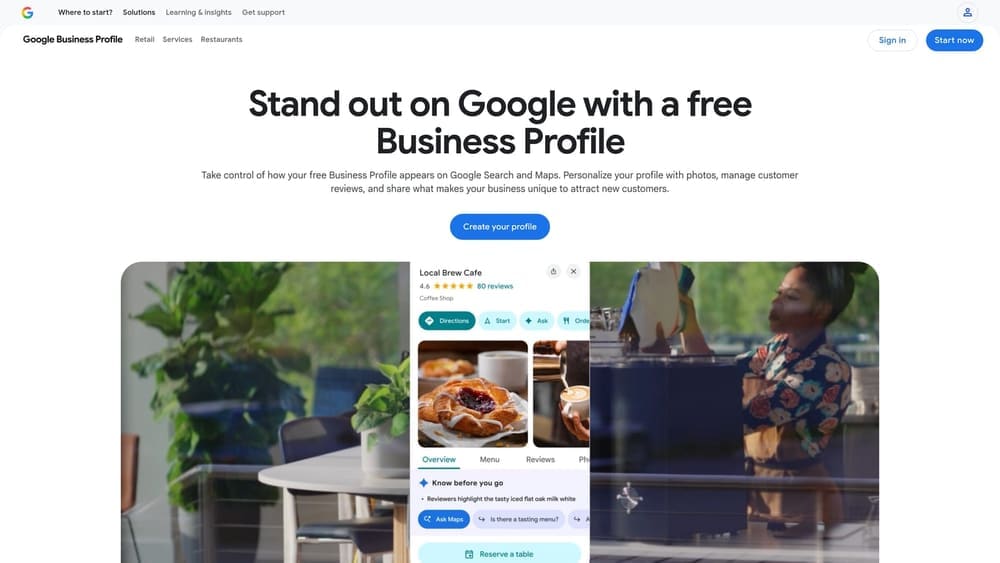
Google Business Profile is the foundation of local organic search — and when combined with proper SEO, it’s the channel that consistently produces the lowest CPL for mature, well-managed campaigns.
Where This Tool Shines
The Map Pack captures roughly 42% of clicks on local search results pages. That’s not a small slice — it’s nearly half of all the clicks available for a given local search. A business ranking in the top three Map Pack positions for its primary service category is receiving a significant volume of free, high-intent traffic that compounds over time rather than stopping the moment you pause a budget.
The tradeoff is time. Local SEO takes 6-12 months to mature. But once it does, CPL drops to $7-15 for well-optimized profiles and sites — a fraction of what paid search costs. For businesses with staying power and a longer planning horizon, this is often the highest-ROI channel over a three-to-five year window. For context on which channels produce results fastest versus which ones compound over time, this breakdown on marketing investment timelines is worth reading.
Key Features
Map Pack Placement: Appearing in the top three local results captures a disproportionate share of clicks from high-intent searchers.
Google Business Profile Optimization: Drives calls, direction requests, and messages directly from the search results page without requiring a website visit.
Citation Consistency: Accurate business information across directories reinforces local authority signals to Google.
Review Integration: Review volume and recency directly affect Map Pack ranking — reviews are not optional in a competitive market.
Long-Tail Content Ranking: Service area pages and optimized site content capture searches beyond your primary category.
Best For
Service businesses that plan to operate in the same market for years and want to build an asset that keeps producing leads without continuous ad spend. Also essential as a complement to paid search — a business ranking organically while running ads captures more total search real estate.
Pricing
Google Business Profile is free. SEO management typically runs $500-2,500/month for local service businesses, depending on market competitiveness and the scope of work involved.
5. Facebook and Instagram Ads (Meta Ads)
Best for: Demand generation for visually driven services, and retargeting audiences who’ve already shown interest.
Meta Ads reach potential customers by demographic, geography, and behavior — before they’ve searched for your service. That distinction matters when you’re thinking about how to use the channel.
Where This Tool Shines
Meta is a demand generation channel, not a demand capture channel. The person scrolling Instagram hasn’t typed “roof replacement near me” yet — but they’re a homeowner in your zip code, their roof is 18 years old, and they’ve been engaging with home improvement content. Meta lets you reach that person before they ever get to Google. Done well, it fills the top of your pipeline with prospects who are warming up before they become active searchers.
Visual service categories — landscaping, remodeling, painting, pool installation — perform particularly well here because before-and-after content and video walkthroughs translate directly into social formats. For emergency services where someone needs help in the next hour, Meta is a weaker fit. For more on structuring Meta campaigns for service businesses, this guide on Facebook Ads in 2026 covers current best practices.
Key Features
Audience Targeting: Reach people by location, homeownership status, age, income range, and interest signals relevant to your service.
Visual Ad Formats: Video, carousel, and before-and-after formats work naturally for service businesses with visual outcomes.
Lead Form Ads: Capture contact information directly within the platform, without requiring the prospect to visit your website.
Retargeting: Reach people who visited your website or engaged with your content but haven’t called yet.
Competitive CPL: CPL typically runs $10-25 for local service businesses with strong creative and well-defined audiences.
Best For
Service businesses with visually compelling work, higher average job values, and enough budget to run meaningful spend consistently. Meaningful results typically require $1,000 or more per month in ad spend — below that, the algorithm doesn’t have enough data to optimize effectively.
Pricing
You set the budget. CPL of $10-25 is achievable for the right service category with strong creative. Meta’s minimum daily budget is low, but plan for $1,000+/month in spend to see consistent results.
6. Email Marketing
Best for: Re-engaging past customers at near-zero cost to drive repeat bookings and referrals.
Mailchimp and similar platforms give service businesses a direct line to their existing customer base — the most underused high-ROI channel for any business that already has a list of past clients.
Where This Tool Shines
Acquiring a new customer costs significantly more than retaining or re-engaging an existing one. Most local service businesses have a database of past customers sitting in their CRM or invoicing software that never gets contacted again after the job closes. That list is an asset that most owners are leaving idle.
A seasonal maintenance reminder, a referral ask, or a limited-time promotion sent to 500 past customers costs almost nothing and can produce booked jobs the same week. Automated sequences — like a follow-up 90 days after an HVAC tune-up asking if the customer wants to schedule again before summer — run without any manual effort once they’re set up.
Key Features
Near-Zero Re-Engagement Cost: Sending to an existing list costs a fraction of what any paid channel charges to reach a cold audience.
Seasonal and Maintenance Campaigns: Timely promotions and service reminders drive repeat bookings without requiring the customer to search again.
Automated Follow-Up Sequences: Trigger emails based on job completion dates, service intervals, or customer actions.
Referral Campaigns: Ask satisfied customers to refer friends and neighbors — a channel most service businesses never formally activate.
Membership and Agreement Upsells: Email is well-suited for promoting maintenance plans and annual service agreements to customers who already trust you.
Best For
Any service business with a list of 100 or more past customers that isn’t already emailing them regularly. Particularly valuable for businesses where repeat service is natural — HVAC, pest control, lawn care, cleaning services, and similar categories.
Pricing
Mailchimp is free up to 500 contacts. Paid plans start around $13/month. More advanced automation platforms like Klaviyo and ActiveCampaign start higher but offer more sophisticated sequencing for growing lists.
7. Review Generation and Reputation Management
Best for: Multiplying the conversion rate of every other marketing channel you’re already running.
Birdeye and similar platforms systematize the process of collecting, managing, and responding to customer reviews — the force multiplier that makes everything else work better.
Where This Tool Shines
Reviews don’t generate leads in isolation — they convert them. A business with 200 reviews at 4.8 stars will close a higher percentage of leads from every channel versus one with 20 reviews at 3.9. The leads are the same quality; the close rate is not. That gap is pure money left on the table.
Review velocity also directly affects Map Pack ranking. Google factors in how recently and how frequently reviews are coming in, not just the total count. A systematic post-job review request process — automated via text or email immediately after service — keeps that signal strong without requiring anyone to remember to ask manually.
Key Features
Automated Review Requests: Post-job text and email requests go out automatically, increasing review velocity without manual follow-up.
Map Pack Ranking Impact: Higher review count and recency directly improve your position in Google’s local results.
Multi-Platform Aggregation: Reputation dashboards pull reviews from Google, Yelp, Facebook, and others into one place.
Negative Review Alerts: Get notified quickly when a low rating comes in so you can respond before it compounds.
CRM and Field Service Integration: Platforms like Birdeye connect with common job management tools to trigger requests at the right moment.
Best For
Any service business running paid ads or SEO that doesn’t have a systematic review collection process. If you’re spending money to generate leads but losing them because your review profile looks thin, fixing reviews will improve your return on every other channel you’re running.
Pricing
Birdeye starts around $299/month. Simpler tools like NiceJob start lower. Some CRMs include basic review request features that may be sufficient for smaller operations before upgrading to a dedicated platform.
8. Content Marketing and Long-Form SEO
Best for: Higher-ticket services with longer sales cycles where prospects research before they call.
Semrush is the research backbone for this channel — identifying what your prospects are searching during the research phase and building content that answers those questions before a competitor does.
Where This Tool Shines
Not every service purchase is a same-day decision. A homeowner considering a full kitchen remodel, a commercial property owner evaluating a new HVAC system, or a business owner researching pest control contracts will spend days or weeks reading before they call anyone. Content marketing puts your business in front of that research process — and a well-ranked page keeps producing leads for months or years after it’s published, with no ongoing ad spend required.
The ramp time is the longest of any channel on this list, often 6-12 months before content starts ranking competitively. But for businesses with higher average job values, the math works. A single page that consistently ranks for a high-intent comparison search and generates two or three jobs per month pays for itself many times over across its lifetime.
Key Features
Compounding Lead Value: Well-ranked pages continue producing leads long after the initial investment in creation and optimization.
Research-Phase Targeting: Captures prospects during comparison and evaluation searches that precede high-value decisions.
Topical Authority: Publishing comprehensive content around your service category reinforces local SEO rankings across your entire site.
Long-Tail Keyword Opportunities: Service area pages and FAQ content can rank for specific queries with lower competition than primary category terms.
Competitive Intelligence: Tools like Semrush identify which keywords your competitors are ranking for and where gaps exist in your current coverage.
Best For
Service businesses with average job values above $1,000 or services that involve a longer consideration period — remodeling, landscaping design, commercial services, specialty trades. Less suited to emergency services where the customer needs someone now and won’t spend time reading a guide first.
Pricing
Content production costs vary widely — from in-house writing to agency management at $1,500-5,000+/month. Semrush plans start at $139.95/month for keyword research and competitive tracking.
Which Channel Is Right for Your Business Right Now
The honest answer is that the right starting point depends on where your business is today, not on which channel sounds most appealing.
If you need leads in the next 30 days and your average job value supports a $20-35 CPL, Google Ads or LSA should be your first move. They’re the fastest path from budget to booked jobs. If you’re already running paid search and want to lower your long-term CPL, local SEO and Google Business Profile optimization run in parallel and compound over time.
If you have a list of past customers and you’re not emailing them, that’s the easiest win on this entire list. Set up a simple seasonal campaign and a referral ask before you spend another dollar on paid channels. And regardless of which channels you’re running, if your review profile is thin, fix that first — it improves the return on everything else.
For businesses with visually strong services and budgets that can sustain $1,000+/month in spend, Meta Ads fill the top of the pipeline with prospects who are warming up before they search. Content marketing is the long game for higher-ticket services where prospects research before they call.
If you’d rather hand the whole thing off and let someone else execute, our roundup of done-for-you marketing services compares the top providers that handle strategy and execution under one roof.
Here’s a quick reference by situation:
Need leads fast, emergency or time-sensitive service: Google Ads Search, then LSA once verified.
Want the lowest CPL over 12+ months: Local SEO and Google Business Profile, starting now.
Have past customers you’re not marketing to: Email marketing — start this week.
Running ads but not converting leads: Review generation before increasing spend.
Visual service, higher average job value, demand generation: Meta Ads with strong creative.
Higher-ticket service with a research-heavy buyer: Content marketing and long-form SEO.
Want a managed partner who handles PPC and SEO across all of it: That’s what Clicks Geek does.
None of these channels are mutually exclusive. The businesses that generate the strongest returns typically run two or three of them in combination — paid search for immediate volume, local SEO for long-term CPL reduction, and reviews to make sure every lead they generate actually converts.
If you want to see what this would look like for your business, we’ll walk you through how it works and break down what’s realistic in your market. If you want to see what this would look like, the strategy call is the right starting point — no commitment, just a clear picture of where your marketing dollars should go first.