You’ve probably been burned at least once. Maybe you hired an agency that sent monthly reports full of impressions and click-through rates while your phone stayed quiet. Maybe you tried Angi, got five leads, called all five, and booked zero jobs because four other contractors beat you to the punch. Maybe you’re spending on Google Ads but have no idea if the clicks are turning into customers.
This is the situation most local service business owners are in: spending on marketing without a clear picture of what’s actually working. And the frustration is legitimate, because most marketing content written for business owners is either too generic to be useful or written by people who have never actually run a campaign for a plumber or an HVAC company.
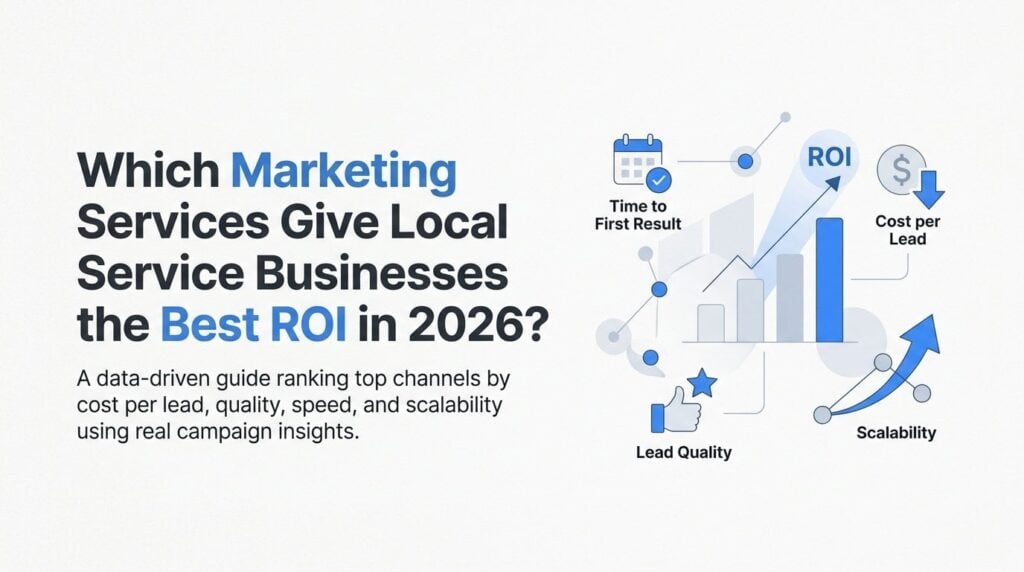
This guide is different. We ranked the top marketing services by what matters to a local service business: cost per lead, lead quality, time to first result, and whether the channel holds up as you scale. The benchmarks below come from real campaign data, not projections. The trade-offs are honest, including the ones most agencies won’t tell you. Here is the priority order, and why it is what it is.
1. Clicks Geek
Best for: Local service businesses that want booked jobs, not traffic reports or vanity metrics.
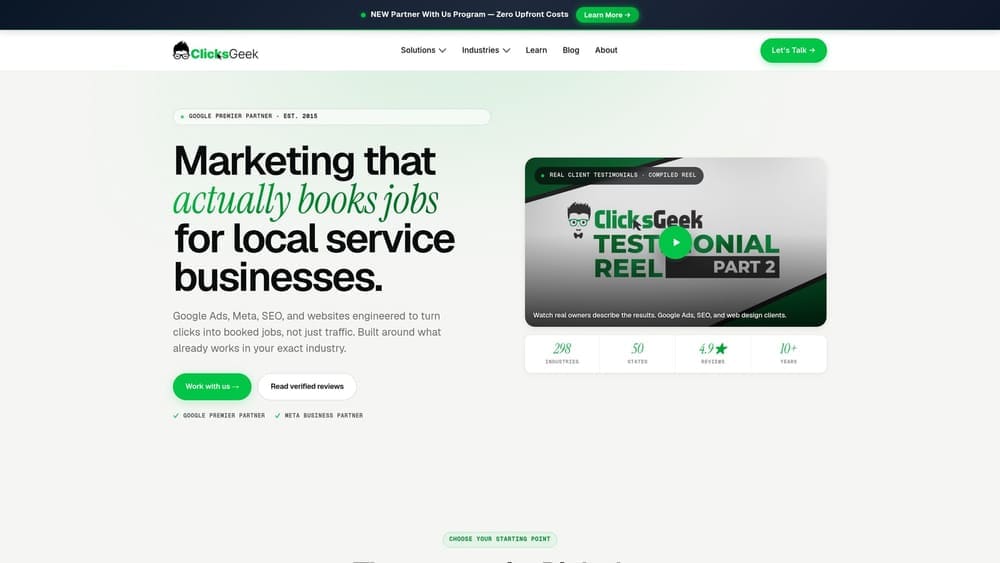
Clicks Geek is a Pennsylvania-based digital marketing agency, established in 2015, that specializes in paid and organic lead generation for local service businesses across 298 industry verticals.
Where This Tool Shines
Most agencies build campaigns from templates. Clicks Geek builds them from industry playbooks developed across more than $100 million in managed ad spend and over 10,000 campaigns. That distinction matters when you’re a roofing company trying to compete in a saturated market, or an HVAC business trying to make Google Ads work in a region where the CPL can easily get away from you without the right structure.
The focus is on booked jobs and phone calls, not impressions or session counts. As a Google Premier Partner and Meta Business Partner, Clicks Geek also gets access to beta features and dedicated Google support that standard agencies don’t have. For business owners who have been burned by generic campaign management, the no lock-in, month-to-month contract structure removes a lot of the risk from trying a new agency.
Key Features
298 Industry Playbooks: Campaign structures built from real data across hundreds of service verticals, not generic templates applied to every trade.
Google Premier Partner Status: Access to beta features, direct Google support, and performance benchmarks most agencies can’t see.
Month-to-Month Contracts: No lock-in. You stay because results keep you there, not because a contract does.
Phone Call Optimization: Campaigns built around the reality that 40 to 70 percent of local service leads come in by phone, with call tracking and conversion data to match.
White-Label PPC and SEO: Available for agencies that want to offer paid and organic services without building an in-house team.
Best For
Local service businesses that have tried paid advertising before and didn’t see the return they expected. Also a strong fit for businesses ready to scale across multiple markets, and for agencies looking for a reliable white-label partner. Clicks Geek operates across all 50 states with a 4.9-star rating.
Pricing
Custom pricing based on ad spend and services. No lock-in contracts. You can get a breakdown of what a campaign would look like for your market at clicksgeek.com/services/.
2. Google Local Services Ads
Best for: Licensed trades that want to pay per lead instead of per click, with Google’s trust badge doing the selling.
Google Local Services Ads is a pay-per-lead ad product that puts vetted local businesses above standard search results with a Google Guarantee or Google Screened badge.
Where This Tool Shines
LSA is the closest thing to a guaranteed-intent lead channel that exists in local marketing right now. You only pay when someone contacts you directly through the ad, not when they click and bounce. The Google Guarantee badge does real work before the call is even made: consumers see that Google has verified your license and insurance, which removes a significant trust barrier for first-time customers.
Ranking in LSA is driven by review count, review rating, responsiveness, and proximity. That means businesses with strong review velocity and fast response times naturally rise. It also means a new business can compete with an established competitor if they manage those factors well. One important note: LSA availability varies by trade and geography, so not every service category or market has access.
Key Features
Pay Per Lead: You’re charged when a customer contacts you through the ad, not for clicks that go nowhere.
Google Guarantee Badge: Signals to homeowners that Google has vetted your business for license and insurance before they call.
Dispute Process: You can dispute invalid or low-quality leads and get credit back for ones that don’t meet Google’s criteria.
Review-Driven Ranking: More reviews, faster response times, and closer proximity all push your listing higher.
No Fixed Monthly Fee: Budget is flexible based on how many leads you want to receive.
Best For
Licensed trades like plumbing, HVAC, electrical, roofing, and locksmith services where Google has approved LSA coverage. Especially strong for businesses with solid review counts that can compete on ranking factors rather than pure spend.
Pricing
Pay per lead. Lead costs vary by trade and market. No fixed monthly fee, though you set a weekly budget to control volume.
3. Google Ads (Search)
Best for: Capturing high-intent searches like “emergency plumber near me” with immediate, measurable results.
Google Ads is the auction-based pay-per-click platform that puts your business in front of people actively searching for your service right now.
Where This Tool Shines
No other channel matches the purchase intent of someone typing “AC repair today” or “water heater replacement near me” into Google. They are not browsing. They are ready to call someone. Search Ads put you in front of that person before they scroll to your competitors, and with proper call tracking, you know exactly which keywords and ads are producing phone calls versus clicks that go nowhere.
The trade-off is that Google Search Ads require real setup and ongoing management to stay profitable. Smart bidding strategies like Target CPA work well once conversion data builds, but Google recommends 30 to 50 conversions per month per campaign before those automated strategies can optimize reliably. Before you hit that threshold, manual or enhanced CPC bidding with tight keyword control is usually the better approach.
Key Features
Immediate Visibility: Your ads appear within days of campaign launch for searches with active buying intent.
Full Budget Control: Daily spend caps prevent runaway costs while you’re learning what works in your market.
Call Assets and Call-Only Ads: Built specifically for phone-first businesses where the goal is a call, not a click.
Smart Bidding: Automated bidding strategies that optimize toward calls and form submissions once sufficient conversion data exists.
Measurable CPL: With proper call tracking in place, you know exactly what each lead costs.
Best For
Any local service business that needs leads within 30 to 90 days and has the budget to compete in their market. CPL for home services typically runs $18 to $35 depending on trade and geography. Businesses with higher average job values can absorb higher CPLs and still run profitable campaigns.
Pricing
You set the budget. Home services CPL typically runs $18 to $35. Competitive markets and high-value trades like HVAC and roofing can run higher.
4. Local SEO and Google Business Profile
Best for: Building a long-term lead source with the lowest cost per lead of any channel once rankings take hold.
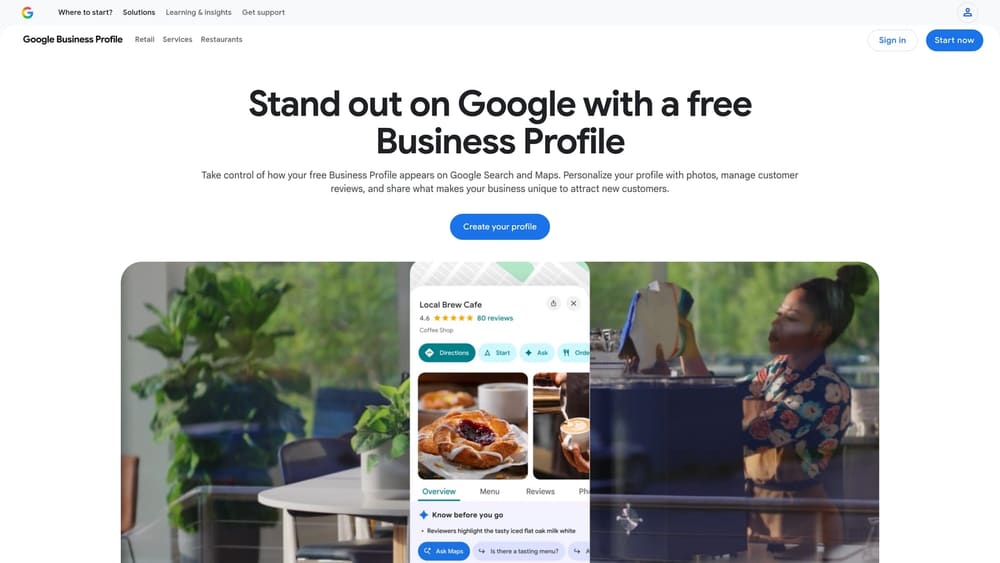
Google Business Profile combined with local SEO is the organic counterpart to paid search, and it’s the channel with the best long-term economics for most local service businesses.
Where This Tool Shines
The Map Pack captures roughly 42 percent of local search clicks. That’s a substantial share of searches going to three businesses, and getting into that pack consistently means leads without a per-click cost. At the 12-month mark, businesses with strong local SEO typically see CPL drop to $7 to $15 as rankings compound and organic traffic grows without proportional increases in spend.
The honest caveat is that this takes time. In competitive markets, meaningful ranking improvements take 6 to 12 months of consistent execution: GBP optimization, citation building, review management, and on-page content. Business owners who expect SEO to replace paid ads in the first quarter will be disappointed. The right approach is to run paid ads while SEO builds, then reduce paid dependency as organic rankings strengthen.
Key Features
Map Pack Visibility: A well-optimized GBP with strong reviews competes for the top three positions that capture the majority of local search clicks.
Compounding Returns: Unlike paid ads, organic rankings continue generating leads without ongoing spend per click.
GBP Optimization: Category selection, service areas, photo updates, and Q&A all influence ranking and conversion.
Citation Building: Consistent name, address, and phone number data across directories strengthens local authority.
Review Management: Review velocity and rating directly affect Map Pack position and consumer trust.
Best For
Established businesses with a 6-to-12-month horizon who want to reduce long-term dependence on paid advertising. Also critical for any business already running paid ads, since a strong GBP improves performance across LSA, Search Ads, and organic simultaneously.
Pricing
GBP is free to set up and manage. SEO management costs vary by agency and market. Expect 6 to 12 months before significant organic lead volume in competitive markets.
5. Meta Ads (Facebook and Instagram)
Best for: Services with strong visual proof, seasonal demand creation, and retargeting website visitors who didn’t convert.
Meta Ads covers Facebook and Instagram advertising and works on a fundamentally different principle than search: you’re interrupting someone’s feed rather than answering an active search.
Where This Tool Shines
Meta’s targeting lets you put an ad in front of homeowners in a specific zip code who match the demographic profile of your best customers, before they’ve searched for anything. For services like remodeling, landscaping, and roofing, where before-and-after visuals tell the story immediately, this interruption model works well. A homeowner scrolling past a dramatic roof transformation is now thinking about their own roof, even if they weren’t five minutes ago.
Retargeting is where Meta often produces its best ROI for local service businesses. Someone who visited your website, looked at your services page, and left without calling is a warm lead. Retargeting ads that follow that person on Facebook and Instagram for the next few days cost a fraction of what a new click costs and convert at a higher rate because the person already knows who you are.
Key Features
Demographic and Geographic Targeting: Reach homeowners by age, income, location, and interest before they start searching for your service.
Lead Form Ads: Reduce friction for offers like free estimates or seasonal tune-ups by capturing contact info without requiring a website visit.
Retargeting: Re-engage website visitors who didn’t convert, typically at a lower CPL than cold traffic.
Visual Storytelling: Strong format for services with before-and-after results that photograph well.
Seasonal Campaign Flexibility: Easy to ramp up budget for spring HVAC tune-up campaigns or fall gutter cleaning pushes.
Best For
Businesses with services that photograph well, or businesses trying to fill slow seasons by creating demand before customers start searching. CPL for home services on Meta typically runs $10 to $25, though lead quality can vary. Budget of $1,000 or more per month is typically needed to generate enough data for meaningful optimization.
Pricing
You set the budget. No minimum spend required, but $1,000 or more per month is the practical floor for generating enough data to optimize. CPL typically runs $10 to $25 for home services.
6. Email and SMS Marketing
Best for: Established businesses with an existing customer list who want the highest ROI per dollar spent on any channel.
Mailchimp and similar platforms let you market directly to past customers and leads via email and text, which is consistently the most overlooked high-return channel for local service businesses.
Where This Tool Shines
Most local service businesses have a substantial past-customer database sitting in their CRM or field service software that they are not systematically marketing to. These are people who already hired you, already trust you, and are statistically more likely to hire you again than a stranger who found you through an ad. The cost to reach them is near zero compared to paid acquisition.
Maintenance reminders, seasonal campaigns, and membership plan upsells convert well through direct channels because the relationship already exists. SMS open rates are substantially higher than email for time-sensitive offers, making text a strong channel for flash promotions or appointment reminders. If you integrate with ServiceTitan, Jobber, or a similar platform, automated sequences can run without manual effort after initial setup.
Key Features
Near-Zero Cost Per Contact: Once the list exists, reaching past customers costs a fraction of what paid acquisition costs.
Maintenance and Seasonal Campaigns: Automated reminders generate repeat jobs without requiring ongoing ad spend.
SMS for Time-Sensitive Offers: Text messages get opened at rates email can’t match, making them effective for promotions with a short window.
Membership Plan Upsells: Direct channels are the natural home for converting one-time customers into recurring revenue relationships.
CRM Integration: Works alongside ServiceTitan, Jobber, and other field service platforms to automate outreach based on job history.
Best For
Any established business with more than a few hundred past customers in their database. This is often the fastest ROI improvement available without increasing acquisition spend. If you’re not systematically emailing and texting your past customers, you’re leaving repeat jobs on the table.
Pricing
Mailchimp starts free for small lists. SMS platforms vary. Cost is minimal compared to any paid acquisition channel, making this the highest-margin marketing activity most established businesses aren’t doing.
7. Lead Aggregators (Angi, Thumbtack, HomeAdvisor)
Best for: New businesses with no web presence that need leads immediately while longer-term channels ramp up.
Angi, Thumbtack, and HomeAdvisor are third-party platforms that match homeowners with local contractors. They are useful as a short-term bridge, but come with trade-offs that most platforms won’t tell you upfront.
Where This Tool Shines
The honest answer is that lead aggregators shine most for businesses that have nothing else running. If you launched a plumbing company last month, have no website, no GBP, and no Google Ads campaign, a platform like Thumbtack gives you access to homeowners actively looking for services right now. That is genuinely useful when the alternative is waiting 90 days for paid campaigns to ramp and 12 months for SEO to produce anything.
The problem is structural. Most leads on these platforms are sold to multiple contractors simultaneously. You call the same lead as four other plumbers, and the homeowner picks whoever calls first or quotes lowest. That dynamic drives prices down and makes it hard to build a profitable business on aggregator leads alone. Lead costs have also increased significantly as more contractors compete on these platforms.
Key Features
Immediate Access: No website or established web presence required to start receiving leads.
Active Homeowners: People on these platforms are actively looking for services, not passively browsing.
Stopgap Functionality: Useful bridge while Google Ads and SEO are in their ramp-up phases.
Dispute Options: Some platforms offer credit for leads that don’t meet quality standards, though the process varies.
Category and Geography Filters: You can narrow the types of jobs and service areas you receive leads for.
Best For
New businesses with no digital presence who need leads within the first 30 days. Not recommended as a primary channel for established businesses. The shared-lead model and rising costs make it difficult to build sustainable margins compared to owned channels.
Pricing
Varies by platform and lead type. Most use a subscription plus per-lead fee model. Costs have increased as contractor competition on these platforms has grown.
8. Reputation and Review Management (Birdeye)
Best for: Businesses that want to multiply the performance of every other marketing channel they’re running.
Birdeye is an automated reputation management platform that handles review requests, monitoring, and response across Google, Facebook, and other platforms. It’s not a standalone lead channel. It’s the infrastructure that makes every other channel work better.
Where This Tool Shines
Google reviews affect your LSA ranking, your Map Pack position, your Google Ads landing page quality signals, and the conversion rate of anyone who finds you through any channel and then looks you up before calling. A business with 200 reviews at 4.8 stars will outperform a competitor with 40 reviews at 4.6 stars across every Google touchpoint, often without any other change.
The problem most businesses have is that review collection is manual and inconsistent. A technician finishes a job, the customer is happy, and nothing happens. Birdeye and similar platforms automate the request tied to job completion, which dramatically improves review velocity without requiring your team to remember to ask. Negative review alerts let you respond quickly before reputation damage compounds.
Key Features
Automated Review Requests: Triggered by job completion through CRM integration, so review collection happens without manual effort.
Multi-Platform Monitoring: Centralized dashboard for Google, Facebook, and other review sources in one view.
Negative Review Alerts: Fast notification when a negative review posts so you can respond before it sits unaddressed.
LSA and Map Pack Impact: Review count and rating directly influence ranking in the channels that drive the most local search volume.
CRM Integration: Works with ServiceTitan, Jobber, and similar platforms to automate the post-job review request sequence.
Best For
Any business running LSA, Google Ads, or Local SEO. Reviews are a ranking and conversion factor across all three. Birdeye is particularly valuable for multi-location businesses managing reputation across several markets. Alternatives like NiceJob and Podium offer similar functionality at different price points.
Pricing
Birdeye starts around $299 per month. NiceJob and Podium offer comparable features at varying price points depending on the size of your operation.
Which Service Is Right for Your Business Right Now
The question isn’t which channel has the best ROI in the abstract. It’s which channel is right for where you are today, and in what order you should add the others.
If you need leads within 30 days, start with Google LSA and Google Search Ads. They are the fastest path to phone calls for most local service businesses, and the CPL of $18 to $35 is manageable when your average job value is several hundred dollars or more. Layer in Local SEO once your paid campaigns are producing consistent results, because the CPL drops to $7 to $15 at the 12-month mark as organic rankings compound.
Use Meta Ads when you have a service with strong visual proof or when you need to fill a slow season by creating demand before customers start searching. Activate your past customer list through email and SMS before you spend another dollar on new acquisition. If you have 500 past customers in your database and you’re not emailing them, that’s a faster ROI improvement than any new paid channel you could add.
Avoid lead aggregators as a primary channel. Use them as a stopgap only, and only while your owned channels are ramping. Treat reputation management as infrastructure, not a tactic. The reviews you build today affect your LSA ranking, your Map Pack position, and your conversion rate across every channel you’re running.
The sequence matters more than the channel selection. Most owners are spending in the wrong order, which is why the same budget produces dramatically different results for different businesses in the same market. If you want help narrowing down which agency can actually execute on these channels for your trade, our guide to the best marketing agencies for local service businesses ranks providers by industry expertise, pricing transparency, and real performance data.
If you want to compare specific services side by side with real cost-per-lead data, our breakdown of marketing services that deliver the best ROI ranks eight options by speed-to-return and lead quality for local service businesses.
If you want to know what this sequence would look like for your specific trade and market, if you want to see what this would look like, we’ll walk you through how it works and break down what’s realistic where you operate. Clicks Geek has managed this playbook across more than 10,000 campaigns in 298 industry verticals, and we work month-to-month because the results should be reason enough to stay.