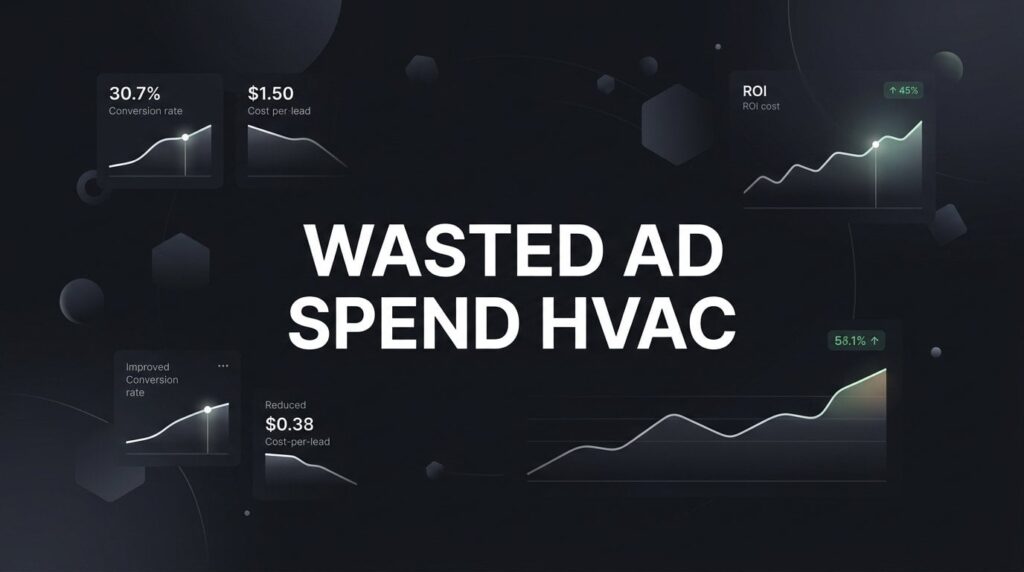
Picture this: it’s the last week of the month, and you’re sitting down to review your Google Ads account. You’ve spent several thousand dollars over the past 30 days. You pull up your job board and start counting the bookings you can actually trace back to those ads. The number is… disappointing. A handful of jobs, maybe fewer. The math doesn’t work, and you know it.
If that scenario sounds familiar, you’re not alone. HVAC is one of the most competitive local service categories in Google Ads, and it’s also one of the most unforgiving when the fundamentals aren’t right. High cost-per-click figures, unpredictable seasonal spikes, and platform defaults that favor broad reach over precision all combine to create an environment where budget can disappear fast without producing real booked jobs.
Here’s what makes wasted ad spend in HVAC particularly frustrating: the campaigns often look fine on the surface. Impressions are up. Click-through rates seem reasonable. Google might even tell you the campaign is performing well. But the phone isn’t ringing with quality leads, and the revenue isn’t following the spend. That gap between what the dashboard shows and what actually hits your bank account is where the real problem lives.
What this article is going to do is pull back the curtain on exactly where HVAC ad budgets go to die. Not one cause. Not a simple fix. The reality is that wasted ad spend in HVAC is almost always a compounding problem, meaning multiple layers of issues stacking on top of each other. Fix one and you’ll still lose money. Understand the whole picture and you can actually stop the bleeding. Let’s get into it.
Why HVAC Campaigns Burn Through Budget Faster Than Most Industries
HVAC sits in a uniquely difficult position in the paid search ecosystem. Unlike industries where clicks are relatively affordable and experimentation is low-risk, HVAC operates in a vertical where every misplaced click carries a real cost. Major metro markets are among the most expensive local service categories you’ll find in Google Ads, and even mid-sized markets have seen CPCs climb significantly as more HVAC companies have shifted their marketing dollars online.
Seasonal demand makes this worse. When a heat wave hits in July or temperatures drop hard in December, search volume for HVAC services spikes dramatically. That’s good news for intent, but it also means competition intensifies precisely when you need your budget to work hardest. Mismanaged campaigns during peak season don’t just waste money, they cost you the jobs that should have been your highest-revenue months of the year.
Then there’s the platform itself. Google has progressively pushed advertisers toward broader match types and automated bidding strategies. The default settings, if left unchallenged, will expand your reach in ways that feel productive but often aren’t. Your budget starts absorbing clicks from searches that have nothing to do with someone needing HVAC service today.
The most dangerous part of all this is the delay in discovering the problem. HVAC owners are running a business, not managing a marketing dashboard full-time. By the time the pattern becomes obvious, often after several months of underperformance, a significant amount of budget has already been wasted. The campaigns didn’t fail overnight. They drifted into inefficiency gradually, and the evidence only became undeniable once the cumulative damage was already done.
Vanity metrics are the thing that masks this drift longest. If your campaign is generating impressions and clicks, it’s easy to assume the ads are “working.” But impressions don’t pay technician wages. Clicks don’t book jobs. The only number that matters is how many qualified service calls you can directly attribute to your ad spend, and that number is frequently much lower than the dashboard would suggest.
The Five Biggest Budget Killers in HVAC Google Ads
Understanding where the money goes requires looking at the specific mechanisms of waste. In HVAC campaigns, the same culprits show up repeatedly across accounts of all sizes.
Broad and phrase match keyword abuse: This is the most common and most costly problem. When your campaign is built around broad or loosely defined phrase match keywords, Google’s algorithm will serve your ads against search queries that share surface-level similarities with your targets but have completely different intent. Real examples from HVAC search term reports include queries like “HVAC technician jobs near me,” “HVAC certification programs,” “how to recharge AC yourself,” and “HVAC school.” These are people looking for careers, education, or DIY solutions. They are not calling you to book a service appointment. Every click from one of these searches is pure waste, and without regular search term report audits, these clicks accumulate invisibly.
Geographic targeting errors: HVAC businesses serve a defined geographic area. If your ads are serving outside that area, whether it’s neighboring counties, cities you don’t cover, or even adjacent states in some misconfigured campaigns, you’re paying for clicks that have zero chance of converting into a booked job. Geographic targeting errors are surprisingly common, especially in campaigns set up quickly or inherited from a previous agency. The fix sounds simple, but identifying the full scope of the problem requires pulling a geographic performance breakdown and comparing it against your actual service area map.
Ad scheduling misalignment: Running ads 24 hours a day, seven days a week sounds like maximum coverage. In practice, it often means paying for clicks and calls during hours when no one answers the phone. An HVAC company that operates Monday through Friday, 8 AM to 6 PM, is wasting money on every click generated at 11 PM on a Saturday. Those prospects aren’t going to leave a voicemail and wait until Monday. They’re going to click the next result. Ad scheduling should be tightly aligned with actual business hours, with possible exceptions for genuine emergency service lines that are actually staffed around the clock.
Device performance imbalances: Many HVAC campaigns run across desktop, mobile, and tablet without any device-level bid adjustments. In reality, mobile typically dominates HVAC search traffic because people searching for urgent service are usually on their phones. But desktop and tablet conversion rates often differ significantly. Without device-level analysis and corresponding bid adjustments, you may be overpaying for clicks on devices that convert poorly while underbidding on the device that actually drives calls.
Competitor and brand term confusion: Bidding on competitor brand names or failing to properly isolate your own brand terms can create additional waste. Without clear campaign structure separating branded from non-branded traffic, budget allocation becomes muddled and performance data becomes harder to interpret accurately.
Landing Page Failures That Turn Paid Clicks Into Dead Ends
Here’s a scenario that plays out constantly in HVAC advertising: a prospect searches “AC repair [city name],” sees your ad, clicks it, and lands on your homepage. Your homepage has a navigation menu with eight options, a slider featuring your company history, a section about your commercial services, and a contact form buried somewhere near the footer. The prospect, who is hot, frustrated, and needs help today, clicks the back button within seconds. You just paid for that click.
Sending paid traffic to a generic homepage is one of the most reliable ways to waste HVAC ad spend. The homepage serves many purposes for many audiences. A dedicated landing page serves one purpose for one audience: converting a high-intent visitor into a booked appointment or phone call. These are not interchangeable. Every dollar you spend driving traffic to a poorly matched destination is a dollar working against itself.
Page load speed compounds this problem significantly. HVAC prospects are often searching urgently, frequently from a mobile device, and frequently in conditions where they’re not inclined to wait. If your landing page takes more than a few seconds to load, a meaningful portion of your paid traffic will bounce before they ever see your offer. This isn’t a minor conversion rate issue. It’s a fundamental waste multiplier: you paid for the click, and the page never even had a chance to do its job.
Weak calls-to-action and missing trust signals are the third layer of landing page failure. An HVAC prospect who does make it to your page still needs to be convinced to act. That means a clear, prominent phone number that’s clickable on mobile. It means visible reviews and ratings. It means your license number, service area confirmation, and any relevant certifications. It means one obvious next step, not a menu of options. When these elements are absent or buried, visitors who arrived with genuine intent leave without converting, and your cost-per-lead climbs while your booking rate stays flat.
Conversion rate optimization, or CRO, is the discipline that addresses all of this. It’s not a luxury or an advanced tactic. For HVAC businesses running paid ads, it’s the foundation that determines whether your ad spend produces revenue or just traffic. A campaign generating strong clicks to a poorly converting page is a campaign that’s working against itself at every step.
Why Tracking Gaps Are the Silent Multiplier
You cannot fix what you cannot measure. In HVAC advertising, this principle has a specific and critical application: if you’re not tracking phone calls as conversions, you are optimizing your campaigns blind.
The majority of HVAC service inquiries come in via phone call, not web form. This is a defining characteristic of the industry. People with a broken air conditioner in August don’t want to fill out a contact form and wait for a callback. They want to talk to someone now. If your conversion tracking only captures form submissions, you’re missing most of your actual lead data. Google’s algorithm, which is constantly learning and adjusting based on conversion signals, is making decisions based on an incomplete and misleading picture of what’s actually working.
The downstream consequences of this are significant. When Google Ads auto-optimizes toward the wrong goal, budget shifts toward campaigns, keywords, and time periods that appear to generate conversions but are actually generating low-quality interactions. The campaigns that drive real phone calls from real customers may be underfunded because the tracking data doesn’t give them credit. You end up in a situation where the algorithm is actively working against your actual business goals because it doesn’t know what your actual business goals look like in the data.
Call tracking solves this by assigning unique phone numbers to specific campaigns, ad groups, or even individual keywords, then passing call data back into Google Ads as a conversion event. This gives the algorithm accurate signals to optimize toward. It also gives you the visibility to see which keywords are driving actual calls versus which ones are generating clicks that go nowhere.
Without this foundation, every other optimization effort is built on sand. You might tighten your keyword list, improve your landing page, and refine your geographic targeting, but if the tracking isn’t capturing real conversions, the campaign will continue to drift toward inefficiency. Tracking isn’t a nice-to-have. It’s the infrastructure that makes everything else work.
The Channels You’re Probably Underusing While Overpaying for Clicks
Google Ads is not the only game in town for HVAC visibility, and treating it as if it is creates an unnecessary and expensive dependency. Two other channels deserve serious attention alongside any paid search investment.
Google’s Local Service Ads operate on a fundamentally different model than standard Google Ads. Instead of paying per click, you pay per lead, and those leads are pre-qualified in the sense that they’ve actively requested contact from a local service provider. LSAs also display above traditional search ads in many cases, giving them prominent placement without the same click-waste risk. For HVAC businesses, LSAs can be a cost-effective complement to standard PPC, particularly for high-intent, emergency-type searches.
Google Maps visibility, meaning your ranking in the Local Pack that appears when someone searches for HVAC services near them, is a separate channel entirely. It’s driven by your Google Business Profile optimization, review volume and quality, local SEO signals, and proximity factors. Businesses that rank well in the map pack receive clicks and calls without paying per click. This reduces overall cost-per-acquisition and, critically, reduces your exposure when paid ad costs spike during peak season.
The practical framework here is straightforward. If your business has strong map pack visibility and a healthy LSA presence, your paid search campaigns can be more targeted and efficient because you’re not depending on them for every lead. If paid ads are your only source of digital visibility, you’re fully exposed to every fluctuation in CPC, every seasonal cost spike, and every platform change that affects your campaign performance.
Channel diversification isn’t about abandoning paid ads. It’s about building a lead system that doesn’t collapse when one channel gets more expensive or less effective. HVAC businesses that invest in their organic and local presence alongside paid ads consistently achieve better cost-per-acquisition over time than those relying on PPC alone.
A Practical Audit Framework to Find Where Your Budget Is Going
If you want to know exactly where your HVAC ad spend is leaking, a structured audit will surface the problems faster than any amount of dashboard staring. Here’s how to approach it systematically.
Start with the search terms report: This is the most revealing document in your Google Ads account. It shows you the actual queries that triggered your ads and resulted in clicks. Filter for the past 90 days and look for patterns: job-related searches, DIY queries, competitor brand names, searches from industries adjacent to HVAC but not relevant to your business. Every irrelevant search term you find should become a negative keyword immediately.
Audit your negative keyword list: If it’s short, or if it hasn’t been updated recently, that’s a problem. A well-maintained HVAC campaign should have a robust negative keyword list that grows continuously based on search term report findings. Common negatives for HVAC include terms related to employment, training, certification, DIY repair, equipment purchase, and wholesale supply.
Pull a geographic performance breakdown: In Google Ads, you can see performance segmented by location. Compare where your clicks and spend are coming from against your actual service area. Any significant spend outside your service territory is waste that can be eliminated with tighter location targeting settings.
Review device performance: Segment your campaign data by device type and compare conversion rates and cost-per-conversion across mobile, desktop, and tablet. If one device type is dramatically underperforming, your bid adjustments should reflect that.
Verify your conversion tracking: Confirm that phone calls are being tracked as conversions, not just form fills. Check that your conversion actions are correctly attributed and that the data flowing into Google Ads reflects actual lead activity, not proxy metrics like page visits or time on site.
Evaluate your landing pages: Load your landing pages on a mobile device with a standard connection. Time how long they take to load. Check whether the phone number is prominent and click-to-call enabled. Assess whether the page has a clear, singular call-to-action and visible trust signals.
What good looks like in a healthy HVAC campaign is a tight keyword list dominated by exact and phrase match with aggressive negative keyword management, geographic targeting that precisely mirrors your service area, ad scheduling aligned with staffed hours, call tracking integrated as a primary conversion action, and traffic directed to purpose-built landing pages. If your campaign deviates significantly from any of these, you’ve found your leak.
The question of whether to fix it yourself or bring in a specialist depends on how deep the structural issues go. Surface-level problems, like adding negative keywords or tightening geographic settings, are manageable internally. But if your conversion tracking is broken, your campaign structure is fundamentally flawed, or you’ve been running broad match without controls for months, the cleanup requires someone who has done it before and knows what a properly built HVAC campaign looks like from the ground up.
Putting It All Together: Stop the Bleeding Before Peak Season
Wasted ad spend in HVAC is almost never bad luck. It’s a predictable result of specific, fixable structural problems stacking on top of each other. Broad match keywords attracting irrelevant traffic. Geographic targeting serving ads outside your service area. Ads running when no one answers the phone. Traffic landing on pages that don’t convert. Campaigns optimizing toward the wrong goals because call tracking isn’t in place. Each of these problems is manageable on its own. Together, they compound into a situation where significant budget produces minimal revenue.
The good news is that every one of these problems has a solution. Keyword hygiene, geo-targeting precision, ad scheduling alignment, call tracking integration, landing page optimization, and a smarter channel mix are not advanced tactics reserved for large marketing budgets. They’re fundamentals that every HVAC business running paid ads should have in place.
The key is not to fix one layer and call it done. The compounding nature of the problem means that partial fixes produce partial results. A clean keyword list means nothing if the traffic still lands on a page that doesn’t convert. Accurate conversion tracking means nothing if the geographic targeting is still serving ads three counties outside your service area.
At Clicks Geek, we’re a Google Premier Partner agency that works specifically with businesses like yours to identify exactly where the budget is going and rebuild campaigns that produce actual booked jobs, not just impressions and clicks. We’ve audited enough HVAC accounts to know what the problems look like before we even open the dashboard.
If you want to see what this would look like for your specific market, we’ll walk you through the audit findings and show you what a properly structured HVAC campaign should be producing. No vague promises, just a clear picture of what’s realistic and what it takes to get there.