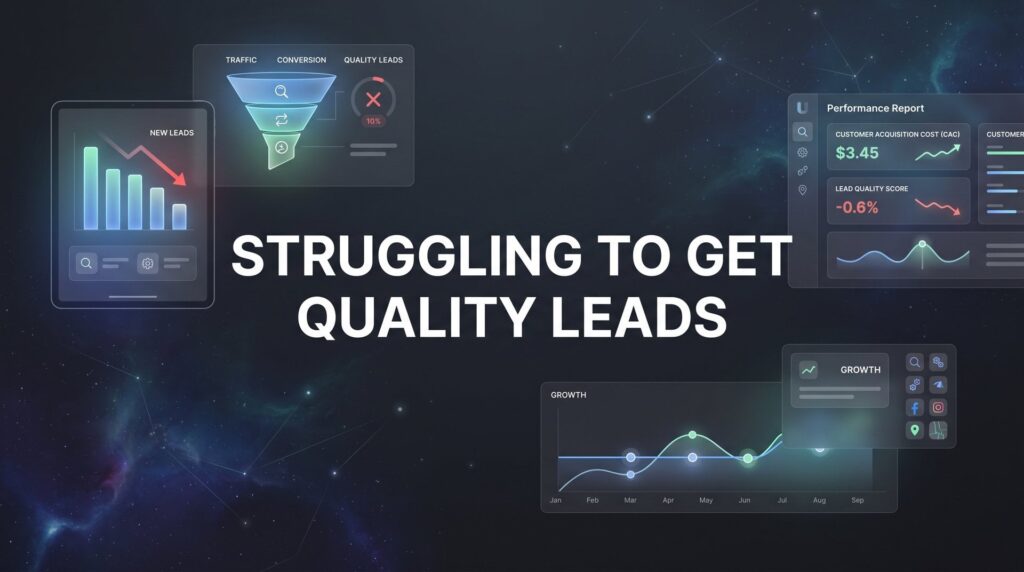
You’re running ads. The phone rings. But when you pick up, it’s someone asking if you offer discounts, someone three counties away, or someone who clearly has no intention of actually buying. Sound familiar?
This is the quiet frustration that doesn’t show up in marketing reports. The leads are technically coming in. The cost-per-lead looks acceptable on paper. But your close rate is dismal, your team is burned out from fielding time-wasters, and the revenue isn’t moving the way it should. You’re not imagining it. This is one of the most common problems local business owners face, and it has nothing to do with your market being “too competitive” or your business not being good enough.
It’s almost always a targeting, conversion, or tracking problem. And every single one of those is fixable.
This article is a diagnostic guide. We’re going to walk through the real reasons lead quality tanks, what’s actually draining your budget, and a concrete framework for turning things around. At Clicks Geek, we’re a Google Premier Partner agency that works with local businesses on exactly this problem every day. What follows is the same thinking we apply when a new client comes to us frustrated, burned out, and ready to quit on paid advertising entirely.
Let’s start at the foundation.
Redefining What a “Good Lead” Actually Looks Like
Most business owners define a lead as anyone who fills out a form or picks up the phone. That definition is costing you money.
A quality lead isn’t just a contact. It’s someone with three specific characteristics: intent, budget, and fit. They’re actively looking for what you offer (not just browsing). They can afford your services. And they’re the type of customer your business is actually built to serve well. Strip away any one of those three, and you’re not looking at a lead. You’re looking at a distraction.
Here’s where most businesses go wrong. They optimize for volume. More form fills. More calls. More clicks. The logic seems reasonable: if you get enough leads, some of them will convert. But this approach inflates your costs at every stage of the funnel. Your team spends time on calls that were never going to close. Your follow-up sequences get clogged with people who aren’t serious. And your close rate looks terrible, which makes it hard to know whether your sales process is broken or your lead quality is just poor.
Chasing volume is a trap. It feels like progress because the numbers go up, but the revenue doesn’t follow. If you want a deeper dive into practical tactics, our guide on lead quality improvement tactics breaks down specific methods for filtering out the noise.
The fix starts before you spend a single dollar on ads. You need a clear, written definition of what a quality lead looks like for your specific business. Think about your best customers. What service did they need? What was their budget range? Where were they located? How quickly did they need to move? What questions did they ask before signing on?
That profile is your qualification criteria. Every campaign, every landing page, every ad should be built to attract that person and filter out everyone else. This isn’t about being exclusionary. It’s about being precise. The businesses that get the best ROI from their marketing aren’t the ones with the most leads. They’re the ones whose leads are already half-sold before they ever pick up the phone.
Once you have that definition locked in, you can start diagnosing why your current campaigns aren’t producing it.
The 5 Hidden Reasons Your Lead Quality Has Tanked
When lead quality drops, there’s usually a specific cause. Sometimes it’s one problem. Often it’s a combination. Here are the five most common culprits we see when working with local businesses.
Reason 1: Your targeting is too broad. This is the most common issue by far. If your Google Ads campaign is running broad match keywords without tight controls, you’re showing up for searches that have almost nothing to do with your business. Geographic targeting that’s set too wide pulls in people outside your service area. Demographic settings that haven’t been refined attract audiences who don’t match your customer profile. Broad targeting feels safe because it generates volume, but that volume is mostly noise.
Reason 2: Your ad copy and landing pages attract the wrong buyer. If your ads lead with discounts, free estimates, or lowest prices, you’re pre-qualifying bargain hunters. That’s exactly who will show up. Serious buyers, the ones with budget and real intent, are looking for confidence, expertise, and proof that you can solve their specific problem. Weak or misleading messaging doesn’t just fail to attract quality leads. It actively repels them.
Reason 3: You’re flying blind on attribution. If you don’t know which keywords, ads, or channels are producing your best leads versus your worst, you can’t make smart decisions. Many businesses are unknowingly pouring budget into campaigns that generate plenty of form fills but zero actual revenue. Without proper tracking and attribution, you keep repeating the same mistakes because you can’t see them. Setting up call tracking for your ad campaigns is one of the fastest ways to close this visibility gap.
Reason 4: There’s no qualification mechanism in place. If anyone can submit a form with three fields and instantly become a “lead,” you’re going to get a lot of unserious submissions. Pre-qualifying questions on intake forms, a brief screening process before booking calls, or even a clear price anchor on the page can dramatically reduce junk leads. This step is often skipped because it feels like friction, but the right friction filters out the wrong people before they waste your team’s time.
Reason 5: You’re competing on the wrong keywords or channels entirely. National brands dominate broad, high-volume search terms. Local businesses that try to compete on those same terms often get crushed by cost and relevance. Your ideal customers are searching hyper-local, intent-driven terms. If your budget is chasing the wrong keywords or running on a channel where your audience simply doesn’t spend time, no amount of optimization will fix the lead quality problem.
How Broad Targeting Quietly Bleeds Your Budget Dry
Let’s get specific about the targeting problem, because it’s more expensive than most business owners realize.
Broad match keywords in Google Ads are designed to maximize reach. They’ll show your ads for searches that Google considers “related” to your keyword, which can mean almost anything. A plumbing company targeting “pipe repair” on broad match might find their ads appearing for “pipe fitting tools” or “DIY plumbing videos.” These clicks cost real money and produce zero qualified leads.
A poor negative keyword list compounds the problem. Negative keywords are the terms you tell Google not to show your ads for. Without a robust negative keyword list, you’re paying for clicks from people searching for jobs at your company, free information, competitor names, or services you don’t even offer. Building and regularly updating that list is one of the highest-leverage activities in any PPC campaign.
Geographic targeting is another common leak. Many campaigns default to targeting entire metro areas or states when the business only serves a 20-mile radius. Every click from outside that zone is money gone. Tightening your geographic settings, sometimes down to specific zip codes or radius targets, immediately cuts waste. If you’re curious how location-based precision works, our article on geofencing advertising services explains how granular targeting can transform local campaigns.
Here’s the real cost calculation that most people miss. It’s not just the wasted ad spend. Every unqualified lead that comes through requires your team’s time. Someone has to answer that call, read that form submission, and respond to that inquiry. When that person turns out to be unqualified, you’ve lost the ad cost plus the labor cost plus the opportunity cost of not following up faster with a real prospect. If your ads are spending too much with no results, this hidden labor cost is often the biggest contributor.
The counterintuitive truth is that tightening your targeting almost always means fewer leads in the short term. But those fewer leads are far more likely to close, which means your cost per acquisition drops even if your cost per lead stays the same or rises slightly. That’s the trade-off worth making.
The Conversion Problem That’s Hiding in Plain Sight
Here’s a scenario worth considering. Your targeting is actually decent. The right people are clicking your ads. But they’re landing on your page and leaving without converting. In that case, the lead quality problem isn’t really a targeting problem. It’s a conversion problem. And it’s more common than most businesses want to admit.
Slow page load times are one of the most underestimated conversion killers. People searching for local services are often on mobile devices and in a hurry. If your landing page takes more than a few seconds to load, a significant portion of those visitors will leave before they ever see your offer. This is especially damaging on paid traffic, where you’re paying for every click regardless of whether the page loads in time. A dedicated mobile ad optimization service can help ensure your pages perform where most local searches happen.
Confusing or lengthy forms create unnecessary friction. If someone has to fill out ten fields before they can request a quote, many of them will abandon the form entirely. On the flip side, a form with only a name and email gives you almost no information to qualify the lead. The goal is a form that’s short enough to complete easily but includes one or two qualifying questions that help you understand what the prospect actually needs.
Trust signals matter more than most business owners expect. Reviews, certifications, photos of real work, licensing information, and clear contact details all tell a visitor that you’re legitimate and capable. A page without these signals, even a visually clean one, often feels hollow to someone who’s about to hand over their contact information.
Weak calls to action are another consistent problem. “Submit” and “Contact Us” don’t tell the visitor what happens next or why they should act now. Specific, benefit-driven CTAs like “Get Your Free Estimate Today” or “Schedule Your Consultation” perform better because they describe the outcome, not just the action.
This is where working with a conversion optimization agency pays for itself. Rather than spending more to drive additional traffic, CRO focuses on converting more of the traffic you’re already paying for. Even modest improvements to your landing page can produce meaningfully more leads from the same ad spend. It’s one of the most overlooked levers in local business marketing.
A Practical Framework for Better Leads Starting This Month
Enough diagnosis. Here’s how to actually fix it.
Step 1: Audit your current campaigns with fresh eyes. Pull your campaign data and look at it through the lens of lead quality, not lead volume. Which keywords are generating your best customers? Which ones produce a lot of clicks and calls but never close? If you have call tracking set up, listen back to recorded calls and tag them by quality. If you don’t have call tracking, that’s your first fix. You cannot improve what you cannot measure. Identify your top three performing lead sources and your three biggest money-wasters. That alone will tell you where to cut and where to invest more.
Step 2: Tighten everything. Move broad match keywords to phrase or exact match. Build out your negative keyword list aggressively. Tighten your geographic targeting to reflect your actual service area. Rewrite your ad copy to speak directly to your ideal customer and pre-qualify out the wrong ones. If your service has a minimum investment, consider including a price anchor in the ad or on the landing page. Yes, this will reduce click volume. That’s the point. For a complete walkthrough of building campaigns that actually generate revenue, our guide on profitable marketing campaigns lays out the full framework.
Step 3: Fix your intake process. Audit your landing page against the conversion killers described earlier. Check your load time, simplify your form, add qualifying questions, and update your trust signals. Then look at what happens after someone submits a form or calls. How quickly does your team follow up? Research consistently shows that the speed of follow-up has a major impact on whether a lead converts to an appointment or sale. If you’re waiting hours or days to respond, you’re losing people who were ready to buy but moved on to a competitor who responded faster. Build a confirmation sequence that reduces no-shows and keeps serious prospects engaged until the appointment happens.
These three steps won’t fix everything overnight, but they will produce measurable improvements within a single billing cycle if executed properly. Start with the audit. The data will tell you what to do next.
Knowing When to Manage It Yourself vs. Bring In a Specialist
Not every business needs to hire an agency. But not every business can afford to keep DIYing their way through a lead quality problem either. Here’s how to think about it honestly.
You can probably handle this yourself if you have a limited budget and a straightforward service area, you’re genuinely willing to invest time in learning Google Ads and analytics, and your campaigns are relatively simple with a small number of services and locations. In that case, the frameworks in this article, combined with Google’s own free training resources, can get you a long way.
You likely need outside help if your cost per lead has been rising for months with no improvement, you’ve already worked with an agency that didn’t deliver and you’re not sure why, competitors are consistently outranking you and winning customers you should be getting, or you simply don’t have the bandwidth to manage campaigns properly on top of running your business. Half-managed campaigns are often worse than no campaigns at all. They spend money without the consistent optimization that makes paid advertising actually work. If you’re weighing your options, our comparison of digital marketing consultant vs agency can help you decide which path makes sense for your situation.
When evaluating a lead generation partner, a few things matter more than anything else. Google Premier Partner status isn’t just a logo. It means the agency has demonstrated consistent performance across client accounts and has access to tools, beta features, and direct Google support that most agencies don’t. CRO expertise is equally important. An agency that only manages ad spend without optimizing what happens after the click is leaving a significant amount of performance on the table. Transparent reporting is non-negotiable. You should know exactly what your campaigns are spending, what they’re producing, and how lead quality is being measured. And perhaps most importantly, look for a partner who talks about lead quality and revenue, not just click-through rates and impressions. Understanding how much Google Ads management costs upfront will also help you set realistic expectations and avoid overpaying.
The Bottom Line on Better Leads
Struggling to get quality leads is not a sign that your market is broken or that paid advertising doesn’t work for your industry. It’s almost always a targeting problem, a conversion problem, or a tracking problem. Usually some combination of all three.
The good news is that each of those problems has a clear solution. Tighter targeting. Better landing pages. Smarter qualification. Faster follow-up. And the discipline to measure what’s actually working instead of optimizing for the metrics that feel good but don’t drive revenue.
Start with the audit. Look at your campaigns with honest eyes, identify where the junk leads are coming from, and begin tightening from there. The framework outlined in this article gives you a starting point that works for most local businesses regardless of industry or budget size.
And if you’ve been through this cycle more than once and you’re ready to stop guessing, we can help. If you want to see what this would look like for your specific business, we’ll walk you through how it works and break down what’s realistic in your market. Clicks Geek builds lead systems for local businesses that turn ad spend into qualified leads and measurable sales growth. Not more noise. Real revenue.