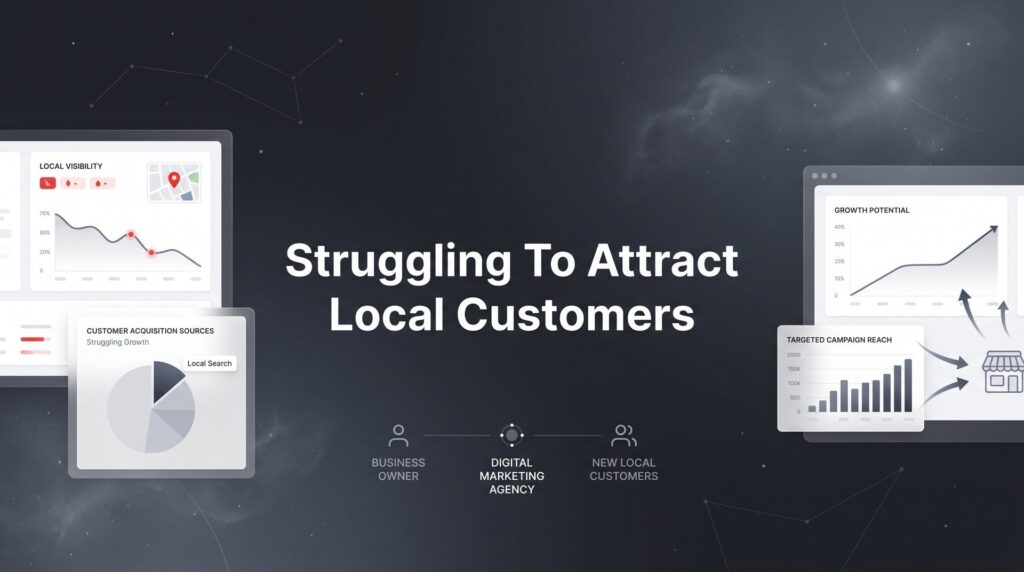
You’ve tried social media posts. You’ve updated your website. Maybe you’ve even run some ads. But your phone still isn’t ringing like it should, and your competitors down the street seem to have customers lined up while you’re struggling to fill your schedule.
Here’s the reality: attracting local customers isn’t about throwing marketing tactics at the wall and hoping something sticks. It’s about implementing specific, proven strategies that put your business directly in front of people who are actively searching for what you offer right now.
The difference between businesses that thrive and those that struggle often comes down to just a few strategic moves. The good news? You don’t need a massive budget or years of marketing experience. You need the right approach, consistently applied.
These seven strategies represent what actually works for local businesses in 2026—not theory, but practical approaches that drive real foot traffic, phone calls, and revenue. Let’s break down exactly how to implement each one.
1. Dominate Your Google Business Profile
The Challenge It Solves
When someone searches for a service in your area, Google displays a map with three local businesses—the “local pack.” If you’re not there, you’re invisible to customers actively looking for what you sell. Most local businesses create a Google Business Profile and then abandon it, leaving critical information incomplete and missing the opportunity to stand out when it matters most.
The Strategy Explained
Your Google Business Profile is the single most powerful free marketing tool available to local businesses. When optimized correctly, it positions you in front of high-intent customers at the exact moment they’re making buying decisions. This isn’t just about having a listing—it’s about making your profile so complete and compelling that Google prioritizes it over competitors.
Think of your GBP as your digital storefront. Just like you wouldn’t leave your physical location looking neglected, your Google profile needs attention and maintenance to convert browsers into customers. Understanding the benefits of local SEO starts with mastering this fundamental tool.
Implementation Steps
1. Complete every single field in your profile—business hours, services offered, service areas, attributes, and business description with natural keyword usage that describes what you actually do.
2. Add high-quality photos of your work, team, and location (businesses with photos receive significantly more engagement than those without).
3. Select your primary category carefully and add all relevant secondary categories to appear in more search results.
4. Create a system to request reviews from satisfied customers immediately after service completion, then respond to every review within 24-48 hours.
5. Post updates weekly—service highlights, special offers, before-and-after photos—to signal active engagement to Google’s algorithm.
Pro Tips
Use the Q&A section proactively by posting common customer questions and detailed answers yourself. This prevents competitors from planting questions and lets you control the narrative. Also, monitor your GBP insights to see which search terms bring customers to your profile, then incorporate those terms naturally into your business description.
2. Target High-Intent Local Keywords with PPC
The Challenge It Solves
Organic visibility takes time to build, but you need customers now. Meanwhile, your competitors are capturing customers who are ready to buy today because they’re showing up at the top of search results when people are actively looking for services in your area.
The Strategy Explained
Pay-per-click advertising lets you appear immediately for searches that matter—when someone types “emergency plumber near me” or “roofing contractor in [your city],” you can be the first business they see. The key is geographic targeting combined with high-intent keywords that indicate someone is ready to hire, not just researching.
Local PPC works because you’re only paying when someone in your service area clicks your ad, and you’re capturing them at the decision-making moment. This isn’t broad brand awareness—it’s precision targeting of people who need your service right now. If you’re wondering why you’re not getting customers online, paid search often fills the gap while organic strategies build momentum.
Implementation Steps
1. Set up location targeting to show ads only within your actual service radius, preventing wasted spend on clicks from areas you don’t serve.
2. Build campaigns around service-specific keywords with local modifiers like “best HVAC repair in [city]” or “emergency electrician [neighborhood]” rather than generic terms.
3. Create compelling ad copy that addresses the immediate need and includes your unique value proposition—what makes you different from the three other ads on the same page.
4. Design dedicated landing pages for each service that match the ad promise and make it dead simple to call, book, or request a quote.
5. Implement call tracking to measure which keywords and ads actually generate phone calls, not just website clicks, so you can optimize for real conversions.
Pro Tips
Schedule your ads to run during your business hours or when you can actually respond to inquiries. There’s no point paying for clicks at 2 AM if nobody’s answering the phone. Also, use negative keywords aggressively to exclude searches for DIY solutions, jobs, or other non-customer queries that waste budget.
3. Build a Reputation That Sells for You
The Challenge It Solves
Customers don’t just choose businesses—they choose businesses they trust. When prospects compare you to competitors, reviews often become the deciding factor. Without a strong reputation visible across platforms, you’re losing customers to businesses that might not even do better work than you.
The Strategy Explained
Social proof isn’t optional anymore—it’s the foundation of local business credibility. Customers read reviews before making decisions, and they’re looking for both quantity and quality. A business with 100+ positive reviews signals reliability and experience. A business with five reviews from two years ago signals neglect or problems.
The businesses that win aren’t necessarily the best at their craft—they’re the best at systematically collecting and showcasing customer feedback. This creates a compounding advantage where more reviews lead to more visibility, which leads to more customers, which leads to more reviews. Building a solid customer acquisition system for local businesses requires making reputation management a core process.
Implementation Steps
1. Create a simple review request system that triggers immediately after service completion—email, text message, or in-person request with a direct link to your Google Business Profile.
2. Make leaving a review as frictionless as possible by providing direct links and simple instructions, removing any barriers between the customer’s satisfaction and their review.
3. Respond to every review within 48 hours—thank positive reviewers specifically for what they mentioned, and address negative reviews professionally with solutions.
4. Showcase your best reviews on your website, in proposals, and in marketing materials to amplify their impact beyond the review platform.
5. Monitor reviews across all platforms (Google, Facebook, Yelp, industry-specific sites) so you never miss feedback or opportunities to engage.
Pro Tips
When responding to negative reviews, always take the conversation offline after your initial public response. Your public reply demonstrates professionalism to future customers, but the real resolution happens privately. Also, ask satisfied customers to mention specific services in their reviews—this helps with keyword visibility and provides more useful information for prospects.
4. Create Neighborhood-Specific Landing Pages
The Challenge It Solves
Generic websites don’t rank well for local searches, and they don’t resonate with customers looking for service providers who understand their specific neighborhood. When someone searches for a contractor in their area, they want to see evidence that you actually serve their location and understand their community.
The Strategy Explained
Location-specific landing pages allow you to capture search traffic for every neighborhood, suburb, or district you serve. Instead of one generic page trying to rank for your entire metro area, you create targeted pages that speak directly to residents of each location. This dramatically increases your visibility for local searches while building relevance with prospects.
These pages work because they satisfy both search engines and customers. Google sees location-specific content that matches search intent. Customers see a business that clearly serves their area and understands their community. This approach is central to the best local SEO services strategies used by top-performing businesses.
Implementation Steps
1. Identify all neighborhoods, suburbs, and districts within your service area where customers actually search for your services.
2. Create unique landing pages for each location with specific content—not just template pages with the city name swapped out.
3. Include location-specific elements like landmarks, community references, local testimonials, and photos of work completed in that area.
4. Optimize each page for local search terms like “[service] in [neighborhood]” while maintaining natural, helpful content that addresses customer needs.
5. Link these pages from your main site navigation and Google Business Profile so they’re discoverable by both search engines and site visitors.
Pro Tips
Include a map showing your service area on each location page, and mention specific streets or landmarks to reinforce local relevance. Also, create location-specific offers or highlight projects you’ve completed in each neighborhood to make the pages genuinely useful rather than just SEO exercises.
5. Partner with Complementary Local Businesses
The Challenge It Solves
Customer acquisition costs keep rising, and competing for attention in crowded markets gets expensive. Meanwhile, other local businesses already have relationships with your ideal customers—they just offer different services. You’re all fighting for the same marketing dollars when you could be sharing customers instead.
The Strategy Explained
Strategic partnerships with non-competing businesses create referral networks that benefit everyone. A real estate agent, mortgage broker, and home inspector serve the same customers at different stages. A wedding photographer, florist, and venue work with the same couples. A dentist and orthodontist complement each other perfectly.
These partnerships work because they’re based on mutual benefit and shared customers. You’re not asking for favors—you’re creating value exchange where everyone wins, including the customer who receives trusted recommendations. Many businesses struggling with lead generation overlook this powerful channel entirely.
Implementation Steps
1. Identify businesses that serve your ideal customer before, during, or after they need your service—look for natural customer journey connections.
2. Approach potential partners with a specific collaboration proposal, not a vague “let’s work together” conversation—be clear about the mutual benefit.
3. Create formal referral agreements that specify how referrals work, any commission structures, and expectations on both sides.
4. Develop co-marketing opportunities like joint events, bundled promotions, or shared content that introduces each business to the other’s audience.
5. Track referrals meticulously and reciprocate generously—partnerships only work when both sides actively participate and see results.
Pro Tips
Start with businesses you already use and trust personally. Your accountant, lawyer, or insurance agent likely works with other business owners who need your services. Also, create simple referral materials—business cards, brochures, or digital assets—that make it easy for partners to recommend you professionally.
6. Run Irresistible Local Offers That Drive Action
The Challenge It Solves
Customers know they need your service eventually, but “eventually” doesn’t fill your schedule today. Without urgency or compelling reasons to choose you now, prospects default to procrastination or price shopping. You need a mechanism that converts interest into immediate action.
The Strategy Explained
Strategic offers create the urgency and value proposition that motivate customers to act now rather than later. This isn’t about discounting your services into unprofitability—it’s about designing promotions that attract your ideal customers, differentiate you from competitors, and create genuine urgency.
The most effective local offers combine real value with smart constraints. Limited time windows, seasonal relevance, or first-time customer incentives all create legitimate reasons for prospects to stop researching and start buying. Learning how to get more customers for small business often comes down to mastering this balance between value and urgency.
Implementation Steps
1. Design offers around your business goals—new customer acquisition, seasonal demand smoothing, or service line promotion—rather than random discounts.
2. Create genuine urgency with specific end dates, limited quantities, or seasonal relevance that makes delaying genuinely costly for customers.
3. Promote offers through multiple channels—Google Business Profile posts, PPC ads, email to past customers, and social media—to maximize reach.
4. Make redemption simple with clear instructions and easy booking processes that don’t create friction between interest and conversion.
5. Track offer performance meticulously to understand which promotions attract profitable customers versus which just attract bargain hunters.
Pro Tips
Bundle services rather than just discounting—”Spring maintenance package” sounds more valuable than “20% off.” Also, use offers strategically to fill slow periods or promote higher-margin services rather than discounting your most popular offerings that already sell well.
7. Retarget Website Visitors Who Didn’t Convert
The Challenge It Solves
Most website visitors leave without taking action—they’re researching, comparing, or simply not ready to commit yet. You’ve already paid to get them to your site, but without retargeting, they disappear into your competitors’ marketing funnels. You’re constantly chasing new traffic when previous visitors already showed interest.
The Strategy Explained
Retargeting keeps your business visible to prospects after they leave your website, appearing in their social media feeds and across websites they visit. This multi-touchpoint exposure builds familiarity and trust while keeping you top-of-mind during their decision-making process.
Most customers don’t convert on their first website visit. They research, compare options, get distracted, or simply aren’t ready to commit immediately. Retargeting ensures you’re still in the conversation when they’re ready to make a decision, even if that’s days or weeks after their initial visit. If customers aren’t filling out your forms, retargeting gives you another chance to bring them back when they’re ready.
Implementation Steps
1. Install retargeting pixels on your website from platforms like Google Ads and Facebook to track visitors and build retargeting audiences.
2. Create audience segments based on behavior—people who viewed service pages, visited pricing information, or spent significant time on site show different intent levels.
3. Design ad creative specifically for retargeting that acknowledges the previous visit and provides new reasons to return, not just repeated generic messages.
4. Set appropriate frequency caps so you stay visible without becoming annoying—showing the same ad 50 times daily damages your brand.
5. Use sequential messaging that evolves over time, starting with brand reinforcement and progressing to specific offers or calls-to-action for engaged prospects.
Pro Tips
Exclude people who already converted—there’s no point retargeting current customers unless you’re promoting additional services. Also, adjust your retargeting window based on your sales cycle. Emergency services might retarget for 7-14 days, while major home renovations might stay visible for 90 days or more.
Your Implementation Roadmap
You now have seven proven strategies that local businesses use to transform customer acquisition. But knowing strategies and implementing them are different things. The question becomes: where do you start?
Begin with your Google Business Profile. It’s free, it delivers immediate visibility, and it’s the foundation everything else builds on. Spend this week completing every field, adding photos, and creating your review request system. This alone will put you ahead of most competitors.
Next, layer in one paid strategy based on your immediate needs. If you need customers now and have budget, PPC delivers fastest. If you’re building for sustainable growth, invest in location-specific landing pages. If you’re in a relationship-driven business, focus on partnerships.
Here’s the truth about implementation: doing two or three of these strategies consistently and well will outperform competitors who dabble in everything but master nothing. Pick your priorities, commit to execution, and measure results.
The businesses thriving in your market aren’t necessarily better at their craft than you. They’re better at putting themselves in front of customers who need their services. That’s the gap you’re closing with these strategies.
Tired of spending money on marketing that doesn’t produce real revenue? We build lead systems that turn traffic into qualified leads and measurable sales growth. If you want to see what this would look like for your business, we’ll walk you through how it works and break down what’s realistic in your market.
The customers you need are searching for services like yours right now. The only question is whether they’ll find you or your competitors. These seven strategies ensure they find you.