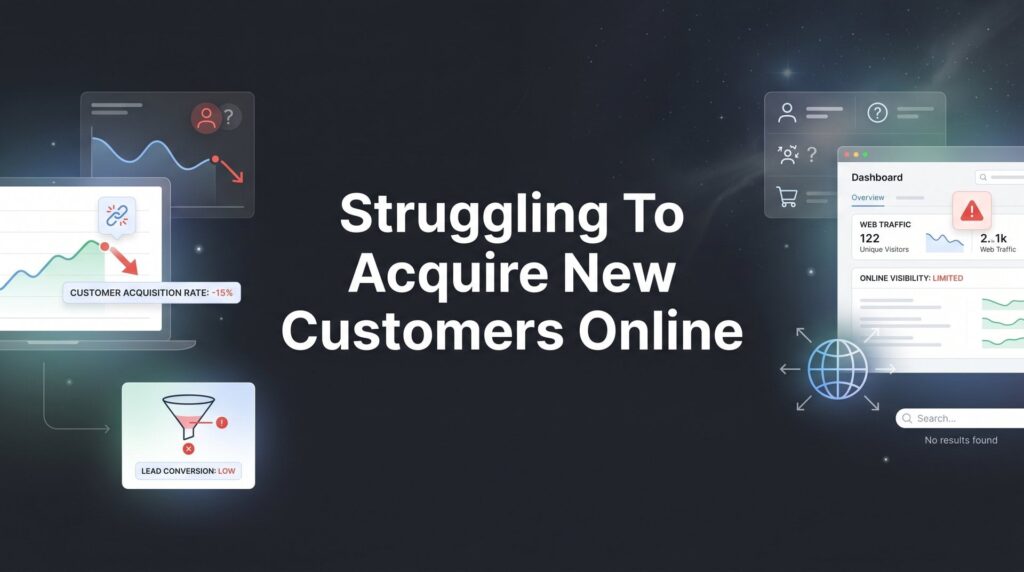
You built something real. Your work is good, your customers are happy, and for a while, the referrals kept coming. Then, gradually, things got quieter. The phone rings less. You’re watching competitors you’ve never heard of show up at the top of Google, picking up jobs that should have been yours. You’ve maybe tried a few things online — a website refresh, some boosted posts, a brief Google Ads experiment that burned through budget without much to show for it — and now you’re wondering whether online marketing is simply a game rigged against small businesses.
It isn’t. But it is more unforgiving than it used to be.
The hard truth is that most local business owners who are struggling to acquire new customers online aren’t failing because of their service quality. They’re failing because the way customers find and choose local businesses has fundamentally changed, and the old playbook — rely on referrals, put up a website, wait — no longer holds up. The businesses winning online aren’t necessarily better at what they do. They’re just more visible, more strategic, and more deliberate about how they convert attention into revenue.
This article is a plain-language breakdown of what’s actually going wrong and what fixing it looks like. No jargon, no vague tips. Just a clear-eyed look at the real reasons your pipeline has stalled and the specific levers that move the needle.
The Real Reasons Your Pipeline Has Gone Quiet
Here’s a shift worth sitting with: when someone in your area needs a plumber, a roofing contractor, a family lawyer, or a cleaning service, the first thing they do is open Google. Not ask a neighbor. Not flip through a directory. They search, they scan the top results, and they call one of the first two or three names they see. If your business isn’t visible at that exact moment of intent, you simply don’t exist to that buyer.
This isn’t a trend anymore. It’s the default behavior for most consumers, and it’s been that way long enough that businesses without strong digital visibility have been quietly bleeding market share for years. The frustrating part is that many business owners don’t notice until the gap is already significant — often because customers are finding competitors instead of them in search results.
So what creates that visibility gap? A few root causes come up again and again.
An outdated or underperforming website: A site that hasn’t been updated in years, loads slowly on mobile, or doesn’t clearly communicate what you do and where you serve it is invisible to Google and confusing to visitors. It’s the digital equivalent of a storefront with the lights off.
No paid advertising strategy: Organic rankings take time to build. If you’re not running paid search ads while your SEO matures, you’re handing the top of the page to competitors who are willing to invest in visibility. Many local businesses have no paid presence at all, or they ran ads once, saw poor results, and stopped — without ever diagnosing why it didn’t work.
No local SEO presence: Showing up in Google’s local results requires deliberate effort: an optimized Google Business Profile, consistent business information across directories, and a steady stream of genuine customer reviews. Without these, you’re invisible in the local pack — the map results that appear above organic listings and generate a large share of local service calls.
Over-reliance on one channel: Social media is great for brand awareness, but it rarely drives purchase-ready traffic. If your entire digital strategy is “post on Facebook and hope,” you’re fishing in a pond where most people aren’t actively looking to buy.
There’s also a compounding dynamic at work. Every month you’re not visible online, a competitor is capturing customers who didn’t know you existed. Those customers leave reviews, refer friends, and become repeat buyers. The gap between you and a well-established competitor doesn’t stay static — it widens. That’s why the time to address visibility problems is always now, not after you see if things pick up on their own.
Your Website Might Be Costing You Customers, Not Winning Them
A website that looks decent but doesn’t convert is actually more dangerous than no website at all. Why? Because it gives you false confidence. You think you have that box checked. Meanwhile, visitors land on your site, can’t figure out what to do next, and leave to call your competitor.
Slow load times are one of the biggest silent killers. Most people searching for a local service are on their phones, and they have zero patience for a site that takes more than a few seconds to load. If your site is slow, a significant portion of your visitors will bounce before they ever see your offer. You paid for that traffic — through ads, through SEO effort, through word-of-mouth — and it evaporated before it had a chance to convert.
Unclear calls-to-action are the next culprit. Visit most local business websites and you’ll find a lot of information about the company, but very little guidance on what the visitor should do right now. Should they call? Fill out a form? Book an appointment? If your site doesn’t make the next step obvious and easy, most people will take no step at all.
Poor mobile experience is the third major issue. A site that was designed for desktop but is clunky on a phone is broken for the majority of your visitors. Buttons that are too small to tap, text that requires zooming, forms that are frustrating to fill out on a touchscreen — these friction points cost you leads every single day.
The distinction worth understanding here is the difference between a brochure website and a conversion-optimized website. A brochure website describes your business. A conversion-optimized website, by contrast, is engineered with one goal: turning visitors into phone calls, form fills, and booked appointments. Working with a sales funnel optimization agency can help you bridge that gap between a passive site and one that actively generates revenue.
Here’s a quick diagnostic: if your site is getting traffic but generating very few inquiries, you don’t have a traffic problem. You have a conversion rate problem. More traffic to a broken funnel just means more wasted opportunity. Fixing the conversion issue first is almost always the higher-leverage move.
Why “Just Running Some Ads” Isn’t a Strategy
This is one of the most common stories in local business marketing. A business owner decides to try Google Ads. They set up a campaign themselves, or hand it to someone without specialized experience. The budget runs for a few weeks, the results are underwhelming, and the conclusion becomes: “Google Ads doesn’t work for my type of business.”
The real conclusion should have been: “That particular campaign wasn’t set up to succeed.” If you’ve experienced this, you’re not alone — there are specific, diagnosable reasons why you’re not getting customers from ads, and most of them are fixable.
Paid search is genuinely one of the most powerful customer acquisition tools available to local businesses. When it’s working correctly, you’re putting your business in front of people who are actively searching for exactly what you offer, at the exact moment they’re ready to buy. That’s as good as advertising gets. But a poorly structured campaign burns money at an alarming rate, and the problems are usually invisible unless you know what to look for.
The cost-per-lead trap is where most DIY campaigns fall apart. Without proper conversion tracking, you don’t actually know which clicks are turning into customers. You’re flying blind. Without negative keywords, your ads show up for searches that have nothing to do with your business — “how to fix my own roof” instead of “roofing contractor near me.” Without disciplined bid management, you overpay for clicks that were never going to convert. All of this adds up to a campaign that looks like it’s running but is actually just spending too much with no results.
A properly structured paid acquisition campaign looks quite different. It starts with intent-based keyword targeting — focusing on the searches that signal someone is ready to hire, not just browsing. It uses compelling ad copy that speaks directly to the customer’s problem and sets clear expectations. It sends traffic to dedicated landing pages that are built to convert, not to your homepage. And it runs continuous optimization: reviewing search term reports, adjusting bids, testing ad variations, and refining targeting based on actual performance data.
This is the kind of work that Clicks Geek does every day as a Google Premier Partner agency. That designation matters because it means Google has recognized the agency’s consistent ability to manage campaigns effectively and deliver results for clients. It’s not a title you buy — it’s earned through sustained performance. When you’re trusting someone with your ad budget, that track record is worth paying attention to.
The Local Visibility Gap: Google Maps, SEO, and Being Found First
If you run a local service business and you’re not appearing in Google’s local pack — the map results that show up near the top of the page for searches like “electrician in [city]” — you are missing a substantial portion of the high-intent traffic in your market. These are people who have already decided they need help. They’re comparing options right now. And they’re calling one of the three businesses they see on that map.
Getting into that local pack isn’t magic, but it does require consistent effort across a few specific areas. Our local business online marketing guide covers many of these fundamentals in detail.
Google Business Profile optimization: Your GBP is the foundation of local visibility. It needs to be fully completed, accurately categorized, regularly updated with posts and photos, and actively managed. An incomplete or neglected profile sends weak signals to Google and weak trust signals to potential customers.
NAP consistency: Your business name, address, and phone number need to be identical across every directory and listing on the web. Inconsistencies confuse Google’s ability to verify your business information, which hurts your local rankings.
Reviews: The quantity and quality of your Google reviews are a significant local ranking factor, and they’re also the first thing potential customers look at when comparing options. A business with dozens of recent, positive reviews wins the click over a competitor with few or outdated ones. Generating reviews systematically — by asking satisfied customers at the right moment — should be a standard part of your process.
On-page local SEO signals: Your website needs to clearly communicate what you do and where you do it. Location-specific pages, service area content, and locally relevant keywords help Google understand your relevance for searches in your area.
One more point worth making: businesses that show up in both the paid results and the organic results capture more clicks than those appearing in just one place. Visibility stacks. A comprehensive strategy combines paid search for immediate presence with local SEO for long-term organic authority, and understanding how to compete with big brands locally can help you make the most of both channels.
Lead Quality vs. Lead Quantity: The Metric That Actually Matters
More leads is not always better. This sounds counterintuitive when you’re struggling to acquire new customers online, but it’s one of the most important distinctions in digital marketing.
If your campaigns are generating a high volume of inquiries from people outside your service area, people who are price-shopping and will never pull the trigger, or people who are searching for something adjacent to what you offer — that’s not a lead volume success. That’s a targeting failure dressed up as activity. If this sounds familiar, you may be dealing with the wrong customers responding to your ads, which is a distinct and fixable problem.
Many business owners mistake a quality problem for a volume problem. They think the solution is more traffic, more leads, more spend. But if the underlying targeting is wrong, scaling up just means losing money faster.
The way you solve a quality problem is by making your targeting, your ad messaging, and your landing page work together as a pre-qualification system. Your ads should speak specifically to the type of customer you want — by location, by service need, by intent signal. Your landing page should reinforce that specificity and set clear expectations about what you offer, who it’s for, and what the next step looks like. When these elements are aligned, the wrong people self-select out before they ever fill out your form, and the right people feel like you’re speaking directly to them.
The other critical piece is tracking revenue by lead source, not just lead volume. You need to know which campaigns, which keywords, and which channels are generating customers who actually pay and stay. Building a qualified lead generation system gives you the infrastructure to measure what matters and continuously improve targeting over time.
Building a Customer Acquisition Engine That Doesn’t Depend on Luck
The businesses that consistently win online aren’t just running ads or doing a bit of SEO. They’ve built a system where each component reinforces the others: paid search drives immediate visibility and qualified traffic, local SEO builds long-term organic authority, and conversion rate optimization ensures that every dollar spent on traffic has the best possible chance of turning into a customer.
Think of it as three legs of a stool. Paid search alone is fast but expensive and stops the moment you stop spending. SEO alone is sustainable but slow to build and vulnerable to algorithm changes. CRO alone improves efficiency but can’t compensate for insufficient traffic. Together, they create a resilient acquisition engine that compounds over time. Understanding the digital marketing challenges for small business owners is the first step toward building this kind of integrated system.
Here’s why most DIY efforts plateau: building and maintaining this system properly requires dedicated expertise, the right tools, and constant attention. Google Ads campaigns need ongoing optimization to stay efficient as competition and search behavior evolve. Local SEO requires consistent effort across content, citations, and review generation. Landing pages need to be tested and refined based on actual conversion data. Without someone whose full focus is on these tasks, campaigns slowly degrade. Budgets get wasted. Rankings slip. And the business owner, who already has a company to run, doesn’t have the bandwidth to catch and fix these issues in real time.
The signal that it’s time to bring in a specialist is usually one of three things: your cost per lead is climbing without a corresponding improvement in lead quality, your conversion rate has been flat for months despite your best efforts, or you simply don’t have the time to manage campaigns with the attention they need to perform. If you’re weighing whether online marketing is too expensive for small business, the real question is whether you can afford the cost of continued invisibility.
This is exactly the kind of challenge Clicks Geek was built to solve. Working with local businesses across a wide range of industries, the focus is always on the same outcome: qualified leads that turn into real revenue, not just traffic and impressions that look good in a report but don’t move the business forward.
Putting It All Together
Struggling to acquire new customers online is not a verdict on the quality of your business. It’s a signal that your digital strategy needs recalibration — and that’s a solvable problem.
The areas to address are clear: close the visibility gap so customers can actually find you, fix the conversion experience so your website works as hard as you do, build paid campaigns that are structured to perform rather than just spend, and track the metrics that actually tell you whether your marketing is generating profitable growth.
None of this requires you to become a digital marketing expert. It requires working with people who already are.
Clicks Geek is a Google Premier Partner agency that specializes in turning underperforming digital marketing into profitable customer acquisition for local businesses. We’ve seen every version of the problems described in this article, and we know exactly what it takes to fix them.
Tired of spending money on marketing that doesn’t produce real revenue? We build lead systems that turn traffic into qualified leads and measurable sales growth. If you want to see what this would look like for your business, we’ll walk you through how it works and break down what’s realistic in your market.