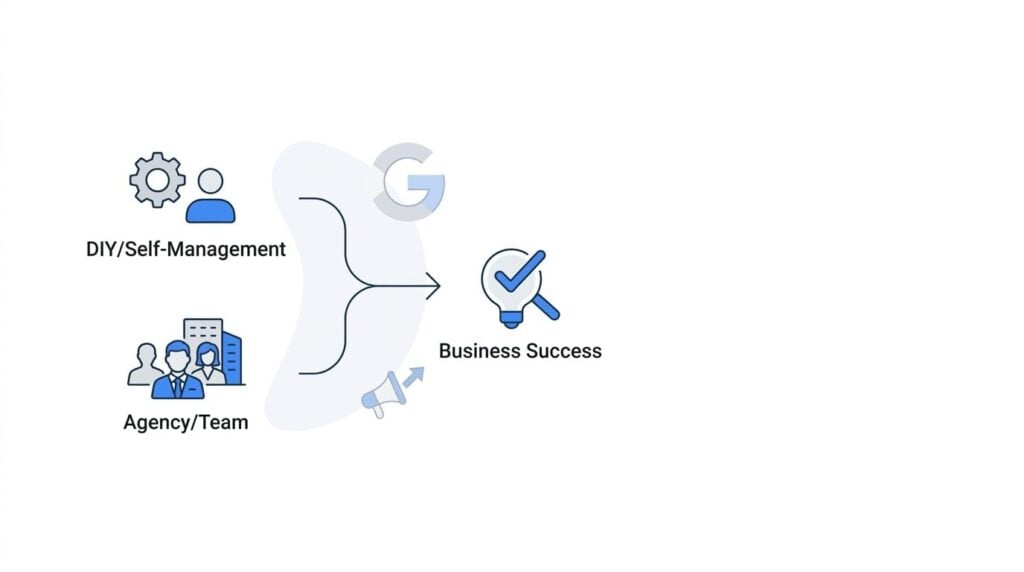
Google makes it look easy. You set up an account, pick some keywords, add a credit card, and the leads start coming. That’s the pitch, anyway. The reality most local service business owners discover is messier: budget spent, phone quiet, no clear explanation for why.
At the same time, plenty of owners are skeptical of agencies for good reason. The industry has a reputation problem. You’ve probably heard stories about retainers paid for months with nothing to show, or agencies that report on clicks and impressions while you’re wondering why the phone isn’t ringing. That skepticism is earned.
So here’s what this article is going to do: give you an honest framework for making this decision based on your actual situation. Not a sales pitch dressed up as advice. Not a hedge that concludes “it depends” without telling you what it depends on. There’s a real answer here, and it comes down to your budget, your time, your market, and what you’ve already tried. We’ll walk through all of it.
What Running Ads Yourself Actually Costs You
The obvious cost of DIY Google Ads is ad spend. The less obvious cost is time, and for most service business owners, time is the more expensive resource.
Running a Google Ads campaign properly isn’t a set-it-and-forget-it task. Initial setup involves keyword research, campaign structure, match type decisions, geographic targeting, ad copy, landing page alignment, and conversion tracking. That’s before the campaign goes live. Once it’s running, you’re looking at weekly tasks: reviewing search term reports, adding negative keywords, adjusting bids, testing ad variations, and monitoring for budget pacing issues. Realistically, that’s five to ten hours per week if you’re doing it right. For a plumber or HVAC owner running a crew and handling customer calls, those hours don’t exist.
Google’s own tools push you toward simpler options. Smart Campaigns and Performance Max are designed to reduce management time by automating decisions. The tradeoff is control. Performance Max, which has largely replaced several older campaign types, uses machine learning to allocate budget across Google’s entire network. It sounds appealing until you realize that negative keywords aren’t automatically applied in PMax, that the algorithm needs significant conversion data before it optimizes well, and that the “black box” nature of the campaign makes it very hard to diagnose problems when performance drops.
Broad match keywords combined with Smart Bidding strategies can work at scale with large conversion datasets. For a local service business spending $2,000 to $3,000 per month, the data volume often isn’t there. The result is a campaign that spends confidently on irrelevant queries while the algorithm waits for enough signal to course-correct.
Mistakes compound fast. A plumber running $2,000 per month with broken call tracking may not realize for 60 to 90 days that the “leads” being reported are actually spam form fills or calls from existing customers. By then, $4,000 to $6,000 is gone. Misconfigured conversion tracking is one of the most common DIY failure points, and it’s not always obvious because the dashboard still shows conversions — just the wrong ones.
The time cost and the error cost together are the real price of self-management. They don’t show up on a credit card statement, which is why they’re easy to underestimate.
Where Self-Management Can Actually Work
DIY Google Ads isn’t always the wrong answer. There are specific situations where it makes sense, and being honest about those matters.
Self-management is most viable when you have prior digital marketing experience, a budget under $1,000 per month, and a relatively simple service offering in a low-competition market. If you’ve run PPC campaigns before, understand match types, know how to build a negative keyword list, and have conversion tracking set up correctly, you can manage a modest campaign without paying agency fees. That’s a real scenario for some owners.
Market competition changes the calculus significantly. A single-service business in a smaller market with few competitors bidding on the same keywords is more forgiving. If you’re the only plumber in a mid-size town running ads, a less-than-perfect campaign structure still gets you calls. If you’re a roofing company in a major metro competing against ten other advertisers, precision matters a lot more. Higher CPCs mean each targeting mistake costs more, and the margin for error shrinks.
Simple campaigns are also more manageable than complex ones. A single service, a single geographic area, and a clear conversion goal (phone call) is something an attentive owner can manage. Multi-service campaigns with different landing pages, seasonal budget shifts, and multiple conversion types are a different problem entirely.
The learning curve carries a real cost that’s worth naming directly. Most owners who start from scratch with Google Ads report a 60 to 90 day period of poor performance before things improve, if they improve at all. That’s not incompetence — it’s the nature of learning a complex platform with real money. Some owners treat that period as tuition and come out the other side with usable skills. Others burn through budget and walk away frustrated. You need to decide honestly which outcome is more likely for you before committing to the DIY path.
One middle path worth considering: use an agency for initial setup and strategy, then manage day-to-day yourself once the structure is in place. This can work, but it requires honest self-assessment. Campaigns drift without maintenance. Negative keyword lists go stale. Bid strategies need adjustment as seasons change. If you know you’ll actually maintain the campaign, this hybrid approach can reduce ongoing costs. If you know you’ll let it sit untouched for months, the initial investment in setup won’t hold.
What a Qualified Google Ads Agency Actually Does Differently
The value of a good agency isn’t that they know Google Ads generally. It’s that they’ve run campaigns in your vertical specifically, and that history is worth a lot.
An agency with real home services experience knows which keywords convert for HVAC versus plumbing versus roofing. They know that “AC repair near me” and “air conditioning service” behave differently. They have negative keyword lists built from thousands of hours of search term data — terms that waste budget without converting — and they deploy those lists from day one instead of discovering them over three months of your money. The home services CPL benchmark on Google Ads runs $18 to $35 per lead. An experienced agency knows that number and holds campaigns accountable to it. A generalist agency may not even know what to aim for.
Google Premier Partner status is worth understanding because it’s specific, not just a badge. Premier Partner agencies meet verified spend thresholds across their client base, maintain certified staff, and hit ongoing performance standards. They also get access to beta features before general release and have a direct line to Google support — which matters when something breaks or a policy issue affects your account. Not every agency qualifies, and the certification requires maintaining standards, not just passing a one-time test. If an agency claims Premier Partner status, you can verify it through Google’s partner directory.
Call tracking is non-negotiable for local service businesses, and a qualified agency treats it that way. Between 40 and 70 percent of home service leads arrive by phone. If your campaign isn’t tracking calls as conversions, your bid strategy is flying blind and you have no way to know which keywords are actually producing booked jobs. This is a basic setup requirement that many DIY campaigns and some careless agencies get wrong.
The agency accountability question is worth pressing on directly. Ask any agency you’re evaluating how they define success and what they report on. The right answer involves cost-per-lead, lead volume, and call tracking data. If the answer focuses on impressions, clicks, or click-through rate, that’s a signal they’re optimizing for metrics that don’t pay your bills. Clicks don’t book jobs. Calls do.
There’s also the matter of what agencies can see across accounts. An agency managing campaigns for dozens of service businesses in your vertical has pattern recognition that a solo owner simply can’t develop. They’ve seen what happens when Performance Max burns budget on branded terms. They’ve tested ad copy across hundreds of variations. That accumulated data shortens the learning period considerably.
The Real Numbers: Agency Fees vs. DIY Mistakes
Agency fees are real and worth understanding clearly. Google Ads management typically runs 10 to 20 percent of ad spend, or a flat monthly retainer depending on the agency and budget level. On a $3,000 per month ad budget, you’re looking at $300 to $600 per month in management fees. That’s not nothing, and you should go in with eyes open.
The comparison that actually matters isn’t agency fees versus zero cost. It’s agency fees versus the combined cost of wasted spend, missed leads, and your own time.
Think about it in lead terms. Home services campaigns run $18 to $35 per lead on Google Ads when managed well. If a poorly structured DIY campaign is generating leads at $60 or $80 each because of bad keyword targeting or weak conversion tracking, the math changes fast. On a $3,000 monthly budget, the difference between a $25 CPL and a $60 CPL is roughly 120 leads versus 50 leads per month. Over a quarter, that gap is significant — and it compounds if the campaign runs uncorrected for months.
The ramp period matters here too. Campaigns typically take 30 to 90 days to stabilize regardless of who manages them. Google’s algorithms need conversion data before Smart Bidding strategies can optimize effectively. An agency with vertical experience shortens that window because they’re not starting from scratch. They know the keyword structure that works for your service type, which bid strategies to start with given your budget size, and how to configure audience signals in Performance Max to give the algorithm a head start. A first-time DIY manager is learning all of that in real time, on your dime.
The time cost is harder to quantify but real. If you’re spending eight hours per week managing campaigns, that’s eight hours you’re not running jobs, following up on quotes, or managing your team. For most service business owners, that time has a clear dollar value. Factor it in before concluding that DIY is the cheaper option.
The honest summary: agency fees are a known, predictable cost. DIY mistakes are unpredictable and often invisible until you’ve already spent the money. For owners running meaningful budgets in competitive markets, the predictability of a qualified agency often wins on pure economics, not just convenience.
How to Evaluate an Agency Before You Sign Anything
The agency market has a lot of noise. Knowing what to ask cuts through it quickly.
Ask for vertical-specific experience, not just Google Ads credentials. General PPC experience doesn’t transfer cleanly to local service businesses. An agency that has run campaigns for dozens of HVAC companies has data on seasonal bidding patterns, service-area targeting, and competitor keyword strategies that a generalist agency doesn’t have. Ask them directly: how many clients in my industry have you managed? What CPL do campaigns in my vertical typically run? If they can’t answer those questions specifically, they’re learning on your budget.
Contract terms tell you a lot about confidence. Reputable agencies don’t need long lock-in contracts. Their results keep clients. Month-to-month arrangements signal that the agency is willing to earn the relationship every month, which is the right incentive structure. If an agency requires a six-month or twelve-month commitment before you’ve seen any results, that’s a flag worth taking seriously.
Reporting should be lead-based, not vanity-metric-based. Ask any prospective agency to walk you through a sample report. It should show cost-per-lead, total lead volume, call tracking data (number of calls, call duration, time of day), and form fill volume. If the report leads with impressions, clicks, or quality score without tying those to actual leads, the agency is measuring what’s easy to report rather than what matters to your business.
Ask how they handle Performance Max. Given that PMax has become a significant part of Google’s local advertising ecosystem, a qualified agency should be able to explain how they structure asset groups, what audience signals they use, and how they manage negative keywords given that PMax doesn’t apply standard negative keyword lists automatically. If the answer is vague, that’s a gap in their knowledge that will cost you.
Finally, ask about their process when a campaign underperforms. Every campaign hits rough patches. What matters is whether the agency has a systematic diagnostic process or just adjusts bids and hopes. The answer tells you whether you’re working with a reactive vendor or a proactive partner.
A Decision Framework for Service Business Owners
Here’s a direct answer rather than a hedge.
Hire an agency if: your monthly ad budget is $2,000 or more, you’re operating in a competitive market with multiple advertisers bidding on your keywords, you don’t have five to ten hours per week to manage campaigns actively, or you’ve tried DIY Google Ads and the results were poor. At these budget levels and in these conditions, the cost of mistakes and the value of vertical expertise typically outweigh agency fees.
Consider self-management if: your budget is under $1,000 per month, you have prior PPC experience or are genuinely willing to invest in structured training (not just YouTube tutorials), and you’re in a lower-competition market with a simple, single-service campaign. In this scenario, the cost of mistakes is more contained and the learning investment may be worth it.
The hybrid path — agency setup, owner-managed maintenance — can work for owners who are honest with themselves about follow-through. If you know you’ll review the account weekly, add negative keywords monthly, and adjust bids seasonally, this approach can reduce ongoing costs while keeping the structure sound. If you know the campaign will drift untouched for months, pay for ongoing management.
One factor that often gets overlooked: the Map Pack captures roughly 42 percent of local clicks. Paid search fills the gap above organic results and above the Map Pack. If your Google Business Profile is strong, you may already be capturing a meaningful share of local intent without paid ads. That context matters for how aggressively you need to run paid campaigns and what budget makes sense.
The spending benchmark worth knowing: most service businesses should be investing 8 to 12 percent of revenue in marketing. If your current spend falls well below that, the question of agency versus DIY may be secondary to the question of whether you’re investing enough to grow at all.
The Bottom Line
The question isn’t really “agency or DIY.” The question is what produces the most booked jobs per dollar spent, given your budget, your market, and the time you actually have.
For most local service businesses running $2,000 or more per month in competitive markets, a qualified agency with vertical experience will outperform self-management. Not because owners aren’t capable, but because the platform rewards specialization and consistent time investment that most owners genuinely can’t spare while running a business. The math on wasted spend and missed leads usually makes the agency fee look reasonable in comparison.
For owners with smaller budgets, real PPC experience, and simpler campaigns in lower-competition markets, self-management is a legitimate path. Just go in with a clear-eyed view of the learning curve and the time commitment.
If you’re running meaningful ad spend and want to know what a well-structured campaign would actually look like for your market and service type, if you want to see what this would look like, we’ll walk you through how it works and break down what’s realistic in your area. Clicks Geek has been a Google Premier Partner since the program’s requirements tightened, manages campaigns across 298 industry verticals, and works on month-to-month terms because we’d rather keep clients with results than contracts.