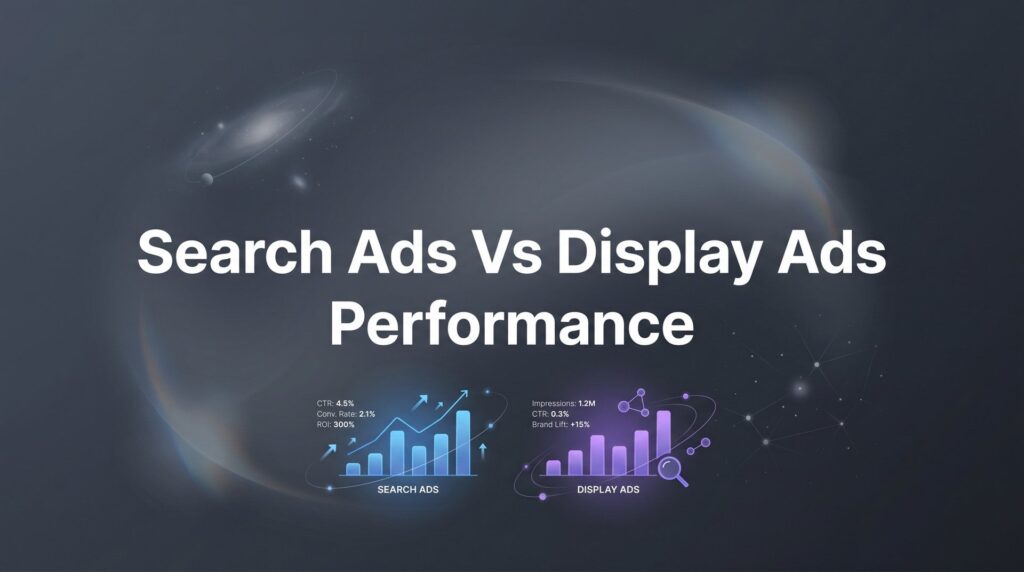
Every dollar you spend on advertising should work hard for your business. But too many local business owners pour money into the wrong ad format without understanding why their results fall flat. The debate between search ads and display ads isn’t about which one is “better.” It’s about understanding when each format dominates, how their performance metrics differ, and how to strategically deploy both for maximum return.
Search ads intercept buyers actively looking for your service. Display ads build awareness among people who don’t know they need you yet. The performance gap between these two formats can be massive, and if you’re measuring them with the same yardstick, you’re almost certainly making costly mistakes.
This guide breaks down seven actionable strategies to evaluate, deploy, and optimize search ads and display ads based on real performance differences. Whether you’re running campaigns yourself or evaluating what your agency delivers, these strategies will help you stop wasting budget and start generating the leads that actually convert into revenue.
1. Match Ad Format to Buyer Intent Stage
The Challenge It Solves
One of the most common budget mistakes local businesses make is running display ads to people who are ready to buy, or running search ads to cold audiences who have never heard of them. When ad format doesn’t match where your prospect is in their decision journey, you pay for clicks that go nowhere. The fix starts with understanding the fundamental difference between pull advertising and push advertising.
The Strategy Explained
Search ads operate on a pull model. The user types a query, signals their intent, and your ad appears in direct response to that demand. Display ads operate on a push model. Your ad is placed in front of users based on targeting criteria like demographics, interests, or browsing behavior, regardless of whether they’re actively searching for your service right now.
This isn’t a flaw in display advertising. It’s simply a different job. Awareness-stage audiences need to be introduced to your brand before they’re ready to convert. Trying to close a sale with someone who has never heard of you is like proposing on a first date. Search ads, on the other hand, are perfectly positioned for the moment someone is actively comparing options and ready to make a decision.
Implementation Steps
1. Map your customer’s journey from first awareness to purchase decision, and identify which stage represents the most urgent revenue opportunity for your business right now.
2. Assign search campaigns to keywords that signal purchase intent, such as “plumber near me” or “best HVAC company in [city],” where the user is clearly ready to hire.
3. Assign display campaigns to audience segments in the awareness or consideration phase, particularly people who have visited your website but haven’t converted yet.
Pro Tips
Don’t assume display ads are always the top-of-funnel tool. When combined with retargeting, display ads can be extremely effective at closing warm leads who already know your brand. The intent stage of your audience matters more than the format itself. We’ll cover retargeting in detail in Strategy 4.
2. Use Separate KPIs to Judge Each Format Fairly
The Challenge It Solves
If you measure display ads by the same conversion rate benchmarks you use for search ads, display will lose every single time. That comparison is like judging a billboard by how many people called immediately after driving past it. The formats serve different purposes, and evaluating them with identical metrics leads to premature budget cuts and missed opportunities.
The Strategy Explained
Search ads should be measured primarily on direct conversion metrics: cost per lead, conversion rate, and return on ad spend. These campaigns target people who are ready to act, so holding them accountable to direct response results is entirely appropriate.
Display ads require a broader measurement framework. Click-through rates for display are typically much lower than search, and that’s expected. The more relevant metrics include view-through conversions, assisted conversions, brand search lift, and remarketing conversion rates. Google Ads provides an Attribution section that includes assisted conversions, which shows how display ads contributed to a sale even when they weren’t the final touchpoint before conversion.
Implementation Steps
1. Set up separate conversion tracking goals in Google Ads for your search and display campaigns so you can evaluate each independently.
2. Enable assisted conversion reporting in your Google Ads attribution settings to capture the full contribution of display ads in multi-touch journeys.
3. Establish distinct performance benchmarks for each format based on your industry, and review them quarterly rather than making reactive changes based on a single week of data.
Pro Tips
If you’re working with a digital marketing agency, ask them to report on search and display performance separately with format-appropriate KPIs. Any agency that compares both formats on the same dashboard without context is either inexperienced or not paying close enough attention to your results.
3. Prioritize Search Ads When Every Lead Counts
The Challenge It Solves
Budget constraints are real, especially for local businesses that need leads this month, not six months from now. When resources are limited, spreading budget across multiple formats can dilute results across the board. Knowing where to concentrate your spend during lean periods is a critical skill that separates businesses that grow from those that stagnate.
The Strategy Explained
Search ads capture existing demand. Someone is already searching for what you offer, and your ad connects them directly to your business. This pull model means you’re not creating demand from scratch; you’re intercepting it at the exact moment it exists. For a local service business with a tight budget, this is typically the highest-efficiency use of paid advertising dollars.
Google’s own platform documentation acknowledges that search ads are designed to reach users with high commercial intent. That intent advantage translates directly into more predictable, measurable lead flow compared to display campaigns targeting cold audiences. Industries like plumbing see especially strong results, which is why Google Ads for plumbers consistently delivers high-quality leads at competitive costs.
Implementation Steps
1. Before allocating any budget to display, build a tightly structured search campaign focused exclusively on your highest-intent keywords, those that signal someone is ready to hire or buy.
2. Set a realistic daily budget for search that allows your campaigns to run consistently throughout the month rather than exhausting spend in the first two weeks.
3. Use negative keywords aggressively to filter out irrelevant searches and ensure every click has a genuine chance of converting into a lead.
Pro Tips
If your search campaigns are generating consistent leads at an acceptable cost per acquisition, that’s your signal to introduce display as a supplementary channel. Search should be your revenue engine first. Display can amplify it once the foundation is profitable. Learn more about building a high-performance PPC advertising strategy that prioritizes lead quality over volume.
4. Deploy Display Ads as a Retargeting Powerhouse
The Challenge It Solves
Many local businesses dismiss display advertising after seeing low conversion rates from cold audience campaigns. That’s a reasonable reaction, but it misses the most powerful application of display ads entirely. Retargeting, also called remarketing, transforms display from a brand awareness tool into a precision conversion mechanism by targeting people who already know your business.
The Strategy Explained
Retargeting via display ads is widely recognized as one of the highest-ROI uses of the format. When someone visits your website but doesn’t convert, they’ve already shown interest. They compared you to competitors, read your service pages, maybe even started filling out a form. Showing them a targeted display ad over the following days keeps your business top of mind while they continue their research.
The Google Display Network reaches a vast number of websites and apps, meaning your retargeting ads can follow warm prospects across the internet in a way that cold outreach simply can’t replicate. This approach works especially well for service businesses like HVAC companies where customers often compare multiple providers before making a decision.
Implementation Steps
1. Install the Google Ads remarketing tag on your website and create audience segments based on specific behaviors, such as visitors who viewed your contact page but didn’t submit a form.
2. Build dedicated display ad creatives for retargeting that speak to a warm audience. Reference their previous visit, highlight a specific service they viewed, or offer a reason to come back like a free consultation or a clear differentiator.
3. Set frequency caps on your retargeting campaigns to avoid overexposing the same users, which can create ad fatigue and negative brand associations.
Pro Tips
Segment your retargeting audiences by recency. Someone who visited your site yesterday is a very different prospect than someone who visited three weeks ago. Tailor your messaging and bid adjustments accordingly, and exclude people who have already converted to avoid wasting spend on existing customers.
5. Layer Both Formats Into a Full-Funnel Strategy
The Challenge It Solves
Running search and display as completely separate, disconnected campaigns leaves significant revenue on the table. The businesses that get the most out of paid advertising aren’t choosing one format over the other. They’re building a system where both formats work together, each feeding the next stage of the customer journey in a deliberate, coordinated way.
The Strategy Explained
Think of your advertising funnel in three stages. At the top, display ads introduce your brand to people who match your ideal customer profile but haven’t searched for you yet. In the middle, retargeting display ads re-engage people who have already interacted with your brand. At the bottom, search ads capture people who are actively searching for your service and ready to make a decision.
When these stages are connected, something powerful happens. Display ads at the top of the funnel increase brand familiarity, which means that when those same people later search for your service, they’re more likely to click on your search ad and convert. The formats aren’t competing. They’re compounding. This is the same principle that drives results for businesses running Google Ads for roofers and other competitive local service industries.
Implementation Steps
1. Define your three funnel stages and assign specific campaign types to each: cold display for awareness, retargeting display for consideration, and branded plus high-intent search for conversion.
2. Use audience data from your search campaigns to inform your display targeting. If certain demographics convert well through search, build lookalike or similar audiences for your display campaigns.
3. Monitor cross-channel attribution regularly to understand how your display campaigns are influencing search conversions, and use that data to justify and optimize your full-funnel budget allocation.
Pro Tips
This full-funnel approach is where lead generation strategies really accelerate. Local businesses that commit to the full funnel typically see their search campaigns become more efficient over time because display is warming up audiences before they ever hit the search results page.
6. Optimize Landing Pages Differently for Each Ad Type
The Challenge It Solves
Sending all your paid traffic to the same landing page is one of the most common and costly mistakes in digital advertising. A person who clicked your search ad after typing “emergency plumber near me” has completely different expectations than someone who clicked a display ad after seeing your brand for the first time. Treating them identically destroys your conversion rate and wastes your ad spend.
The Strategy Explained
Google’s Quality Score system explicitly rewards relevance between your ad and the landing page it leads to. This isn’t just about improving your ad rank. It’s a fundamental principle of conversion rate optimization that applies whether you’re running ads for electricians, dentists, or any other local service.
Search traffic landing pages should be direct, fast, and conversion-focused. These visitors know what they want. They need a clear headline that confirms they’re in the right place, a specific offer or call to action, and minimal friction between arrival and form submission. Display traffic landing pages, particularly for cold audiences, benefit from a different approach: more educational content, trust signals like reviews and credentials, and a softer call to action that acknowledges the visitor may be in early research mode.
Implementation Steps
1. Audit your current landing pages and identify whether they’re built for high-intent search visitors or awareness-stage display visitors. If one page is serving both, it’s likely underperforming for at least one of them.
2. Build dedicated landing pages for your top search campaigns with a single, clear conversion goal, a headline that mirrors the search intent, and a form or phone number prominently displayed above the fold.
3. Create separate landing pages for display and retargeting campaigns that include social proof, a brief explanation of what you do and who you help, and a low-commitment CTA like “See How It Works” or “Get a Free Quote.”
Pro Tips
For retargeting display campaigns, consider using landing pages that acknowledge the visitor’s previous interest. A page that says “Still thinking it over? Here’s why businesses in [city] choose us” speaks directly to a warm audience and can dramatically improve conversion rates compared to a generic homepage.
7. Audit Performance Monthly and Reallocate Budget Aggressively
The Challenge It Solves
Set-it-and-forget-it advertising is one of the fastest ways to burn through a marketing budget with nothing to show for it. The paid advertising landscape shifts constantly. Search volumes change, competitor bids fluctuate, audience behaviors evolve, and what worked last quarter may be underperforming today. Without a structured monthly audit process, you won’t catch these shifts until the damage is already done.
The Strategy Explained
Monthly performance audits aren’t just about checking numbers. They’re about making deliberate decisions with your budget based on evidence rather than assumptions. The goal is to identify which campaigns, ad groups, and formats are delivering results at an acceptable cost, and to shift resources toward what’s working while cutting or pausing what isn’t.
This requires setting clear performance thresholds in advance. Before the month begins, define what “acceptable” looks like for each format: what’s your target cost per lead for search? What view-through conversion rate signals that your display retargeting is contributing meaningfully? Without these benchmarks, every audit becomes a subjective exercise rather than a data-driven decision. This disciplined approach is what separates successful campaigns, whether you’re running Google Ads for dentists or any other competitive vertical.
Implementation Steps
1. Set monthly performance thresholds for both your search and display campaigns, including metrics like cost per lead, conversion rate, and assisted conversion volume, before the month begins.
2. At the end of each month, compare actual performance against those thresholds and categorize campaigns as performing, underperforming, or paused for review.
3. Reallocate budget from underperforming campaigns to top performers immediately rather than waiting for a quarterly review. In paid advertising, speed of optimization directly impacts profitability.
Pro Tips
Don’t make reactive cuts after a single bad week. Look for trends across three to four weeks before making major structural changes. Short-term fluctuations are normal. Sustained underperformance against your benchmarks is the signal to act. If you’re working with an agency, your monthly reporting should include clear budget reallocation recommendations, not just a summary of what happened.
Putting It All Together: Your Search vs Display Action Plan
Here’s the strategic framework in plain terms. Start with search advertising to capture immediate demand and generate revenue as efficiently as possible. Once your search campaigns are profitable and consistent, layer in display advertising for retargeting warm audiences and building awareness with cold ones. Measure each format on its own terms, with distinct KPIs that reflect what each format is actually designed to do. Build landing pages that match the intent of each traffic source. And audit your performance every month with the willingness to move budget aggressively based on results.
The businesses seeing the best returns from paid advertising aren’t the ones who picked the “right” format. They’re the ones who built a system where search and display feed each other at every stage of the customer journey. Search captures demand. Display builds and recaptures it. Together, they create a compounding growth engine that neither format can achieve alone.
This kind of coordinated, performance-driven approach is exactly what separates campaigns that generate real revenue from campaigns that generate reports full of impressions and clicks that never turn into customers.
Tired of spending money on marketing that doesn’t produce real revenue? We build lead systems that turn traffic into qualified leads and measurable sales growth. If you want to see what this would look like for your business, we’ll walk you through how it works and break down what’s realistic in your market. As a Google Premier Partner agency, Clicks Geek brings the expertise and accountability to ensure your ad spend works as hard as you do.