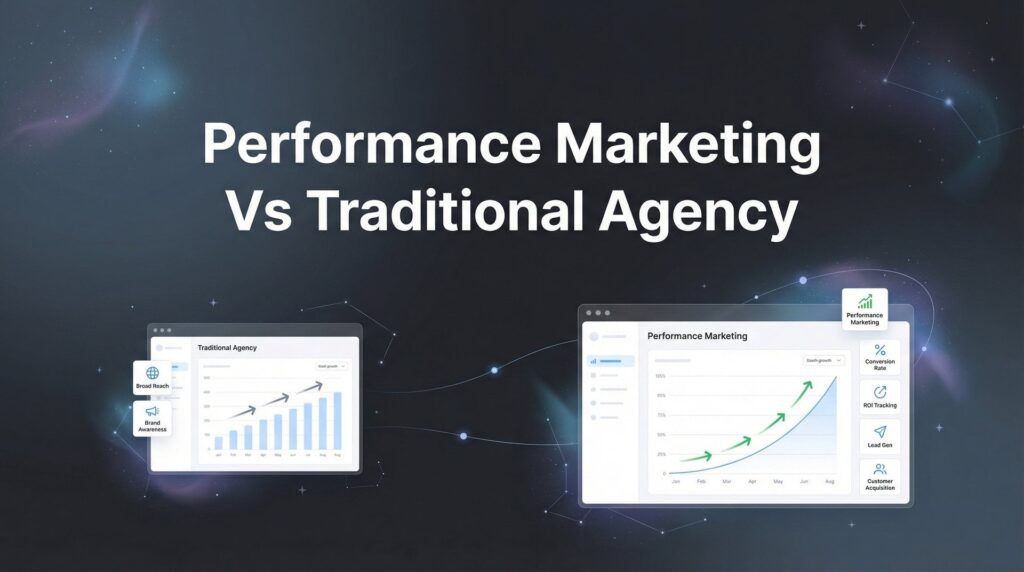
For local business owners watching their marketing budgets, the choice between performance marketing and traditional agency approaches can feel like gambling with your growth. One model promises you only pay for results; the other offers brand-building expertise honed over decades. But here’s the truth most agencies won’t tell you: the right choice depends entirely on your specific business goals, timeline, and risk tolerance.
This guide breaks down seven proven strategies to help you evaluate both approaches, understand when each excels, and ultimately make a decision that drives real revenue—not just vanity metrics. Whether you’re a service-based business needing leads tomorrow or building a brand for long-term market dominance, these strategies will cut through the confusion and give you a clear path forward.
1. Define Your Primary Business Objective First
The Challenge It Solves
Most business owners approach agency selection backward—they start by comparing pricing models or services before clarifying what they actually need to achieve. This creates confusion because both performance marketing and traditional agencies can deliver results, just different kinds. Without a clear objective, you’ll end up evaluating agencies on the wrong criteria entirely.
The fundamental question isn’t which model is better. It’s whether you need immediate customer acquisition or long-term brand positioning. These require fundamentally different approaches, timelines, and measurement frameworks.
The Strategy Explained
Start by writing down your primary business goal in one sentence. Are you trying to generate 50 qualified leads per month? Build brand awareness in a new market? Launch a new service line? Increase customer lifetime value?
Performance marketing agencies excel when your objective is measurable customer acquisition—leads, sales, appointments, or conversions you can track directly. They build systems optimized for immediate response and continuous improvement based on conversion data. Traditional agencies shine when your goal involves brand perception, market positioning, or creative campaigns where results unfold over months rather than weeks.
Think of it like choosing between a sprint coach and a marathon trainer. Both are excellent at what they do, but you need to know which race you’re running first.
Implementation Steps
1. Write your primary business objective as a specific, measurable outcome with a timeline (e.g., “Generate 30 qualified leads per month within 90 days”).
2. Identify whether this objective requires immediate measurable action or sustained brand-building over time.
3. Ask potential agencies to explain how their model specifically addresses your stated objective—not their general capabilities.
Pro Tips
Be brutally honest about what “success” looks like for your business right now. If you need revenue this quarter to make payroll, brand awareness campaigns won’t save you. Conversely, if you’re entering a market where trust takes years to build, chasing cheap clicks might waste your budget on unqualified traffic.
2. Evaluate Your Risk Tolerance and Budget Structure
The Challenge It Solves
Cash flow determines survival for local businesses, yet many owners don’t consider how different agency payment structures impact their financial risk. A $5,000 monthly retainer paid upfront creates very different cash flow pressure than paying $150 per qualified lead after delivery. Understanding this difference helps you choose a model your business can actually sustain.
The payment structure also reveals how agencies view risk. When an agency only gets paid for results, they’re sharing your risk. When they require payment regardless of outcomes, you’re carrying all the risk alone.
The Strategy Explained
Traditional agencies typically operate on monthly retainers or project fees paid upfront. You’re essentially buying their time, expertise, and creative services—regardless of whether those efforts generate revenue for your business. This model works well when you have predictable cash flow and view marketing as a long-term investment in brand equity.
Performance marketing agencies often structure fees around actual results—cost per lead, cost per acquisition, or revenue share arrangements. You pay when specific outcomes occur, which means your marketing investment scales directly with results. This creates natural accountability but may include setup fees or minimum commitments.
Consider your business’s financial reality. Can you invest $3,000-$10,000 monthly for six months before seeing meaningful returns? Or do you need each marketing dollar to generate measurable outcomes within weeks?
Implementation Steps
1. Calculate your available marketing budget and determine whether you can commit to 6-12 months of fixed costs before seeing ROI.
2. Ask agencies to break down their payment structure completely—setup fees, monthly minimums, performance thresholds, and when you actually pay.
3. Model both scenarios financially: paying $5,000/month regardless of results versus paying per lead or acquisition as they’re delivered.
Pro Tips
Watch for hybrid models that combine elements of both approaches. Some performance agencies charge a small base fee plus performance bonuses, which can balance risk while ensuring the agency has resources to optimize your campaigns. The key is understanding exactly when money leaves your account and what you’re guaranteed to receive in return.
3. Assess Your Sales Cycle and Customer Journey
The Challenge It Solves
Your sales cycle length fundamentally determines which agency model can realistically deliver results. If customers typically research for six months before buying, an agency optimized for immediate conversions will struggle to show value. Mismatching your customer journey to the wrong agency model creates frustration on both sides and wastes money on strategies that can’t work.
Many business owners don’t realize that different industries and price points create vastly different buying timelines. A $500 service might convert in days, while a $50,000 solution requires months of nurturing.
The Strategy Explained
Performance marketing thrives in scenarios with shorter, more direct sales cycles. When customers can evaluate your offer and make decisions relatively quickly—think local services, e-commerce, or transactional B2B—performance models can track attribution clearly and optimize for conversions efficiently.
Traditional agency approaches become more valuable as sales cycles lengthen and customer journeys become complex. When buyers need multiple touchpoints, educational content, and relationship-building before purchasing, you’re playing a longer game. Brand presence, thought leadership, and consistent messaging matter more than immediate click-to-conversion optimization.
Map out your actual customer journey honestly. How many interactions do prospects typically need before becoming customers? Do they buy impulsively or conduct extensive research? Can you track the complete path from first contact to sale?
Implementation Steps
1. Document your average sales cycle from first contact to closed deal—be specific about timeline and typical touchpoints.
2. Identify whether you can track customer interactions across this journey or if attribution becomes murky after initial contact.
3. Ask agencies how they’ve handled businesses with similar sales cycles and what realistic timelines look like for seeing results.
Pro Tips
If your sales cycle is long but you need short-term wins, consider whether you can create “micro-conversions” that performance marketing can optimize—like consultation bookings or lead magnet downloads. This lets you benefit from performance accountability even in longer sales cycles by tracking earlier-stage conversions that predict eventual sales.
4. Examine Data Ownership and Transparency Requirements
The Challenge It Solves
The data generated from your marketing campaigns represents valuable business intelligence about your customers, market, and what actually works. Yet many business owners don’t realize that some agency arrangements leave them completely blind to this data—or worse, the agency owns it entirely. Without transparency and data ownership, you’re building your business on rented land.
This becomes critical if you ever want to change agencies, bring marketing in-house, or simply understand what’s driving your results beyond surface-level reporting.
The Strategy Explained
Performance marketing agencies typically provide extensive data access because their model depends on proving results. They usually set up tracking in your own accounts (Google Ads, Facebook Ads, analytics platforms) where you maintain ownership and visibility. You can see exactly what’s being spent, which campaigns perform, and how leads flow through your funnel.
Traditional agencies vary widely in their transparency approaches. Some provide detailed reporting and full account access, while others present only high-level summaries and maintain control of advertising accounts in their own business manager. This can create dependency where switching agencies means starting completely from scratch.
The difference matters because data ownership affects your ability to make informed decisions, verify results, and maintain continuity if the relationship ends.
Implementation Steps
1. Ask potential agencies directly: “Will I own and have full access to all advertising accounts, tracking systems, and campaign data?”
2. Request to see sample dashboards or reporting systems they provide—look for real-time access versus monthly PDF reports.
3. Clarify what happens to all accounts, data, and campaign setups if the partnership ends—will you retain everything or start over?
Pro Tips
Push for agencies that set up infrastructure in your own business accounts from day one. This means your Google Ads account, your Facebook Business Manager, your analytics—all owned by your business with the agency granted access. If an agency resists this arrangement, ask why. Legitimate reasons exist in some cases, but you deserve a clear explanation.
5. Consider Your Industry’s Competitive Landscape
The Challenge It Solves
Market competition dramatically affects which agency model delivers better returns. In highly commoditized markets where dozens of businesses offer identical services, brand differentiation becomes crucial. In emerging markets or specialized niches, direct response and lead generation might dominate. Choosing an agency model without considering your competitive reality sets you up for disappointment.
The challenge is that most business owners evaluate agencies in a vacuum, without considering how their specific market dynamics favor different approaches.
The Strategy Explained
Performance marketing excels in markets where customers actively search for solutions and make relatively quick decisions based on clear value propositions. If your industry has high search volume, direct intent, and customers who compare options primarily on price or availability, performance models can capture that demand efficiently.
Traditional agency approaches become more valuable in saturated markets where everyone offers similar services at similar prices. When customers can’t differentiate based on features or cost, brand perception becomes the deciding factor. If you’re competing against established players with strong brand recognition, you may need sustained creative campaigns and brand-building before direct response tactics can work effectively.
Look at your top three competitors. How do they market themselves? Are they winning on brand reputation or on aggressive lead generation? What’s working in your specific market right now?
Implementation Steps
1. Research your top 5-10 competitors and document their marketing approaches—brand-focused content and awareness campaigns versus direct response ads and lead generation.
2. Identify whether customers in your market typically choose based on brand trust or immediate need fulfillment.
3. Ask agencies for specific examples of businesses they’ve worked with in competitive landscapes similar to yours.
Pro Tips
Don’t assume your market requires the same approach as other industries. Local service businesses often succeed with performance marketing even in competitive markets because customers have immediate needs. Conversely, some less competitive markets still require brand-building because purchase decisions involve high trust and long consideration periods. Your specific market matters more than general industry trends.
6. Test Accountability and Alignment of Incentives
The Challenge It Solves
The most overlooked factor in agency selection is incentive alignment—whether the agency’s financial success depends on delivering outcomes that actually matter to your business. Many agencies optimize for metrics that make their reports look good but don’t translate to revenue in your bank account. Clicks, impressions, and engagement might satisfy a retainer agreement while your phone stays silent.
This misalignment creates a fundamental problem: the agency can be “successful” by their metrics while you’re losing money. True partnership requires shared risk and shared reward.
The Strategy Explained
Performance marketing agencies structure fees around outcomes that directly impact your business—qualified leads, booked appointments, completed sales. When they only get paid for delivering these results, their incentives naturally align with yours. They’re motivated to optimize for quality, not just volume, because poor leads that don’t convert hurt their economics.
Traditional agency retainers create a different dynamic. The agency gets paid the same amount whether your campaigns generate ten leads or a hundred. This doesn’t mean traditional agencies don’t care about results—many are deeply committed to client success—but the financial incentive to optimize for your specific business outcomes is weaker.
The test is simple: ask any potential agency, “How do you personally benefit financially when my business grows?” Their answer reveals everything about incentive alignment.
Implementation Steps
1. Ask agencies to define the specific metrics they’ll be measured on and how those metrics connect directly to your revenue.
2. Request to see their compensation structure—do they earn more when you get better results, or is payment fixed regardless of outcomes?
3. Propose a performance component even with traditional agencies—bonuses for hitting specific lead or revenue targets.
Pro Tips
The strongest indicator of true accountability is whether an agency will discuss performance guarantees or risk-sharing arrangements. Agencies confident in their ability to deliver results are often willing to structure some portion of compensation around outcomes. If an agency immediately dismisses any performance-based component, ask yourself why they’re unwilling to share even minimal risk in the results they promise.
7. Plan for Scalability and Long-Term Partnership
The Challenge It Solves
Your marketing needs today won’t match your needs in six months or two years. Choosing an agency model without considering how it scales with your business creates painful transitions—either you outgrow the agency’s capabilities or you’re locked into a model that becomes increasingly expensive as you grow. The right choice accommodates your current stage while supporting your growth trajectory.
Many business owners focus exclusively on immediate needs and then find themselves trapped in arrangements that don’t scale or require complete restarts as the business evolves.
The Strategy Explained
Performance marketing models typically scale naturally with your business. As you grow and need more leads, you increase spend and pay for additional results. As you refine your sales process and improve conversion rates, the same marketing investment delivers better returns. The model flexes up or down based on your capacity and goals.
Traditional agency relationships can scale well if structured properly, but often require renegotiation as scope expands. A retainer that covers three service lines might need significant increases when you launch a fourth. Project-based work requires new contracts for new initiatives. This isn’t necessarily bad—it just requires more active management as your needs evolve.
Consider where you want your business to be in 12-24 months. Will you need dramatically more marketing capacity? Will you expand into new markets or services? Can your chosen agency model accommodate that growth without complete overhaul?
Implementation Steps
1. Map out your business growth plans for the next 12-24 months, including new services, markets, or capacity increases.
2. Ask agencies how their model accommodates growth—what happens when you need to double lead volume or expand into new channels?
3. Understand pricing structures at different scales—will costs increase linearly with results, or are there economies of scale as you grow?
Pro Tips
Look for agencies that have successfully scaled with businesses similar to yours. Ask for specific examples where they’ve taken a client from your current stage to your target stage. The ability to handle your business today matters, but the ability to grow with you over years creates compounding value. The best partnerships evolve as your business evolves without requiring you to start over every 18 months.
Making Your Decision With Confidence
Choosing between performance marketing and traditional agency models isn’t about which is universally better—it’s about which aligns with where your business is right now and where you’re headed. Start by defining your primary objective, then work through each strategy to build clarity around risk tolerance, sales cycles, data needs, competitive positioning, incentive alignment, and scalability.
For most local businesses focused on customer acquisition and measurable growth, performance marketing offers the accountability and ROI focus that drives real results. When you need leads this month, when cash flow matters, when you want to know exactly what you’re paying for—performance models deliver transparency that traditional retainers can’t match.
The right agency doesn’t just execute tactics. They become a partner whose success depends entirely on your success. That alignment changes everything about how marketing gets prioritized, optimized, and measured.
Tired of spending money on marketing that doesn’t produce real revenue? At Clicks Geek, we build lead systems that turn traffic into qualified leads and measurable sales growth. We only win when you win—our performance-driven approach means your results determine our success. If you want to see what this would look like for your business, we’ll walk you through how it works and break down what’s realistic in your market.
Your next customer is searching for your services right now. The question is whether your marketing is set up to capture that opportunity and turn it into revenue—or just generate reports that look good in monthly meetings.