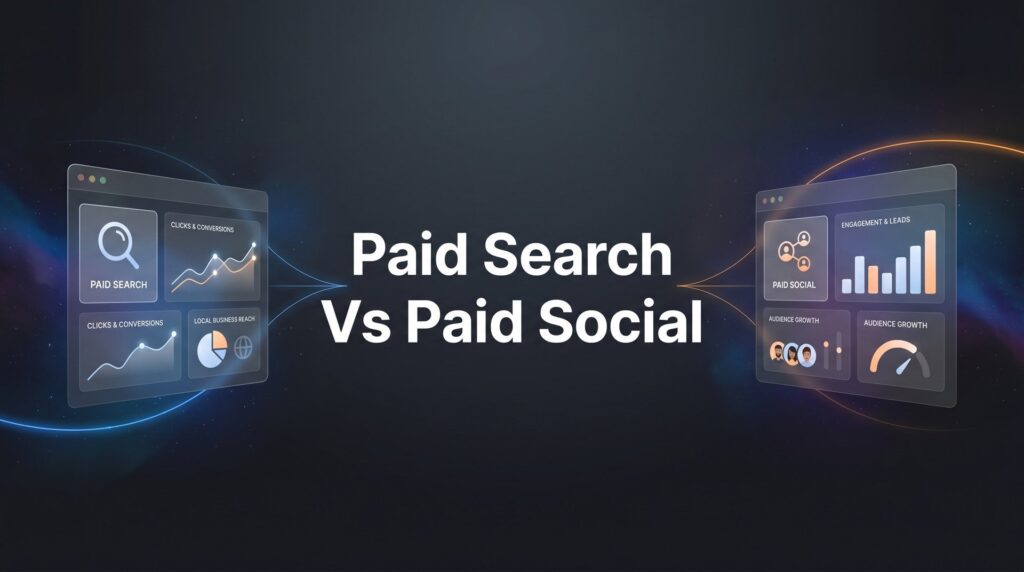
Every dollar you spend on advertising should work hard for your business. But too many local business owners dump budget into the wrong channel simply because they don’t understand the fundamental differences between paid search and paid social.
Here’s the core distinction: paid search (think Google Ads) captures people who are actively searching for what you sell right now. Paid social (think Facebook and Instagram Ads) interrupts people who match your ideal customer profile but aren’t necessarily in buying mode yet. Both channels can drive serious revenue, but deploying the wrong one at the wrong time is like fishing with the wrong bait in the wrong lake.
This guide breaks down seven battle-tested strategies for deciding when to lean into paid search, when to invest in paid social, and when to run both simultaneously for maximum ROI. Whether you’re a plumber trying to fill next week’s schedule or a service-based business owner building long-term brand awareness, these strategies will help you allocate your ad budget with confidence and stop wasting money on guesswork.
1. Match Your Channel to Buyer Intent Level
The Challenge It Solves
Most business owners pick an advertising channel based on what they’ve heard works, what a friend recommended, or simply what feels familiar. That’s a recipe for wasted budget. The channel you choose should be driven by one question above all others: how much intent does your ideal customer have right now?
The Strategy Explained
Think of buyer intent as a spectrum. On one end, you have someone typing “emergency plumber near me” into Google at 11pm. On the other end, you have someone scrolling Instagram who has no idea their water heater is about to fail. These two people require completely different advertising approaches.
Paid search is an intent-capture channel. It meets customers at the moment they’re actively expressing a need. Paid social is a demand-creation channel. It plants seeds with the right audience before they ever reach the search bar. Matching your channel to where your customer sits on that intent spectrum is the single most important strategic decision you’ll make when building a paid advertising strategy.
Implementation Steps
1. Define your primary business goal: are you trying to capture existing demand or create new demand? Emergency services, local tradespeople, and high-urgency businesses almost always benefit from starting with search.
2. Map your customer’s typical buying journey. Ask yourself: does my customer search for this type of service, or do they discover it through recommendations and scrolling?
3. Identify where your customers are in the funnel when they’re most likely to convert. Bottom-of-funnel intent points to search; top-of-funnel awareness points to social.
Pro Tips
Don’t assume every business fits neatly into one category. A high-end home renovation company might use paid social to inspire homeowners who aren’t yet searching, then use paid search to capture the ones who are actively getting quotes. Knowing your customer’s decision timeline is just as important as knowing their intent level.
2. Use Paid Search to Dominate Bottom-of-Funnel Conversions
The Challenge It Solves
When a potential customer is ready to buy, hire, or book, the last thing you want is for a competitor to show up first. Bottom-of-funnel moments are the highest-value moments in any customer journey, and many local businesses leave serious money on the table by not owning their most valuable search terms.
The Strategy Explained
Google Ads lets you bid on the exact phrases your ready-to-buy customers are typing into search engines. These high-commercial-intent keywords, things like “HVAC repair near me,” “best personal injury lawyer in [city],” or “book a house cleaner today,” signal that the searcher is close to making a decision. Showing up at the top of those results with a compelling ad and a well-designed landing page is one of the most direct paths to a new customer that exists in digital marketing.
The key is precision. You’re not trying to reach everyone. You’re trying to reach the person who is ready right now. Tight keyword targeting, strong ad copy that speaks directly to their need, and a landing page built for conversion (not just general information) are the three pillars of a successful paid search advertising campaign.
Implementation Steps
1. Build a tightly themed keyword list focused on high-commercial-intent terms. Prioritize phrases with buying signals: “near me,” “cost,” “price,” “hire,” “book,” and service-specific terms.
2. Write ad copy that directly addresses the searcher’s need and includes a clear call to action. Match the ad message to the specific keyword group it’s serving.
3. Send traffic to a dedicated landing page, not your homepage. The page should match the ad’s promise, load quickly, and make it easy to call, fill out a form, or book an appointment.
Pro Tips
Negative keywords are just as important as your target keywords. Regularly audit your search term reports and exclude irrelevant queries that are eating your budget without converting. A well-maintained negative keyword list can meaningfully improve your cost per lead over time.
3. Deploy Paid Social to Build Awareness and Generate Demand
The Challenge It Solves
Not every potential customer knows they need you yet. If your business solves a problem people don’t actively search for, or if you’re trying to grow beyond the existing demand in your market, paid search alone will hit a ceiling. That’s where paid social earns its place in your strategy.
The Strategy Explained
Platforms like Facebook, Instagram, and TikTok give you something paid search cannot: the ability to define your audience by who they are rather than what they’re searching for. You can target homeowners in a specific zip code, parents of children under five, small business owners in your city, or people who have shown interest in topics directly relevant to your service. This makes paid social media advertising powerful for creating demand before it exists.
The mindset shift here is important. You’re not catching someone mid-search. You’re interrupting their scroll with something relevant enough to make them stop, think, and eventually act. That requires creative that earns attention, messaging that resonates with their identity or aspirations, and enough frequency to stay top of mind when they do eventually reach the buying stage.
Implementation Steps
1. Build detailed audience profiles based on your best current customers. Use Facebook’s audience tools to target by demographics, interests, behaviors, and geographic location relevant to your service area.
2. Create content-driven ads that lead with value or emotion rather than a hard sell. Think before-and-after results, short video testimonials, educational content, or compelling visuals that showcase your work.
3. Set realistic expectations for the timeline. Paid social awareness campaigns build momentum over weeks, not days. Monitor reach, engagement, and brand search volume as early indicators before direct conversions ramp up.
Pro Tips
Paid social creative fatigue is real. Audiences see the same ad and stop responding within weeks. Build a rotation of at least three to five creative variations per campaign and refresh them regularly to maintain performance.
4. Layer Both Channels Into a Full-Funnel Strategy
The Challenge It Solves
Running paid search alone means you’re only capturing demand that already exists. Running paid social alone means you’re building awareness without a strong mechanism to convert it. The businesses that consistently win with paid advertising are the ones that use both channels in a coordinated way, each doing the job it’s best suited for.
The Strategy Explained
A full-funnel paid media strategy looks like this: paid social introduces your brand to the right audience and builds familiarity over time. When that audience eventually reaches a buying moment and types a relevant query into Google, your paid search ads are right there to capture the conversion. The two channels compound each other. Customers who have seen your brand on social before encountering your search ad are more likely to click, more likely to trust, and more likely to convert.
This is why attribution can be tricky. A customer might first encounter your business through an Instagram ad, ignore it, later search for your service on Google, click your ad, and convert. Last-click attribution would credit Google entirely. But the social touchpoint played a real role. Understanding conversion funnel optimization helps you acknowledge that both channels contribute to the final outcome.
Implementation Steps
1. Map out your customer journey from first awareness to final conversion. Identify which touchpoints typically occur at each stage and assign a channel role to each.
2. Align your messaging across channels so the brand experience feels consistent. Someone who sees your Facebook ad and then your Google ad should feel like they’re encountering the same brand with the same value proposition.
3. Use multi-touch attribution reporting where possible to understand how your channels interact. Even a simple view of assisted conversions in Google Analytics can reveal how social is contributing to search-driven conversions.
Pro Tips
Don’t try to run a full-funnel strategy on a shoestring budget. If your total monthly ad spend is limited, it’s better to dominate one channel than spread thin across two. The full-funnel approach delivers its best results when each channel has enough budget to reach meaningful scale.
5. Let Your Budget Size Dictate Your Starting Channel
The Challenge It Solves
Budget constraints are the reality for most local businesses. When you’re working with limited ad spend, the order in which you invest matters enormously. Choosing the wrong starting channel can mean months of learning before you see meaningful returns, and many businesses don’t have that runway.
The Strategy Explained
For most local businesses with modest starting budgets, paid search is the smarter first investment. The reason is straightforward: you’re capturing demand that already exists. You’re not trying to create desire from scratch. Someone searching “roof repair near me” already wants what you offer. Your job is simply to show up, look credible, and make it easy for them to contact you. That’s a much shorter path to revenue than building awareness from zero through social.
Once paid search is generating consistent leads and you understand your cost per acquisition, you have a baseline to work from. At that point, you can begin layering in paid social to expand your reach, build brand awareness, and fill your pipeline with future customers who aren’t searching yet. This sequenced approach reduces risk and is one of the most profitable paid advertising strategies for local businesses.
Implementation Steps
1. If your monthly budget is limited, start with paid search focused on your highest-value, most specific service keywords. Resist the urge to target broad terms that will burn through budget without converting.
2. Once your paid search campaigns are profitable and producing consistent leads, calculate your average cost per lead and your customer lifetime value. This gives you the data to confidently justify expanding into paid social.
3. When you do add paid social, start with a retargeting campaign (covered in the next strategy) before investing in cold audience prospecting. Retargeting delivers faster results and helps you build confidence in the channel before committing larger budgets.
Pro Tips
Resist the temptation to split a small budget evenly between both channels. Spreading $1,000 a month across two platforms often means neither channel has enough spend to generate meaningful data or results. Concentration beats diversification at small budget sizes.
6. Use Retargeting to Bridge the Gap Between Search and Social
The Challenge It Solves
Most website visitors don’t convert on their first visit. They browse, compare options, get distracted, and leave. Without a retargeting strategy, all the money you spent driving that traffic disappears the moment they close the tab. Retargeting is how you recapture that investment and dramatically improve your overall conversion rate.
The Strategy Explained
Retargeting works by placing a small piece of tracking code (a pixel) on your website. When someone visits your site, whether from a paid search ad, an organic search, or any other source, that pixel tags them as a known visitor. You can then serve them ads on Facebook, Instagram, and Google’s display network as they browse elsewhere online.
This is one of the highest-ROI tactics available in paid advertising because you’re targeting warm audiences. These people already know your brand. They’ve shown interest by visiting your site. They just haven’t converted yet. A well-timed retargeting ad with the right message, perhaps a testimonial, a special offer, or a simple reminder of what you offer, can be the nudge that brings them back to convert. Applying proven conversion rate optimization tactics to your retargeting landing pages amplifies these results even further.
Retargeting also serves as a natural bridge between paid search and paid social. Someone might find you through Google, visit your site, leave without converting, and then see your Facebook retargeting ad three days later. That cross-channel touchpoint builds trust and keeps your business top of mind throughout their decision-making process.
Implementation Steps
1. Install the Meta Pixel on your website and set up Google’s remarketing tag. Configure both to track key events like page visits, form submissions, and phone call clicks.
2. Build segmented retargeting audiences based on behavior. Someone who visited your pricing page deserves a different ad than someone who only read your homepage. Tailor your messaging to where they are in the decision process.
3. Set frequency caps on your retargeting campaigns to avoid over-saturating your audience. Seeing your ad too many times without converting can create negative brand associations rather than positive ones.
Pro Tips
Create retargeting exclusion lists for people who have already converted. Serving acquisition ads to existing customers wastes budget and can feel tone-deaf. Segment your converted customers into a separate list and either exclude them or shift them to a referral or upsell campaign instead.
7. Track the Right Metrics for Each Channel
The Challenge It Solves
One of the most common mistakes businesses make is comparing paid search and paid social using the same metrics. When paid social doesn’t generate the same direct conversion volume as paid search, they conclude it isn’t working and cut the budget. But that comparison is like judging a billboard by how many people called immediately after seeing it. Different channels play different roles, and they need to be measured accordingly.
The Strategy Explained
Paid search is a direct response channel. Its primary metrics should be conversion-focused: cost per click, conversion rate, cost per lead, and return on ad spend. Because users are expressing active intent, you should expect relatively short paths from click to conversion, and you should hold the channel accountable to those outcomes. Implementing Google Ads optimization best practices ensures you’re maximizing performance on every one of those metrics.
Paid social, particularly when used for awareness and demand generation, operates on a longer timeline. Measuring it purely on immediate conversions will almost always make it look underperforming. Instead, track metrics like reach, frequency, engagement rate, video view rate, and brand search volume lift over time. When running retargeting campaigns on social, direct conversion metrics become more relevant again since you’re working with warm audiences.
The broader principle is this: your measurement framework should match your campaign objective. Awareness campaigns need awareness metrics. Conversion campaigns need conversion metrics. Applying a solid marketing ROI optimization framework helps you avoid conflating the two and making bad budget decisions.
Implementation Steps
1. Define clear objectives for each campaign before it launches. Awareness, consideration, and conversion campaigns each have distinct KPIs. Document these upfront so you’re not redefining success after the fact.
2. For paid search, track conversions directly in Google Ads and connect to your CRM where possible. Monitor cost per lead, lead quality, and close rate to understand the true ROI of your search spend.
3. For paid social awareness campaigns, track reach, frequency, and engagement as primary metrics. As a secondary indicator, watch whether branded search volume (people searching directly for your business name) increases as your social campaigns run. That’s a strong signal that awareness is building.
Pro Tips
Avoid making budget decisions based on last-click attribution alone. Many businesses undervalue paid social because it rarely gets the last click before a conversion. Use assisted conversion reports and consider a simple data-driven attribution model to get a more accurate picture of how each channel contributes to your overall revenue.
Putting It All Together: Your Paid Search vs Paid Social Action Plan
Here’s the decision framework in plain terms: start with intent, assess your budget, choose your starting channel, then layer in the second channel as you grow.
If your customers are actively searching for your service right now, start with paid search. Capture the demand that already exists before you invest in creating new demand. Once your search campaigns are profitable and generating consistent leads, build in paid social to expand your audience and fill your future pipeline.
If your business requires education, inspiration, or brand familiarity before a customer will consider buying, paid social may deserve an earlier place in your strategy. And regardless of which channel you start with, retargeting should be running from the moment you have enough website traffic to build an audience.
Neither channel is universally better. The winning strategy depends on your business model, your budget, your growth stage, and how your customers actually make buying decisions. A plumber filling emergency calls needs a different approach than a home staging company building long-term brand equity. The businesses that win with paid advertising are the ones that understand these differences and build their strategy around them, not around what worked for someone else in a different industry.
Tired of spending money on marketing that doesn’t produce real revenue? Clicks Geek builds lead systems that turn traffic into qualified leads and measurable sales growth. If you want to see what this would look like for your business, we’ll walk you through how it works and break down what’s realistic in your market.