You’re staring at your marketing budget spreadsheet again. Should you dump everything into Google Ads for quick wins, or invest in SEO for long-term growth? Most local business owners treat this as an either/or decision, burning cash on one channel while completely ignoring the other. The truth? That’s like showing up to a gunfight with either bullets or a gun—but not both.
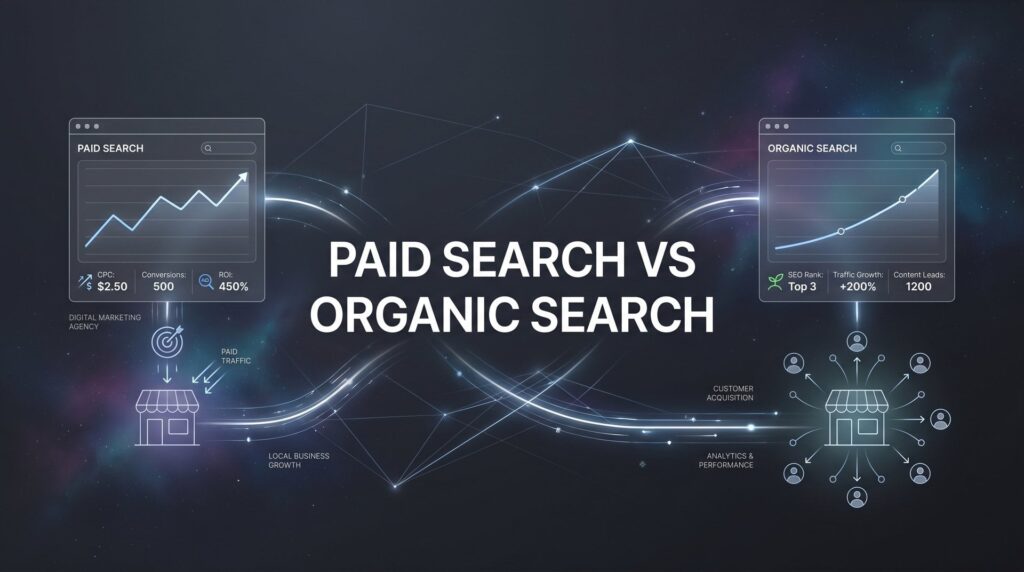
The paid search vs organic search question isn’t about picking a winner. It’s about understanding when each channel serves your business best, and how they work together to compound your results. A new restaurant needs tables filled this weekend. An established law firm needs to dominate search for the next decade. Same marketing channels, completely different strategies.
Here’s what actually matters: knowing which approach fits your current business situation, how to allocate resources intelligently, and when to shift your strategy as your business evolves. The businesses crushing it in your market aren’t spending more—they’re deploying their budgets strategically across both channels based on clear frameworks, not guesswork.
Let’s break down seven proven strategies that help you stop wasting money on the wrong channel at the wrong time, and start building a marketing system that delivers both immediate revenue and long-term growth.
1. The Speed vs. Sustainability Framework
The Challenge It Solves
Business owners constantly face the same dilemma: do I need customers tomorrow, or am I building for next year? This isn’t a philosophical question—it’s a resource allocation problem that determines whether your business survives or thrives. Choose wrong, and you either burn through cash with nothing to show long-term, or you invest in SEO while your competitor steals your lunch with paid ads.
The real issue isn’t which channel is “better.” It’s that most businesses apply the same strategy regardless of their situation. A startup with six months of runway can’t afford to wait for organic rankings. An established business throwing all their budget at paid search management is essentially renting customers when they could be building equity.
The Strategy Explained
Think of paid search as renting traffic and organic search as buying property. Rent gives you immediate occupancy but builds zero equity. Buying requires upfront investment and time, but eventually you own an appreciating asset.
Your business situation determines the right mix. New product launch? Heavy paid search gets you immediate market feedback and revenue while your organic presence builds. Established service business? Shift resources toward organic to reduce customer acquisition costs over time. Seasonal business? Ramp paid during peak season, invest in organic during slow periods.
The framework works like this: if you need results in days or weeks, paid search dominates your budget. If you’re measuring success in quarters or years, organic becomes your primary focus. Most businesses need both, but the ratio shifts dramatically based on urgency and available capital.
Implementation Steps
1. Define your revenue timeline—do you need customers this month, this quarter, or are you building for next year? Your answer determines whether you allocate 80/20 paid/organic or flip that ratio.
2. Calculate your customer lifetime value and how long you can afford to wait for ROI. If your LTV supports higher acquisition costs and you need speed, paid search becomes your primary channel with organic as a supporting player.
3. Set quarterly checkpoints to reassess your mix. As your organic presence strengthens, systematically reduce paid spend in areas where you’re ranking organically, and redeploy that budget to new paid opportunities or more organic investment.
Pro Tips
Don’t make this decision once and forget it. Your optimal mix evolves as your business matures. Start with the channel that matches your timeline and cash position, but always invest at least 20% in the other channel. This prevents you from building a house on rented land or waiting so long for organic results that you run out of runway.
2. Budget Allocation Based on Business Lifecycle Stage
The Challenge It Solves
A startup and an established business have completely different marketing needs, yet many apply the same budget split across paid and organic search. This mismatch wastes money and opportunity. The startup dumps 50% into SEO they won’t see results from for months, while the established business keeps overpaying for clicks on terms they should own organically.
Your business lifecycle stage determines not just how much you spend, but where that spend creates maximum impact. Get this wrong, and you’re either burning cash on immediate returns with no compounding effect, or investing in long-term assets while your cash flow chokes your growth.
The Strategy Explained
Business lifecycle stages require different paid/organic ratios. Startup stage demands immediate validation and revenue—think 70-80% paid search, 20-30% organic foundation building. You need to prove your market exists and generate cash flow while planting organic seeds. If you’re just getting started, understanding paid advertising management for startups can help you scale without burning through your runway.
Growth stage shifts toward 50/50 as you scale what works. Your paid campaigns are proven, your organic content starts ranking, and you’re building momentum in both channels. This is where integration matters most—your paid data informs organic strategy, and your organic presence reduces paid costs.
Established stage flips to 30% paid, 70% organic. You’ve built authority, your organic rankings drive consistent traffic, and paid search becomes surgical—targeting new markets, defending against competitors, and capturing high-intent searches where organic hasn’t reached yet.
Implementation Steps
1. Honestly assess your current lifecycle stage based on market position, not how long you’ve been in business. A five-year-old business with weak organic presence still operates like a startup in search marketing.
2. Map your budget allocation to your stage, but build in transition triggers. When your organic traffic reaches 40% of total search traffic, start shifting more budget to organic. When specific keyword groups rank in top 3 positions, reduce or eliminate paid spend on those terms.
3. Create a 12-month roadmap showing how your allocation will evolve. This prevents reactive budget decisions and ensures you’re always investing ahead of where you need to be, not just solving today’s problem.
Pro Tips
Most businesses underestimate how long each stage lasts. Startup stage in competitive markets can extend 12-18 months. Don’t prematurely shift to “established” allocation just because you’ve been around a few years. Let your actual organic performance and market position dictate the transition, not your timeline expectations.
3. Keyword Intent Mapping for Channel Selection
The Challenge It Solves
Not all keywords deserve the same treatment. Business owners waste massive budgets running paid ads for informational searches that convert poorly, while missing high-intent commercial searches where paid dominates. Meanwhile, they ignore informational content opportunities that could build authority and feed their conversion funnel organically.
The problem isn’t just picking keywords—it’s matching each keyword’s intent to the channel that converts it best. Run paid ads for “what is X” searches and you’re burning money on tire-kickers. Rely only on organic for “X service near me” and you’re letting competitors steal ready-to-buy customers.
The Strategy Explained
Search intent falls into distinct categories, and each performs differently across paid and organic channels. Informational intent (how-to, what is, why does) converts better organically—users want helpful content, not ads. These searches build your authority and feed your funnel, but they’re expensive and low-converting in paid search.
Commercial investigation intent (best X, X vs Y, X review) works in both channels but requires different approaches. Organic content builds trust through comprehensive comparisons. Paid search captures users ready to decide, especially when you’re not ranking organically yet. Using the right keyword research tools helps you identify which intent category each term falls into.
Transactional intent (buy X, X service near me, X pricing) is where paid search shines. Users know what they want and they want it now. These clicks cost more but convert significantly higher. If you’re not ranking organically for these terms, paid search becomes non-negotiable for capturing ready-to-buy traffic.
Implementation Steps
1. Audit your current keyword list and categorize every term by intent—informational, commercial investigation, or transactional. This reveals where you’re mismatching channel to intent and wasting budget.
2. Shift your informational keywords primarily to organic content strategy. Build comprehensive guides, how-tos, and educational content that ranks organically and establishes authority. Only run paid ads on informational terms if you’re launching and need immediate brand visibility.
3. Deploy paid search aggressively on transactional and high-intent commercial terms where you don’t rank organically in top 3 positions. As your organic rankings improve for these terms, gradually reduce paid spend but maintain presence to defend against competitors.
Pro Tips
The biggest mistake is treating all keywords equally in your budget allocation. A single transactional keyword converting at 8% might be worth more than 50 informational keywords combined. Analyze your conversion rates by intent category, then allocate budget based on actual performance, not keyword volume. Your highest-intent, lowest-ranking keywords should get the most aggressive paid investment.
4. The Data Feedback Loop Strategy
The Challenge It Solves
Most businesses run paid search and organic search as completely separate initiatives. Your PPC team doesn’t talk to your SEO team. Your paid data sits in Google Ads while your organic strategy gets built on guesswork and keyword research tools. This separation costs you months of wasted effort and thousands in budget testing things your paid campaigns already proved or disproved.
Paid search generates immediate, actionable data about what actually converts—which keywords drive sales, which ad copy resonates, which landing pages perform. Ignoring this intelligence when building your organic strategy is like having the answer key but choosing to guess instead.
The Strategy Explained
Paid search becomes your testing laboratory for organic strategy. Every paid campaign generates conversion data, messaging insights, and audience intelligence that should directly inform your organic content and optimization decisions. This dramatically accelerates your organic results because you’re building based on proven performance, not assumptions.
Start by analyzing your paid search conversion data to identify your highest-performing keywords. These aren’t just keywords with high click-through rates—they’re the searches that actually turn into customers. These become your priority targets for organic content development and on-page optimization.
Your paid ad copy reveals which value propositions and messaging angles resonate with your audience. The headlines and descriptions with the highest click-through and conversion rates should directly inform your organic title tags, meta descriptions, and content structure. Understanding how responsive search ads work gives you even more messaging data to leverage for organic optimization.
Implementation Steps
1. Export your paid search conversion data monthly and identify keywords with conversion rates above your account average. Create a prioritized list of these terms for organic content development and optimization efforts.
2. Analyze your top-performing paid ad copy and extract the messaging patterns, value propositions, and calls-to-action that drive clicks and conversions. Use these insights to rewrite your organic title tags, meta descriptions, and H1 headlines on key landing pages.
3. Set up a quarterly review process where your paid search performance directly informs your organic content calendar. Keywords that convert well in paid but lack organic content become your next content priorities. Landing pages that convert poorly in paid get redesigned before you invest in ranking them organically.
Pro Tips
Don’t just look at conversion rates—analyze the full customer journey. Which paid keywords lead to highest lifetime value customers? Those deserve organic investment even if initial conversion rates seem average. Also track which keywords have high engagement but low conversion—these often indicate content gaps where educational resources could build trust before the sale.
5. Competitive Gap Analysis for Resource Deployment
The Challenge It Solves
You’re competing against businesses with different strengths across paid and organic search. Some competitors dominate organic rankings but run minimal paid campaigns. Others flood paid search but have weak organic presence. Most business owners either try to compete everywhere or randomly pick battles, wasting resources fighting where they’re weakest instead of exploiting competitor gaps.
The strategic opportunity isn’t matching your competitors’ approach—it’s finding where they’re vulnerable and deploying your resources there. A competitor with strong organic rankings but no paid presence leaves the door wide open for you to capture high-intent traffic immediately. A competitor burning cash on paid search for terms they could rank organically signals inefficiency you can exploit.
The Strategy Explained
Map your competitive landscape across both channels to identify opportunity gaps. Search your key transactional keywords and document which competitors appear in paid positions versus organic positions. This reveals strategic vulnerabilities you can exploit with focused resource deployment. If you’re wondering why competitors are ranking higher in search, this analysis often reveals the answer.
When competitors dominate organic but ignore paid search, they’re leaving immediate revenue on the table. Deploy paid budget aggressively on these terms to capture ready-to-buy traffic while they rely solely on organic. Your cost per click might be lower because competition is reduced, and you’re capturing customers they assume they already own.
When competitors flood paid search but have weak organic presence, they’re overpaying for customers and building zero long-term equity. This signals an opportunity to invest in organic content and SEO to eventually dominate those searches at a fraction of their customer acquisition cost. You’re playing the long game while they rent customers month after month.
Implementation Steps
1. Create a competitive matrix for your top 20 keywords. Document which competitors appear in paid positions (top 4 ads) versus organic positions (top 10 results) for each term. This reveals patterns in their strategy and exposes gaps.
2. Identify keywords where fewer than 3 competitors run paid ads but 8+ competitors rank organically. These represent immediate paid search opportunities with reduced competition and potentially lower costs. Launch targeted campaigns to capture this traffic.
3. Find keywords where 4+ competitors run paid ads but organic results show weak, outdated content or limited local business presence. These signal organic content opportunities where comprehensive resources could rank relatively quickly and reduce your long-term acquisition costs.
Pro Tips
Competitive dynamics shift constantly. Set calendar reminders to repeat this analysis quarterly, not just once. A competitor might launch aggressive paid campaigns, or their organic rankings might improve. Your resource deployment should adapt to these changes. Also watch for new competitors entering the market—they often create temporary gaps as they build presence in one channel before the other.
6. The Conversion-First Integration Model
The Challenge It Solves
Traffic means nothing if it doesn’t convert. Business owners obsess over keyword rankings and click costs while ignoring the fundamental question: what happens after the click? You can drive thousands of visitors from both paid and organic search, but if your conversion path is broken, you’re just paying more to disappoint more people.
The integration problem runs deeper than most realize. Your paid search sends traffic to one set of landing pages optimized for ad relevance. Your organic search sends traffic to different pages optimized for keywords. Neither is optimized for the actual conversion, and you’re missing the remarketing opportunities that make both channels exponentially more effective together.
The Strategy Explained
Stop thinking about paid search and organic search as separate traffic sources. Start thinking about them as complementary touchpoints in a conversion system. A user might discover you organically, leave without converting, then see your paid ad later and convert. Or they click a paid ad, don’t convert, then return through organic search when they’re ready to buy.
Build your conversion path to leverage both channels together. Your organic content should capture users early in their research phase, provide value, and build trust. Your paid search should target users showing high purchase intent and remarketing audiences who engaged with your organic content but haven’t converted yet. Investing in sales funnel optimization services ensures both traffic sources flow into a conversion system that actually works.
The integration multiplier comes from remarketing. Users who engaged with your organic content are warm prospects. Showing them targeted paid ads costs less and converts better than cold traffic. Meanwhile, users who clicked paid ads but didn’t convert can be nurtured with organic content that addresses their specific objections or questions.
Implementation Steps
1. Audit your current conversion paths for both paid and organic traffic. Identify where users drop off and what obstacles prevent conversion. Fix these fundamental issues before increasing spend in either channel—more traffic to a broken funnel just wastes more money.
2. Set up remarketing audiences based on organic engagement—users who visited specific content pages, spent over 2 minutes on site, or viewed multiple pages. Create targeted paid campaigns to these audiences with messaging that acknowledges their previous engagement and addresses next-step objections.
3. Build content remarketing sequences that nurture paid traffic that didn’t convert. If someone clicked your paid ad for “emergency plumbing service” but didn’t call, show them organic content about “how to choose a reliable plumber” or “questions to ask before hiring.” This builds trust and brings them back when they’re ready.
Pro Tips
The biggest integration opportunity most businesses miss is using organic blog traffic to build remarketing audiences for paid search. A user reading your “complete guide to X” is showing research-phase interest. Remarketing to them with paid ads as they move toward purchase intent costs a fraction of cold traffic and converts significantly better. Build your organic content strategy with remarketing integration in mind from day one.
7. ROI Measurement and Optimization Cadence
The Challenge It Solves
Most business owners measure paid search and organic search with completely different metrics and timeframes, making it impossible to compare performance or make intelligent allocation decisions. Paid search gets judged on this month’s ROAS while organic gets vague credit for “brand building.” This measurement mismatch leads to random budget decisions based on whoever makes the loudest argument, not actual performance.
The real challenge isn’t just tracking ROI—it’s establishing comparable metrics and review cadences that account for each channel’s different timelines while still enabling data-driven decisions. Without this framework, you’re flying blind, shifting budgets based on gut feel instead of evidence.
The Strategy Explained
Create a unified measurement framework that accounts for each channel’s characteristics while enabling direct comparison. Paid search should be measured on immediate metrics—cost per acquisition, return on ad spend, conversion rate—reviewed weekly or bi-weekly for rapid optimization. Following Google Ads optimization best practices helps you establish the right benchmarks and review cadence.
Organic search requires longer measurement windows but equally rigorous tracking. Measure organic ROI based on the value of traffic from ranking improvements, the reduction in paid spend for terms you now rank for, and the lifetime value of customers acquired organically versus paid. Review monthly or quarterly to identify trends and inform strategy adjustments.
The key is establishing what success looks like for each channel based on your business goals, then measuring consistently against those benchmarks. A new business might accept higher paid acquisition costs for immediate revenue while tracking organic progress toward reducing those costs. An established business might target specific organic revenue thresholds while using paid search defensively.
Implementation Steps
1. Define your target metrics for each channel based on your business stage and goals. Paid search might target 400% ROAS with weekly reviews. Organic might target 25% quarterly traffic growth and 15% reduction in paid spend on ranking keywords with monthly reviews.
2. Set up tracking that attributes revenue and conversions accurately to each channel, including assisted conversions where both channels played a role. This reveals the true value of your organic content in supporting paid conversions and vice versa.
3. Establish a monthly review process where you analyze performance against targets for both channels, identify underperforming areas, and make specific optimization decisions. This might mean pausing paid spend on keywords where you’ve achieved strong organic rankings, or increasing paid budget on high-converting terms where organic progress is slow.
Pro Tips
Don’t fall into the trap of judging both channels on the same timeline. Paid search can and should show positive ROI within weeks. Organic search in competitive markets might take 6-12 months to show meaningful results. The mistake is either expecting organic to perform like paid, or giving organic unlimited time without accountability. Set realistic timeframes based on your market and competition, then measure rigorously within those windows.
Putting It All Together
The paid search vs organic search question stops being a debate when you understand it’s really about strategic deployment, not choosing sides. Your business situation, lifecycle stage, competitive landscape, and specific goals determine the right mix—and that mix evolves as your business grows.
Start by honestly assessing where you are right now. If you need revenue this quarter, paid search delivers while you build organic foundations. If you’re bleeding cash on paid clicks for terms you should own organically, shift resources to content and SEO. If competitors are leaving gaps in either channel, exploit those vulnerabilities before someone else does.
The businesses winning in your market aren’t spending the most—they’re allocating intelligently based on clear frameworks, measuring rigorously, and optimizing continuously. They use paid search data to accelerate organic strategy. They leverage organic content to reduce paid costs over time. They integrate both channels into a conversion system that compounds returns instead of treating them as separate initiatives.
Your next step isn’t complicated: audit your current performance in both channels, identify your biggest gaps using the frameworks in this guide, and start implementing these strategies progressively. You don’t need to overhaul everything overnight. Pick the strategy that addresses your most pressing challenge—whether that’s immediate revenue, long-term cost reduction, or competitive positioning—and execute it well.
Tired of spending money on marketing that doesn’t produce real revenue? We build lead systems that turn traffic into qualified leads and measurable sales growth. If you want to see what this would look like for your business, we’ll walk you through how it works and break down what’s realistic in your market.