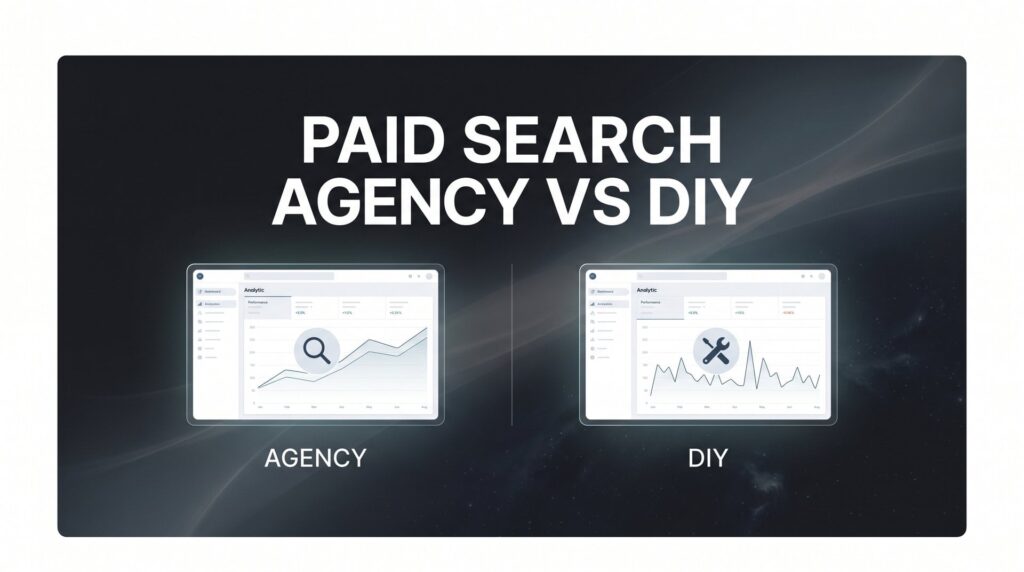
Every local business owner eventually faces the same crossroads: should you manage your own Google Ads campaigns, or hand the reins to a paid search agency? The answer isn’t one-size-fits-all. Your budget, available time, technical comfort level, and growth goals all factor into the decision.
Some business owners thrive running lean DIY campaigns. Others burn through thousands in ad spend before realizing they needed expert help from the start. The frustrating part is that both outcomes are avoidable with the right framework going in.
This guide breaks down seven concrete strategies to help you evaluate the paid search agency vs DIY question honestly. Whether you’re a plumber weighing your first Google Ads campaign or an established contractor wondering if your self-managed ads are leaving money on the table, these frameworks will give you real clarity. No vague advice, no one-size-fits-all answer, just an honest decision process built around your specific situation.
1. Audit Your True Cost of Time Before Touching a Single Ad
The Challenge It Solves
Most business owners underestimate what managing Google Ads actually costs them in time. They see an agency management fee and think “I can avoid that.” But that math only works if your time is free, and it isn’t. Understanding the real cost of DIY before you start is the single most important calculation you can make.
The Strategy Explained
Start by calculating your effective hourly rate as a business owner. Take your annual revenue and divide it by the hours you work. That number represents what each hour of your time is worth when spent on revenue-generating activities.
Now estimate the true time commitment of managing Google Ads competently. Learning the platform basics takes many hours upfront. Ongoing campaign management, bid adjustments, keyword research, ad copy testing, and performance analysis typically require several hours per week for even a modest local campaign. Multiply that by your hourly rate and compare it to what a professional agency charges monthly. For many business owners, the math surprises them. Understanding in-house vs agency PPC management trade-offs makes this calculation even clearer.
Implementation Steps
1. Calculate your effective hourly rate: annual revenue divided by annual hours worked.
2. Estimate realistic weekly time investment for Google Ads management, including learning time in the first 90 days.
3. Multiply weekly hours by your hourly rate, then multiply by four to get a monthly opportunity cost figure.
4. Compare that number directly against agency management fees in your market.
Pro Tips
Don’t just count the hours you’d spend in the platform. Factor in the mental load, the learning curve for platform updates, and the time spent troubleshooting problems. Time spent on Google Ads is time not spent closing sales, serving customers, or building your business. That’s the real trade-off.
2. Stress-Test Your Campaign Complexity Against Your Skill Set
The Challenge It Solves
Google Ads was simpler ten years ago. Today, the platform includes Performance Max campaigns, AI-driven bidding strategies, broad match changes that have shifted how keyword targeting works, and audience layering that requires strategic thinking beyond just picking keywords. Many business owners don’t realize how much the technical bar has risen until they’re already spending money on campaigns that aren’t performing.
The Strategy Explained
Honest self-assessment is the key here. Think about your specific situation: How competitive is your local market? Do you offer multiple services with different margins and intent signals? Are you targeting multiple geographic areas? The more complexity your campaign requires, the more technical skill it demands to manage profitably.
A single-service business in a low-competition market might run a successful DIY campaign with basic keyword targeting and a strong landing page. A multi-service contractor in a competitive metro area is dealing with a very different challenge. Auction competition, quality score management, and smart bidding calibration all become critical factors that can make or break your profitable paid advertising strategies.
Implementation Steps
1. List every service you plan to advertise and rank them by profit margin and search competition level.
2. Search your main keywords in Google and count how many paid ads appear above organic results in your area.
3. Honestly rate your comfort level with bid strategies, negative keyword management, Quality Score optimization, and conversion tracking setup on a scale of one to ten.
4. If your competition score is high and your technical comfort score is low, that gap is your risk profile for DIY management.
Pro Tips
Google’s own platform has introduced significant AI automation in recent years, but automation still requires informed oversight. Smart bidding strategies need clean conversion data to optimize correctly. If you don’t have that foundation in place, automated bidding can spend your budget inefficiently without any obvious warning signs.
3. Set a Budget Threshold That Justifies Professional Management
The Challenge It Solves
Agency management fees are a fixed cost layered on top of your ad spend. At low budget levels, that fee can represent a large percentage of your total investment, which changes the ROI math significantly. Understanding where the budget threshold sits for your market helps you make a financially sound decision rather than an emotional one.
The Strategy Explained
There’s no universal number that applies to every business, but the general principle is straightforward: as your monthly ad spend increases, agency management fees become a smaller percentage of your total investment, and the cost of wasted spend from poor management becomes larger. At higher spend levels, the expertise that prevents budget waste often pays for itself many times over. Reviewing different PPC agency pricing models helps you understand how fees scale with your budget.
Think about it this way. If you’re spending a small amount monthly and an agency charges a management fee on top of that, you need a meaningful performance improvement just to break even on the fee. But if you’re spending a substantial monthly budget, even a moderate improvement in conversion rate or cost per lead can generate returns that dwarf the management cost.
Implementation Steps
1. Get actual management fee quotes from two or three reputable agencies in your niche.
2. Calculate what percentage of your intended monthly ad spend those fees represent.
3. Estimate how much budget waste you could realistically prevent with expert management, based on your current campaign performance or industry benchmarks.
4. If the potential waste prevention exceeds the management fee, professional management is likely the better financial decision.
Pro Tips
Ask agencies how they structure their fees. Some charge a flat monthly retainer, others charge a percentage of ad spend, and some use hybrid models. A percentage-of-spend model aligns incentives differently than a flat fee. Understanding the fee structure helps you evaluate the real cost at different budget levels.
4. Evaluate Access to Tools, Data, and Platform Expertise
The Challenge It Solves
DIY advertisers have access to Google Ads and Google Analytics, which are powerful tools. But professional agencies, particularly those with Google Premier Partner status, operate with additional advantages that aren’t available to the general public. Understanding what you’re getting access to, and what you’re giving up, is part of an honest comparison.
The Strategy Explained
Google’s Partner program tiers agencies based on performance, spend thresholds, and certification requirements. Premier Partners, which represent a smaller subset of certified agencies, receive access to advanced support, beta features before they’re publicly released, and dedicated Google account representatives. This matters in practice because beta access to new features can provide a competitive edge, and direct support access means faster resolution of platform issues that would otherwise stall your campaigns.
Beyond platform access, established agencies have accumulated data across many client accounts in similar industries. That cross-account pattern recognition, knowing which bid strategies perform well for local service businesses in competitive markets, which ad formats drive qualified leads versus clicks, is something no individual DIY advertiser can replicate from a single account. If you’re exploring your options, learning how to choose a PPC agency can help you evaluate these advantages more effectively.
Implementation Steps
1. Identify what third-party tools you’d need as a DIY advertiser: keyword research platforms, call tracking software, landing page testing tools, and reporting dashboards.
2. Price out those tools monthly and add that to your total DIY cost calculation.
3. When evaluating agencies, ask specifically about their Google Partner tier, what beta features they currently have access to, and what tools are included in their management fee.
4. Ask for examples of how their cross-account data or platform access has directly benefited clients in your industry.
Pro Tips
Clicks Geek holds Google Premier Partner status, which is a verifiable credential you can confirm directly through Google’s Partner directory. When evaluating any agency, don’t just take their word for credentials. Ask for verification and check the Google Partners search tool yourself.
5. Build a Conversion Tracking System Before You Spend a Dollar
The Challenge It Solves
Conversion tracking is the foundation of accountable advertising, and it’s also one of the areas where many local businesses struggle most. Without proper tracking, you’re flying blind. You might be generating leads that look like costs in your dashboard because the system isn’t connecting ad clicks to actual phone calls, form submissions, or booked appointments.
The Strategy Explained
Before you decide between DIY and agency management, you need to answer one question honestly: can you set up and verify a complete conversion tracking system? This includes Google Ads conversion tracking, Google Analytics 4 integration, call tracking that ties phone leads back to specific campaigns and keywords, and ideally some form of lead quality tracking that connects ad spend to actual revenue.
This matters for both paths. If you go DIY without proper tracking, you’ll have no reliable way to know if your campaigns are working. If you hire an agency, you need to verify that they’re setting up tracking correctly, because agencies that report on clicks and impressions without tying results to actual leads and revenue are not giving you an accountable picture of performance. Understanding conversion rate optimization services can help you benchmark what proper tracking and optimization should cost.
Implementation Steps
1. Set up Google Ads conversion tracking for your primary lead actions: form fills, phone calls from your website, and appointment bookings if applicable.
2. Connect Google Analytics 4 to your Google Ads account and verify that goals are importing correctly.
3. Implement call tracking software that attributes phone calls to specific campaigns, ad groups, and keywords.
4. Create a simple reporting dashboard that shows cost per lead by campaign, not just clicks and impressions.
Pro Tips
If setting up conversion tracking feels overwhelming, that’s useful information in itself. Tracking setup is one of the more technical components of running Google Ads well. An agency that includes proper tracking infrastructure as part of their onboarding process is providing real value from day one, not just campaign management.
6. Run a 90-Day DIY Test With Clear Performance Benchmarks
The Challenge It Solves
Sometimes the best way to answer the paid search agency vs DIY question is to run a structured test. But most business owners who try DIY don’t set clear benchmarks upfront, which means they have no objective way to evaluate the results. They either quit too early or keep spending money on underperforming campaigns because they don’t have a defined stopping point.
The Strategy Explained
A 90-day test gives Google’s algorithms enough time to gather meaningful data, allows you to move through the learning phase of new campaigns, and provides enough performance history to make a real comparison. The key is defining your success metrics and your stop-loss threshold before you start, not after you’ve already spent the budget. Our guide on launching your first paid advertising campaign walks through this process step by step.
Your benchmarks should be specific to your business. What is an acceptable cost per lead in your market? What conversion rate from click to lead would indicate your campaigns are working? What’s the maximum monthly budget you’re willing to invest during the test period? Write these numbers down before you launch. They become your decision framework at the 90-day mark.
Implementation Steps
1. Define your target cost per lead based on your average customer value and acceptable acquisition cost.
2. Set a monthly budget cap for the test period and commit to not exceeding it regardless of early results.
3. Define a minimum acceptable conversion rate from click to lead for your campaigns.
4. At the 30-day mark, review data and make one round of optimizations. At 60 days, review again. At 90 days, compare your actual results against your benchmarks and make the call.
Pro Tips
Build in a clear decision rule upfront. For example: if your cost per lead is more than double your target at the 60-day mark and trending in the wrong direction, that’s your signal to stop the test and explore agency management rather than continuing to spend. Defining the exit criteria before you start removes the emotional component from the decision.
7. Know the Warning Signs That It’s Time to Switch Approaches
The Challenge It Solves
The paid search agency vs DIY decision isn’t always made once and then locked in forever. Business situations change, campaigns evolve, and what worked at one stage of growth may not work at another. Knowing the specific warning signs that indicate your current approach isn’t working helps you course-correct before you’ve wasted significant budget.
The Strategy Explained
There are warning signs on both sides of this equation. DIY campaigns often show specific patterns when they’re underperforming due to management gaps. Agency-managed campaigns can also show red flags that suggest the relationship isn’t delivering what it should. Being able to recognize both sets of signals protects your investment regardless of which path you’re on.
For DIY campaigns, watch for consistently rising cost per click without corresponding improvement in lead quality, campaigns stuck in Google’s learning phase for extended periods, ad spend concentrated in broad match terms that don’t match your actual services, and a growing list of irrelevant search terms in your search term reports. If your paid ads aren’t profitable, these are often the root causes that need immediate attention.
For agency-managed campaigns, watch for reporting that focuses heavily on impressions and clicks rather than leads and revenue, difficulty getting straight answers about what optimizations were made and why, month-over-month budget increases without corresponding lead volume increases, and a lack of proactive communication about campaign changes or market shifts.
Implementation Steps
1. Review your search term report monthly and flag the percentage of spend going to irrelevant queries. A high percentage indicates a keyword management problem.
2. Track your cost per lead trend over 90-day rolling periods. Flat or rising cost per lead over time without a clear explanation is a warning sign.
3. If agency-managed, request a monthly summary of specific optimizations made, not just a performance report. Agencies doing real work should be able to articulate what they changed and why.
4. Set a calendar reminder every six months to objectively re-evaluate whether your current approach is still the right fit for your business stage and goals.
Pro Tips
One of the clearest warning signs for DIY campaigns is when you notice competitors consistently appearing above you despite similar bid levels. This often indicates a low Quality Score problem that requires landing page optimization, ad relevance improvements, and structural campaign changes that go beyond basic bid management. That’s typically the point where professional expertise starts paying for itself quickly.
Making the Right Call for Your Business
Neither a paid search agency nor DIY Google Ads management is inherently the right answer. The right answer depends entirely on your specific situation: your time, your technical skill, your budget, your market competition, and your growth goals.
What these seven strategies give you is an honest framework for making that call without guessing. Start with your time cost. Stress-test your skill set against your campaign complexity. Set a budget threshold that makes the math work. Understand what tools and expertise you’re gaining or giving up. Build your tracking foundation before you spend a dollar. If you test DIY, do it with clear benchmarks and a defined exit point. And no matter which path you choose, know the warning signs that tell you it’s time to reassess.
The businesses that lose the most money on Google Ads are the ones that make this decision emotionally rather than strategically. They either hold onto DIY management too long out of pride, or they hire an agency without setting clear expectations and accountability measures. Both mistakes are expensive.
Tired of spending money on marketing that doesn’t produce real revenue? We build lead systems that turn traffic into qualified leads and measurable sales growth. If you want to see what this would look like for your business, we’ll walk you through how it works and break down what’s realistic in your market.