You check your ad dashboard and see thousands of impressions. Your website analytics show hundreds of visitors. Your social media posts are getting likes and shares. Everything looks like it’s working—except your bank account tells a different story. The sales aren’t coming. The phone isn’t ringing. And you’re left wondering where all that marketing effort is actually going.
This is one of the most frustrating positions a business owner can find themselves in. You’re doing what everyone says you should do—running ads, posting content, driving traffic—but the revenue isn’t following. You’re not alone in this. Many businesses pour money into digital marketing that generates activity without generating income.
The good news? When online marketing isn’t generating sales, it’s almost always a fixable problem. The issue isn’t usually that digital marketing doesn’t work—it’s that somewhere between the ad click and the purchase decision, something is breaking down. This article will help you identify exactly where your marketing funnel is leaking and what you can do to plug those holes. Let’s diagnose what’s really happening with your marketing investment.
The Illusion of Success: When Numbers Lie
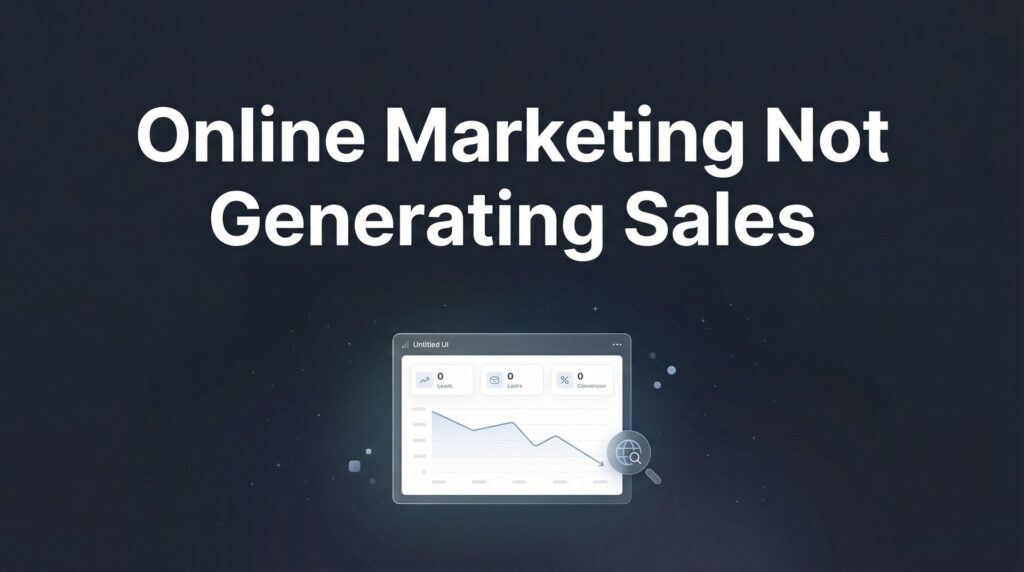
Traffic numbers can be intoxicating. When you see 5,000 website visitors last month, it feels like progress. When your Facebook ad reaches 20,000 people, it looks impressive. But here’s the uncomfortable truth: none of those numbers matter if they’re not connected to revenue.
This is what marketers call the traffic versus revenue disconnect. It’s the gap between activity and results, between visibility and profitability. Many businesses fall into the trap of celebrating vanity metrics—numbers that look good in reports but don’t correlate with actual business growth. Understanding why digital marketing isn’t generating revenue starts with recognizing this fundamental problem.
Think of it like this: if you owned a retail store, would you celebrate having 1,000 people walk past your storefront each day if none of them came inside? Would you be satisfied if 100 people entered your store but nobody bought anything? Of course not. Yet that’s exactly what’s happening when you focus on impressions and clicks without tracking what happens next.
The concept of a “leaky funnel” explains this perfectly. Imagine your marketing as a funnel where potential customers enter at the top and (hopefully) become paying customers at the bottom. At each stage of this journey—from seeing your ad, to clicking through, to browsing your site, to considering a purchase—some people drop off. That’s normal. But when too many people are leaking out at each stage, you end up with lots of activity at the top and nothing coming out the bottom.
The metrics that actually matter are the ones tied to revenue: conversion rate, cost per acquisition, customer lifetime value, and return on ad spend. Learning how to track marketing ROI properly will tell you whether your marketing is working or just creating the illusion of progress. If you’re tracking website visits but not tracking how many of those visitors request a quote, fill out a contact form, or make a purchase, you’re flying blind.
Here’s what separates businesses that generate revenue from their marketing and those that just generate reports: they know exactly which actions lead to sales, and they optimize every part of their funnel to drive those actions. They’re not impressed by traffic numbers unless that traffic is doing something valuable.
The Wrong People Are Clicking Your Ads
Getting traffic is easy. Getting the right traffic is where most businesses struggle. You might be attracting hundreds of visitors who were never going to become customers—people who are curious but not ready to buy, people looking for free information, or people who clicked by accident.
This happens when your targeting is too broad or when you’re bidding on the wrong keywords. There’s a fundamental difference between someone searching for “how to fix a leaky faucet” and someone searching for “emergency plumber near me.” The first person is in research mode, looking for DIY solutions. The second person has a problem right now and is ready to hire someone. Both searches might lead to a plumber’s website, but only one represents a potential customer.
This distinction between informational intent and buyer intent is critical. Informational keywords bring traffic. Buyer intent keywords bring customers. If your campaigns are optimized for the former, you’ll see plenty of clicks and very few sales. You’re essentially paying to educate people who are going to solve their problem themselves or buy from someone else later.
The signs that you’re attracting the wrong audience are usually obvious once you know what to look for. High bounce rates—when visitors leave your site immediately after arriving—suggest that what they found didn’t match what they expected. Low time on site means people aren’t engaging with your content or exploring your offerings. Zero interaction with your product or service pages indicates that visitors aren’t even considering a purchase.
Geographic targeting issues are another common culprit. If you’re a local business serving a specific area but your ads are showing to people across the entire state or country, you’re wasting money on clicks from people who could never become customers. This is one of the most common reasons why businesses aren’t getting customers online despite significant ad spend.
The solution starts with getting brutally honest about who your actual customers are and what they’re searching for when they’re ready to buy. Look at your existing customer base. What problems were they trying to solve? What language did they use when they first contacted you? What convinced them to choose you over competitors? Use these insights to refine your targeting so you’re reaching people who match your ideal customer profile, not just anyone who might click.
Sometimes the issue isn’t who you’re targeting but what you’re promising in your ads. If your ad copy focuses on features that appeal to tire-kickers rather than benefits that resonate with serious buyers, you’ll attract the wrong crowd. Your messaging needs to filter out casual browsers and speak directly to people who are ready to take action.
Your Website Is the Real Problem
Let’s say you’ve fixed your targeting and you’re now attracting the right visitors. They click your ad, land on your website, and then… nothing happens. They leave. They don’t fill out your form. They don’t call. They don’t buy. This is where many marketing campaigns fall apart—not in the ad itself, but in what happens after the click.
Your website might be killing your conversions without you realizing it. Slow load times are one of the biggest culprits. When someone clicks an ad and waits more than a few seconds for your page to load, many of them simply leave. They’re not going to sit there watching a loading spinner—they’re going to hit the back button and click on your competitor’s ad instead. Every second of delay costs you potential customers.
Confusing navigation is another conversion killer. If visitors can’t immediately figure out where to go or what to do next, they’re gone. Your site might make perfect sense to you because you built it and know every page, but first-time visitors need clarity. They need obvious next steps. They need to understand within seconds whether they’re in the right place and what action they should take.
Weak or missing calls-to-action leave visitors stranded. Think about it: someone just clicked your ad because they’re interested in what you offer. They land on your page, read your content, and then… what? If you don’t tell them exactly what to do next—”Call Now,” “Get Your Free Quote,” “Schedule Your Consultation”—many of them will simply close the tab and move on. They’re not going to hunt around your site looking for a way to contact you.
Here’s a critical concept that many businesses miss: landing page relevance. If your ad promises one thing and your landing page delivers something different, you’ve broken trust immediately. Someone clicks an ad for “Same-Day AC Repair” and lands on your homepage with general information about your company? That’s a mismatch. They wanted immediate help, and you gave them a company overview. They’re leaving. This disconnect is a primary reason ads aren’t converting to sales for many businesses.
Your landing page needs to be a direct continuation of your ad. If the ad talks about emergency services, the landing page should focus on emergency services. If the ad mentions a specific offer or price point, that offer needs to be front and center on the page. This alignment between ad and page isn’t just good practice—it’s what converts clicks into customers.
Mobile experience failures are particularly devastating because more than half of your traffic likely comes from mobile devices. If your site isn’t optimized for mobile—if buttons are too small to tap, if forms are difficult to fill out, if the layout breaks on smaller screens—you’re losing customers who are literally holding their credit card, ready to buy. They’re on their phone because they want to take action right now, and your website is making it impossible.
The fix here isn’t necessarily a complete website redesign. Often, it’s about identifying the specific friction points that are causing visitors to leave. Run speed tests. Check your mobile experience. Make sure your calls-to-action are clear and prominent. Ensure that the path from landing on your site to taking the desired action is as smooth and obvious as possible.
Nobody Trusts You Yet
Even when everything else is working—you’re attracting the right visitors, your website loads quickly, your calls-to-action are clear—there’s still one major barrier that stops sales: trust. Most people who visit your website for the first time aren’t ready to buy from you. They don’t know you. They don’t know if you’re legitimate. They don’t know if you’ll deliver what you promise.
This trust gap is completely normal, but many businesses fail to address it. They assume that if someone needs their service and finds their website, the sale should happen automatically. But that’s not how buying decisions work, especially for higher-value services or unfamiliar companies.
Trust signals are what bridge this gap. These are the elements on your website that reassure visitors they’re making a safe decision. Customer reviews and testimonials are powerful because they provide social proof—evidence that other people have worked with you and had positive experiences. When someone sees that dozens of other customers gave you five-star reviews, it reduces their perceived risk.
But here’s what many businesses get wrong: they either don’t display reviews prominently, or they only have a few generic testimonials that sound fake. “Great service!” from “John D.” doesn’t build trust. What builds trust is specific testimonials that mention real problems and real results: “We were losing customers because our website was so slow. Clicks Geek rebuilt it, and our conversion rate doubled in the first month.”
Security signals matter too, especially for e-commerce or any transaction that involves entering payment information. SSL certificates, trust badges, secure payment icons—these visual cues tell visitors that their information is safe. Without them, people hesitate. With them, the transaction feels more secure.
Clear contact information is another trust signal that’s often overlooked. If your website doesn’t have a physical address, a phone number, and real names of people who work at your company, visitors wonder if you’re even a legitimate business. They want to know there’s a real company behind the website, not just a landing page set up to collect their money.
Inconsistent branding across touchpoints erodes trust in subtle but significant ways. If your ad shows one logo and color scheme, your website has a different look, and your social media profiles use yet another design, it creates subconscious doubt. Professional businesses have consistent branding because consistency signals stability and attention to detail. A strong multi channel marketing strategy ensures your brand appears cohesive everywhere customers encounter it.
The trust gap is especially wide for local service businesses. When someone needs a plumber, electrician, or contractor, they’re letting a stranger into their home. That requires a higher level of trust than buying a product online. Your marketing needs to address this by showcasing your team, highlighting your credentials and certifications, and demonstrating your local presence and community involvement.
Building trust isn’t about manipulating people into buying from you. It’s about making it easy for people who should work with you to feel confident in that decision. When you remove doubt and provide reassurance at every stage of the customer journey, conversions naturally increase.
You’re Giving Up After One Interaction
Here’s a reality that surprises many business owners: most people who visit your website aren’t going to buy on their first visit. They’re going to leave. They’ll get distracted, need to think about it, want to compare options, or simply not be ready to commit yet. And if you don’t have a system to bring them back, you’ve lost them forever.
This is where most marketing strategies completely fall apart. Businesses spend money to drive traffic, watch visitors leave without converting, and then do nothing to re-engage those people. It’s like spending money to get someone interested in your business and then immediately forgetting they exist.
The reality is that most purchases require multiple touchpoints. Someone might see your ad, visit your website, leave, see your ad again a week later, read a blog post, leave again, receive an email, and then finally decide to contact you. This isn’t unusual—it’s normal buyer behavior. People need time to make decisions, especially for higher-value purchases or services they’re not familiar with.
Retargeting is how you stay in front of these warm prospects. When someone visits your website but doesn’t convert, retargeting allows you to show them ads as they browse other websites or social media. These aren’t cold prospects anymore—they’ve already shown interest. Retargeting ads typically have much higher conversion rates and lower costs than initial prospecting ads because you’re reaching people who already know who you are.
Email nurturing is the other critical piece of follow-up. If someone fills out a form on your website, downloads a resource, or signs up for your newsletter, you now have permission to stay in touch. But many businesses either don’t send follow-up emails at all, or they send one generic email and stop. Effective email marketing for lead generation means sending a series of valuable messages over time that build trust, demonstrate expertise, and eventually lead to a purchase decision.
Building a simple follow-up system doesn’t require complex automation or expensive software. Start with the basics: set up retargeting pixels on your website so you can show ads to people who visited but didn’t convert. Create a welcome email sequence for new leads that provides value and gradually introduces your services. Exploring the best marketing automation tools can help you implement these systems efficiently without overwhelming your team.
The businesses that succeed with online marketing understand that the first click is just the beginning of the relationship, not the end. They invest in follow-up systems that turn one-time visitors into engaged prospects and eventually into paying customers. Without these systems, you’re constantly starting from zero, spending money to attract new people while ignoring the warm leads you’ve already generated.
From Diagnosis to Action: Fixing What’s Broken
Now that you understand where online marketing typically breaks down, the question becomes: what do you do about it? The answer starts with a systematic audit of your current marketing funnel to identify your specific conversion blockers.
Begin by mapping your customer journey from start to finish. Where do people first encounter your business? What happens when they click your ad or find your website? What path do they take through your site? Where do they drop off? Use your analytics tools to track this journey and identify the biggest drop-off points. A comprehensive digital marketing audit can reveal exactly where your funnel is leaking and what to fix first.
Look at your ad targeting and keyword strategy. Pull a report of which keywords are driving the most clicks and which are driving actual conversions. You’ll often find that a small percentage of your keywords generate most of your results, while the majority are wasting money on unqualified traffic. Cut the underperformers and reinvest that budget into what’s working.
Audit your landing pages with fresh eyes. Better yet, ask someone who’s never seen your website to visit and try to complete your desired action. Watch where they get confused or stuck. Test your site on mobile devices. Check your load speed. Make sure your calls-to-action are impossible to miss. Small improvements here can have massive impact on conversion rates.
Review your trust signals. Do you have customer reviews displayed prominently? Are your testimonials specific and credible? Is your contact information easy to find? Do you have security badges if you’re processing payments? Add these elements if they’re missing.
Evaluate your follow-up systems. Are you retargeting website visitors who didn’t convert? Do you have an email sequence for new leads? Is someone following up with people who request quotes? If the answer to any of these is no, you’re leaving money on the table.
Prioritize your fixes based on impact and effort. Some changes—like improving ad targeting or adding retargeting—can be implemented quickly and produce immediate results. Others—like redesigning your website—require more time and resources. Understanding marketing campaign optimization principles helps you start with the quick wins that will have the biggest impact on your conversion rate.
There’s an important distinction to make here: when to optimize existing campaigns versus when to rebuild your strategy from scratch. If your fundamental approach is sound but your conversion rate is low, optimization is the answer. If you’re targeting the wrong audience, using the wrong channels, or your entire funnel is broken, you might need to start over with a fresh strategy.
The key is to be honest about what’s working and what isn’t. Many businesses keep pouring money into campaigns that have never generated positive ROI, hoping that eventually something will change. That’s not strategy—that’s wishful thinking. If your current approach isn’t producing results after a reasonable testing period, it’s time to try something different.
Putting It All Together
When your online marketing isn’t generating sales, it’s frustrating—but it’s also fixable. The problem is almost never that digital marketing doesn’t work for your business. The problem is that somewhere in your funnel, something is breaking down and preventing conversions.
We’ve covered the most common culprits: attracting the wrong audience with poor targeting, losing conversions due to website issues, failing to build trust with first-time visitors, and giving up on prospects after one interaction. Each of these issues is addressable with the right approach and attention to detail.
The businesses that succeed with online marketing treat it as a system, not a series of disconnected tactics. They understand that getting clicks is just the first step. They optimize every stage of the customer journey from initial awareness through to final purchase. They track the metrics that actually matter—conversions, revenue, return on ad spend—not just vanity metrics like impressions and traffic. This is the foundation of conversion focused marketing that actually drives revenue.
Most importantly, they recognize that marketing is an ongoing process of testing, measuring, and improving. What works today might not work next month. What works for one audience segment might not work for another. Success comes from continuous optimization based on real data and real results.
If you’ve been investing in online marketing without seeing the sales results you expected, start with an honest audit of where your funnel is breaking down. Look at your targeting, your website experience, your trust signals, and your follow-up systems. Identify the biggest gaps and prioritize fixing them. In many cases, small improvements in conversion rate can transform an unprofitable campaign into a profitable one without spending any additional money on ads.
Tired of spending money on marketing that doesn’t produce real revenue? We build lead systems that turn traffic into qualified leads and measurable sales growth. If you want to see what this would look like for your business, we’ll walk you through how it works and break down what’s realistic in your market.
Want More Leads for Your Business?
Most agencies chase clicks, impressions, and “traffic.” Clicks Geek builds lead systems. We uncover where prospects are dropping off, where your budget is being wasted, and which channels will actually produce ROI for your business, then we build and manage the strategy for you.