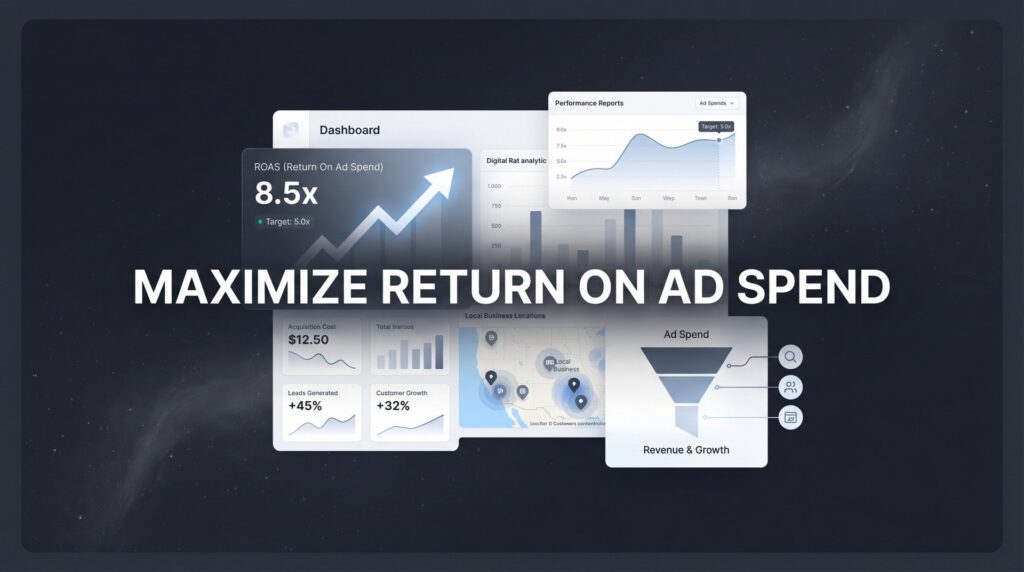
Every dollar you spend on advertising should work harder than the last. Yet many local business owners watch their ad budgets evaporate with little to show for it—clicks that don’t convert, leads that ghost, and campaigns that drain resources without delivering real revenue. The difference between profitable advertising and expensive guesswork comes down to one metric: Return on Ad Spend (ROAS). When you maximize return on ad spend, you’re not just improving a number on a dashboard—you’re building a predictable customer acquisition engine that fuels sustainable growth.
ROAS is calculated simply: revenue generated divided by ad spend. A ROAS of 4:1 means you’re generating $4 in revenue for every $1 you spend on advertising. For service businesses with high customer lifetime values, you might need a higher ROAS threshold than e-commerce businesses with lower margins. The goal isn’t just to hit an arbitrary number—it’s to create a sustainable system where advertising becomes your most reliable revenue driver instead of your biggest expense.
In this guide, we’ll break down seven battle-tested strategies that transform underperforming campaigns into profit-generating machines. These aren’t theoretical concepts; they’re the exact approaches that separate businesses bleeding money on ads from those turning every advertising dollar into multiple dollars of revenue.
1. Ruthlessly Eliminate Wasted Spend with Negative Keywords
The Challenge It Solves
You’re paying for clicks from people who will never become customers. Someone searching for “free plumbing advice” triggers your ad for “plumbing services,” burning budget on a searcher with zero purchase intent. Someone looking for “plumbing jobs” clicks your ad expecting employment opportunities, not service offerings. These irrelevant clicks accumulate silently, draining thousands of dollars annually while delivering exactly zero qualified leads.
The problem compounds because most business owners don’t realize how much of their budget disappears this way. You see clicks happening and assume they’re potential customers. Meanwhile, your cost per actual lead skyrockets because you’re subsidizing an audience that was never going to convert.
The Strategy Explained
Negative keywords are search terms you explicitly tell advertising platforms to ignore. When you add “free” as a negative keyword, your ads won’t show for searches containing that word. When you add “jobs” or “careers,” you eliminate employment seekers from your audience. This isn’t about being less visible—it’s about being visible only to people who might actually buy.
Think of negative keywords as filters that screen out window shoppers, tire kickers, and completely irrelevant searchers before they can waste your money. Every click you prevent from someone who was never going to convert is money you can redirect toward someone who will. The cumulative effect transforms campaign economics and directly impacts your ad spend optimization efforts.
The most effective negative keyword strategies are proactive, not reactive. Yes, you should review search term reports and add negatives based on what you discover. But you should also anticipate common irrelevant searches before they drain budget. If you’re a premium service provider, add “cheap,” “affordable,” and “discount” from day one. If you’re B2B, add consumer-focused terms immediately.
Implementation Steps
1. Review your search terms report for the past 30 days and identify every query that generated clicks but zero conversions—look for patterns in what people are actually searching for versus what you want them to search for.
2. Create a comprehensive negative keyword list organized by category: price-focused terms (cheap, free, discount), informational queries (how to, DIY, tutorial), employment searches (jobs, careers, hiring), competitor names you don’t want to bid on, and any industry-specific irrelevant terms.
3. Add these negative keywords at the campaign level for broad protection, but also create shared negative keyword lists that can be applied across multiple campaigns simultaneously—this ensures consistency and saves time when scaling.
4. Schedule weekly search term reviews for the first month, then shift to bi-weekly once you’ve captured the most obvious waste—set calendar reminders because this task is easy to postpone but critical for sustained performance.
Pro Tips
Use broad match negative keywords sparingly and phrase match more liberally. A broad match negative for “free” will block “free consultation” which might actually be a valuable lead for service businesses offering free estimates. Instead, use phrase match negatives like “free plumbing” to block specific irrelevant combinations while preserving flexibility. Monitor your negative keyword list quarterly to ensure you haven’t accidentally blocked valuable traffic as your business offerings evolve.
2. Align Landing Pages with Search Intent for Higher Conversions
The Challenge It Solves
Your ads are getting clicks, but visitors bounce immediately because what they see doesn’t match what they expected. Someone searches for “emergency AC repair,” clicks your ad, and lands on your homepage featuring all your HVAC services with no clear path to emergency service. The disconnect creates friction. They leave. You paid for the click. Nothing happened.
This misalignment kills conversion rates and destroys ROAS. You might be spending money driving traffic to pages that were never designed to convert that specific searcher. The problem isn’t your offer or even your traffic quality—it’s the gap between promise and delivery.
The Strategy Explained
Search intent alignment means your landing page delivers exactly what your ad promised. If your ad promotes emergency plumbing services, the landing page should scream “emergency plumbing” above the fold with a clear call-to-action to call now. If your ad targets kitchen remodeling, the landing page should focus exclusively on kitchen remodels, not general contracting services.
This isn’t about creating dozens of unique pages for every possible search. It’s about matching the specificity of the search to the specificity of the landing experience. Generic landing pages work for generic searches. Specific landing pages convert specific searches. The tighter the match, the higher the conversion rate, and the lower your cost per acquisition. Professional landing page optimization services can help you systematically improve these conversion points.
Google rewards this alignment through Quality Score, which directly impacts your cost per click. When your landing page relevance is high, Google charges you less for the same ad position. This creates a compounding effect: better alignment leads to higher conversion rates and lower costs simultaneously, dramatically improving ROAS.
Implementation Steps
1. Identify your top five highest-spend keywords and audit whether their landing pages directly address that specific search intent—if someone searching for “water heater installation” lands on a general plumbing page, you’ve found your first opportunity.
2. Create dedicated landing pages for your highest-value service categories, ensuring the headline matches the ad copy nearly word-for-word and the primary call-to-action appears above the fold without requiring any scrolling.
3. Remove navigation menus from landing pages to eliminate exit paths—every link away from your conversion goal is a leak in your funnel, and visitors who came from paid ads don’t need to browse your entire site.
4. Test page load speed using Google PageSpeed Insights and compress images, minimize code, and enable caching to achieve sub-three-second load times—every additional second of load time measurably reduces conversion rates.
Pro Tips
Use dynamic keyword insertion in your headlines to automatically mirror the exact search term that triggered your ad. If someone searches “furnace repair Chicago,” they should see “Furnace Repair Chicago” in your headline, not “HVAC Services.” This creates instant relevance. Also, include trust signals specific to the service: emergency availability for urgent searches, financing options for high-ticket services, and customer reviews from people who bought that exact service.
3. Implement Smart Bidding Strategies Based on Actual Value
The Challenge It Solves
You’re manually adjusting bids based on gut feeling or arbitrary rules, leaving money on the table during high-value opportunities while overpaying during low-conversion windows. Manual bidding can’t process the hundreds of signals that influence conversion probability in real-time—device type, location, time of day, audience characteristics, and dozens of other factors that shift constantly.
The result is inconsistent performance. You might win auctions when conversion likelihood is low and lose auctions when it’s high. You’re flying blind, making decisions with a fraction of the data that could inform optimal bid amounts. This inefficiency directly erodes ROAS.
The Strategy Explained
Smart bidding uses machine learning to automatically adjust your bids based on the likelihood of conversion for each individual auction. Instead of setting one bid for all situations, the system analyzes signals like user device, location, time, and browsing history to bid more aggressively when conversion probability is high and pull back when it’s low.
Target ROAS bidding takes this further by optimizing specifically toward your revenue goal. You tell the system you want a 4:1 return, and it adjusts bids to achieve that target. It will bid higher for searches from high-value customer segments and lower for searches that historically convert at lower values. This shifts your focus from managing individual keywords to managing overall performance targets.
The key is understanding that smart bidding requires data to work effectively. The algorithms need conversion history to identify patterns. For most campaigns, this means having at least 15-30 conversions per month before implementing Target ROAS. Below that threshold, manual bidding with strategic adjustments often performs better because the machine doesn’t have enough signal to optimize effectively. Our Google Ads optimization guide covers these bidding strategies in greater detail.
Implementation Steps
1. Ensure your conversion tracking is comprehensive and accurate—verify that you’re tracking not just form submissions but also phone calls, chat interactions, and any other conversion actions that represent real business value.
2. Assign actual revenue values to different conversion types based on your average customer value—a phone call from a high-intent searcher might be worth more than a newsletter signup, and your bidding strategy should reflect that difference.
3. Start with Maximize Conversions bidding if you’re below the 30-conversion-per-month threshold, then transition to Target ROAS once you have sufficient conversion data—set your initial Target ROAS at your current performance level rather than your aspirational goal to allow the algorithm to learn without restricting volume too severely.
4. Monitor performance weekly for the first month after implementing smart bidding, watching for any dramatic shifts in cost per conversion or conversion volume—the learning period typically lasts 1-2 weeks, during which performance may fluctuate before stabilizing.
Pro Tips
Don’t judge smart bidding performance during the learning period. The algorithm needs time to gather data and optimize. Give it at least two weeks before making major changes. If you need to adjust your Target ROAS, make incremental changes rather than dramatic shifts—moving from a 3:1 target to a 5:1 target overnight will likely crash your volume. Instead, increase by 0.5:1 increments and allow the system to adapt gradually.
4. Segment Audiences to Serve the Right Message at the Right Time
The Challenge It Solves
You’re showing the same ad to someone who visited your site ten minutes ago and someone who’s never heard of you. The first person needs a gentle nudge; the second needs education and trust-building. Treating all traffic identically wastes the advantage you have with warm audiences while failing to properly nurture cold prospects who need more convincing.
This one-size-fits-all approach means you’re either over-investing in cold traffic that isn’t ready to convert or under-investing in warm traffic that’s primed to buy. Either way, your ROAS suffers because you’re not matching message intensity to audience readiness.
The Strategy Explained
Audience segmentation divides your potential customers into groups based on their relationship with your business and their position in the buying journey. Someone who visited your pricing page is further along than someone who read a blog post. Someone who abandoned a contact form is warmer than someone who bounced after five seconds. Each segment deserves a different message and a different bid strategy.
Remarketing to website visitors typically shows much stronger intent than cold audiences. These people already know who you are, what you offer, and have demonstrated interest by visiting your site. They convert at higher rates and often justify higher bids. Meanwhile, cold prospecting requires more touchpoints and typically converts at lower rates, warranting lower initial bids with the understanding that you’re building awareness for future conversion. Leveraging display advertising services can help you reach these segmented audiences effectively across the web.
The power comes from layering these segments strategically. You might bid aggressively on people who visited your services page in the past seven days while bidding conservatively on people who only visited your blog months ago. You could create a special offer exclusively for cart abandoners while running educational content for cold audiences. This precision transforms campaign efficiency.
Implementation Steps
1. Create audience lists based on website behavior: all visitors (past 30 days), specific page visitors (pricing, services, contact), time on site (engaged visitors who spent 2+ minutes), and converters (people who already submitted forms or called)—these become your foundational segments.
2. Build remarketing campaigns specifically for your highest-intent audiences with messaging that acknowledges their previous interaction—use phrases like “Still considering?” or “Ready to get started?” that speak directly to where they are in the decision process.
3. Exclude existing customers and recent converters from prospecting campaigns to prevent wasting budget on people who already bought—create a “customers” audience list and apply it as an exclusion across all acquisition-focused campaigns.
4. Set up Customer Match lists if you have email addresses from existing customers or leads, allowing you to either exclude them from prospecting or target them with retention and upsell campaigns—this prevents the awkward experience of existing customers seeing ads for first-time customer offers.
Pro Tips
Layer geographic and demographic data onto your behavioral audiences for even tighter targeting. If you know that website visitors from certain zip codes convert at three times the rate of others, create a segment combining “visited services page” plus “located in high-converting zip codes” and bid more aggressively on that combination. Also, create exclusion audiences for people who visited your careers page—they’re job seekers, not customers, and should be filtered out immediately.
5. Optimize Ad Scheduling Around Peak Conversion Windows
The Challenge It Solves
Your ads run 24/7 at the same bid levels, even though conversions happen primarily during specific hours and days. You’re paying the same amount for a click at 2 AM when your phones are off as you are for a click at 10 AM when your sales team is ready to respond. This inefficiency means you’re overspending during low-conversion windows and potentially under-investing during high-conversion periods.
For service businesses especially, timing matters enormously. A plumbing emergency at 3 AM might convert, but a roofing inquiry at midnight probably won’t because the searcher is just researching. Understanding when your specific audience is ready to buy versus just browsing determines whether ad scheduling improves or destroys your ROAS.
The Strategy Explained
Ad scheduling (also called dayparting) lets you adjust bids or pause ads entirely during specific hours and days based on when conversions actually happen. If your data shows that Tuesday through Thursday from 9 AM to 5 PM generates 70% of your conversions, you can increase bids during those windows and decrease them during off-peak times.
This isn’t about completely turning off ads during slow periods unless you have clear evidence that those hours never convert. It’s about proportional investment. Maybe you bid at 100% during peak hours, 70% during moderate hours, and 40% during historically slow periods. This way you maintain presence while concentrating budget where it works hardest.
The key is basing these decisions on actual conversion data, not assumptions. You might assume weekends are slow, but your data could show Saturday morning converts exceptionally well for your business. You might think evenings are dead, but remote workers might be searching after traditional business hours. Let the data reveal your actual peak windows. Working with experienced paid search management services can help you identify and capitalize on these patterns.
Implementation Steps
1. Run your campaigns without ad scheduling for at least 30 days to gather baseline conversion data across all hours and days—you need this foundation to make informed scheduling decisions rather than guessing based on assumptions.
2. Export a conversion report segmented by hour of day and day of week, then calculate your conversion rate and cost per conversion for each time block—identify clear patterns where certain windows consistently outperform or underperform.
3. Implement bid adjustments starting conservatively: increase bids by 20-30% during your top-performing windows and decrease by 20-30% during your worst-performing periods—avoid dramatic changes that might eliminate volume entirely from certain dayparts.
4. Monitor the impact for two weeks and adjust incrementally based on results—if your peak windows are maintaining strong performance, you can increase those bid adjustments further, and if slow periods improve with lower bids, you might keep them active rather than pausing completely.
Pro Tips
Consider your business operations when setting ad schedules. If you can’t answer phones after 6 PM, either pause ads during those hours or direct traffic to form submissions instead of calls. There’s no point generating phone call conversions when nobody’s available to answer. Also, account for time zones if you serve multiple regions—a 10 AM peak in Eastern time is 7 AM Pacific, which might be too early for West Coast conversions.
6. Tighten Geographic Targeting to Focus on Profitable Service Areas
The Challenge It Solves
You’re advertising across your entire metro area, but only certain zip codes actually generate profitable customers. Some neighborhoods convert at high rates with reasonable acquisition costs. Others generate leads that ghost, haggle excessively, or require so much service time that the customer lifetime value doesn’t justify the acquisition cost. You’re spreading budget across profitable and unprofitable geography equally.
For local service businesses, this geographic inefficiency often represents the single biggest ROAS leak. A lead from one zip code might be worth three times what a lead from another zip code is worth, yet you’re paying similar amounts to acquire both. Tightening geographic focus redirects budget from areas that drain resources to areas that drive profit.
The Strategy Explained
Geographic targeting refinement means analyzing which specific locations generate your most valuable customers and concentrating ad spend accordingly. This goes beyond basic radius targeting. It requires looking at conversion rates, customer lifetime value, and profitability by zip code or neighborhood to identify your highest-value service areas.
You might discover that certain suburbs convert at twice the rate of others. You might find that downtown leads cost three times as much to acquire but have half the lifetime value. You might realize that areas requiring longer drive times eat into profitability even when leads convert. All of this data should inform where you advertise and how aggressively you bid.
The strategy isn’t necessarily to eliminate unprofitable areas entirely—sometimes maintaining brand presence across your full service area matters for other reasons. But you should absolutely adjust bids to reflect the actual value of leads from different locations. Bid aggressively in your sweet spot zip codes. Bid conservatively or pause entirely in areas that consistently underperform. Understanding these dynamics helps address situations where you’re experiencing high ad spend with low conversions.
Implementation Steps
1. Export your conversion data for the past 90 days and append zip code or city information to each conversion—if you’re tracking phone calls, your call tracking system should capture caller location, and form submissions should include address or service area fields.
2. Calculate conversion rate and customer acquisition cost by zip code, then layer in average customer value data if available to identify which areas generate the most profitable customers—look for patterns where certain locations consistently outperform across multiple metrics.
3. Implement location bid adjustments in your campaigns, increasing bids by 30-50% in your top-performing zip codes and decreasing by 30-50% in underperforming areas—use exclusions only for locations that have generated significant spend with zero conversions over 90+ days.
4. Create separate campaigns for your highest-value service areas with dedicated budgets and messaging tailored to those communities—this allows you to invest more heavily in your most profitable geography without being constrained by overall campaign budgets.
Pro Tips
Don’t just look at where leads come from—analyze where profitable customers come from. A zip code might generate lots of leads but terrible customers who dispute invoices, cancel appointments, or require excessive service time. Those aren’t valuable leads even if they convert initially. Focus your geographic targeting on areas that produce customers you actually want to serve. Also, update your analysis quarterly as neighborhoods change and your service capacity evolves.
7. Track the Full Customer Journey, Not Just the First Click
The Challenge It Solves
You’re crediting conversions to the last click before purchase, which means you’re probably killing campaigns that actually drive revenue. Someone might discover you through a blog post ad, research your services, leave, return via a branded search, and convert. Last-click attribution gives all the credit to that final branded search and none to the initial discovery campaign. You conclude the blog post ads don’t work and cut their budget, eliminating a crucial top-of-funnel driver.
This attribution blindness leads to systematic underinvestment in awareness campaigns and overinvestment in bottom-funnel tactics. You optimize for what’s easily measured rather than what actually drives business growth. Your ROAS calculations become fiction because you’re not tracking the full path to purchase.
The Strategy Explained
Full customer journey tracking means understanding every touchpoint a customer interacted with before converting, not just the final one. This requires implementing conversion tracking that captures multiple interactions and using attribution models that distribute credit appropriately across the journey. A customer might see a display ad, click a search ad, visit your site directly, and then convert via a remarketing ad. Each touchpoint contributed to that conversion.
For local service businesses, this is especially critical because many high-value conversions happen offline through phone calls. If you’re only tracking online form submissions, you’re missing a huge portion of your actual conversion activity. Someone might click your ad, call from their mobile device, and become a $5,000 customer—but if you’re not tracking marketing conversions properly, you have no idea that campaign is working.
Attribution modeling helps you understand which campaigns drive initial awareness versus which ones close the sale. Data-driven attribution in Google Ads analyzes actual conversion paths and assigns credit based on what actually influences conversion probability. This reveals which campaigns deserve more investment even if they don’t get last-click credit.
Implementation Steps
1. Implement call tracking that dynamically assigns unique phone numbers to different campaigns and keywords, allowing you to track which ads drive phone conversions—integrate this data with your Google Ads conversion tracking so phone calls appear alongside form submissions in your reporting.
2. Set up conversion values that reflect actual business worth, assigning higher values to phone calls from high-intent keywords and lower values to email newsletter signups—this ensures your bidding algorithms optimize toward revenue, not just activity.
3. Switch from last-click attribution to data-driven attribution in Google Ads to see which campaigns contribute to conversions even when they don’t get final credit—review the “Top Paths” report to understand common conversion journeys and identify campaigns that consistently appear early in successful paths.
4. Create a simple spreadsheet tracking ad spend against actual closed revenue (not just leads) by campaign, updating it monthly to identify which campaigns drive profitable customers versus which ones generate leads that don’t close—this offline analysis often reveals patterns that platform reporting misses.
Pro Tips
Don’t obsess over perfect attribution—it’s impossible to track every influence on a purchase decision. The goal is directional accuracy, not precision. If you can see that certain campaigns consistently appear in conversion paths even when they don’t get last-click credit, that’s signal enough to maintain investment. Also, track offline conversions by asking every new customer how they found you and logging that data systematically. This qualitative feedback often reveals attribution gaps your tracking systems miss.
Putting It All Together
Maximizing return on ad spend isn’t about finding one magic trick—it’s about systematically eliminating waste while amplifying what works. Each strategy we’ve covered addresses a specific leak in your advertising funnel. Negative keywords stop irrelevant traffic from draining budget. Landing page alignment converts the traffic you do get. Smart bidding optimizes what you pay. Audience segmentation ensures you’re showing the right message to the right person. Ad scheduling concentrates spend during high-conversion windows. Geographic targeting focuses on profitable service areas. And comprehensive tracking ensures you actually know what’s working.
Start with the strategy that addresses your biggest leak. If you’re getting clicks but no conversions, focus on landing page alignment and negative keywords first. If you’re converting but losing money, tighten your targeting through audience segmentation and geographic refinement. If you’re profitable but plateaued, implement smart bidding and full-journey tracking to find untapped efficiency.
The businesses that win at paid advertising aren’t necessarily spending more; they’re spending smarter. Every optimization compounds over time. A 10% improvement in conversion rate plus a 10% reduction in wasted spend plus a 10% better bid strategy doesn’t equal 30% better ROAS—it equals exponentially better results because these improvements multiply rather than add.
Implementation matters more than knowledge. You now understand seven proven strategies. The question is which one you’ll tackle first. Pick one, implement it completely, measure the results, then move to the next. Systematic improvement beats sporadic optimization every time.
Tired of spending money on marketing that doesn’t produce real revenue? We build lead systems that turn traffic into qualified leads and measurable sales growth. If you want to see what this would look like for your business, we’ll walk you through how it works and break down what’s realistic in your market.
Want More Leads for Your Business?
Most agencies chase clicks, impressions, and “traffic.” Clicks Geek builds lead systems. We uncover where prospects are dropping off, where your budget is being wasted, and which channels will actually produce ROI for your business, then we build and manage the strategy for you.