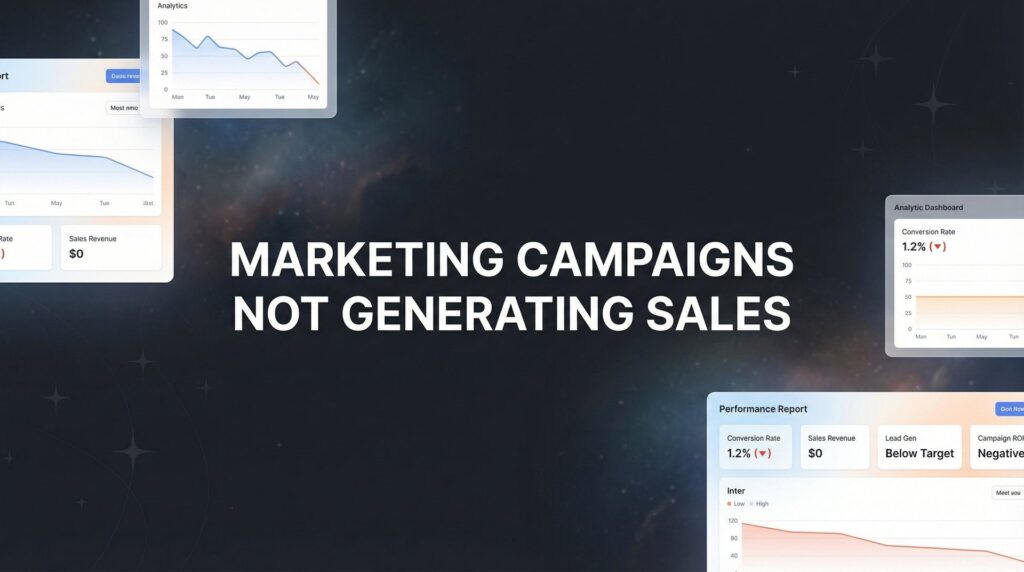
You’re watching the ad spend tick up every month. The dashboard shows clicks coming in. Your social posts are getting engagement. The marketing agency sends you reports full of impressive-looking numbers. But when you check your bank account and look at actual sales? Crickets.
This is the nightmare scenario thousands of business owners face right now. Money flowing out to marketing campaigns, but revenue stubbornly refusing to flow back in. The disconnect is maddening because everything looks like it should be working. The metrics say people are seeing your ads, clicking through, even visiting your website. Yet somehow, none of this activity translates into customers who actually buy.
The problem isn’t that digital marketing doesn’t work. It’s that most campaigns are optimized for the wrong outcomes. They’re built to generate clicks, impressions, and engagement rather than sales. And there’s a massive difference between those two goals. This article will help you diagnose exactly where your marketing is breaking down and, more importantly, what to do about it. We’ll walk through the five most common failure points where potential customers slip through the cracks, and the specific fixes that turn marketing spend into actual revenue.
The Costly Gap Between Clicks and Customers
Let’s start with the fundamental problem: most businesses are measuring the wrong things. When you look at your marketing reports, what numbers jump out at you? Probably impressions, reach, clicks, and engagement rates. These are what marketers call vanity metrics, and they’re called that for a reason. They look impressive in a presentation, but they have almost no correlation with revenue.
Think about it this way. If your campaign gets 10,000 impressions, that sounds significant. But impressions just mean someone’s eyeballs passed over your ad for a fraction of a second. They might not have even consciously registered what they saw. Even clicks, which feel more substantial, don’t tell you much. A click costs you money, but it doesn’t put money in your account. What matters is what happens after the click.
The metrics that actually predict revenue are conversion rate, cost per qualified lead, lead-to-customer rate, and customer acquisition cost. These numbers tell you whether your marketing is attracting people who might actually buy, and whether the economics make sense. A campaign with 100 clicks and 10 qualified leads will outperform a campaign with 1,000 clicks and 5 qualified leads every single time, even though the second campaign looks more impressive on paper. Understanding how to track marketing ROI is essential for measuring what actually matters.
Here’s where most marketing campaigns break down. Picture your marketing as a funnel with five stages: awareness, interest, consideration, intent, and purchase. At each stage, some people drop out. That’s normal and expected. The problem happens when you’re losing people at rates that don’t make economic sense.
Many businesses see 90% or higher drop-off rates between clicks and conversions. That means if 100 people click your ad, fewer than 10 take any meaningful action. And of those 10, maybe 1 or 2 actually become customers. When you’re paying for every single click, those economics fall apart quickly. You’re essentially paying to drive 90+ people to your website who were never going to buy in the first place.
The warning signs are usually obvious once you know what to look for. High traffic but low time on site means people are bouncing immediately. Lots of page views but no form fills or phone calls means visitors aren’t finding what they need. Shopping cart additions without purchases means something is breaking down at the final step. Each of these patterns points to a specific problem in your funnel.
The most insidious issue is when your campaigns are attracting the wrong audience entirely. You might be getting plenty of engagement from people who love your content, share your posts, and click your ads. But if those people don’t have the budget, authority, need, or timeline to actually buy, all that engagement is worthless. This happens constantly with overly broad targeting that prioritizes reach over relevance. If you’re experiencing this, your digital marketing is not generating revenue for a very specific reason.
Targeting Troubles: Reaching Everyone Means Converting No One
The single biggest reason marketing campaigns fail to generate sales is simple: they’re talking to the wrong people. Not wrong in the sense that these people are bad or unqualified in general, but wrong for your specific offer at this specific moment. When you try to reach everyone, you end up converting no one.
Broad targeting feels safe. If you cast a wide net, surely you’ll catch some fish, right? But in digital marketing, broad targeting just means you’re paying to show your ads to massive numbers of people who will never buy. You’re the vegetarian restaurant advertising to meat lovers. The premium service pitching to bargain hunters. The B2B software showing ads to teenagers.
The fix starts with actual customer research, not assumptions about who your customers might be. Look at your existing customers, the ones who actually bought and stayed bought. What do they have in common? What problems were they trying to solve? What other solutions did they consider? Where do they spend time online? This data tells you who to target.
Buyer personas help, but only if they’re based on real customer data rather than guesswork. A useful persona includes demographics, but more importantly, it includes psychographics: what keeps this person up at night, what goals are they trying to achieve, what objections do they have to buying, what would make them choose you over a competitor. These insights shape everything from your ad copy to your landing page messaging.
Platform-specific targeting mistakes compound the problem. On Google Ads, many businesses use broad match keywords that trigger their ads for irrelevant searches. If you sell premium landscaping services and you’re bidding on “lawn care,” you’re showing ads to people looking for $30 mowing services, not $5,000 landscape designs. The clicks cost the same, but the intent is completely different. Learning search engine marketing for beginners can help you avoid these costly mistakes from the start.
Facebook and Instagram targeting often goes too broad in the opposite direction. Businesses select interests like “small business” or “entrepreneurship” and wonder why their ads don’t convert. Those audiences include millions of people at vastly different stages, with vastly different needs. The person just thinking about starting a business has completely different needs than the person running a seven-figure company, but broad interest targeting treats them the same.
Search intent matters more than almost anything else. Someone searching “how to start a garden” is in research mode, not buying mode. Someone searching “landscaping services near me pricing” is much closer to making a purchase decision. Your campaigns need to match the searcher’s intent, not just include relevant keywords.
The solution is to start narrow and expand gradually based on performance data. Target your ideal customer profile as precisely as possible, even if it means reaching fewer people. Then monitor which audience segments actually convert, and allocate more budget there. This approach costs less and generates more revenue than trying to reach everyone and hoping some of them buy.
Your Landing Pages Are Killing Conversions
Let’s say you’ve fixed your targeting. You’re now driving qualified traffic to your website. People who actually need what you sell, who can afford it, who are ready to buy. But they land on your page, spend three seconds looking around, and leave. This is where most campaigns die, and it’s completely preventable.
Landing page problems fall into three categories: technical issues, message mismatch, and conversion barriers. Technical issues are the easiest to spot and fix. If your page takes more than three seconds to load, you’ve already lost a huge percentage of visitors. Mobile users are even less patient. A slow-loading page on a phone might as well not exist.
Run your landing pages through Google PageSpeed Insights right now. If you’re scoring below 80 on mobile, you’re hemorrhaging potential customers. Compress your images, minimize your code, use a content delivery network, and eliminate anything that doesn’t directly contribute to conversion. Every second of load time costs you sales.
The message-match problem is more subtle but just as deadly. Your ad promises one thing, but your landing page delivers something else. The disconnect confuses visitors and destroys trust immediately. If your ad says “Get a Free Marketing Audit,” your landing page headline better say exactly that, not “Welcome to Our Marketing Services.” The visitor clicked for a specific reason, and you need to confirm they’re in the right place instantly. When your ads are not converting to sales, message mismatch is often the culprit.
Visual consistency matters too. If your ad uses certain colors, images, or design elements, your landing page should echo those. The brain processes visual information faster than text, and visual discontinuity triggers an unconscious “something’s wrong here” response that makes people bounce.
Confusing navigation is conversion poison. Your landing page should have one goal and one clear path to that goal. If you’re asking people to fill out a form, don’t give them 15 other things they could click on instead. Remove your main site navigation. Eliminate sidebar links. Get rid of the footer full of distractions. Every element on the page should either persuade the visitor to convert or get out of the way.
Your call-to-action needs to be impossible to miss and completely clear about what happens next. “Submit” is weak. “Get Started” is vague. “Get Your Free Marketing Audit” tells visitors exactly what they’re getting and removes uncertainty. The CTA button should stand out visually, appear multiple times if the page is long, and never make people hunt for it. This is the foundation of conversion focused marketing services that actually drive revenue.
Mobile experience gaps are especially problematic because mobile traffic often exceeds desktop traffic now. If your forms are hard to fill out on a phone, if your buttons are too small to tap accurately, if visitors have to pinch and zoom to read your text, you’re losing sales. Test every landing page on an actual phone, not just in desktop browser’s mobile view. The real experience often reveals problems the simulation misses.
Forms themselves deserve special attention. Every field you add reduces conversion rate. Ask yourself: do I absolutely need this information right now, or can I get it later? Name and email might be enough for an initial lead. You can gather more details during follow-up. Long forms work for high-value offers where people expect to provide more information, but for most businesses, shorter is better.
The Offer Problem: Why Nobody Wants What You’re Selling
Sometimes the targeting is right, the landing page is optimized, and people still don’t buy. That’s when you need to look hard at your offer itself. Not your product or service, which might be excellent, but how you’re positioning and presenting it. The offer is what you’re asking people to do and what they get in return.
Weak value propositions are everywhere. “We provide quality service” means nothing because every competitor says the same thing. “We’re a family-owned business” doesn’t tell me why I should choose you. “We’ve been in business for 20 years” suggests experience but doesn’t promise a specific benefit. Your value proposition needs to answer one question clearly: Why should I choose you instead of any other option, including doing nothing?
The strongest value propositions are specific, quantifiable, and focused on outcomes rather than features. “We reduce your cost per lead by an average of 40% within 90 days” is infinitely more compelling than “We offer comprehensive digital marketing services.” One promises a concrete result, the other just describes what you do.
Pricing and positioning misalignment kills conversions quietly. If you’re targeting price-sensitive customers but presenting yourself as a premium option, the disconnect is obvious. If you’re trying to attract high-end clients but your pricing signals “budget option,” they’ll assume you can’t deliver the quality they need. Your price point, your messaging, your design, and your target market all need to align.
Many businesses make the mistake of competing on price when they should be competing on value. Racing to the bottom on price attracts customers you don’t want: the ones who will leave for a competitor who undercuts you by five dollars. If you’re not the cheapest option in your market, don’t pretend to be. Own your positioning and attract customers who value what you actually offer. A results driven marketing approach focuses on demonstrating value rather than competing on price alone.
Trust signals have become critical as consumers have grown more skeptical of marketing claims. Testimonials matter, but only if they’re specific and credible. “Great service!” from “John D.” doesn’t build trust. “They increased our qualified leads by 60% in the first month, and the quality was noticeably better than our previous agency” from “Sarah Mitchell, Owner of Mitchell & Associates” is powerful because it’s specific, quantified, and attributed to a real person.
Social proof comes in many forms. Customer count, years in business, certifications, awards, media mentions, case studies, and reviews all contribute to credibility. But they need to be relevant to what you’re selling. If you’re a local service business, Google reviews from local customers matter more than a national award. If you’re selling to businesses, testimonials from recognizable companies in your industry carry more weight than consumer reviews.
Guarantees and risk reversal can dramatically improve conversion rates for the right offers. If someone is hesitant to buy because they’re worried about wasting money, a money-back guarantee removes that barrier. The fear of offering a guarantee is usually unfounded. Most customers won’t abuse it, and the increase in conversions typically far outweighs the occasional refund.
The offer itself might need to change. If you’re asking for too much commitment too soon, people will hesitate. A free consultation, audit, or trial reduces the barrier to entry. Once someone experiences what you do, converting them to a paying customer becomes much easier. The initial offer doesn’t have to be your main product; it just needs to start the relationship.
Follow-Up Failures That Let Warm Leads Go Cold
You’ve done everything right. Your targeting is precise, your landing page converts, your offer is compelling. Leads are coming in. Then nothing happens, or what does happen is too little, too late. This is the follow-up failure, and it’s staggeringly common. Businesses spend thousands attracting leads, then let them evaporate through poor or nonexistent follow-up.
Lead response time is one of the most well-documented factors in conversion rates. Leads contacted within five minutes are dramatically more likely to convert than leads contacted an hour later. After 24 hours, your chances of conversion drop by more than 80%. This isn’t opinion or theory; it’s been measured across millions of leads in multiple industries.
The reason is simple: when someone fills out a form or calls your business, they’re thinking about their problem right now. They’re in buying mode. They might have contacted three competitors in the same five-minute window. Whoever responds first and most helpfully wins the business. If you wait until tomorrow to follow up, they’ve probably already bought from someone else.
Automated follow-up helps but can’t replace human contact entirely. An immediate automated email confirming receipt of the lead and setting expectations for next steps is good. But that needs to be followed by actual human outreach, fast. The businesses that win are the ones who call within minutes, not hours or days. Implementing marketing automation for small business can help you respond instantly while your team prepares for personal follow-up.
Nurturing sequences are essential for leads who aren’t ready to buy immediately. Not every lead converts on the first contact. Some need time to evaluate options, get budget approval, or wait for the right timing. But if you go silent after the initial contact, they’ll forget about you. A nurturing sequence keeps you top of mind without being pushy.
Effective nurturing educates rather than just selling. Send helpful content that addresses common questions and concerns. Share case studies showing how you’ve solved similar problems. Provide insights that demonstrate your expertise. The goal is to build trust and stay relevant so when they’re ready to buy, you’re the obvious choice. Using email marketing for lead generation is one of the most effective ways to nurture prospects through your funnel.
Email is the primary nurturing channel, but it shouldn’t be the only one. Text message follow-up has higher open rates for certain audiences. Retargeting ads keep you visible as leads browse other sites. Direct mail can stand out in an increasingly digital world. A multi channel marketing strategy reaches people where they are and accommodates different communication preferences.
Sales team alignment is often the hidden problem. Marketing generates leads, hands them to sales, and assumes their job is done. But if the sales team doesn’t understand the context, doesn’t follow up promptly, or doesn’t have a process for working leads, conversions suffer. Marketing and sales need to agree on what constitutes a qualified lead, how quickly leads should be contacted, and what the follow-up process looks like.
Lead scoring helps prioritize follow-up efforts. Not all leads are created equal. Someone who visited your pricing page three times and downloaded a case study is hotter than someone who signed up for a newsletter. Score leads based on their behavior and demographics, then route the hottest leads to your best salespeople for immediate follow-up.
CRM systems are non-negotiable at this point. You cannot rely on spreadsheets or memory to manage follow-up. A proper CRM tracks every interaction, sets reminders for follow-up tasks, and ensures no lead falls through the cracks. It doesn’t have to be expensive or complicated, but it has to exist and actually be used.
Building a Campaign That Actually Converts
Now that you understand where campaigns typically fail, let’s talk about the systematic approach to fixing yours. Start with a diagnostic audit of your entire marketing funnel. Don’t assume you know where the problem is; measure it. A comprehensive digital marketing audit can reveal exactly where your funnel is leaking potential customers.
Begin at the top of the funnel. Look at your targeting and traffic sources. What percentage of your clicks come from relevant searches or audiences? Use Google Analytics to see which traffic sources have the highest bounce rates and the lowest conversion rates. Those are your problem channels. Either fix the targeting or stop spending money there.
Move to your landing pages. Check load speeds first since that’s easy to measure and fix. Then look at conversion rates by device. If mobile converts at half the rate of desktop, you have a mobile experience problem. Use heat mapping tools to see where people click and how far they scroll. If they’re not making it to your CTA, your page is too long or not engaging enough.
Audit your offer and positioning. Show your landing page to people in your target market who don’t know your business. Ask them to explain in their own words what you’re offering and why they should care. If they can’t articulate it clearly, your value proposition needs work. Check your pricing against competitors. Make sure your positioning matches your price point.
Review your follow-up process. Pull reports on lead response times. How long does it take from form submission to first contact? What percentage of leads never get contacted at all? How many touchpoints does it take to close a sale? These metrics reveal whether your follow-up is helping or hurting.
Prioritize fixes based on impact and effort. Quick wins are changes that are easy to implement and likely to improve results significantly. Fixing slow page load times is a quick win. Improving your headline to better match your ad is a quick win. These should be done immediately. Long-term fixes like rebuilding your entire website or implementing a new CRM take more time but might be necessary for sustained improvement. Understanding marketing campaign optimization helps you prioritize which changes will have the biggest impact.
Test systematically, not randomly. Change one element at a time so you know what actually moved the needle. Test your headline, then your CTA, then your form length, then your offer. If you change everything at once and results improve, you won’t know which change mattered. If results get worse, you won’t know what to fix.
Sometimes optimization isn’t enough. If your campaign is fundamentally flawed, tinkering around the edges won’t save it. You need to know when to optimize and when to start over. If your targeting is attracting completely the wrong audience, no amount of landing page optimization will fix that. If your offer isn’t compelling to anyone, better ad copy won’t help. Be honest about whether you need incremental improvements or a complete rebuild.
Set realistic benchmarks based on your industry and offer type. Conversion rates vary wildly depending on what you’re selling and who you’re selling to. A 2% conversion rate might be excellent for a high-ticket B2B service but terrible for a low-cost consumer product. Research typical conversion rates in your space so you know whether your numbers are actually problematic or just feel low.
Turning Wasted Spend Into Real Revenue
Marketing campaigns that don’t generate sales aren’t a mystery. They’re a diagnosis waiting to happen. Somewhere in your funnel, from targeting to follow-up, there’s a breakdown point where potential customers are slipping away. The good news is that every breakdown point is fixable.
Start with your metrics. Stop celebrating vanity metrics like impressions and clicks. Focus ruthlessly on the numbers that predict revenue: qualified leads, conversion rates, cost per acquisition, and return on ad spend. If those numbers aren’t where they need to be, you have work to do.
Audit your targeting. Are you reaching the right people, or are you paying to show ads to audiences that will never buy? Narrow your focus, even if it means reaching fewer people. Qualified traffic converts; unqualified traffic just costs money.
Fix your landing pages. Make them fast, make them clear, and make them focused on one goal. Remove distractions, strengthen your value proposition, and make it obvious what visitors should do next.
Sharpen your offer. Be specific about what you’re promising and why it matters. Add trust signals that prove you can deliver. Consider whether you’re asking for too much commitment too soon.
Speed up your follow-up. Respond to leads within minutes, not hours. Implement nurturing sequences for leads who aren’t ready to buy immediately. Make sure your sales team has the tools and process to work leads effectively.
The businesses that succeed with marketing are the ones who treat it as a system, not a collection of random tactics. Each piece of the funnel affects the others. Small improvements compound. A 10% improvement in targeting, a 15% improvement in landing page conversion, and a 20% improvement in follow-up conversion multiply together into dramatically better results.
Tired of spending money on marketing that doesn’t produce real revenue? We build lead systems that turn traffic into qualified leads and measurable sales growth. If you want to see what this would look like for your business, we’ll walk you through how it works and break down what’s realistic in your market.
Want More Leads for Your Business?
Most agencies chase clicks, impressions, and “traffic.” Clicks Geek builds lead systems. We uncover where prospects are dropping off, where your budget is being wasted, and which channels will actually produce ROI for your business, then we build and manage the strategy for you.