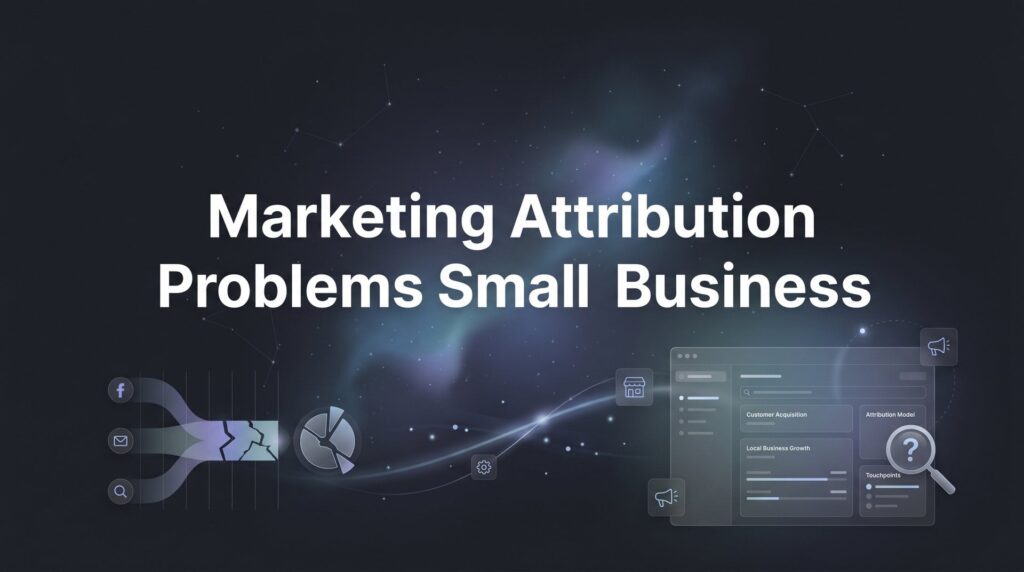
You’re running Google Ads, posting on social media, and your SEO is finally starting to gain traction. Leads are coming in. The phone is ringing. Business feels like it’s moving. But when you sit down to figure out which of those channels actually drove those new customers, you hit a wall. Google Ads says it generated 15 conversions. Facebook claims 12. Your organic traffic looks healthy too. The math doesn’t add up, and you’re left with a nagging question: where is my money actually working?
This is the marketing attribution problem, and it’s one of the most frustrating challenges small business owners face. Marketing attribution, at its core, is the process of identifying which marketing touchpoints deserve credit for bringing in a customer or lead. It sounds straightforward. In practice, it’s anything but, especially when you’re running a lean operation without a dedicated analytics team or a five-figure software budget.
For small businesses, this isn’t just an academic headache. When every dollar matters, misreading your attribution data can mean pouring budget into channels that look good on paper but don’t actually drive revenue, while quietly cutting the campaigns that do. This guide is designed to cut through the confusion, explain the most common attribution mistakes draining your budget, and give you practical fixes you can start implementing this week.
Why Small Businesses Feel Attribution Pain More Acutely
Enterprise companies have a cushion that small businesses simply don’t. A large corporation can absorb the inefficiency of misallocated marketing spend because they have the volume and margin to experiment, make mistakes, and correct course over time. A small business running a $3,000 monthly ad budget doesn’t have that luxury. Every misattributed conversion represents a real decision about where to put next month’s money, and getting it wrong compounds quickly. Understanding marketing budget waste solutions becomes essential when margins are this thin.
The resource gap makes things worse. Most small businesses don’t have an in-house analytics specialist or a dedicated marketing operations role. The owner, or maybe a generalist marketing hire, is wearing five hats simultaneously. That means attribution often gets treated as a “nice to have” rather than a business-critical function. You end up relying on whatever the platforms tell you, which creates its own set of problems we’ll get into shortly.
There’s also a structural challenge that’s unique to local and service-based businesses. The customer journey rarely stays in one lane. Someone might see your Google Ad, visit your website, close the tab, then see your Facebook post a few days later, then Google your business name directly, then call your office to book an appointment. Which channel gets credit for that customer? In a purely digital business, you at least have a trail of clicks to follow. But when the conversion happens over the phone or in person, that trail goes cold unless you’ve deliberately built systems to track it. This is why a thoughtful multi-channel marketing approach must include attribution planning from the start.
Think about a plumbing company, a dental practice, or a home remodeling contractor. These businesses generate a significant portion of their leads through phone calls. If every marketing channel is using the same phone number on the website, in ads, and on Google Business Profile, there is no way to know whether that call came from someone who clicked a paid ad, found you through organic search, or saw your yard sign. The data simply doesn’t exist unless you create it.
This combination of tighter budgets, limited analytics infrastructure, and offline conversion paths makes attribution genuinely harder for small businesses than it is for larger ones. That’s not an excuse to ignore it. It’s a reason to approach it strategically rather than hoping the platforms will sort it out for you.
The 5 Attribution Mistakes That Are Quietly Draining Your Budget
Understanding where attribution goes wrong is the first step toward fixing it. These are the mistakes that show up most consistently across small business marketing accounts, and each one can lead to seriously flawed decisions about where to invest your budget.
Last-click bias: This is the most common attribution error, and it’s baked into the default settings of many analytics tools. Last-click attribution gives 100% of the credit for a conversion to the final touchpoint before the sale. On the surface, that seems logical. But it completely ignores every other interaction that built the customer’s awareness and trust. Your SEO content might have introduced a prospect to your business. A retargeting ad might have kept you top of mind for two weeks. But if they ultimately clicked a branded search ad right before converting, paid search gets all the credit. The result is that top-of-funnel campaigns get defunded because they “don’t convert,” even though they were doing the essential work of creating demand.
Trusting platform self-reporting at face value: Every major advertising platform uses self-attribution, meaning each platform claims credit for conversions where a user interacted with their ads, regardless of what else happened in the customer journey. Google Ads, Meta Ads, and others each have their own attribution windows and counting methodologies. When a customer sees a Facebook ad and then clicks a Google ad before converting, both platforms will likely count that as their conversion. This is not a bug or a trick. It’s how these systems are designed. But if you add up the conversions each platform reports, the total will often exceed your actual number of leads by a significant margin. Learning how to track marketing ROI effectively requires looking beyond what any single platform tells you.
Ignoring phone calls and offline conversions: For service businesses especially, this is often the biggest blind spot of all. If your leads primarily come through phone calls, and you’re not tracking which marketing source generated each call, you’re flying blind on the majority of your attribution data. A business running both PPC and SEO with a single phone number has no way to separate which channel is driving calls. This leads to a scenario where you might be about to cut your SEO investment because it “doesn’t show conversions” in Google Ads, when in reality it’s driving a large portion of your inbound call volume.
Inconsistent or missing UTM parameters: UTM parameters are small tags you add to URLs that tell Google Analytics where traffic came from. They’re free to use and straightforward to implement, yet many small businesses either skip them entirely or use them inconsistently. When UTMs are missing, traffic gets lumped into “direct” or “unassigned” categories in Analytics, which makes your channel data increasingly unreliable over time. You lose the ability to compare campaign performance accurately, and your data quality degrades with every untagged link you send out.
No defined conversion tracking in the first place: Some small businesses are trying to make attribution decisions without having properly set up conversion tracking at all. If your Google Ads account isn’t tracking form submissions, calls, and purchases as distinct conversion events with assigned values, you’re essentially optimizing in the dark. The platform’s algorithm can’t optimize toward revenue if it doesn’t know what revenue looks like. If you’re unsure where to begin, a guide on how to track marketing conversions can walk you through the essentials.
Attribution Models in Plain Language: Picking the Right One
Once you understand why attribution is broken, the next question is: which attribution model should you actually use? There are several to choose from, and each tells a different story about your marketing performance.
First-touch attribution gives all the credit to the first interaction a customer had with your business. This is useful if your primary goal is understanding how customers discover you. For a business that’s focused on brand awareness and top-of-funnel growth, first-touch can highlight which channels are best at generating initial interest. The downside is that it ignores everything that happened between discovery and conversion.
Last-touch attribution does the opposite, crediting the final interaction before conversion. It’s simple and easy to explain, but as discussed earlier, it systematically undervalues channels that build awareness and consideration. This is one of the core reasons why marketing campaigns appear to not generate revenue when they’re actually contributing to the pipeline.
Linear attribution splits credit equally across every touchpoint in the customer journey. If a customer interacted with your business through a Facebook ad, an organic search, and a Google Ad before converting, each gets one-third of the credit. This is a more balanced view and a reasonable starting point for small businesses that want to move beyond last-click without overcomplicating things.
Time-decay attribution gives more credit to touchpoints that happened closer to the conversion. The logic is that the interactions just before a decision carry more influence than something that happened three weeks ago. This model tends to work well for businesses with shorter sales cycles.
Data-driven attribution uses machine learning to assign credit based on actual patterns in your conversion data. Google Ads now uses this as its default model. The catch is that it requires a substantial volume of conversions to function accurately. Many small businesses don’t generate enough conversion events for this model to produce reliable results, which means the algorithm is working with insufficient data and the outputs can be misleading.
For most small businesses running multiple channels, a simple multi-touch model like linear or time-decay is the most practical starting point. It acknowledges that your customer’s journey involves more than one interaction, without requiring the data volume that makes data-driven attribution meaningful. As your conversion volume grows and your tracking infrastructure matures, you can revisit more sophisticated models. Building a solid marketing dashboard and reporting setup makes it far easier to compare how different models interpret your data.
The right model also depends on your sales cycle. If customers typically convert within a day or two of their first interaction, a last-touch or time-decay model might be appropriate. If your sales cycle stretches over weeks or months, as it often does for remodeling contractors or B2B service providers, a linear or first-touch model will give you a more accurate picture of what’s building the pipeline.
Practical Fixes You Can Start This Week
Attribution problems can feel overwhelming, but the foundational fixes are more accessible than most business owners realize. Here’s where to start.
Set up call tracking with unique phone numbers per channel. This is the single highest-impact fix for most service-based businesses. Tools like CallRail allow you to assign different phone numbers to different marketing sources. Your Google Ads landing page gets one number. Your SEO pages get another. Your Facebook ads get a third. When someone calls, the system automatically logs which number they dialed, connecting that lead back to its source. This turns your phone calls from an attribution black hole into a trackable data stream. Our complete guide on call tracking for local businesses walks through the entire setup process step by step.
Use UTM parameters consistently on every campaign link. Every paid ad, every email campaign link, every social media post that drives traffic to your website should have UTM parameters attached. Google’s Campaign URL Builder is a free tool that makes this straightforward. The key is consistency: establish a naming convention and stick to it. If you use “google-ads” as your source one month and “google_ads” the next, your data will be fragmented. Build a simple UTM template your team uses for every campaign, and your Google Analytics data will become significantly more useful.
Create a lead source field in your CRM or inquiry process. Sometimes the most powerful attribution tool is also the simplest: asking people how they found you and actually recording the answer. Add a “How did you hear about us?” field to your contact forms, train your team to ask the question on every inbound call, and log the response in your CRM or even a basic spreadsheet. This isn’t a replacement for digital tracking, but it adds a layer of first-party data that can validate or challenge what your analytics tools are showing. When a customer says “I found you on Google,” that’s a data point worth capturing.
Audit your conversion tracking in Google Ads. Log into your Google Ads account and check whether you have conversion actions set up for every meaningful action a customer can take: form submissions, phone calls, chat initiations, and any other lead-generating events. Each conversion action should ideally have an assigned value so the platform can optimize toward revenue rather than just volume. If your conversion tracking is incomplete or missing, fix that before making any major budget allocation decisions based on performance data. If you’re new to the platform, our guide to PPC advertising covers the fundamentals of getting your account structured correctly.
When DIY Attribution Isn’t Enough
There’s a point at which managing attribution yourself becomes genuinely counterproductive. If you’re spending a meaningful amount across multiple channels each month and you still can’t confidently answer “which channel drives the most revenue,” you’re likely making budget decisions on incomplete or misleading data. The cost of that uncertainty compounds over time.
There are specific red flags worth watching for in your current marketing setup. If your agency’s monthly reports focus heavily on impressions, clicks, and engagement without connecting those metrics to actual leads and revenue, that’s a problem. If there’s no call tracking in place for a service business that generates leads by phone, that’s a significant gap. If your Google Ads account doesn’t have conversion value tracking configured, the platform is optimizing toward the wrong objective. These are classic signs that your marketing is not driving sales as effectively as it could be.
A performance-focused marketing partner should be doing several things that directly address attribution. They should have proper conversion tracking set up before launching any campaigns. Their reporting should tie marketing activity to real business outcomes: leads generated, cost per lead, and ideally revenue influenced. They should be using attribution data to make ongoing optimization decisions, not just reporting on what happened last month. Implementing proven marketing ROI optimization strategies is what separates agencies that generate results from those that simply manage spend.
As a Google Premier Partner agency, Clicks Geek works specifically on this layer of the problem. Proper attribution isn’t a side feature of what we do. It’s the foundation, because without it, conversion rate optimization and campaign performance improvements are built on guesswork. When you know which channels, campaigns, and keywords are actually driving revenue, you can make confident decisions about where to invest and where to pull back.
Your Next Steps Toward Clear Attribution
Marketing attribution problems are solvable. Not perfectly, and not overnight, but solvable enough to make dramatically better decisions about your marketing budget. The goal isn’t a flawless attribution model. It’s building enough visibility to stop wasting money on what doesn’t work and confidently invest more in what does.
Start with the fundamentals: implement call tracking with unique numbers per channel, tag every campaign link with UTM parameters, and capture lead source data at the point of inquiry. Choose an attribution model that fits your sales cycle rather than defaulting to whatever the platform suggests. And if your reporting still doesn’t connect marketing activity to actual revenue, take that seriously as a sign that your current setup needs professional attention.
The businesses that grow predictably aren’t the ones spending the most on marketing. They’re the ones who know where their leads come from, understand what those leads cost, and use that information to make smarter decisions every month.
If you want to see what this would look like for your business, Clicks Geek will walk you through how it works and break down what’s realistic in your market. Tired of spending money on marketing that doesn’t produce real revenue? We build lead systems that turn traffic into qualified leads and measurable sales growth. Let’s show you exactly what’s working and build a plan to scale it.