You’ve launched your lead generation campaign. The ads are running. The budget is burning. And then… crickets. Or worse—your inbox fills up with people who have no intention of buying, wasting your sales team’s time on dead-end conversations. Sound familiar?
Here’s the truth most business owners learn the hard way: the problem isn’t that lead generation doesn’t work. The problem is the setup.
A poorly configured campaign is like trying to fill a bucket with a hole in the bottom. No matter how much money you pour in, you’ll never get the results you need. The good news? When you set up your lead generation campaign correctly from the start, everything changes. You get qualified prospects who actually want what you’re selling. Your cost per lead becomes predictable. Your sales team stops complaining about tire-kickers.
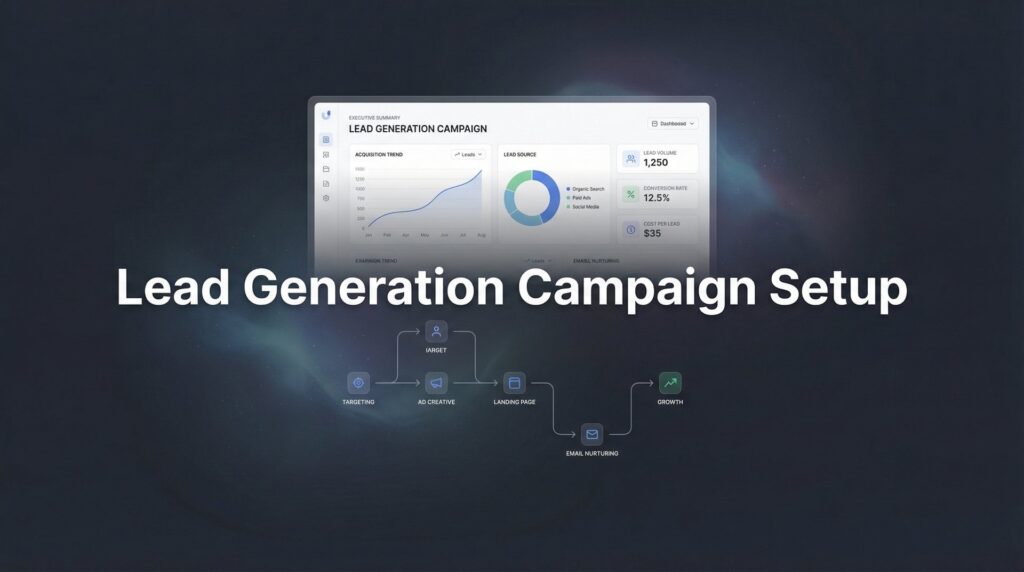
This guide walks you through the exact lead generation campaign setup process that separates profitable campaigns from expensive experiments. You’ll learn how to define your ideal customer, choose the right channels, build landing pages that convert, and track the metrics that actually matter. Whether you’re running your first campaign or fixing a broken one, these seven steps will help you build a lead generation machine that delivers results.
Let’s get your campaign set up right the first time.
Step 1: Define Your Ideal Customer and Campaign Goals
Before you spend a single dollar on ads, you need to know exactly who you’re trying to reach. And I mean exactly—not “small business owners” or “homeowners.” That’s too broad to be useful.
Start by creating a specific ideal customer profile. What’s their age range? What industry are they in? What keeps them up at night? What problem are they actively trying to solve right now? The more specific you get, the better your campaign will perform.
Think about it like this: if you’re a CRO agency targeting e-commerce businesses, your ideal customer isn’t just “someone who sells online.” It’s a business doing $500K-$5M annually, struggling with cart abandonment, frustrated with their current conversion rates, and actively looking for solutions. See the difference?
Once you’ve nailed down your ideal customer, set measurable campaign goals. What’s your target cost per lead? How many leads do you need per month to hit your revenue goals? What defines a “qualified” lead for your business?
Here’s where most campaigns go wrong: they chase volume instead of quality. Getting 100 leads at $20 each sounds great until you realize only 5 of them are actually qualified prospects. Meanwhile, 30 leads at $50 each with a 50% qualification rate gives you 15 quality prospects—three times better for the same budget. Understanding the low quality leads problem is essential before you launch.
Calculate your maximum allowable cost per lead based on customer lifetime value. If your average customer is worth $5,000 and you close 20% of qualified leads, you can afford to pay up to $1,000 per lead and still be profitable. This math becomes your north star for campaign performance.
Determine your lead qualification criteria before launching. What questions need to be answered? What budget range makes sense? What timeline indicates serious intent? Document these criteria so everyone—marketing, sales, and you—agrees on what counts as a quality lead.
This foundation work feels tedious, but it’s the difference between a campaign that prints money and one that drains your bank account. Get this step right, and everything else becomes easier.
Step 2: Choose Your Lead Generation Channels
Now that you know who you’re targeting, you need to figure out where to find them. This isn’t about picking the trendiest platform or the channel your competitor uses. It’s about matching your strategy to where your ideal customers actually spend their time and what mindset they’re in.
Search ads capture active buyers—people who are literally searching for solutions right now. If you’re a local plumber, someone searching “emergency plumber near me” is ready to buy. That’s high-intent traffic, and it converts fast. The downside? You’re competing with everyone else who figured this out, which can drive costs up.
Social media ads work differently. These platforms let you target specific demographics, interests, and behaviors, but you’re interrupting people who aren’t actively searching for you. This works brilliantly for awareness and for reaching customers who don’t know they need your solution yet. But the conversion timeline is typically longer. If you’re unsure which platform fits your business, this guide on Google Ads vs Facebook Ads for lead generation breaks down the key differences.
Content marketing and SEO play the long game. You’re building authority and capturing organic traffic over time. This approach costs less per lead long-term but requires patience and consistent effort. It’s not a quick win—it’s a compounding asset.
Here’s the critical mistake: trying to do everything at once. You spread your budget across five channels, none of them get enough spend to generate meaningful data, and you can’t figure out what’s actually working. Start with one primary channel that matches your ideal customer’s behavior and your campaign goals.
For local service businesses, Google Search Ads often win because you’re capturing people with immediate intent. For B2B companies with longer sales cycles, LinkedIn Ads combined with content marketing might make more sense. For e-commerce selling impulse-buy products, Facebook and Instagram Ads could be your sweet spot.
Consider your budget too. Search ads in competitive industries might require $3,000-$5,000 monthly to gather enough data. Social ads can sometimes work with $1,000-$2,000 monthly budgets. Content marketing requires time investment more than cash.
Pick your primary channel, commit enough budget to make it work, and master it before expanding. You can always add channels later once you’ve proven your campaign works and you have cash flow to support expansion.
Step 3: Build a High-Converting Landing Page
Sending paid traffic to your homepage is like inviting someone to your store and then giving them 47 different directions at once. They get confused, overwhelmed, and leave without buying. Your landing page needs one job: convert visitors into leads. Nothing else.
Start with a headline that speaks directly to your ideal customer’s primary pain point. Not a clever tagline. Not your company slogan. A clear statement that makes them think, “Yes, that’s exactly what I need.” If you’re targeting restaurant owners struggling with online orders, “Get More Online Orders Without Raising Prices” beats “Innovative Restaurant Solutions” every single time.
Your landing page should have one clear path forward—filling out your form or calling your number. Remove navigation menus. Remove links to other pages. Remove anything that gives visitors an excuse to click away. This feels counterintuitive, but it works.
Form fields are where most landing pages die. Every additional field you add drops your conversion rate. Ask yourself: what do I absolutely need to know right now to qualify this lead and follow up? Name, email, and phone number? Perfect. Name, email, phone number, company name, annual revenue, current challenges, preferred contact time, and how they heard about you? You just killed your conversion rate.
You can always gather more information later in the sales process. Right now, you just need enough to start the conversation. For most businesses, 3-5 form fields is the sweet spot. If you’re struggling with form submissions that don’t convert to sales, learn how to generate qualified leads online instead of just collecting names.
Trust signals matter more than you think. Include testimonials from real customers with real names and photos if possible. Display any relevant credentials, certifications, or awards. If you offer a guarantee, make it prominent. If you’re handling sensitive information, add security badges.
The visual design should support conversion, not distract from it. Use contrasting colors for your call-to-action button. Make sure your form is visible without scrolling on mobile devices. Include relevant images that support your message, but don’t let them overshadow your offer.
Test your landing page on multiple devices before launching. A page that looks perfect on your desktop might be completely broken on mobile, and mobile traffic often represents 50-70% of paid traffic depending on your industry.
Your landing page is your conversion engine. Build it with a single purpose, remove every distraction, and make it ridiculously easy for qualified prospects to take the next step.
Step 4: Craft Your Lead Magnet or Offer
Nobody fills out forms just for fun. You need to offer something valuable enough to overcome the natural resistance to sharing contact information. This is your lead magnet or offer, and it needs to solve an immediate problem for your prospect.
The best offers match the buyer’s journey stage. Someone who’s just starting to research their problem isn’t ready for a sales call—they need education. Offer them a guide, checklist, or resource that helps them understand their options. Someone who’s actively comparing solutions is ready for a consultation, quote, or assessment.
For service businesses, free consultations, quotes, or assessments work well because they naturally lead to your core offering. “Get a Free Website Audit” positions you as the expert and gives you a reason to demonstrate value. Just make sure you’re actually delivering value in that audit, not just using it as a sales pitch disguised as an offer. If you run a service business, this guide on lead generation for service businesses covers offer strategies in depth.
For businesses with longer sales cycles, downloadable resources like guides, templates, or case studies can work brilliantly. The key is making them specific and immediately useful. “The Complete Guide to Marketing” is too broad. “7 Email Templates That Recovered $50K in Abandoned Carts” is specific, valuable, and immediately actionable.
Limited-time offers create urgency, but only if they’re genuine. “50% off if you sign up this week” works if you actually honor that deadline. If “this week” turns into “every week,” you’ve destroyed your credibility and trained customers to wait for the next discount.
Your offer should naturally lead to your core service or product. If you’re a PPC agency, offering a free guide on “How to Write Better Blog Posts” attracts writers, not potential PPC clients. Offering a “Free PPC Account Audit” attracts businesses already running ads who might need expert help—exactly who you want.
Test different offers to see what resonates with your audience. Sometimes a simple “Get a Free Quote” outperforms elaborate lead magnets. Sometimes a specific resource generates more qualified leads than a generic consultation offer. Let the data tell you what works.
Step 5: Set Up Tracking and Analytics
Here’s where most campaigns completely fall apart: tracking. You can’t optimize what you can’t measure, and you can’t measure what you haven’t set up properly. Install conversion tracking before you launch anything. Not after. Before.
Start with Google Analytics if you’re not using it already. Set up goals for every conversion action you care about—form submissions, phone calls, chat initiations, whatever indicates a lead for your business. Configure event tracking so you can see exactly what actions people take on your landing page before converting.
If you’re running Google Ads, set up conversion tracking in your Google Ads account and link it to your Google Analytics. This lets you see which specific keywords, ads, and campaigns are driving actual leads, not just clicks. The difference between clicks and conversions is everything.
For businesses where phone calls matter, implement call tracking for marketing campaigns. Use dynamic number insertion so different traffic sources display different phone numbers, or use call tracking software that records and attributes calls to specific campaigns. You might discover that half your leads come through phone calls you weren’t even counting.
Create a lead source attribution system so you know exactly where every lead came from. This is critical for multi-channel campaigns. Use UTM parameters in your URLs to track traffic sources in Google Analytics. Set up hidden form fields that capture the traffic source when someone submits your form.
Set up automated reporting so you don’t have to manually pull data every time you want to check performance. Google Analytics can email you weekly reports. Most ad platforms have automated reporting features. Use them.
Document your tracking setup. Write down what you’re tracking, how you’re tracking it, and where to find the data. Six months from now when you’re trying to figure out why numbers don’t match between platforms, you’ll thank yourself for having this documentation. For a complete walkthrough, see this guide on marketing technology stack setup.
Test everything before launching. Submit a test form. Make a test phone call. Click through your ads to make sure tracking fires correctly. Finding tracking problems after you’ve spent $5,000 on ads is expensive and frustrating. Finding them during testing costs you 10 minutes.
Step 6: Launch and Monitor Your Campaign
You’ve done the setup work. Now it’s time to launch. But don’t just turn everything on and walk away. The first week of any campaign is critical for gathering data and catching problems early.
Start with a controlled budget. Don’t blow your entire monthly budget in the first three days. Set daily spending limits that let you gather data without risking catastrophic waste. If your monthly budget is $3,000, start with $100-150 daily and adjust based on performance.
Monitor key metrics daily during the first week. Check impressions to make sure your ads are actually showing. Check clicks to verify people are interested enough to click. Check conversions to see if your landing page is doing its job. Check cost per lead to make sure you’re in the ballpark of profitability.
Identify underperforming elements quickly and pause them. If a specific ad has 1,000 impressions and zero clicks, it’s not suddenly going to start working. Pause it and reallocate that budget to ads that are getting engagement. If a keyword is burning budget without conversions, pause it and focus on what’s working. Many businesses experience poor lead quality from ads in the early stages—this is normal and fixable with proper monitoring.
Set up automated alerts for budget pacing and conversion anomalies. Most ad platforms let you set up alerts when spending exceeds certain thresholds or when conversions drop unexpectedly. These alerts can save you from expensive mistakes.
Watch for technical issues. Are form submissions actually reaching your CRM? Are phone calls being answered? Is your landing page loading quickly? Technical problems can kill an otherwise solid campaign, and you won’t know unless you’re actively monitoring.
The launch phase is about learning, not perfecting. You’re gathering data about what works and what doesn’t. Expect to make adjustments. Expect some things to underperform. That’s normal and why you’re monitoring closely.
Step 7: Optimize Based on Real Data
Your campaign is live and generating data. Now the real work begins: optimization. This is where good campaigns become great campaigns, and where most businesses leave massive amounts of money on the table by not doing it consistently.
Review campaign performance weekly and make data-driven adjustments. Look at which ads are generating the lowest cost per lead and scale them up. Look at which keywords are converting best and increase bids. Look at which audience segments are responding and expand targeting to similar audiences.
A/B test your landing page elements systematically. Test headlines first—they typically have the biggest impact. Then test your call-to-action button copy and color. Then test form length. Then test images. Test one element at a time so you know what actually moved the needle.
Let tests run long enough to reach statistical significance. Changing your headline after 50 visitors isn’t testing—it’s guessing. You need enough traffic to confidently say one version outperforms another. For most campaigns, this means hundreds or thousands of visitors per variation.
Refine audience targeting based on which segments convert best. If you’re running Facebook Ads and notice that 35-44 year olds convert at twice the rate of 25-34 year olds, adjust your targeting to focus more budget on the higher-converting segment. If certain geographic areas consistently deliver better leads, shift budget there. These lead generation strategies for businesses can help you identify which optimizations to prioritize.
Scale winning campaigns gradually. If you’re getting $50 cost per lead at $100 daily spend, doubling to $200 daily won’t necessarily maintain that $50 cost per lead. Scale in 20-30% increments and monitor how cost per lead changes. Some campaigns scale beautifully. Others hit a ceiling where costs increase dramatically.
Continue testing new variations even when you have winners. Markets change. Audiences get saturated. What works today might not work next quarter. Always have new ads, new keywords, or new landing page variations in testing so you’re not caught flat-footed when performance shifts.
Document what you learn. Keep a simple spreadsheet or doc tracking what you tested, what happened, and what you learned. This becomes your playbook for future campaigns and prevents you from repeating failed experiments.
Your Lead Generation Success Blueprint
Let’s recap your lead generation campaign setup checklist:
✓ Ideal customer profile and qualification criteria defined
✓ Measurable goals with target cost per lead established
✓ Primary channel selected based on audience behavior
✓ Dedicated landing page built with clear value proposition
✓ Compelling lead magnet or offer created
✓ Conversion tracking and analytics configured
✓ Campaign launched with controlled initial budget
✓ Optimization schedule in place for ongoing improvements
A properly configured lead generation campaign setup isn’t a one-time task—it’s the foundation for predictable, profitable customer acquisition. Execute these seven steps, track your results religiously, and you’ll build a lead generation system that consistently delivers qualified prospects to your business.
The difference between campaigns that work and campaigns that waste money comes down to setup and optimization. Most businesses skip the foundation work, launch too fast, and wonder why they’re not getting results. You now know better.
Start with a clear picture of your ideal customer. Choose one channel and master it. Build a landing page that removes every obstacle to conversion. Create an offer that solves a real problem. Track everything that matters. Launch with discipline. Optimize based on data, not hunches.
Do this right, and you’ll never worry about where your next customer is coming from. You’ll have a system that generates qualified leads on demand, scales with your budget, and gets better over time as you optimize.
Tired of spending money on marketing that doesn’t produce real revenue? We build lead systems that turn traffic into qualified leads and measurable sales growth. If you want to see what this would look like for your business, we’ll walk you through how it works and break down what’s realistic in your market.
Want More Leads for Your Business?
Most agencies chase clicks, impressions, and “traffic.” Clicks Geek builds lead systems. We uncover where prospects are dropping off, where your budget is being wasted, and which channels will actually produce ROI for your business, then we build and manage the strategy for you.