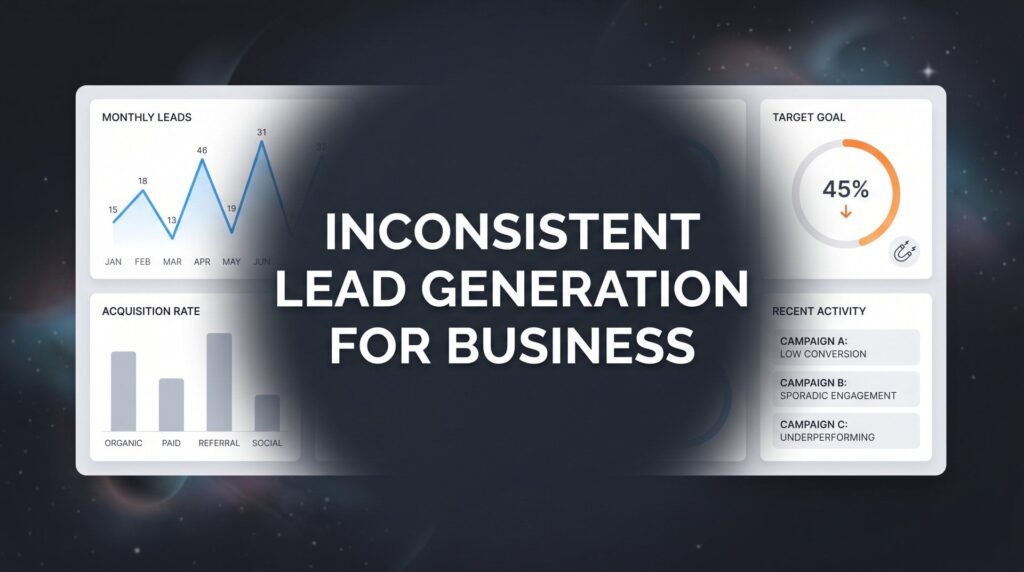
If your business has months where the phone rings nonstop followed by weeks of absolute silence, you already know the feeling. The feast-or-famine cycle is exhausting, unpredictable, and genuinely damaging to growth. It creates cash flow chaos, makes staffing decisions nearly impossible, and forces you into panic-marketing mode every time the pipeline dries up.
Here’s the thing: the root cause is almost never a lack of effort. Most business owners are working hard. The problem is a lack of system.
Most local businesses rely on one or two lead sources, have little visibility into what’s actually working, and treat marketing as something they do reactively rather than as an always-on engine. The result is a cycle that stunts growth and quietly erodes profitability month after month.
This guide breaks down seven battle-tested strategies that replace guesswork with a predictable, measurable lead generation system. Whether you run a service-based business, a local retail operation, or a multi-location company, these approaches will help you stabilize your pipeline and build the kind of consistency that makes real, sustained growth possible.
1. Build a Multi-Channel Lead Engine Instead of Betting on One Source
The Challenge It Solves
When one lead source accounts for the majority of your new business, you’re one algorithm change, one budget cut, or one slow season away from a pipeline crisis. Single-source dependency is the most common structural reason businesses experience inconsistent lead generation. It’s not a marketing problem so much as an architecture problem.
The Strategy Explained
A multi-channel lead engine distributes your acquisition efforts across paid search, organic search, social media, email, and referral programs. The goal isn’t to spread your budget thin across every platform. It’s to build complementary channels where each one reinforces the others and no single failure point can collapse your pipeline.
Think of it like a diversified investment portfolio. If one asset underperforms, the others carry the load while you make adjustments. Paid search can drive immediate leads while SEO builds long-term organic visibility. Referral programs generate high-intent prospects while retargeting keeps warm audiences engaged. Together, they create a scalable lead generation system with built-in redundancy.
Implementation Steps
1. Audit your current lead sources and calculate what percentage of leads come from each one. If any single source accounts for more than half your leads, that’s your immediate vulnerability.
2. Identify two or three complementary channels you’re not currently using or underinvesting in. For most local businesses, this means adding paid search if you’re relying on referrals, or building a referral program if you’re relying entirely on paid ads.
3. Set a realistic budget for each new channel with a 90-day testing window before evaluating performance. New channels need time to generate meaningful data.
Pro Tips
Don’t try to launch every channel at once. Add one new source at a time, stabilize it, then expand. The businesses that struggle most with multi-channel marketing are the ones that go wide before they go deep. Master one channel, then layer in the next.
2. Implement Always-On PPC Campaigns That Never Go Dark
The Challenge It Solves
One of the most damaging habits in paid advertising is toggling campaigns on and off based on how busy you feel. When business is good, you pause ads to save money. When it slows down, you restart them in a panic. This approach doesn’t just waste budget. It actively destroys the performance of your campaigns and guarantees pipeline gaps.
The Strategy Explained
Google’s own documentation makes clear that Smart Bidding strategies require consistent data flow to optimize effectively. When you pause and restart campaigns, you reset the learning period, which means Google’s algorithm has to start from scratch collecting conversion data before it can bid intelligently on your behalf. That learning period can take weeks, and during that time your cost per lead is typically higher and your results are less predictable.
The solution is an always-on approach with a flexible budget structure. Rather than turning campaigns off during slower periods, you dial budget down to a baseline level that maintains data continuity and keeps your brand visible. During high-demand periods, you increase spend to capture more volume. This is a core principle covered in depth in our guide on how to scale lead generation predictably.
Implementation Steps
1. Establish a minimum monthly ad budget that keeps your campaigns active and data flowing, even during your slowest months. Think of this as the floor, not the ceiling.
2. Define a budget scaling protocol tied to demand signals. When lead volume is strong, increase spend. When it’s slower, reduce to your baseline but never go dark.
3. Review campaign performance weekly rather than monthly so you can make small adjustments before problems compound into pipeline gaps.
Pro Tips
If budget is genuinely tight, narrow your targeting rather than pausing entirely. Tighten geographic radius, reduce hours of ad delivery, or focus on your highest-converting keywords only. Staying active at a reduced level is almost always better than stopping and restarting.
3. Fix the Leaky Funnel with Conversion Rate Optimization
The Challenge It Solves
Many business owners assume that inconsistent lead generation is a traffic problem. Not enough people are seeing the ads, not enough clicks are coming through. But often the real problem is what happens after the click. Traffic is coming in and leaking out before it ever becomes a lead. Fixing the leak is frequently more impactful than pouring in more water.
The Strategy Explained
Conversion rate optimization (CRO) is the discipline of systematically improving every step of the path from first impression to completed lead action. That includes your ad copy, your landing page headlines, your form length, your page load speed, your trust signals, and your calls to action. Each of these elements either moves a prospect forward or gives them a reason to leave.
Improving conversion rates on existing traffic is often more cost-effective than acquiring new traffic. If your landing page converts at a low rate and you double that rate through testing and optimization, you’ve effectively doubled your leads without increasing your ad spend. That’s leverage, and it’s one of the most underused tools in digital marketing for small business owners.
Implementation Steps
1. Use Google Analytics or a similar tool to identify where in your funnel prospects are dropping off. High bounce rates on landing pages and abandoned forms are the clearest signals of conversion problems.
2. Audit your landing pages against core CRO principles: clear headline that matches the ad promise, single focused call to action, social proof elements like reviews or credentials, and fast load times on mobile.
3. Run A/B tests on your highest-traffic pages. Test one element at a time, starting with headlines and calls to action, which typically have the highest impact.
Pro Tips
Don’t underestimate the impact of form length. Every additional field you ask a prospect to fill out reduces the likelihood they complete it. Start by asking for only what you absolutely need to follow up, and collect additional information later in the sales process.
4. Create a Lead Nurture System That Reactivates Cold Prospects
The Challenge It Solves
Most businesses focus almost entirely on acquiring new leads and almost nothing on the prospects who showed interest but didn’t convert. Someone who clicked your ad, visited your site, and filled out a form before abandoning it is far more likely to convert than a cold prospect who’s never heard of you. Ignoring them is one of the most expensive mistakes in lead generation.
The Strategy Explained
A lead nurture system keeps your business top-of-mind with unconverted prospects through a combination of automated email sequences and retargeting ads. The goal is to stay present during the gap between when a prospect first shows interest and when they’re ready to make a decision. Many businesses find that nurturing unconverted leads significantly reduces cost per acquisition over time because you’re working an asset you’ve already paid to acquire. Our deep dive into lead nurturing strategies covers the full playbook for turning cold prospects into paying customers.
Think of nurture as a long game. A prospect who isn’t ready to buy this week might be ready in three weeks. If you’ve been consistently showing up in their inbox and their social feed with useful, relevant content, you’re the obvious choice when they’re finally ready to act.
Implementation Steps
1. Set up a retargeting audience in Google Ads and Meta Ads for anyone who visited your site but didn’t convert. Serve them ads with a different angle or offer than what they originally saw.
2. Build a simple email nurture sequence for leads who opted in but haven’t taken the next step. Three to five emails over two to three weeks, focused on answering common objections and reinforcing your credibility, is a solid starting point.
3. Segment your nurture sequences based on where prospects are in the decision process. Someone who requested a quote needs different messaging than someone who just downloaded a free resource.
Pro Tips
Nurture sequences don’t need to be complex to be effective. A simple sequence that addresses the top three objections your sales team hears most often will outperform a sophisticated sequence with irrelevant content. Start simple, measure response rates, and refine from there.
5. Track the Right Metrics to Spot Problems Before They Become Droughts
The Challenge It Solves
Most business owners find out their lead generation has a problem when the phone stops ringing. By that point, you’re already in a drought and playing catch-up. The issue is that most people track lagging indicators like revenue and lead count, which only tell you what already happened. Leading indicators tell you what’s about to happen, and they give you time to fix it.
The Strategy Explained
Building a simple weekly dashboard that tracks leading indicators gives you an early warning system for pipeline problems. Impressions tell you whether your ads are being seen. Click-through rate tells you whether your messaging is resonating. Cost per click and cost per lead tell you whether your economics are staying in range. If any of these metrics shift meaningfully week over week, something in the system has changed and you can investigate before it becomes a revenue problem.
This isn’t about drowning in data. It’s about picking five to seven numbers that give you a clear picture of system health and reviewing them consistently every week. The right lead generation tools for small business can make this tracking process significantly easier to manage.
Implementation Steps
1. Identify your core leading indicators. For most local businesses running paid search, these include impressions, CTR, average CPC, conversion rate, and cost per lead. Add organic traffic and email open rates if those channels are active.
2. Build a simple weekly reporting template. A spreadsheet that pulls these numbers from Google Ads and Google Analytics is sufficient. You don’t need expensive software to start.
3. Set threshold alerts so you’re notified automatically if key metrics move outside of normal ranges. Google Ads has built-in alert functionality that can flag significant changes without you having to check manually every day.
Pro Tips
Review your dashboard at the same time each week and compare to the prior week and the same week last year if you have the data. Patterns become visible quickly when you’re looking at the same metrics consistently. Inconsistency in your review process leads directly to inconsistency in your results.
6. Align Your Marketing Budget to Demand Cycles Instead of Fighting Them
The Challenge It Solves
Many businesses apply a flat marketing budget across the entire year, spending the same amount in their slowest months as in their highest-demand months. This approach ignores the reality of how buying behavior works and often means you’re either overspending during slow periods with low returns or underspending during peak periods when the opportunity is greatest.
The Strategy Explained
Strategic budget allocation means mapping your historical demand patterns and distributing spend in a way that matches when your customers are most likely to convert. During high-conversion periods, you increase investment to capture as much of that demand as possible. During slower months, you maintain a baseline presence that keeps your campaigns healthy and your brand visible without overspending on a period when fewer people are ready to buy.
This is a standard practice in professional PPC management and it’s one of the most straightforward ways to improve the efficiency of your marketing budget. Understanding the difference between inbound vs outbound lead generation can also help you allocate spend more effectively across your demand cycles.
Implementation Steps
1. Pull your lead volume and close rate data by month for the past two years if available. Identify your peak months, your baseline months, and any seasonal patterns specific to your industry or geography.
2. Build a 12-month budget calendar that reflects these patterns. Allocate a higher percentage of your annual budget to your top three or four months and reduce spend proportionally during slower periods.
3. Review and adjust this calendar quarterly. Demand patterns can shift, and your budget allocation should evolve with your data rather than staying fixed indefinitely.
Pro Tips
Don’t confuse slow months with bad months for marketing. Sometimes slower demand periods are ideal for brand awareness campaigns and nurture activity that primes prospects for when demand picks back up. Not all budget in slow months should be cut. Some of it should simply be redirected.
7. Partner with a Performance-Focused Agency to Systematize Everything
The Challenge It Solves
Executing all of the strategies above requires expertise across paid search, conversion optimization, analytics, email marketing, and strategic planning. Most business owners are already running a business. The bandwidth to build and manage a sophisticated lead generation system while also serving customers, managing staff, and handling operations simply isn’t there. Trying to do it all in-house often means doing all of it poorly.
The Strategy Explained
Working with a performance-focused agency means bringing in a team that specializes in building the systems that produce consistent leads, not just running ads. The distinction matters. An agency that’s focused on performance is accountable to your cost per lead, your conversion rate, and your return on ad spend. They’re not just there to spend your budget. They’re there to make it work. Choosing the right partner from the many local business lead generation services available can make or break your results.
Clicks Geek is a Google Premier Partner agency with deep expertise in PPC management and conversion rate optimization. Premier Partner status isn’t a marketing label. It reflects a verified track record of performance across client accounts and requires maintaining high standards for campaign management and spend optimization. When you’re trusting an agency with your lead generation, that kind of accountability matters.
The right agency partner doesn’t just run your campaigns. They audit your funnel, identify your biggest conversion leaks, align your budget to demand cycles, and build the reporting infrastructure that gives you real visibility into what’s working. They systematize the work so your lead generation for local businesses becomes predictable rather than reactive.
Implementation Steps
1. Evaluate potential agency partners based on their track record with businesses similar to yours in size, industry, and geography. Ask for examples of how they’ve solved inconsistent lead generation specifically, not just general campaign performance.
2. Look for transparency in reporting. A performance-focused agency should be able to show you exactly where your leads are coming from, what they cost, and how that compares to your revenue goals.
3. Start with a clear audit of your current state. Before any agency recommends a strategy, they should understand your existing channels, your conversion rates, and where your biggest gaps are.
Pro Tips
Be cautious of agencies that lead with channel recommendations before understanding your funnel. The best agency conversations start with questions about your current results, your cost targets, and your business goals. If an agency jumps straight to “you need more Google Ads” without first diagnosing why your current efforts are inconsistent, that’s a red flag.
Putting It All Together: Your Lead Generation Stabilization Roadmap
Inconsistent lead generation is a systems problem, and systems problems have systems solutions. The strategies above aren’t independent tactics you pick and choose from. They work together as a coordinated approach that replaces reactive marketing with a predictable, measurable engine.
If you’re not sure where to start, prioritize in this order. Fix your conversion rate first, because improving what you already have is the fastest path to more leads from existing spend. Then diversify your channels to eliminate single-point dependency. Then build your nurture sequences to recapture unconverted prospects. Layer in better tracking and budget alignment as your system matures.
Consistency doesn’t come from working harder. It comes from building a system that works even when you’re focused on running your business.
The businesses that break the feast-or-famine cycle aren’t the ones with the biggest budgets. They’re the ones with the clearest systems, the sharpest visibility into their data, and the right partners helping them optimize continuously.
If you want to see what this would look like for your specific business, we’ll walk you through how it works and break down what’s realistic in your market. We’ll start by identifying the biggest leaks in your current lead generation approach so you know exactly where to focus first.