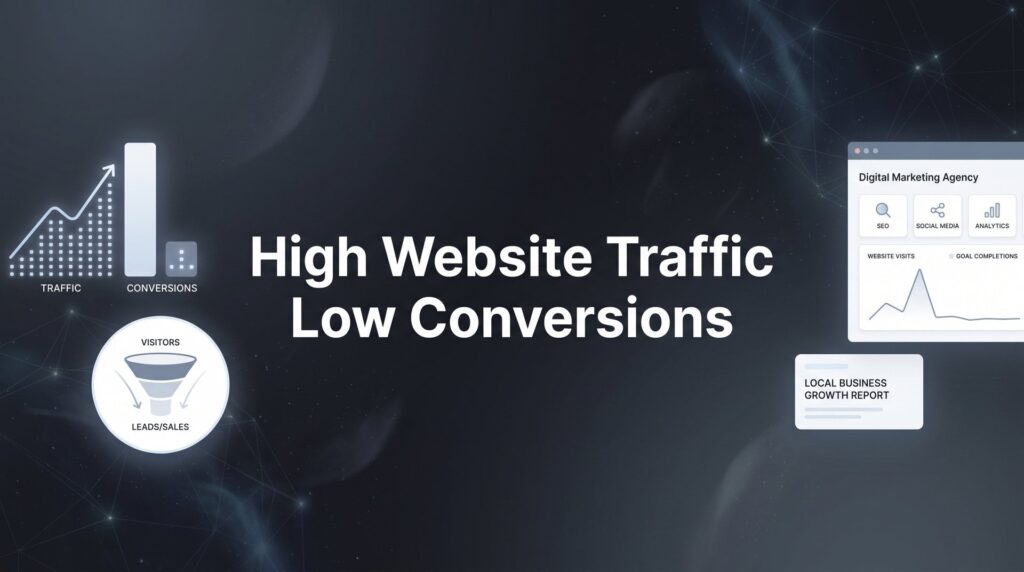
You open Google Analytics, and the numbers look impressive. Thousands of visitors every month, steady traffic growth, maybe even a top-three ranking for a competitive keyword. You should feel good about this. So why does your phone barely ring, and why are leads trickling in at a pace that makes you question everything you’re spending on marketing?
This is one of the most common and quietly devastating problems in digital marketing. High website traffic with low conversions creates a false sense of momentum. You see the visitors, you assume the marketing is working, and you keep investing, but the revenue never materializes the way it should. For local businesses spending real money on Google Ads or SEO, this gap between traffic and results isn’t just frustrating. It’s expensive.
The good news is that this problem is almost always diagnosable and fixable. It just requires looking at the right things. Traffic volume tells you people found you. Conversions tell you whether they cared enough to act. Those are two very different stories, and most businesses only pay attention to the first one. This article breaks down exactly why the gap exists, where the leaks are hiding, and what you can do to close them.
Traffic Is Not the Goal: Understanding What the Numbers Actually Mean
There’s a reason marketers talk about “vanity metrics,” and traffic volume is the classic example. A high visitor count feels like proof that your marketing is working. It’s a number that goes up, and going up feels like progress. But traffic by itself has zero correlation with revenue unless those visitors are the right people, landing in the right place, at the right moment in their buying journey.
Think of it this way. Imagine a physical store on a busy street. Thousands of people walk past every day. Some glance in the window. A few step inside. Even fewer actually buy something. Now imagine you could filter that foot traffic so that only people actively shopping for exactly what you sell walked through the door. The total number of visitors would drop dramatically, but your sales would climb. That’s the difference between traffic quantity and traffic quality.
The metric that actually connects your website to your business outcomes is conversion rate: the percentage of visitors who take a meaningful action, whether that’s filling out a contact form, calling your number, booking an appointment, or making a purchase. A site with 3,000 monthly visitors converting at 5% generates 150 leads. A site with 10,000 visitors converting at 1% generates 100. More traffic, fewer results. Mastering website conversion rate optimization is what separates businesses that grow from those that stagnate.
Search intent is the underlying driver of this problem. Not everyone who lands on your site is a potential buyer. Some are doing research. Some are students or competitors. Some stumbled in from a loosely related search and will leave in seconds. When your traffic strategy optimizes for volume rather than intent, you end up with an audience that was never going to convert in the first place. The visitor count looks great in a monthly report, but the leads column stays empty.
Conversion rate is the true measure of marketing effectiveness. It tells you whether your traffic strategy, your messaging, and your user experience are actually working together. Before you spend another dollar driving more visitors to your site, it’s worth understanding why the ones already arriving aren’t taking action.
Six Reasons Your Visitors Are Leaving Without Converting
When high website traffic produces low conversions, the cause is rarely a single problem. It’s usually a combination of issues working against you simultaneously. Here are the six most common culprits, and recognizing them is the first step toward fixing them.
Wrong Audience Entirely: If your keyword strategy or ad targeting is too broad, you’re attracting people who were never going to become customers. A plumber ranking for “how to fix a leaky faucet” is pulling in DIY searchers, not people ready to hire someone. Broad match keywords in Google Ads are notorious for this, surfacing your ads for searches that are tangentially related at best. Learning how to attract high quality leads starts with targeting the right intent from the beginning.
Weak or Missing Calls-to-Action: Visitors need to be told what to do next. If your page doesn’t have a clear, prominent CTA, most people will simply leave. “Learn More” is not a call-to-action. “Call Now for a Free Quote” is. The difference in conversion rates between a vague button and a specific, benefit-driven one can be dramatic.
Confusing Navigation and Page Structure: If a visitor has to think too hard about where to go or what to click, they’ll leave. Poor site architecture, cluttered layouts, and buried contact information all create friction that kills conversions. People don’t read websites the way they read books. They scan, and if they don’t immediately find what they need, they’re gone.
Slow Page Speed: Every additional second of load time costs you visitors. This is especially true on mobile, where patience is shorter and connections can be slower. Google has published research on this relationship, and the consistent finding is that slower pages produce higher bounce rates. If your site takes more than three seconds to load, you’re losing a meaningful portion of your traffic before they even see your offer.
Non-Mobile-Friendly Design: The majority of local searches happen on mobile devices. If your site isn’t optimized for a phone screen, with tap-friendly buttons, readable text, and a layout that doesn’t require zooming, you’re creating a frustrating experience for the visitors most likely to convert. A click-to-call button that works on desktop but is buried on mobile is a conversion killer for local service businesses.
Missing Trust Signals: People don’t hand over their contact information or money to businesses they don’t trust. If your site has no reviews, no credentials, no photos of real work, and no clear indication of who you are and why you’re credible, visitors will hesitate. For local businesses especially, social proof is a conversion lever that many owners consistently underestimate.
Is Your Traffic Even the Right Traffic?
Before you overhaul your landing pages or start A/B testing headlines, spend time auditing where your traffic is actually coming from and what those visitors are doing when they arrive. This is where most businesses find their biggest conversion problems hiding.
In Google Analytics, break down your traffic by source: organic search, paid search, social media, direct, and referral. Then look at the behavior metrics for each channel separately. Bounce rate, pages per session, and time on site give you a rough picture of engagement quality. More importantly, look at goal completions or conversion events by channel. Setting up proper Google Analytics for conversion tracking is essential before you can make any data-driven decisions about your traffic quality.
For businesses running Google Ads, traffic quality issues are often rooted in campaign structure. Broad match keywords are the most common culprit. They sound efficient because they reach a wide audience, but that audience frequently has nothing to do with what you’re selling. A roofing company using broad match for “roof” might show ads to people searching for “roof rack for car” or “how to build a roof in Minecraft.” Every one of those clicks costs money and converts at zero.
Negative keyword lists are the fix for this, and they’re chronically underused. By telling Google which searches should never trigger your ads, you filter out irrelevant traffic before it hits your site. For local businesses, geo-targeting settings deserve equal attention. If your service area is a 30-mile radius around one city but your ads are showing statewide or nationally because of a targeting oversight, you’re paying for clicks from people you can never actually serve. This is one of the most common reasons why ads spend too much with no results.
On the organic side, the issue is often ranking for informational keywords when you need commercial-intent traffic. Informational queries, the “how to,” “what is,” and “why does” searches, attract people in research mode, not buying mode. Commercial-intent keywords signal that someone is closer to making a decision. Phrases like “best [service] in [city],” “[service] near me,” or “[service] cost” indicate a visitor who is evaluating options and ready to act. If your SEO strategy is built around traffic volume rather than intent, you may be winning the traffic game while losing the revenue game entirely.
Your Landing Page Is Where Leads Go to Die: A Diagnostic Walkthrough
Even with perfectly targeted traffic, a weak landing page will drain your conversions. The page a visitor lands on after clicking an ad or a search result has one job: turn that click into a lead or a sale. Most landing pages fail at this job for predictable, fixable reasons. Understanding what makes a high converting landing page is the foundation for fixing these issues.
Start with the headline. Does it immediately communicate what you offer and who it’s for? A visitor should be able to tell within three seconds whether they’re in the right place. If your headline is vague, generic, or focused on your company name rather than the visitor’s need, you’ve already lost most of them. The headline sets the tone for everything that follows.
Next, look at what’s visible above the fold, meaning what a visitor sees before they scroll. Your core value proposition, your primary CTA, and at least one trust signal should all be present without requiring any scrolling. If a visitor has to hunt for a reason to stay or a way to contact you, most won’t bother.
Form length is another common conversion killer. Every additional field you add to a contact form reduces the percentage of people who complete it. For most local service businesses, name, phone number, and a brief description of the need is sufficient to initiate a conversation. If your form abandonment rate is too high, stripping out unnecessary fields is often the fastest fix available.
One of the most powerful diagnostic tools available is a heatmap or session recording tool. Products like Hotjar or Microsoft Clarity let you watch how real visitors interact with your pages. You’ll see where they click, where they stop scrolling, and where they seem to get confused or frustrated. This data often reveals conversion problems that no amount of guesswork would uncover. You might discover that visitors are clicking on an image that isn’t a link, or that they’re abandoning the page right at the form, or that a key section of content is being completely ignored.
Message match deserves special attention. This is the principle that the promise made in your ad or search result snippet must align precisely with what the landing page delivers. If your ad says “Same-Day HVAC Repair” but the landing page is a generic homepage about your company history, there’s a disconnect. The visitor expected one thing and found another, and that mismatch produces an immediate bounce. Every traffic source should have a corresponding landing page that continues the exact conversation the visitor started before they clicked.
Conversion Rate Optimization Fixes That Produce Real Results
Once you’ve identified where the leaks are, the next step is systematic repair. Conversion rate optimization isn’t about making your website prettier. It’s about removing friction, building trust, and making it as easy as possible for a motivated visitor to take the next step. Here are the changes that tend to move the needle most for local businesses.
Simplify Your Forms: As mentioned above, shorter forms convert better. If you’re worried about lead quality, you can qualify prospects in the follow-up conversation rather than on the form itself. Start with the minimum information needed to make contact, and you’ll see form completion rates improve.
Add a Click-to-Call Button: For local service businesses, the phone call is often the highest-value conversion. A prominent, tap-to-call button that’s easy to find on mobile is one of the simplest and highest-impact changes you can make. It should be visible without scrolling on every key page of your site.
Use Urgency and Scarcity Appropriately: When it’s genuine, urgency works. “Only 3 spots available this week” or “Free estimates through Friday” can push a hesitant visitor toward action. The key word is genuine. Fake urgency erodes trust quickly, and trust is harder to rebuild than it is to maintain.
A/B Test Your Headlines: Your headline is the highest-leverage element on any page. Small changes in wording can produce meaningful differences in conversion rate. Running multivariate testing for landing pages lets you test multiple elements simultaneously and find the combination that converts best.
Load Social Proof Prominently: Reviews, testimonials, star ratings, certifications, and before/after photos all serve the same function: they reduce the perceived risk of choosing you. For local businesses, Google reviews displayed on your website carry particular weight because visitors recognize and trust the platform. Don’t bury this content at the bottom of the page. Bring it up close to your primary CTA where it can do its job.
Improve Page Load Speed: Compress images, minimize unnecessary scripts, and consider a content delivery network if your hosting is slow. Tools like Google PageSpeed Insights give you a free, specific list of what’s slowing your site down and how to fix it. Even modest speed improvements can reduce bounce rates and keep more visitors engaged long enough to convert.
When DIY Optimization Hits Its Ceiling
There’s a point in every business’s conversion optimization journey where the low-hanging fruit has been picked and the remaining problems require a different level of expertise. Knowing when you’ve reached that point can save you months of frustration and wasted budget.
Some signs that it’s time to bring in professional help: your conversion rate has plateaued despite multiple rounds of changes; you’re not sure whether your conversion tracking is even set up correctly; your Google Ads campaigns are spending but the leads aren’t matching the reported conversions; or you’re making decisions based on instinct rather than data because you don’t have the tools or time to analyze the data properly. Reviewing the best CRO optimization services can help you find the right partner for this stage.
What a results-driven agency does differently isn’t magic. It’s methodology. A professional CRO and paid media team starts with proper tracking setup, because you can’t optimize what you can’t measure accurately. They audit traffic sources to identify which channels are delivering actual buyers versus browsers. They run structured A/B tests with clear hypotheses and sufficient sample sizes. And critically, they’re accountable to revenue metrics, not just traffic or click-through rates.
This is exactly how Clicks Geek approaches the traffic-to-conversion problem. As a Google Premier Partner agency, the focus has never been on driving traffic for its own sake. The focus is on building systems that turn qualified visitors into leads and leads into revenue. That means looking at the entire funnel: the targeting, the ads, the landing pages, the follow-up, and the tracking that ties it all together. Understanding what performance based marketing looks like in practice helps business owners set the right expectations for agency partnerships.
Local businesses in particular benefit from this kind of specialized attention because the stakes are high and the margins for error are low. A national e-commerce brand can absorb wasted ad spend more easily than a local contractor or service provider who’s paying for every click out of a tight marketing budget. Getting the conversion side of the equation right isn’t optional at that scale. It’s the difference between a marketing investment that pays for itself and one that quietly drains resources month after month.
Putting It All Together: Stop Celebrating Traffic, Start Measuring Results
High website traffic with low conversions is a solvable problem. But solving it requires an honest look at what’s actually happening, not just what the top-line numbers suggest. Traffic volume tells you one small part of the story. The rest of the story lives in your conversion rate, your traffic quality, your landing page experience, and your ability to systematically test and improve each of those elements.
The areas to investigate are clear: Are you attracting the right visitors, people with genuine buying intent, or are you pulling in browsers and researchers who were never going to call? Are your landing pages doing their job, with clear headlines, prominent CTAs, trust signals, and a mobile experience that doesn’t frustrate people? And are your CRO fundamentals in place, from fast load times to social proof to forms that don’t ask for more than they need?
Every one of these issues is fixable. But fixing them requires data, testing, and a willingness to stop guessing. The businesses that close the traffic-to-conversion gap aren’t the ones who drive more traffic. They’re the ones who take what they already have and make it work harder.
If you want to see what this would look like for your specific business, Clicks Geek will walk you through exactly where your leads are being lost and what it would take to recover them. No generic advice, no vanity metrics, just a clear-eyed look at your funnel and a realistic plan to make your marketing budget produce the revenue it should.