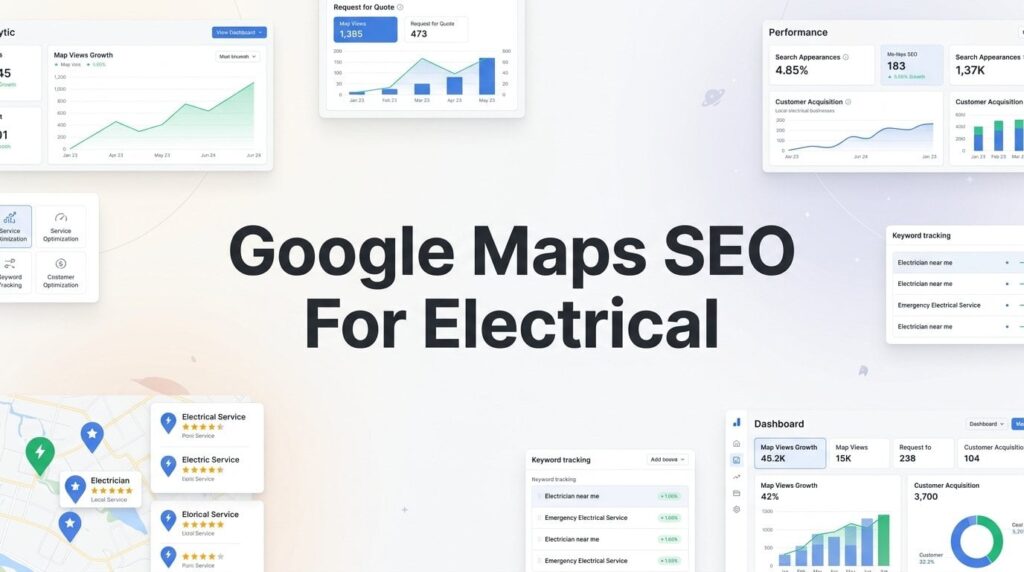
When someone’s breaker trips at 9 PM or they’re planning a panel upgrade before selling their home, they’re not scrolling through a website directory or asking neighbors for recommendations. They open Google, type “electrician near me,” and call whoever shows up first. That first result is almost always the Google Maps Local Pack, and the businesses sitting in those top three spots are capturing the calls, the quotes, and the jobs.
If your electrical contracting business isn’t in that pack, you’re not losing to better electricians. You’re losing to electricians who understand how Google Maps SEO works. That’s a fixable problem, and it’s the entire focus of this guide.
Google Maps SEO for electrical contractors operates differently from traditional search engine optimization. The ranking factors are distinct, the competition is hyperlocal, and the commercial intent of searchers is unusually high. Someone searching “electrical panel replacement in [your city]” isn’t browsing. They’re ready to hire. This guide walks through the specific levers that move your business up in the Map Pack: your Google Business Profile, reviews, citation consistency, and the website signals that most electricians overlook entirely. Each section gives you concrete actions, not vague advice about “being online.”
The Local Pack: Prime Real Estate for Electrical Contractors
Before diving into tactics, it’s worth understanding exactly what you’re competing for. The Google Local Pack, also called the Map Pack, is the block of three business listings that appears above the traditional organic search results for local service queries. It includes a map, star ratings, phone numbers, hours, and a direct link to the business profile. On mobile, it’s often the only thing a searcher sees without scrolling.
This positioning matters enormously. Organic results appear below the Map Pack, meaning even if your website ranks on page one, it’s still below three competitors who have Map Pack placement. The Map Pack is the first interaction point, and in a service category like electrical work, first interaction usually means first call.
Google’s local search algorithm is separate from its organic ranking algorithm, and this distinction changes your strategy entirely. According to Google’s own documentation, local rankings are determined by three factors: Relevance (how well your listing matches what the searcher is looking for), Distance (how close your business is to the searcher or the location they specified), and Prominence (how well-known and trusted your business appears based on reviews, links, and citations).
You can’t control distance in any meaningful way, but relevance and prominence are entirely within your reach. Relevance is shaped by how accurately and completely you describe your services. Prominence is built through reviews, consistent business information across the web, and your website’s authority. Every tactic in this guide traces back to one of those two factors.
There’s also a commercial intent advantage worth naming directly. Someone searching “electrician near me” or “EV charger installation [city]” is not researching. They’re buying. The Map Pack captures these high-intent searchers at the exact moment they’re ready to make a decision, which is why visibility here translates to booked jobs more directly than almost any other marketing channel. Getting this right isn’t a branding exercise. It’s a revenue driver.
One additional note: Local Service Ads (LSAs) now appear above the traditional Map Pack in many markets. These are paid placements, separate from organic Maps rankings. If you’re running LSAs alongside organic Map Pack optimization, you can occupy multiple positions on the page simultaneously. But even without paid ads, the organic Map Pack remains the most valuable unpaid position in local search.
Your Google Business Profile: Getting the Foundation Right
Your Google Business Profile (GBP) is the single most important asset in your Google Maps SEO strategy. Think of it as your storefront on Google’s platform. Everything else you do either supports or undermines what happens here. Most electrical contractors have a GBP set up, but very few have it optimized correctly.
Start with your primary category. This is one of the highest-impact decisions you’ll make in your entire GBP setup. For most electrical contractors, the correct primary category is simply “Electrician.” It’s specific, widely recognized by Google’s algorithm, and matches the exact search terms your prospects are using. Don’t get creative here. Choosing a broader category like “Home Services” or “Contractor” dilutes your relevance signal for the searches that matter most.
Secondary categories give you room to expand your relevance footprint. Depending on your service mix, consider adding “Electrical installation service,” “Generator shop,” “Lighting contractor,” or “Solar energy company” if applicable. These secondary categories help your profile surface for more specific service searches without weakening your primary positioning.
NAP consistency deserves its own attention. Your Name, Address, and Phone number must be exactly identical across your GBP, your website, and every online directory where your business appears. Not roughly the same. Exactly the same. “St.” vs. “Street,” a missing suite number, or a slightly different phone format are all inconsistencies that create confusion for Google and can suppress your ranking. Set a standard format and apply it everywhere.
Beyond the basics, most electricians leave significant ranking potential on the table by ignoring the profile features that actually differentiate strong profiles from weak ones. The Services section is one of the most underused. Add every service you offer with a real description: not just “panel upgrade” but a sentence or two explaining what it involves, who needs it, and where you provide it. This is keyword-rich content that Google indexes directly from your profile.
Photos matter more than most electricians expect. Google’s algorithm treats photo uploads as an engagement and activity signal. Upload real job photos regularly: before-and-after panel replacements, completed EV charger installs, generator setups. These images also build trust with prospective customers who are evaluating your work before calling. Stock photos won’t cut it here.
Your business description is prime real estate for natural keyword inclusion. Write it to describe who you serve, what you do, and where you operate. Mention your service areas, your specialties, and any credentials that matter to your customers. Keep it readable, not stuffed with keywords, but make sure the language reflects how your customers actually search.
Finally, review the Attributes section of your GBP. Options like “Licensed,” “Insured,” “Veteran-led,” and “Women-led” are trust signals that influence both how Google categorizes your business and how prospective customers perceive you. Select every attribute that accurately applies. These small checkboxes carry more weight than most electricians realize.
Reviews: The Ranking Signal That Keeps Paying Off
Reviews are where many electrical contractors either pull ahead of their competition or quietly fall behind. Google’s own documentation confirms that review count, score, and recency all factor into local ranking. That last word, recency, is the one most businesses get wrong.
A business with 200 reviews from three years ago and nothing recent is less competitive than a business with 50 reviews that includes a steady stream of new ones from the past few months. Google interprets recent review activity as a signal that the business is active and that customers are engaging with it. A one-time push to collect reviews, followed by months of silence, is far less effective than a consistent system that generates a few new reviews every week.
Building that system doesn’t require complicated software. It requires process. The most effective moment to ask for a review is immediately after job completion, while the customer’s satisfaction is at its peak. Train your technicians to make the verbal ask as a natural part of the job close: something simple and direct, like “If everything looked good today, it would really help us out if you left us a quick Google review. I’ll text you the link right now.” That combination of a verbal prompt and an immediate direct link removes every possible friction point.
The direct review link is essential. Sending customers to your Google profile homepage and asking them to navigate to the review section results in significant drop-off. Generate a direct review link from your GBP dashboard and use it in every follow-up text. The fewer clicks between the ask and the review form, the higher your conversion rate on review requests.
Here’s a tactic most electricians skip entirely: responding to reviews. Every review, positive or negative, deserves a response. For positive reviews, thank the customer by name, mention the specific service performed, and reference the location if it’s a different service area. This naturally works relevant keywords into your profile activity without any awkwardness. For negative reviews, respond professionally, acknowledge the concern, and offer to resolve it offline. Prospective customers read your responses as carefully as they read the reviews themselves, and a thoughtful response to a complaint often builds more trust than a perfect five-star rating.
Review responses also signal to Google that your business is active and engaged with customers. An optimized profile that goes weeks without any activity, no new reviews, no responses, no photo uploads, is a profile that Google has less reason to prioritize.
Citations and NAP Consistency: The Infrastructure Beneath Everything
Citations are any online mention of your business name, address, and phone number. They appear on directories, review platforms, local business listings, and industry-specific sites. For Google Maps SEO, citations serve as a verification and trust signal. When Google sees your business information listed consistently across dozens of reputable sources, it becomes more confident that your business is legitimate, established, and correctly located.
The flip side is equally true: inconsistent citations actively hurt your ranking. If your address appears as “Suite 100” on your GBP but “Ste. 100” on Yelp and without any suite number on Angi, Google sees three different versions of your business information. That inconsistency creates ambiguity, and Google responds by reducing its confidence in your listing, which translates to lower placement in the Map Pack.
For electrical contractors, the highest-value citation sources include the general directories most local businesses should be on: Yelp, Angi, HomeAdvisor, Houzz, Thumbtack, and the Better Business Bureau. But the sources with the strongest authority signals for electricians specifically go beyond these. Your state’s electrical licensing board directory is one of the most credible citations you can have, because it’s a government source confirming your legitimacy in the trade. NECA (National Electrical Contractors Association) member directories carry similar authority. Local Chamber of Commerce listings and city business directories add geographic relevance that reinforces your local prominence.
The practical challenge is that most electrical businesses have accumulated citations over time without managing them carefully. Phone numbers change, addresses move, and old listings stick around with outdated information. Auditing your existing citations is often one of the fastest wins available in a Maps SEO strategy, because fixing existing errors doesn’t require creating new content or waiting for new reviews. It’s a cleanup job with a direct ranking payoff.
Tools like BrightLocal and Whitespark can scan the web for your existing citations, surface inconsistencies, and help you correct them systematically. Running this audit once and then maintaining consistency going forward is the approach that works. Treat your NAP information like a legal document: every version of it, everywhere it appears, should be identical.
Website Signals: The Connection Most Electricians Miss
Here’s something that doesn’t get enough attention in most Google Maps SEO guides: your website directly influences your Maps ranking. Many electricians optimize their GBP carefully and then wonder why they’re still not ranking. Often, the answer is a weak or generic website that’s undermining the relevance and prominence signals the GBP is trying to send.
Google uses your website as a trust and relevance verification tool. When someone searches “electrical panel upgrade in [city],” Google checks whether your GBP claims this service and whether your website confirms it with real, substantive content. A thin five-page website with no location-specific information and no detailed service descriptions leaves Google without the supporting evidence it needs to rank your business confidently.
The most effective website structure for supporting Maps rankings includes location-specific service pages. Each page should target a specific city or service area where you work, include your business address and an embedded Google Map, and contain genuinely useful content about the specific service in that area. Not templated copy where you’ve swapped out the city name. Real content that addresses what customers in that area typically need, what the process looks like, and why your business is the right choice.
For an electrical contractor serving multiple suburbs or neighborhoods, this means building individual pages for each service area rather than a single generic “service areas” page. It’s more work upfront, but each page becomes an additional relevance signal that reinforces your GBP’s geographic claims.
Schema markup is another website element that most electrical contractors haven’t implemented. Schema is structured code that helps Google understand exactly what your business is and what it does. Adding LocalBusiness schema, and more specifically the Electrician subtype from Schema.org’s HomeAndConstructionBusiness vocabulary, tells Google’s algorithm in explicit terms that you are an electrician, where you’re located, and what your hours and contact information are. It’s not a magic ranking bullet, but it reinforces the relevance signals your GBP is already sending and reduces any ambiguity Google might have about your business type.
Your website’s overall authority also matters. Earning links from local news sites, community organizations, trade associations, and other reputable local sources builds the prominence signal that Google’s algorithm weighs in local rankings. This is a longer-term effort, but it compounds over time in ways that pure GBP optimization cannot replicate on its own.
Your Prioritized Action Plan: Where to Start and What to Sustain
If you’re looking at everything covered in this guide and wondering where to begin, the answer is straightforward: start with what delivers the fastest results and build toward the longer-term plays.
Immediate priority: GBP optimization. Audit your Google Business Profile against everything in this guide. Correct your primary category, add secondary categories, fill out every service with a real description, upload job photos, and complete every attribute that applies to your business. This is a few hours of work that can produce ranking movement within weeks.
Immediate priority: Review generation system. Build the process for consistently collecting reviews. Train your technicians, create your direct review link, and set up a simple follow-up text workflow. Consistency here matters more than volume in a single push. Ten new reviews a month for six months outperforms sixty reviews collected in one week.
Short-term priority: Citation audit and cleanup. Run your business through a citation audit tool, identify inconsistencies, and correct them. This is a foundational fix that removes a drag on your ranking without requiring ongoing effort once it’s done.
Longer-term play: Location pages and website development. Building out location-specific service pages and implementing schema markup takes more time and often benefits from professional help, but it’s the work that creates compounding results over months and years.
The competitive reality in most metro markets is that the gap between ranking first and ranking fourth in the Map Pack isn’t usually about one thing. It’s about consistent execution across all of these areas over time. Many electrical businesses start strong and then let their profiles go stale, stop asking for reviews, and never address their website’s weaknesses. That inconsistency is exactly what creates the opening for a competitor who stays disciplined.
Running a successful electrical business is a full-time job. Managing a Maps SEO strategy that actually produces results is another one. That’s why many electrical contractors who are serious about growth work with a specialized agency rather than trying to handle it alongside everything else on their plate. If you want to see what this would look like for your specific market, Clicks Geek can walk you through exactly what’s realistic, what your competition is doing, and what it would take to move your business into the top of the Map Pack and keep it there.