The paid advertising debate keeps local business owners up at night: should you invest in Google Ads or Facebook Ads for lead generation? The honest answer is that it depends—on your industry, budget, sales cycle, and target customer. Both platforms generate billions in revenue for businesses worldwide, but choosing the wrong one for YOUR specific situation burns through marketing budgets fast.
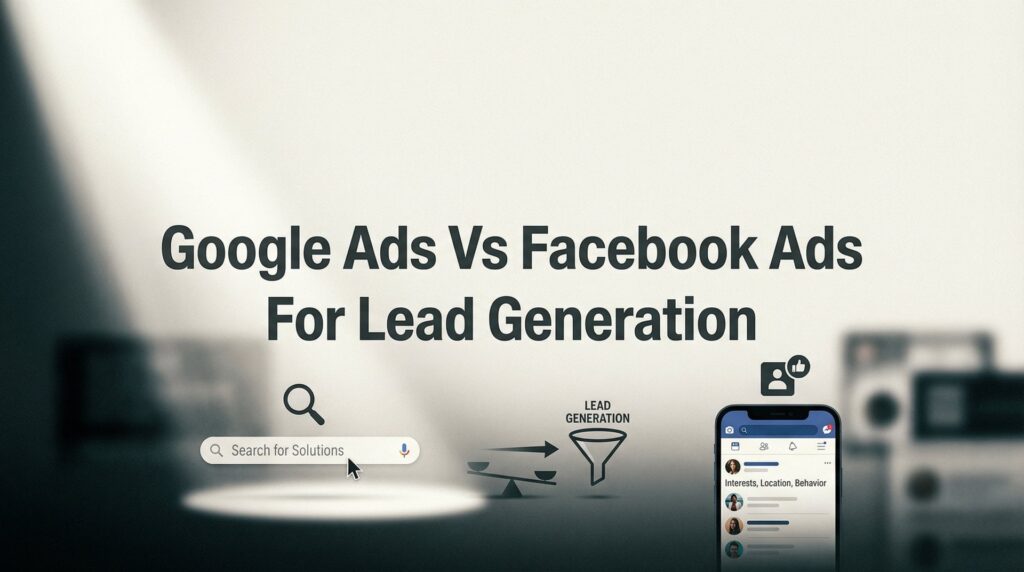
Here’s what makes this decision so challenging: Google Ads captures people actively searching for solutions right now, while Facebook Ads reaches potential customers based on who they are and what they’re interested in. One operates on intent, the other on interruption. Both can flood your business with leads—or drain your account with zero results.
This guide cuts through the noise with 7 battle-tested strategies to help you make the right choice (or smart combination) for your lead generation goals. Whether you’re a service-based business chasing high-intent leads or building brand awareness in a competitive local market, these strategies will help you allocate your ad spend where it actually converts.
1. Match Your Platform to Buyer Intent Level
The Challenge It Solves
Most businesses waste thousands on the wrong platform because they don’t understand where their prospects are in the buying journey. Advertising emergency plumbing services to someone casually scrolling Facebook at midnight delivers terrible results. Similarly, trying to introduce a complex financial service through a text-only search ad misses the mark entirely.
The disconnect happens when you assume all leads are created equal. They’re not. Someone typing “emergency AC repair near me” at 2 AM has completely different intent than someone who might need HVAC maintenance eventually.
The Strategy Explained
Google Ads dominates when prospects actively search for immediate solutions. Think emergency services, urgent repairs, legal help needed now, or any situation where someone knows exactly what they need and wants it fast. These searchers type specific keywords with commercial intent, ready to make decisions quickly.
Facebook Ads excels when you need to introduce your service, educate prospects, or reach people who don’t yet know they need what you offer. This platform works brilliantly for services with longer consideration periods, lifestyle products, or anything requiring visual demonstration and storytelling to build interest over time.
Implementation Steps
1. Map out your typical customer journey from first awareness to purchase decision, noting how long each stage takes and what triggers movement to the next phase.
2. Identify whether most customers find you because they’re actively searching for solutions (high intent) or because they discovered they needed your service after learning about it (low initial intent).
3. Start with Google Ads if your service solves immediate problems or fulfills urgent needs, and Facebook Ads if you need to build awareness and educate prospects before they’re ready to buy.
Pro Tips
Emergency and time-sensitive services almost always perform better on Google initially. However, even high-intent businesses benefit from Facebook for building brand recognition that increases conversion rates when those same prospects later search on Google. The platforms complement each other when used strategically.
2. Analyze Your Sales Cycle Length
The Challenge It Solves
Your sales cycle length dramatically impacts which platform delivers profitable leads. Short sales cycles need different advertising approaches than long consideration purchases. Many businesses burn budgets on Facebook trying to generate instant leads for services that require multiple touchpoints and nurturing, while others miss opportunities by limiting themselves to Google when their prospects need education before converting.
The problem intensifies when you measure success too early or too late in the cycle. A platform might generate cheaper leads initially but terrible conversion rates, or expensive leads that close at much higher rates.
The Strategy Explained
Services with sales cycles under a week typically see stronger performance from Google Ads. When customers make quick decisions—like booking a locksmith, ordering takeout, or scheduling a one-time service—search intent converts immediately. These prospects want solutions now, not next month.
Longer sales cycles spanning weeks or months benefit from Facebook’s ability to stay visible throughout the consideration phase. Complex services, high-ticket offerings, or purchases requiring multiple decision-makers need repeated exposure and nurturing. Facebook’s targeting allows you to build relationships over time through content that educates and builds trust.
Implementation Steps
1. Calculate your average sales cycle by tracking the time between first contact and closed deal across your last 50 customers, identifying the median timeframe rather than just the average.
2. For sales cycles under 7 days, prioritize Google Ads budget to capture ready-to-buy searchers at the moment of highest intent.
3. For sales cycles exceeding 14 days, allocate more budget to Facebook for building awareness and nurturing prospects through educational content, case studies, and social proof that moves them toward purchase readiness.
Pro Tips
Track leads by platform through your entire sales cycle, not just to initial contact. Many businesses discover that Facebook generates cheaper leads initially, but Google leads close faster and at higher rates. The true cost per acquisition often tells a completely different story than cost per lead alone.
3. Calculate Your True Cost Per Lead Threshold
The Challenge It Solves
Chasing the cheapest cost per lead destroys profitability faster than almost any other marketing mistake. A platform delivering leads at $15 each sounds better than one charging $75 per lead—until you realize the cheaper leads never convert to paying customers. This trap catches businesses constantly, especially when comparing platforms without understanding lead quality differences.
The real problem emerges when you optimize for the wrong metric. Cost per lead means nothing without knowing lead quality, conversion rates, and customer lifetime value. You need a profitability threshold, not just a vanity metric.
The Strategy Explained
Your maximum profitable cost per lead depends entirely on your customer lifetime value and conversion rates, not industry benchmarks or what competitors claim they’re paying. Start by calculating what you can afford to pay for a customer, then work backward based on your typical lead-to-customer conversion rate.
Google Ads often delivers higher-quality leads at higher costs because search intent filters out tire-kickers. Facebook typically generates cheaper leads in higher volume, but conversion rates may be lower because you’re reaching people earlier in their buying journey. Neither approach is inherently better—it depends on your math.
Implementation Steps
1. Calculate your customer lifetime value by multiplying average purchase value by average number of purchases over the customer relationship, then subtract your cost of goods and service delivery.
2. Determine your acceptable customer acquisition cost by deciding what percentage of customer lifetime value you’re willing to invest in marketing (typically 20-30% for sustainable growth).
3. Divide your maximum customer acquisition cost by your historical lead-to-customer conversion rate to find your true maximum cost per lead threshold for each platform.
Pro Tips
Track lead quality by source religiously. Create separate tracking for Google leads versus Facebook leads through your CRM, measuring not just conversion rates but also average deal size and customer lifetime value. Many businesses discover one platform delivers cheaper leads while the other delivers more valuable customers, completely changing the profitability equation.
4. Leverage Audience Targeting Strengths
The Challenge It Solves
Each platform targets audiences in fundamentally different ways, and using the wrong approach for your business model wastes money targeting people who’ll never convert. Google reaches people based on what they’re actively searching for right now. Facebook reaches people based on who they are, what they like, and their behaviors. Misunderstanding these differences leads to campaigns that miss your ideal customers entirely.
The targeting mismatch becomes expensive when you try to force a platform to do something it’s not designed for. Attempting to reach a hyper-specific demographic through Google search ads costs more and performs worse than Facebook’s demographic targeting, while trying to capture high-intent searchers on Facebook requires massive retargeting budgets.
The Strategy Explained
Google Ads dominates when your ideal customer can be identified by what they’re searching for. Keyword intent reveals exactly what someone needs right now. If you can describe your perfect customer by the problems they’re trying to solve or solutions they’re actively seeking, Google’s search targeting captures them at peak buying intent.
Facebook Ads excels when your ideal customer can be identified by demographic characteristics, interests, behaviors, or life events. If you target “homeowners aged 35-55 in specific zip codes” or “people interested in fitness who recently got engaged,” Facebook’s detailed targeting options reach these audiences with precision that Google can’t match through search alone.
Implementation Steps
1. Write detailed descriptions of your ideal customer, noting both their demographic characteristics (age, location, income, interests) and their search behaviors (what problems they search for, what questions they ask).
2. Choose Google Ads when your customer definition centers on search intent and specific problems they’re actively trying to solve right now.
3. Choose Facebook Ads when your customer definition centers on demographic characteristics, interests, life stages, or behaviors that don’t necessarily correlate with active searching.
Pro Tips
The most sophisticated lead generation strategies use both platforms for their respective strengths. Facebook builds custom audiences based on demographics and interests, then retargets those engaged users with Google search ads when they later search for related solutions. This combination captures both audience specificity and search intent for maximum conversion rates.
5. Test Creative Formats Against Your Offer Type
The Challenge It Solves
Your service complexity determines which ad format converts best, but most businesses default to whatever format they’re comfortable creating rather than what actually drives leads. Simple, straightforward services get buried in visual complexity on Facebook, while complex offerings fail to convert through text-only Google search ads that can’t adequately explain the value proposition.
The format mismatch becomes obvious in your conversion rates. Beautiful Facebook video ads for emergency locksmith services underperform simple Google text ads, while complex consulting services struggle to convert through basic search ads that can’t demonstrate expertise or build trust visually.
The Strategy Explained
Google’s text-based search ads work brilliantly for straightforward services with clear value propositions. When someone searches “plumber near me” or “divorce attorney,” they don’t need visual storytelling—they need immediate answers about availability, pricing, and credentials. The text format matches the urgency and directness of high-intent searches.
Facebook’s visual formats (images, videos, carousels) excel for services requiring explanation, demonstration, or emotional connection. Complex offerings, before-and-after transformations, lifestyle services, or anything benefiting from visual proof needs Facebook’s creative canvas to communicate value effectively and build the trust required for conversion.
Implementation Steps
1. Evaluate your service complexity by determining how many questions prospects typically ask before buying and whether visual demonstration helps explain your value proposition.
2. Start with Google search ads if your service can be explained in 90 characters or less and prospects make quick decisions based on availability, location, and basic credentials.
3. Prioritize Facebook’s visual formats if your service requires showing results, demonstrating processes, or building emotional connections that text alone can’t accomplish effectively.
Pro Tips
Test lead form ads on both platforms regardless of your primary strategy. Google’s lead form extensions and Facebook’s lead generation ads both reduce friction by keeping prospects on the platform. These formats often outperform traditional landing page approaches, especially for mobile users who hate filling out forms on small screens.
6. Evaluate Local Market Competition
The Challenge It Solves
Your local market competition level dramatically impacts which platform delivers better ROI, but most businesses jump into advertising without researching where their competitors are already spending heavily. Entering an oversaturated market on the wrong platform means paying premium prices for clicks while better opportunities exist elsewhere. Understanding competitive dynamics helps you find the path of least resistance to profitable leads.
The competitive landscape shifts constantly. A platform that worked brilliantly last year might be saturated now, while the other platform offers untapped opportunity. Ignoring these shifts means fighting expensive battles you don’t need to fight.
The Strategy Explained
Research competitor ad presence on both platforms before committing your budget. High competition on Google search drives up cost per click significantly, especially for commercial keywords in established industries. If every competitor in your area runs Google Ads aggressively, you’ll pay premium prices for visibility unless you have a substantial budget to compete.
Facebook competition varies by how saturated your local market is with businesses targeting the same demographics. Less competition often exists on Facebook for traditional service businesses because many still focus exclusively on Google. This creates opportunities to reach potential customers at lower costs before they start actively searching for solutions.
Implementation Steps
1. Search your primary service keywords on Google and note how many ads appear, whether competitors dominate the top positions, and if local service ads fill the entire first screen.
2. Check Facebook’s Ad Library to see which local competitors are running active campaigns, how long they’ve been running (indicating success), and what messaging they’re using.
3. Allocate more initial budget to whichever platform shows less competitive saturation in your specific market, allowing you to establish presence at lower costs before competitors flood that channel.
Pro Tips
Geographic targeting on Facebook often reveals unexpected opportunities. While your immediate city might be saturated with competitors, expanding your radius to surrounding areas frequently uncovers less competitive markets with similar customer profiles. Google’s local service area targeting works similarly—sometimes slightly expanding your service area dramatically reduces competition and costs.
7. Build a Hybrid Strategy for Maximum Lead Flow
The Challenge It Solves
The Google versus Facebook debate creates a false choice that limits your lead generation potential. Most businesses eventually discover that using both platforms strategically generates more total leads at lower overall cost than going all-in on either platform alone. The challenge is understanding how to allocate budget between them and how they complement each other rather than compete.
Single-platform strategies leave money on the table. Google captures only those actively searching right now, missing everyone in earlier consideration stages. Facebook reaches people who don’t know they need your service yet, but struggles to convert them immediately. Using both platforms in coordination solves both problems simultaneously.
The Strategy Explained
The most effective hybrid approach uses Facebook for awareness and nurturing while Google captures ready-to-buy searchers. Facebook campaigns introduce your brand, build credibility through content, and keep you visible during the consideration phase. When those same prospects later search for solutions on Google, your brand recognition increases click-through rates and conversion rates significantly.
Layer retargeting across both platforms to maximize every advertising dollar. Facebook’s pixel tracks website visitors from Google ads, allowing you to retarget them with social proof and testimonials. Google’s remarketing captures Facebook traffic when they later search for related terms, converting awareness into action at the moment of highest intent.
Implementation Steps
1. Allocate 60-70% of your budget to whichever platform best matches your primary buyer intent level and sales cycle, using the strategies outlined earlier to make this determination.
2. Invest the remaining 30-40% in the complementary platform to fill gaps in your lead generation funnel—Facebook for awareness if you’re Google-focused, or Google for conversion if you’re building awareness on Facebook.
3. Implement cross-platform retargeting by installing both Facebook Pixel and Google remarketing tags, creating audiences of engaged users from one platform to retarget on the other with progression-appropriate messaging.
Pro Tips
Track assisted conversions to understand the full customer journey across platforms. Many leads that convert through Google ads were first introduced to your brand through Facebook, and vice versa. Attribution modeling reveals how the platforms work together, helping you optimize budget allocation based on actual contribution to closed deals rather than last-click attribution alone.
Putting It All Together
Choosing between Google Ads and Facebook Ads for lead generation isn’t about picking a winner—it’s about matching the right platform to your specific business situation. Start by assessing your buyer’s intent level and sales cycle length. These two factors alone eliminate most of the guesswork about where to start.
Calculate your true cost per lead threshold based on customer lifetime value, not just the cheapest clicks. This math determines what you can actually afford to pay for leads on each platform while maintaining profitability. Too many businesses optimize for low cost per lead and wonder why their marketing doesn’t generate profit.
Test both platforms with small budgets before committing heavily to either. Measure lead quality, not just quantity. Track conversion rates, average deal size, and customer lifetime value by source. The platform delivering cheaper leads often loses to the platform delivering more valuable customers when you measure what actually matters—revenue and profit.
For most local service businesses, a hybrid approach eventually delivers the best results. Facebook builds awareness and nurtures prospects while Google captures those ready to buy. The platforms complement each other when used strategically, filling different stages of your lead generation funnel.
The businesses that win at paid lead generation are the ones that stop guessing and start testing strategically. They measure religiously, optimize continuously, and scale what works while cutting what doesn’t. They understand that both platforms have strengths, and the real competitive advantage comes from knowing exactly when and how to leverage each one.
Stop wasting your marketing budget on strategies that don’t deliver real revenue—partner with a Google Premier Partner Agency that specializes in turning clicks into high-quality leads and profitable growth. Schedule your free strategy consultation today and discover how our proven CRO and lead generation systems can scale your local business faster.