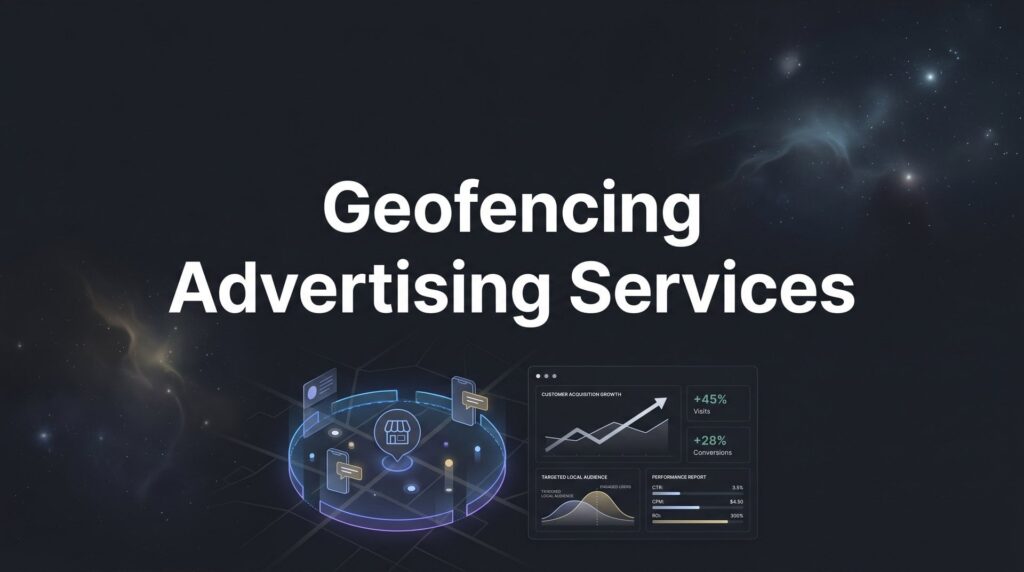
Picture this: a potential customer is running errands two blocks from your restaurant. Their phone buzzes. Your lunch special appears on their screen at 11:47 AM. They decide to stop in. That’s not luck. That’s geofencing.
Most local businesses bleed ad spend on campaigns that reach people who live 40 miles away, have no intention of visiting, or are simply in the wrong mindset at the wrong moment. Broad targeting feels safe because the audience numbers look impressive, but impressive reach and profitable customers are very different things.
Geofencing advertising services solve this problem by drawing a virtual boundary around specific real-world locations and serving ads exclusively to people who physically enter that zone. It’s precision targeting at the street level, and for local businesses competing for customers in a defined geographic area, that precision can be the difference between a campaign that breaks even and one that genuinely moves the needle.
This article breaks down exactly how geofencing works, why local businesses are increasingly allocating budget toward it, what a well-built campaign actually looks like, and how to decide whether it makes sense for your business right now.
The Virtual Fence: How Geofencing Technology Actually Works
Geofencing is a location-based technology that creates a virtual perimeter around a defined real-world geographic area. When a mobile device enters or exits that boundary, it triggers an action: typically the delivery of a display ad, video ad, or mobile interstitial through a programmatic ad exchange.
The technology relies on a combination of GPS data, Wi-Fi signals, and cellular network data to determine device location. Some implementations also use IP targeting as a supplementary signal. The more data sources involved, the more accurate the location determination tends to be, though accuracy always exists on a spectrum depending on signal quality and device settings.
Here’s how the mechanics play out in sequence:
Zone Definition: An advertiser (or their agency) defines the geographic boundary using mapping tools, typically drawing a polygon or radius around a specific address or area. This could be a single store location, a competitor’s parking lot, or the perimeter of a convention center.
The Trigger Event: When a mobile device with location services enabled enters the defined zone, the system registers the event. The device’s presence is matched against opted-in audience data from app publishers and data providers who have obtained location permissions from users.
Ad Delivery: The trigger initiates a bid through a demand-side platform (DSP) such as Simpli.fi, GroundTruth, or Reveal Mobile. If the bid wins, the ad is served to that device through display networks, mobile apps, or social platforms.
Frequency Capping and Dwell Time: Professional campaigns set limits on how many times a single device sees the same ad within a given period. Dwell time filters can exclude devices that only passed through briefly, helping ensure the audience actually spent meaningful time in the zone rather than just driving past.
It’s worth clarifying where geofencing sits relative to similar-sounding technologies. Geotargeting, as used in Google Ads or Meta, is a broader approach that targets users within a defined radius based on their general location or home address. Understanding the fundamentals of targeted advertising for local businesses helps clarify this distinction. It’s useful but less granular. Geofencing is more precise: it targets devices based on real-time physical presence within a tightly defined boundary.
Beacon technology is different again. Beacons are physical Bluetooth hardware installed inside locations that communicate with nearby devices. They require hardware infrastructure and app integration. Geofencing requires neither, which is part of why it scales more easily for local advertisers.
One important limitation worth understanding upfront: geofencing depends on users having location services enabled and having consented to location data collection through app permissions. Privacy regulations, including GDPR in Europe and various state-level privacy laws in the United States, affect data availability. This means geofencing doesn’t reach every device in a zone, only those that meet the consent and data-sharing criteria. A quality geofencing provider will be transparent about this.
Why Local Businesses Are Betting Big on Geofencing
The core appeal of geofencing for local businesses comes down to one thing: you stop paying to reach people who will never walk through your door.
Traditional digital advertising, even when reasonably well-targeted, still casts a wide net. A Google Display campaign targeting a 10-mile radius around your location reaches people at home, at work, and in contexts where your business isn’t remotely relevant to what they’re doing. Geofencing flips this by anchoring targeting to physical behavior rather than just demographic profiles or browsing history. This is why many businesses are rethinking their local PPC advertising strategies to include location-based approaches.
Three use cases consistently deliver strong results for local businesses:
Competitor Conquesting: This is one of the most tactically interesting applications. You draw a geofence around a competitor’s location and serve ads to people who visit there. A personal injury law firm, for example, might target the offices of competing firms. An auto dealership might fence a rival dealership across town. The audience has already demonstrated intent in your category; you’re simply introducing them to an alternative.
Event Targeting: Fencing trade shows, festivals, community events, or industry conferences lets you reach a concentrated audience with high relevance. A home services company targeting a home and garden expo is reaching people who are actively thinking about their homes. A restaurant fencing a nearby concert venue is reaching people who are already out and looking for an experience.
Retargeting Past Visitors: You can place a geofence around your own location and build an audience of people who have physically visited your business but haven’t converted to a specific goal, like scheduling a follow-up appointment, joining a loyalty program, or making a second purchase. This approach shares principles with Google Ads remarketing services, though it operates through a different mechanism. This is particularly valuable for businesses with longer consideration cycles.
The industries where geofencing tends to generate the most meaningful results share common characteristics: a physical location or defined service area, meaningful local competition, and customer lifetime values high enough to justify the investment. Restaurants, retail shops, auto dealerships, healthcare providers, legal practices, and home services companies consistently appear in this category. A personal injury attorney who earns tens of thousands per case has very different economics than a business selling low-margin products, and that math matters when evaluating geofencing’s ROI potential.
The appeal also extends to the competitive intelligence angle. Knowing that your competitors draw consistent foot traffic from a particular area, and being able to intercept that audience with a compelling offer, is a capability that simply didn’t exist for local advertisers a decade ago. The businesses taking advantage of it are gaining ground on those that haven’t.
What a Full-Service Geofencing Campaign Looks Like
There’s a meaningful difference between having access to geofencing technology and running a geofencing campaign that actually produces results. The technology is a commodity. The strategy layered on top of it is not.
A well-built geofencing advertising service involves several components working together:
Audience Strategy and Zone Planning: Before any fence gets drawn, there should be a deliberate conversation about who you’re trying to reach and where those people physically are. Which competitor locations are worth fencing? Are there specific events in your market this quarter? What’s the right dwell time filter to exclude irrelevant passersby? Mastering advertising campaign management principles is essential here, as these decisions shape campaign performance more than any technical setting.
Creative Development: Geofencing typically delivers display ads, video ads, and mobile interstitials. The creative needs to be built for mobile-first consumption, with clear messaging and a compelling offer that makes sense in a location-based context. A generic brand awareness banner performs far worse than an ad that speaks to where someone is and what they might be looking for right now. Most local businesses underinvest here, which limits results regardless of how good the targeting is.
Conversion Zone Setup: A conversion zone is a second geofence placed around your own business location. It measures whether people who were served your ad subsequently showed up in person. This is the primary foot traffic attribution mechanism in geofencing campaigns, and setting it up correctly is essential for understanding real-world impact.
Ongoing Optimization: Campaign performance data should inform continuous adjustments: pausing underperforming zones, refining creative based on CTR, adjusting frequency caps, and testing new audience segments. A campaign that runs on autopilot for 90 days without review is a campaign that’s likely wasting budget.
On the DIY versus agency question: self-serve platforms exist and some are reasonably accessible. But the value a specialized digital advertising agency brings isn’t primarily technical access. It’s strategic judgment, creative quality, and the experience to know what works across different local markets and industries. If you’re running a geofencing campaign for the first time without that context, you’re likely to make expensive mistakes that an experienced team would avoid.
Budget considerations deserve honest treatment. Geofencing campaigns typically operate on a CPM (cost per thousand impressions) pricing model. Actual CPMs vary based on geography, audience size, the platform used, and how competitive the targeting parameters are. What matters more than any specific number is ensuring your budget is sufficient to generate statistically meaningful data. A campaign that runs for two weeks with a very small budget may produce results that are impossible to interpret confidently. Longer campaign windows and adequate impression volume are both necessary before drawing conclusions about performance.
Measuring What Matters: Geofencing KPIs and Attribution
One of the questions local business owners ask most often about geofencing is: how do I know if it’s actually working? The answer requires understanding which metrics reflect real business impact and which are just activity metrics.
The key performance indicators worth tracking in a geofencing campaign:
Impressions Served Within the Geofence: The baseline volume metric. How many times was your ad delivered to devices inside your defined zones? This tells you whether the campaign is reaching people at the scale you intended.
Click-Through Rate (CTR): The percentage of impressions that resulted in a click. CTR in display and mobile advertising tends to be lower than in search, but it’s a useful signal for creative performance. Significant drops in CTR often indicate ad fatigue or a mismatch between the ad and the audience context.
Conversion Zone Visits: This is the metric that most directly connects geofencing to real-world outcomes. When someone who was served your ad subsequently enters the geofence around your business location, that’s recorded as a conversion zone visit. It’s the closest thing to foot traffic attribution available in digital advertising.
Cost Per Visit: Total campaign spend divided by conversion zone visits. This gives you a tangible cost-efficiency metric to evaluate and optimize against over time. Understanding how to increase ROI on advertising helps you benchmark these numbers against your other channels.
Secondary Actions: Phone calls, form fills, and online orders that occur after ad exposure. These require integration with call tracking tools and your website analytics to attribute properly.
It’s important to understand the limitations of conversion zone tracking. The methodology is probabilistic, not deterministic. It’s making an inference that ad exposure contributed to the visit, not a direct causal proof. People who visited your business may have been influenced by your ad, or they may have been coming regardless. Quality providers are transparent about this and will help you interpret the data with appropriate context rather than overclaiming attribution.
Connecting geofencing data to your broader marketing analytics strengthens the picture. Tying campaign periods to CRM data, call volume trends, and overall customer acquisition cost helps you evaluate geofencing not in isolation but as part of the full system driving customers to your business.
Common Pitfalls That Sink Geofencing Campaigns
Geofencing campaigns fail in predictable ways. Understanding these failure modes before you launch is far cheaper than discovering them after you’ve spent your budget.
Fences That Are Too Large or Too Small: This is the most common technical mistake. A geofence drawn around a five-mile radius isn’t geofencing in any meaningful sense; it’s just geotargeting with extra steps. You’ve lost the precision that makes geofencing valuable. On the other end, a fence drawn around a 50-foot radius around a single storefront may be so restrictive that it captures almost no devices, leaving you with insufficient data and negligible reach. The sweet spot depends on context: a dense urban environment might call for a tighter fence, while a suburban strip mall might require a larger boundary to capture the full parking area and surrounding traffic patterns.
Ignoring Creative Quality and Frequency Capping: Geofencing can put your ad in front of the right person at the right place. It cannot make a bad ad perform well. Generic banner ads with no clear offer, no mobile optimization, and no connection to why someone might be in that location right now will generate poor results regardless of how precise the targeting is. Equally damaging is serving the same ad to the same device repeatedly without a frequency cap. Ad fatigue is real: overexposure breeds irritation, not conversion. This is one of the most common reasons businesses find their advertising budget being wasted on impressions that never convert. A person who sees your ad 40 times in a week is not 40 times more likely to visit. They’re more likely to actively avoid your brand.
Treating Geofencing as a Standalone Solution: This is a strategic mistake more than a technical one. Geofencing works best as part of a multi-channel approach. Someone who sees your geofenced display ad and then searches for your business on Google should find strong search presence. Someone who clicks through should land on a page that reinforces the offer from the ad and makes it easy to take the next step. If your landing page is generic, your Google Business Profile is incomplete, and your team isn’t prepared to handle the leads that come in, geofencing will underperform not because the targeting failed but because the rest of the funnel wasn’t ready to convert the traffic it generated. Investing in conversion rate optimization services can help ensure that traffic actually turns into customers.
The businesses that get the most from geofencing are those that treat it as one layer in a coordinated local marketing strategy, not a silver bullet they can set and forget.
Is Geofencing Right for Your Business? A Decision Framework
Not every local business is an ideal candidate for geofencing advertising services. Here’s a practical way to evaluate fit before committing budget.
Ask yourself these questions honestly:
Do you have a physical location or a defined service area? Geofencing is built around physical presence. If your business serves customers across a broad, loosely defined region without any geographic concentration, the precision advantage largely disappears.
Is your average customer value high enough to justify CPM-based spending? A business with a high customer lifetime value, like a dental practice, a law firm, or an auto dealership, can absorb higher customer acquisition costs and still generate strong ROI. A business with thin margins and low transaction values needs to do the math carefully before investing in geofencing.
Are competitors operating nearby? If competitor conquesting is part of your strategy, you need competitors with physical locations in your market. If you’re in a category with little local competition, this use case disappears.
Do you have the creative assets and landing pages to support the campaign? A geofencing campaign without quality creative and a converting landing page is an expensive exercise in brand impressions. Make sure the infrastructure is ready before you invest in the targeting.
Compared to other local advertising approaches, geofencing occupies a specific lane. Pay-per-click search ads on Google capture demand that already exists: people actively searching for what you offer. Understanding what PPC advertising is and how it differs from geofencing helps you allocate budget more effectively. Local SEO builds long-term organic visibility. Social media advertising builds awareness and community. Geofencing targets people based on where they physically are right now, which is a different and complementary signal.
The strongest local marketing strategies typically combine several of these channels. Geofencing generates awareness and foot traffic intent. Search ads capture the conversion when someone acts on that intent. Exploring local business digital marketing services can help you build this kind of integrated approach. SEO and social build the credibility that makes people choose you over a competitor once they’re aware of you.
When evaluating geofencing providers, look for transparent reporting that shows conversion zone data alongside standard digital metrics, clear explanations of methodology and attribution limitations, and evidence of a strategic approach rather than just technology access. A provider who can only talk about impressions and clicks without connecting the campaign to real business outcomes is a provider worth approaching with caution.
Putting It All Together
Geofencing advertising services represent one of the most precise tools available for local customer acquisition. But precision without strategy is just expensive targeting. The technology draws the fence. Strategy determines where to draw it, who to reach inside it, what to say to them, and what to do with them once they show up.
The key takeaways are straightforward. Understand the technology well enough to evaluate providers and set realistic expectations. Define clear goals before you launch: are you driving foot traffic, conquesting competitors, or retargeting past visitors? Measure real-world outcomes through conversion zone tracking and integrate that data with your broader marketing picture. And build geofencing into a coordinated local marketing plan rather than deploying it as a standalone tactic.
For local businesses with physical locations, meaningful competition, and customers worth acquiring, geofencing can be a significant advantage. For businesses without the right infrastructure, creative, or strategic context, it can be an expensive lesson in what not to do.
The difference usually comes down to who’s running the campaign and whether they’re bringing strategy to the table alongside the technology.
If you want to see what this would look like for your specific business, Clicks Geek can walk you through how a geofencing strategy would be structured for your market, what realistic outcomes look like, and how it fits alongside PPC, SEO, and other channels in a system built to drive qualified local customers. Tired of spending on marketing that doesn’t produce real revenue? Let’s talk about what would actually move the needle for your business.